

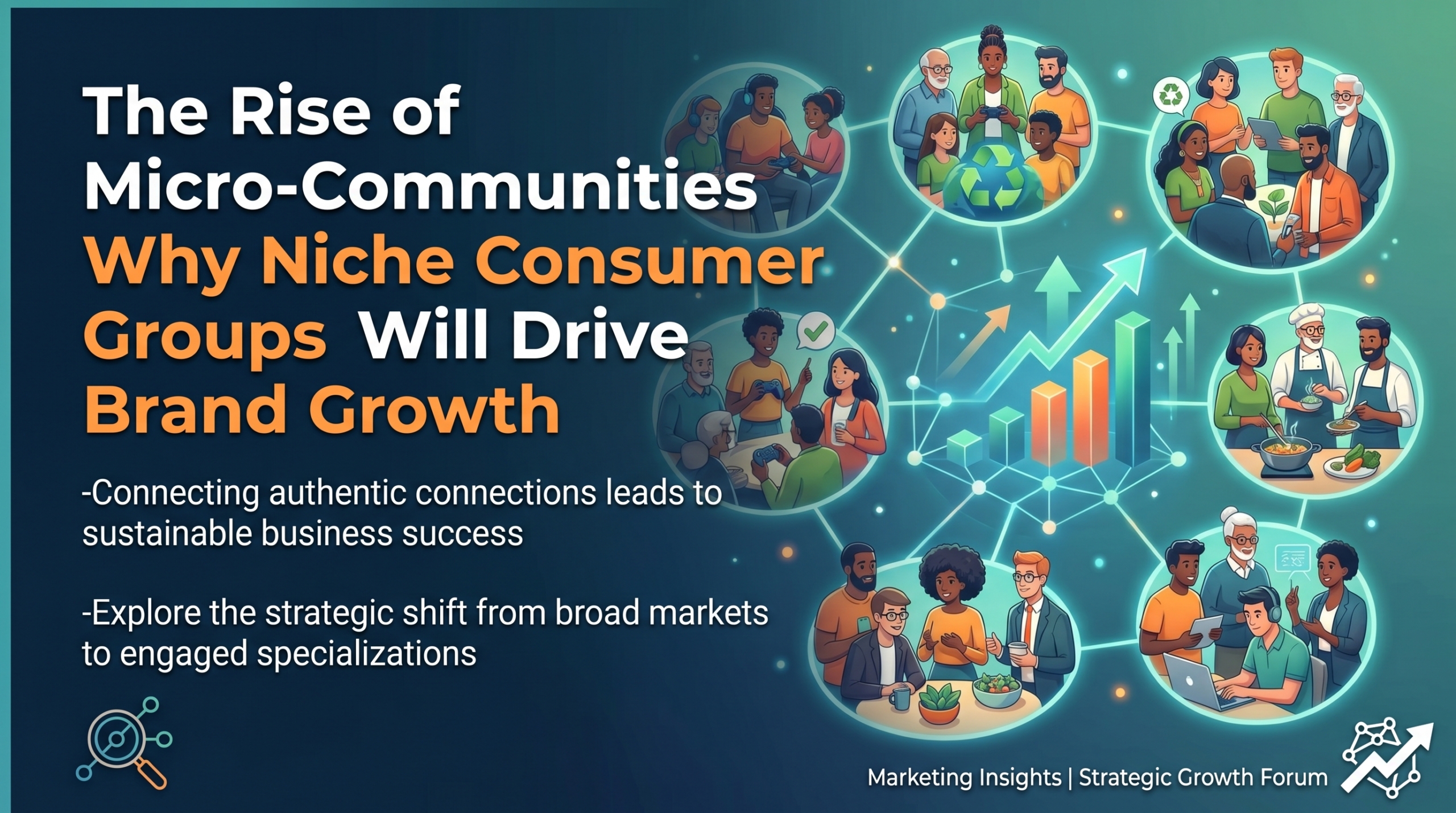
The Rise of Micro-Communities: Why Niche Consumer Groups Will Drive Brand Growth
Mass marketing is dying. Slowly but surely.
The spray and pray approach of reaching everyone is becoming ineffective. Consumers are overwhelmed with generic messaging. Ad blocking is widespread. Trust in traditional advertising is at an all time low.
What is replacing mass marketing? Micro-communities. Small, highly engaged groups of passionate consumers who share common interests and values.
Let me explain why micro-communities matter and how your brand can harness their power.
At Stonehill Research , we help brands identify and engage with the micro-communities that matter most. Our Community Landscape Mapping service is where smart engagement strategies begin.
Understanding micro-communities
According to Harvard Business Review, a micro-community is “a small group of individuals who share a common passion or purpose and interact regularly through digital or physical means to exchange knowledge, support, and experiences.”
That was formal. Sorry.
Here is the real talk. Unlike traditional mass markets, micro-communities are characterised by deep engagement rather than broad reach. Authentic connections between members. Shared identity around specific interests or values. Active participation in content creation and discussion. And platform diversity spanning Discord servers, Reddit threads, private Facebook groups, and specialised forums.
Think of it like a neighbourhood block party versus a stadium concert. One is loud and reaches thousands. The other is intimate where everyone actually knows each other.

The shift from mass to micro
Why mass marketing is losing its edge.
The traditional spray and pray approach is becoming increasingly ineffective. Consumers are overwhelmed with generic messaging. Ad blocking technology is widespread. Trust in traditional advertising continues to decline.
Today’s consumers, particularly Gen Z and Millennials, crave authenticity and meaningful connections with brands that understand their specific needs and values.
Recent data from 2024 to 2025 shows that consumer trust in peer recommendations within niche communities has increased by 47%. Trust in traditional advertising has declined to an all time low of just 23%. People trust their communities more than they trust brands.
The business case for micro-communities
Higher lifetime value.
Members of micro-communities demonstrate significantly higher customer lifetime value compared to general consumers. Studies from 2024 indicate that community members spend 3 to 5 times more than non-community customers and have a 50% higher retention rate. Community belonging creates emotional investment that transcends transactional relationships.
Authentic word of mouth marketing.
Micro-communities are powerful amplification engines. When a community member advocates for your brand, their endorsement carries far more weight than any paid advertisement.
In 2025, user generated content from micro-communities generates 6.9 times higher engagement than brand generated content. Community recommendations have a conversion rate of 38% compared to just 2% to 3% for traditional digital ads.
Innovation and co-creation.
Forward thinking brands are tapping into micro-communities as innovation laboratories. Beauty brand Glossier built its empire by listening to its community and co-creating products with its most engaged members. Gaming companies involve community members in beta testing and feature development.
Resilience in market volatility.
Brands with strong micro-community foundations proved more resilient during recent economic uncertainties. Community loyalty provides a buffer against market fluctuations. Engaged members continue to support brands they feel connected to even during challenging times.
Identifying your micro-communities
Where are they gathering?
Today’s micro-communities exist across diverse platforms. Discord servers for gaming, tech, and creative communities. Reddit threads for virtually every niche interest imaginable. Private Facebook and LinkedIn groups for professional and interest based communities. Specialised platforms like Strava for athletes, Goodreads for book lovers, or Ravelry for crafters. Brand owned platforms like Peloton’s community or Sephora’s Beauty Insider Community. Emerging platforms including BeReal communities, Mastodon instances, and Web3 spaces like Discord DAOs.
Mapping your community landscape.
To effectively engage micro-communities, brands should conduct social listening to identify where conversations about your category are happening. Analyse your most engaged customers to understand their community affiliations. Survey your audience about their interests and community memberships. Monitor niche platforms relevant to your industry or product category. Track emerging trends in community formation, particularly around sustainability, wellness, and technology.
Our Community Culture and Value Analysis helps brands understand the unique dynamics of each micro-community.
Strategies for engaging micro-communities
Listen before you speak.
The cardinal rule of micro-community engagement is to observe and understand before attempting to market. Spend time genuinely participating in communities. Understand their language, values, and pain points. Brands that burst in with promotional content are quickly rejected.

Provide value, not just promotion.
Successful brands contribute to communities through educational content that helps members achieve their goals. Expert insights from your team members. Tools and resources that solve community problems. Sponsorship of community events or initiatives. Recognition of community contributions and achievements.
Empower community champions.
Identify and support your brand’s natural advocates within micro-communities. These champions can bridge the gap between your brand and the community, lending authenticity to your engagement.
In 2025, micro-influencers with 10,000 to 50,000 followers who have deep community ties deliver 60% better engagement rates than macro-influencers.
Create exclusive experiences.
Micro-communities value exclusivity and insider access. Consider early product releases for community members. Behind the scenes content showing your brand’s human side. Community only events, virtual or physical. Input opportunities on product development. Special recognition programmes that celebrate community contributions.
Respect community culture.
Each micro-community has its own culture, norms, and communication style. Successful brands adapt their approach to each community rather than using a one size fits all strategy. What works on LinkedIn will not work on Discord.
Case studies: brands getting it right
Duolingo: mastering community memes.
Language learning app Duolingo has built a massive following by embracing and participating in micro-communities, particularly on TikTok and Reddit. Their mascot, the Duolingo owl, became a meme within language learning communities, and the brand leaned into this playfully rather than trying to control the narrative. This resulted in a 400% increase in brand engagement throughout 2024.
Patagonia: environmental activist communities.
Patagonia does not just market to environmentally conscious consumers. They actively participate in and support environmental micro-communities. From funding grassroots organisations to creating platforms for activism, Patagonia has become inseparable from the communities they serve, resulting in fierce brand loyalty.
Notion: productivity and creator communities.
Notion grew from a niche tool to a billion dollar company largely through micro-community engagement. They empowered productivity enthusiasts and creators to develop templates, tutorials, and resources, effectively turning users into evangelists. Their community driven growth strategy resulted in a 400% user increase in 2023 and 2024 without traditional advertising.
Lego: Adult Fans of Lego (AFOL) communities.
Lego’s engagement with Adult Fans of Lego communities demonstrates long term community investment. They regularly involve community members in product design through the Lego Ideas platform, attend community conventions, and create sets specifically for adult collectors. This strategy has helped Lego tap into a highly profitable market segment that represents 20% of their sales in 2024.
Read our article on Micro-Influencer Identification for Nigerian Brands for local case studies and insights.
Measuring micro-community impact
Beyond vanity metrics.
While follower counts and impressions have their place, micro-community success should be measured through engagement rate including comments, shares, and meaningful interactions per post. Community sentiment measuring how community members talk about your brand. Member retention tracking how long community members stay active. Conversion rate measuring the percentage of community members who become customers. Customer lifetime value of community acquired customers. Net Promoter Score within community segments. Share of voice measuring your brand’s presence in community conversations. User generated content volume and quality.
Attribution challenges and solutions.
Tracking ROI from micro-community engagement can be complex. Implement community specific discount codes or links. Survey new customers about discovery sources. Track referral patterns from community platforms. Monitor brand search volume in correlation with community activities. A/B test community engagement strategies to measure impact.
Our Community Impact Measurement service helps brands track what truly matters.
The future of micro-communities
Web3 and decentralised communities.
Blockchain technology and NFTs are enabling new forms of community ownership and governance. Brands like Starbucks with Starbucks Odyssey and Nike with .SWOOSH are experimenting with token gated communities where members have actual ownership stakes.
AI powered personalisation.
Artificial intelligence is enabling brands to engage with multiple micro-communities simultaneously while maintaining authentic, personalised interactions. However, communities are also becoming more sophisticated at detecting artificial engagement, making genuine human connection more valuable than ever.
Privacy first communities.
As consumers become more privacy conscious, closed or semi-closed communities are growing. Brands must earn access to these spaces through genuine value creation rather than aggressive marketing tactics.
Hyper niche fragmentation.
Communities are becoming increasingly specialised. Rather than a general fitness community, we now see micro-communities around specific approaches like plant-based athletes over 40 or minimalist runners in urban environments.
Virtual and hybrid experiences.
The lines between digital and physical community experiences continue to blur. Successful brands are creating seamless experiences that move between online platforms and real-world meetups, events, and activations.
Getting started: a roadmap for brands
Phase one: Discovery (months 1 to 2). Map your current community landscape. Identify where your customers and prospects congregate. Conduct listening exercises across platforms. Document community cultures, values, and norms.
Phase two: Strategy development (month 3). Select 2 to 3 priority communities for initial engagement. Define your value proposition for each community. Develop community specific content and engagement plans. Establish metrics and measurement frameworks.
Phase three: Soft launch (months 4 to 6). Begin participating authentically in communities. Provide value without overt promotion. Build relationships with community leaders. Test different types of content and engagement.
Phase four: Scale and optimise (months 7 to 12). Expand to additional communities based on learnings. Launch community specific campaigns or initiatives. Develop advocate programmes. Measure and optimise based on community feedback.
Common pitfalls to avoid
Over promotion. Nothing kills community engagement faster than treating micro-communities as just another advertising channel. Follow the 80/20 rule. 80% value adding content, 20% promotional.
Ignoring community feedback. When communities provide feedback, positive or negative, ignoring it signals that you are not genuinely interested in dialogue. Acknowledge and respond to community input, even when it is critical.

Inauthentic engagement. Communities can spot corporate speak and insincere engagement from a mile away. Ensure that team members engaging with communities are genuinely interested and knowledgeable.
Expecting immediate ROI. Micro-community engagement is a long term investment. Brands expecting immediate sales conversions will be disappointed. The payoff comes through sustained relationship building over months and years.
One size fits all approach. What works in one community may be completely inappropriate in another. Customise your approach based on each community’s unique culture and expectations.
Where to start tomorrow
Do not try to engage every community at once.
First, start by listening. Where are your most passionate customers already gathering?
Second, join one community. Participate genuinely. Provide value without selling.
Third, identify your champions. Who already loves your brand? Empower them.
Fourth, create something exclusive. A behind the scenes look. An early access programme.
Fifth, measure what matters. Engagement. Sentiment. Retention. Not just followers.
Finally, be patient. Community building takes time. But the returns compound.
Recommended reading from the Stonehill Research blog
While you are here, check out these related articles from our team:
-
Micro-Influencer Identification for Nigerian Brands – Finding authentic voices in local communities
-
Discord vs WhatsApp vs Telegram: Where Nigerian Micro-Communities Thrive – Platform selection for local engagement
-
Co-Creation with Customers: Turning Fans into Product Designers – Lessons from Glossier and Lego
-
Measuring Community ROI: Beyond Likes and Shares – Attribution frameworks that work
Related services from Stonehill Research
We help brands build meaningful community connections. Here is how:
-
Growth Strategy Design – Building strategies that work in Nigeria’s unique environment
-
Market Segmentation – Treating Nigeria as multiple markets, not one
-
Consumer Insight Research – Understanding real needs and behaviours
-
Strategic Alignment Review – Aligning structure with strategy
-
Operational Resilience Assessment – Building systems that absorb friction
-
Talent and Capability Development – Developing talent and institutional knowledge
-
Data-Driven Decision-Making Frameworks – Making better business decisions with data
About Stonehill Research
Stonehill Research helps organisations move from ambition to execution. Our data-driven insights enable businesses, investors, and policymakers to design strategies that reflect real market conditions.
We understand the complexity. Market fragmentation. Infrastructure gaps. Regulatory volatility. Capital constraints. We have seen it all.
We do not guess. We use market data to guide our recommendations. And we do not just give you a strategy document. We help you execute.
That matters for community engagement because communities evolve fast. You need current, authentic insights. You need a partner who understands how to build genuine connections, not just transactional relationships.
Final word from the trenches
The rise of micro-communities is a fundamental shift in how consumers relate to brands and make purchasing decisions.
Brands that invest in authentic, value driven engagement with niche consumer groups will build stronger relationships, higher customer lifetime value, and more resilient business models.
Consumers are self-organising into passionate, engaged communities around nearly every conceivable interest. The question is whether your brand will show up authentically to participate, or whether you will be left behind shouting into the void.
Success in the micro-community era requires patience, authenticity, and a genuine commitment to serving these communities beyond just making a sale.
The future of brand growth is not about reaching everyone. It is about meaningfully connecting with the right communities.
Stonehill Research is your partner in community engagement. We help you move from ambition to execution.
Let’s work together
Transform your approach to consumer engagement. Partner with Stonehill Research.
Contact us today:
📧 Email: info@stonehillresearch.com
📞 Phone: +234 802 320 0801
📍 Address: 5, Ishola Bello Close, Off Iyalla Street, Alausa, Ikeja, Lagos, Nigeria
Warri Office:
Suite 7, 2nd Floor, St Elizabeth Plaza, 77, Okumagba Avenue, Warri, Delta State
Stonehill Research – Your Partner in Community Engagement
References
-
Harvard Business Review. The Power of Small Groups.
There are no comments