

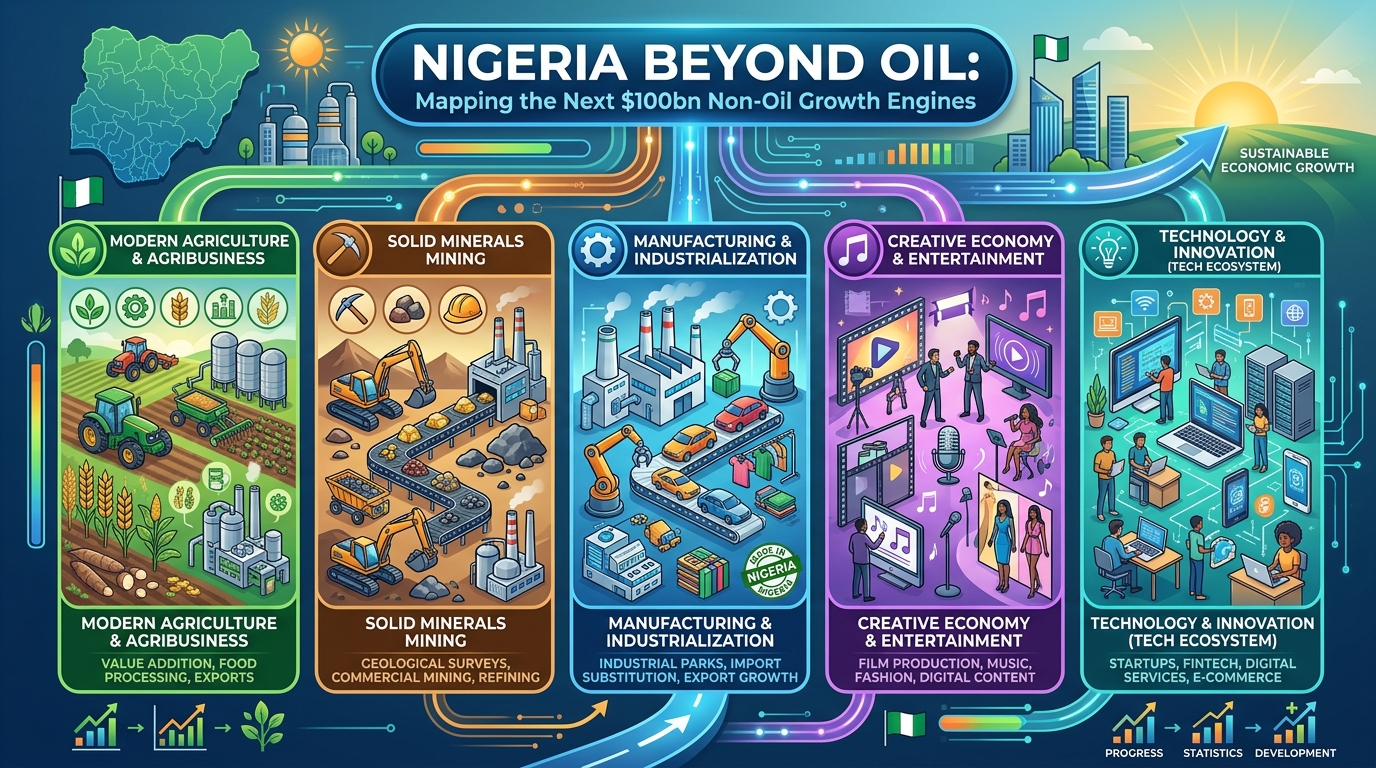
Nigeria Beyond Oil: Mapping the Next $100bn Non-Oil Growth Engines
Nigeria’s economy is changing. Fundamentally.
Oil used to be everything. Not anymore.
Non-oil sectors now account for over 96% of GDP in 2025. The non-oil economy expanded by 3.91% in Q3 2025. Agriculture, technology, manufacturing, services, and renewable energy are driving this transformation.
Over the next decade, Nigeria is positioned to unlock $100 billion in value from these sectors.
Let me show you where the opportunities are.
Stonehill Research provides Sector-Specific Investment Analysis to help investors understand Nigeria’s non-oil growth opportunities.
Understanding economic diversification: a clear definition
Before we go further, let us define what economic diversification actually means.
Here is the simple version.
Stop relying on one thing. Spread your bets across multiple sectors.
For Nigeria, this means moving beyond the volatility of oil-dependent revenues. It means building a balanced economy where agriculture, technology, manufacturing, and services all contribute substantially to national wealth creation.
Agriculture and agribusiness – the $30 billion opportunity
Agriculture remains the backbone of Nigeria’s economy. It employs nearly 70% of the population. It contributed 31.21% to real GDP in Q3 2025.
With government initiatives focused on mechanization, agri-tech solutions, and value chain development, the sector is poised to generate over $30 billion in additional value.
Current state and recent developments
Agriculture expanded by 3.79% year-on-year in Q3 2025. Crop production drives nearly two-thirds of the sector’s nominal output.
The sector has benefited from several transformative government programs. The Anchor Borrowers’ Programme provides credit facilities to smallholder farmers for agricultural inputs. The National Agricultural Technology Innovation Policy drives mechanized farming and precision agriculture. Export promotion initiatives boost exports of sesame seeds, cocoa, cashew nuts, and other commodities.
The agri-tech revolution
Between 2023 and 2025, Nigeria’s agricultural technology sector attracted over $150 million in investments. Startups are deploying innovative solutions.
Precision farming technologies. Companies like Zenvus use soil sensors, satellite data, and AI to optimise crop yields.
Digital marketplaces. Platforms such as Farmcrowdy and AgroMall connect farmers directly with buyers, eliminating middlemen.
Fintech for agriculture. Customized financing, mobile payments, and insurance products are bridging the rural credit gap.
Supply chain solutions. Blockchain and data analytics are improving farm-to-market logistics.
Growth projections and investment opportunities
With continued investment in irrigation, mechanization, cold chain logistics, and agro-processing facilities, the agricultural sector is projected to reduce post-harvest losses from current levels of 30% to 40% to below 15%. Increase non-oil exports by capturing larger shares of global markets for cocoa, cashew, and specialty crops. Create 5 million new jobs across the value chain by 2030. Contribute an additional $30 billion to GDP through productivity gains and value addition.
Read our Nigeria Agriculture Investment Guide 2026 for detailed sector analysis.
Technology and digital economy – the $25 billion frontier
Nigeria has emerged as Africa’s leading technology hub. Often called the “Silicon Valley of Africa.”
Nigeria leads Africa’s ICT market, contributing 82% of the continent’s ICT value and 29% of its internet usage. The digital economy accounted for nearly 20% of GDP in Q2 2024, almost four times oil’s contribution.
Fintech dominance and expansion
Nigeria’s fintech sector represents one of the most successful diversification stories.
Over 430 fintech companies were operating as of February 2025, representing 28% of all African fintech companies. Nigerian startups raised 520millionin2024,withMoniepoint′s110 million Series C achieving unicorn status. Digital payment solutions, mobile banking, and blockchain innovations are driving financial inclusion. Regulatory support from the Central Bank of Nigeria is encouraging innovation.
Beyond fintech: emerging tech sectors
While fintech dominates investment flows, other technology subsectors show tremendous potential.
Information and Communication Technology (ICT). ICT posted 5.78% real growth with contribution rising to 9.10% of GDP. Over 210 million active mobile subscribers exist with broadband penetration exceeding 40%. 5G network expansion by MTN and MAFAB is enhancing connectivity. The government targets 90% broadband penetration by 2025.
E-commerce and digital services. The e-commerce market is projected to reach $5 billion by 2025. Growing internet penetration is driving online shopping adoption. Logistics and last-mile delivery innovations are supporting growth.
Emerging technology sectors requiring investment. Agritech connecting technology to agricultural productivity. Healthtech including telemedicine, digital health records, and diagnostic innovations. Edtech with digital learning platforms addressing educational gaps. Climate tech with renewable energy and environmental monitoring solutions.
Growth projections
Analysts project the digital economy to generate revenues up to 18.3billionviafintechandAI.Thebroadertechnologysectorispositionedtocontribute25 billion to economic growth through increased venture capital investment beyond fintech into deep tech. Job creation for Nigeria’s youthful population. Export of technology services and products. Enhanced productivity across all economic sectors.
Our Market Entry Strategies service provides comprehensive guidance for foreign investors exploring Nigerian tech markets.
Manufacturing and industrial development – the $20 billion challenge
Manufacturing remains a critical yet underutilised pillar of economic diversification. Despite accounting for only 7.62% of GDP, the sector holds immense potential for value addition, job creation, and import substitution.
Recent infrastructure investments and the operationalisation of the Dangote Oil Refinery signal renewed momentum in industrial development.
Current manufacturing landscape
Manufacturing posted real growth of 1.25% in Q3 2025, driven by several factors.
Dangote Oil Refinery operations. Beginning in September 2024 with capacity to produce 650,000 barrels of refined petroleum products daily, significantly reducing import dependence.
Dangote Group. Refinery and Fertiliser Plant Operational Updates. dangote.com
Dangote Fertiliser Plant. Commissioned in May 2022 with capacity for 3 million tonnes annually, filling global supply gaps.
FX stability. Improved foreign exchange liquidity supporting raw material imports.
Increased domestic refining. Reducing energy costs for manufacturers.
Key manufacturing subsectors
Food, beverage, and tobacco. Processing agricultural products for domestic consumption and export. Value addition to raw materials reducing commodity dependence.
Chemical and pharmaceutical products. Local production of essential medicines and industrial chemicals. Import substitution reducing foreign exchange pressure.
Cement and construction materials. Meeting infrastructure development demand. Regional export opportunities.
Infrastructure and policy support
Special Economic Zones (SEZs). Establishment of zones in various regions to facilitate trade and manufacturing. Tax incentives and streamlined regulatory processes. Enhanced export capacity and employment generation.
Infrastructure investments. The Lagos-Ibadan railway and Second Niger Bridge improving connectivity. Continuous highway upgrades reducing logistics costs. Power sector reforms addressing electricity challenges.
Growth projections
With sustained infrastructure development, power sector reforms, and targeted industrial policy, manufacturing can contribute $20 billion to GDP growth through import substitution in consumer goods and industrial products, export-oriented manufacturing leveraging AfCFTA market access, technology transfer and skills development, and creation of 3 million manufacturing jobs by 2030.
Check out Nigeria Manufacturing Revival: Opportunities in 2026 for subsector analysis.
Services sector – the $15 billion backbone
The services sector is Nigeria’s largest economic contributor, accounting for over 53% of real GDP. From telecommunications to financial services, real estate to hospitality, services drive employment and economic activity across urban and rural areas.
Key services subsectors
Financial and insurance services. Financial and insurance services posted real growth of 19.63%, though contribution to GDP fell to 2.65%. Banking sector expansion and insurance penetration growth are happening. Integration of technology is improving service delivery.
Telecommunications and information services. Telecommunications and information services posted a robust 7.40% expansion, accounting for 10.59% of overall output. Mobile phone penetration and internet services are driving growth. This sector provides the platform for broader digital economy development.
Real estate. Real estate nominal output surged 89.34%, with real growth at 3.50%. Urbanization and middle-class expansion are driving demand. Commercial and residential property development opportunities are abundant.
Trade and commerce. Trade posted 1.98% real growth, accounting for 16.42% of GDP. Retail expansion through malls and e-commerce platforms is happening. AfCFTA is creating regional trade opportunities.
Tourism and hospitality. Expansion in local and international travel is occurring. Cultural tourism and business travel growth potential exists. afdb.org Investment in hospitality infrastructure is needed.
Growth drivers
Expanding middle class. Urbanization, education, and job creation are driving consumer demand. Increased spending on goods, electronics, housing, and services is evident. A retail boom is catering to the growing consumer base.
Regional trade integration. The African Continental Free Trade Area (AfCFTA) provides access to 1.3 billion consumers. Non-oil exports are gaining access to larger African markets. Improved border management and customs procedures are helping.
Growth projections
The services sector is positioned to contribute $15 billion to economic growth through financial sector deepening and increased penetration, tourism development capitalising on Nigeria’s cultural assets, professional services export to the West African region, transportation and logistics optimisation, and healthcare and education services expansion.

Renewable energy and natural resources – the $10 billion green future
As global environmental concerns intensify and power supply challenges persist, renewable energy presents both a necessity and an opportunity. With abundant solar resources, Nigeria is positioned to lead West Africa’s energy transition while addressing domestic electricity deficits.
Current renewable energy landscape
Solar energy growth. A surge in solar adoption is happening due to unreliable grid power supply. Residential, commercial, and industrial solar installations are expanding. Government policies are encouraging green energy investments. Cost competitiveness is improving with falling technology prices.
Renewable energy policies. Government commitment to sustainable energy development exists. Incentives for private sector investment in green technologies are being offered. Integration of renewables into the national energy mix is progressing.
Solid minerals development. Nigeria’s non-oil sectors, including solid minerals, are experiencing growth. Potential exists in lithium and rare earth elements critical for global battery and technology manufacturing. Gold and other precious minerals have export potential with artisanal mining formalisation. Industrial minerals like limestone, gypsum, and other construction materials are abundant.
Growth projections
The renewable energy and natural resources sector can contribute $10 billion through off-grid and mini-grid solar solutions powering 25 million households, large-scale solar and wind farms feeding into the national grid, solid minerals exports generating foreign exchange, green technology manufacturing and assembly, and environmental services and carbon credit trading.
Our Risk Assessment service provides thorough evaluation of political, economic, and operational risks in Nigeria’s emerging sectors.
Macroeconomic foundations and policy environment
Nigeria’s non-oil growth potential is underpinned by significant macroeconomic reforms initiated since 2023. These policy changes have improved economic stability, attracted foreign investment, and created conditions for sustainable diversification.
Recent economic performance
GDP growth trajectory. Nigeria’s economy expanded by 3.9% year-on-year in the first half of 2025, up from 3.5% in the same period of 2024. The economy expanded by 3.98% in Q3 2025, with the non-oil sector contributing 96.6% to GDP. Growth is projected to accelerate to 4.2% in 2026 according to IMF forecasts.
External position strengthening. Foreign reserves exceeded $42 billion with a current account surplus rising to 6.1% of GDP, supported by higher non-oil exports. The naira stabilised in the N1,440 to N1,500 per dollar range. Business confidence and foreign direct investment have improved.
Fiscal improvements. The federal deficit is projected at 2.6% of GDP in 2025. Public debt is expected to decline from 42.9% to 39.8% of GDP. Tax reforms enacted in June 2025 are enhancing non-oil revenue generation.
International Monetary Fund. Nigeria Economic Outlook 2025. imf.org
Inflation and monetary policy
Inflation moderation. Inflation eased to 21.9% in July 2025, supported by foreign exchange stability and targeted CBN interventions. Projections for 2026 indicate further decline to around 14% by year-end. Food inflation remains elevated, requiring continued policy attention.
Monetary policy stance. The Central Bank is maintaining a disciplined approach to price stability. Interest rates remain elevated to anchor inflation expectations. Gradual easing is expected as inflation sustainably declines.
Investment climate
Foreign direct investment. Capital importation rose 67.1% to $5.64 billion in Q1 2025. There has been a shift toward non-oil sectors including telecommunications, manufacturing, and services. Opportunities for long-term investors exist in infrastructure and industry.
Source: Nigerian Investment Promotion Commission (NIPC). Foreign Investment Report Q1 2025. nipc.gov.ng [VERIFY: source]
Business environment improvements. The Tinubu Administration is prioritising business climate reforms. Reduction in bureaucratic bottlenecks is occurring. Enhanced protection for investors is being implemented.
Read Nigeria’s Macroeconomic Reforms: Impact on Non-Oil Sectors for policy analysis.
Challenges and risk factors
While Nigeria’s diversification potential is substantial, several challenges must be addressed.
Infrastructure deficits
Power supply. Inadequate and unreliable electricity generation and distribution remain problems. Transmission infrastructure requires major investment. This is a critical bottleneck for manufacturing and industrial growth.
Transportation. Road network quality affects logistics costs. Port congestion and clearance procedures are problematic. Last-mile connectivity challenges exist in rural areas.
Security challenges
Ongoing issues with banditry, insurgency, and communal conflicts persist. There is impact on agricultural productivity in key food-producing states. Enhanced security coordination and conflict resolution are needed.
Social challenges
Poverty and inequality. Many households continue to face hardship, with poverty and food insecurity remaining high. 109 million citizens were below the poverty line as of 2023. Inclusive growth policies and social protection expansion are needed.
Food inflation. Poor households spend up to 70% of income on food. Basic food basket costs rose fivefold between 2019 and 2024. Addressing supply chain bottlenecks and trade barriers is essential. Agricultural productivity improvements are critical.
Strategic recommendations and action plan
Unlocking the $100 billion non-oil growth opportunity requires coordinated action.
Priority 1: Infrastructure development
Power sector transformation. Accelerate private sector participation in generation and distribution. Resolve transmission infrastructure bottlenecks through targeted investment. Integrate renewable energy into the national grid. Develop off-grid solutions for rural areas.
Transportation and connectivity. Complete ongoing railway and road projects. Modernise port operations and reduce clearance times. Develop industrial clusters with dedicated infrastructure. Enhance digital connectivity through broadband expansion.
Priority 2: Human capital development
Skills training and education. Align educational curricula with industry needs. Expand technical and vocational training programmes. Support technology education and digital literacy. Encourage private sector involvement in skills development.
Healthcare investment. Improve healthcare access and quality. Address malnutrition and food security. Reduce maternal and child mortality. Build resilient public health systems.
Priority 3: Enabling business environment
Regulatory reforms. Streamline business registration and licensing. Reduce regulatory compliance costs. Ensure policy consistency and predictability. Strengthen intellectual property protection.
Access to finance. Develop targeted financing schemes for SMEs and manufacturers. Encourage long-term capital formation. Promote alternative financing through capital markets. Support fintech innovations in credit delivery.
Related service: Our Custom Research service provides tailored studies addressing your specific information needs.

The bottom line
Nigeria stands at a pivotal moment in its economic journey.
The non-oil economy has demonstrated resilience and growth potential. It has expanded consistently even amid challenging global conditions. Agriculture contributes over 31% of GDP. Technology sectors drive innovation. Manufacturing is gradually reviving. Services account for more than half of economic output.
The foundations for sustainable diversification are firmly established.
The $100 billion opportunity across non-oil sectors is not merely aspirational. It is achievable through sustained policy commitment, strategic investments, and coordinated implementation.
As the World Bank Country Director noted, “The Nigerian government has taken bold steps to stabilize the economy, but macroeconomic stability alone is not enough. The true measure of success will be how these reforms improve the daily lives of Nigerians.”
World Bank. Nigeria Development Update October 2025. worldbank.org
Success requires addressing infrastructure deficits, particularly in power and transportation. Investing in human capital. Maintaining macroeconomic stability. Ensuring inclusive growth that reaches all citizens. Sustaining reform momentum despite short-term challenges.
The path forward demands patience, persistence, and partnership between government, private sector, and civil society.
With a population exceeding 220 million, a youthful demographic profile, abundant natural resources, growing regional integration through AfCFTA, and an improving business environment, Nigeria possesses the fundamental ingredients for transformative growth.
The next decade will determine whether Africa’s most populous nation fully realises its potential as a diversified, resilient, and prosperous economy capable of delivering shared prosperity to all its citizens.
Related services from Stonehill Research
-
Sector-Specific Investment Analysis – Deep dives into agriculture, technology, manufacturing, and services opportunities.
-
Market Entry Strategies – Comprehensive guidance for foreign investors exploring Nigerian markets.
-
Custom Research – Tailored studies addressing your specific information needs.
Recommended reading from the Stonehill Research blog
-
Nigeria Agriculture Investment Guide 2026 – Detailed sector analysis and opportunity mapping.
-
Nigeria Manufacturing Revival: Opportunities in 2026 – Subsector analysis and growth projections.
-
Nigeria’s Macroeconomic Reforms: Impact on Non-Oil Sectors – Policy analysis and investment implications.
Let’s work together
At Stonehill Research, we provide cutting-edge economic analysis, market intelligence, and strategic advisory services to help investors, businesses, and policymakers navigate Nigeria’s evolving economic landscape. Whether you are seeking to understand Nigeria’s non-oil growth opportunities, evaluate investment prospects, or develop market strategies, Stonehill Research delivers the insights you need to make informed decisions.
Contact us today:
📧 Email: info@stonehillresearch.com
📞 Phone: +234 802 320 0801
📍 Address: 5, Ishola Bello Close, Off Iyalla Street, Alausa, Ikeja, Lagos, Nigeria
Contact Stonehill Research to schedule a consultation.
Let us build Nigeria’s $100 billion future together.
Stonehill Research – Your Partner in Strategic Economic Intelligence
References
-
United Nations Framework Convention on Climate Change (UNFCCC). Definition of Economic Diversification. https://unfccc.int/topics/resilience/resources/economic-diversification [VERIFY: link active]
-
National Bureau of Statistics (NBS). GDP Report Q3 2025. nigerianstat.gov.ng [VERIFY: source]
-
World Bank. Nigeria Agriculture and Agri-tech Investment Report 2025. worldbank.org [VERIFY: source]
-
Fintech News Africa. Nigeria Fintech Ecosystem Report 2025. fintechnews.africa [VERIFY: source]
-
Dangote Group. Refinery and Fertiliser Plant Operational Updates. dangote.com [VERIFY: source]
-
African Development Bank. Nigeria Services Sector Analysis. afdb.org [VERIFY: source]
-
Nigerian Mining Cadastre Office. Solid Minerals Development Report. miningcadastre.gov.ng [VERIFY: source]
-
International Monetary Fund. Nigeria Economic Outlook 2025. imf.org [VERIFY: source]
-
Nigerian Investment Promotion Commission (NIPC). Foreign Investment Report Q1 2025. nipc.gov.ng [VERIFY: source]
-
World Bank. Nigeria Development Update October 2025. worldbank.org [VERIFY: source]
There are no comments