

Sector Prioritisation Frameworks: How to Identify High-Return Industries in Nigeria
Finding the right investment opportunity in Nigeria is not about luck. It is about data.
With GDP growth projected at 3.8% to 4.2% in 2025, fuel subsidies removed, and the naira devalued, the investment landscape has shifted fundamentally. Investors need systematic frameworks to evaluate which sectors offer the most promising returns.
Let me walk you through how to identify high return industries in Nigeria using proven prioritisation frameworks.
Stonehill Research provides Customised Sector Analysis to help investors identify high-return opportunities in Nigeria’s evolving economy.
Understanding sector prioritisation frameworks
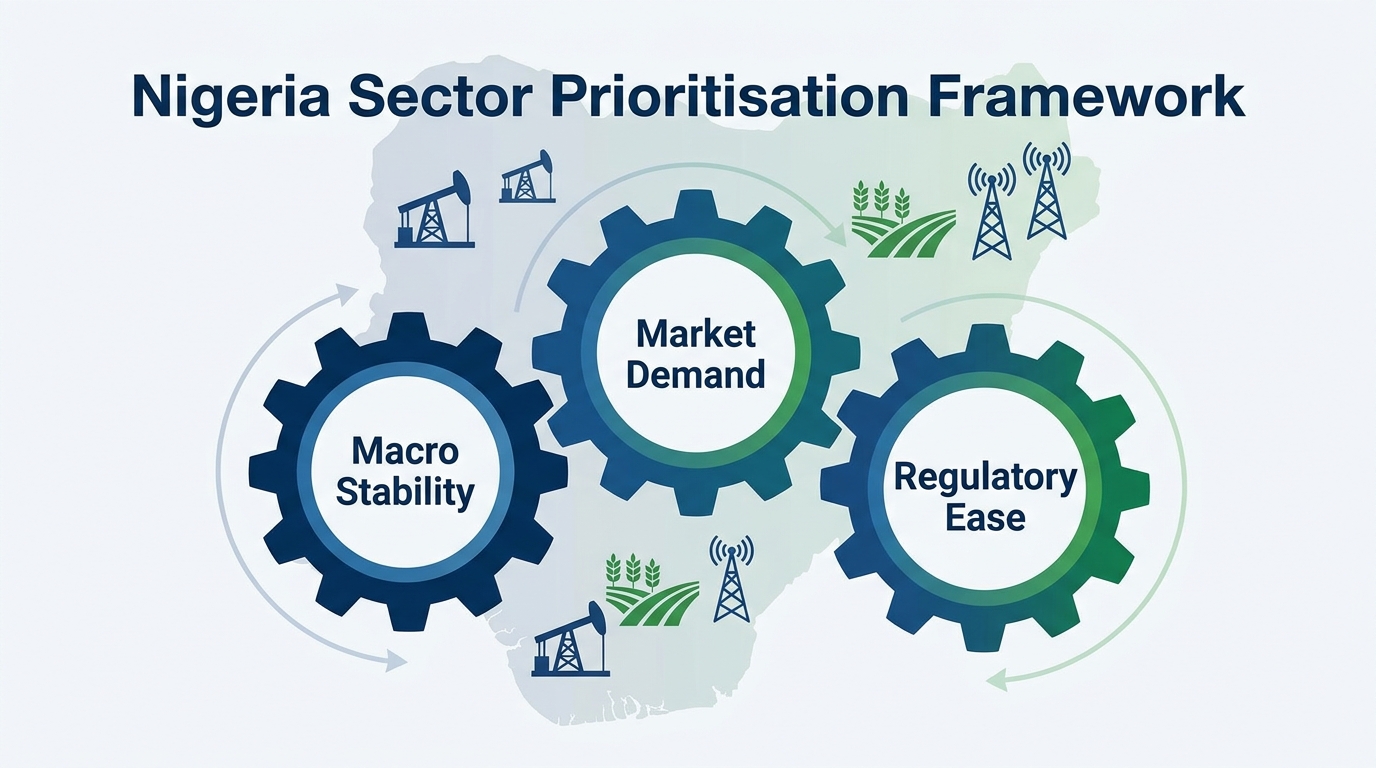
In sector analysis, this framework helps investors evaluate industries based on growth potential, market size, competitive dynamics, regulatory environment, and capital requirements. The goal is to identify where resources should be allocated for maximum returns.
Why sector prioritisation matters in Nigeria
Nigeria’s economy is experiencing a transformative phase in 2025. The removal of fuel subsidies, naira devaluation, and ongoing structural reforms have fundamentally shifted the investment landscape.
A sector prioritisation framework helps you navigate complexity by objectively evaluating opportunities across diverse industries. It helps you optimise resource allocation toward sectors with the highest return potential, manage risk by identifying favourable risk-return profiles, align with macroeconomic trends, and make data-driven decisions instead of guesswork.
Nigeria’s economic context: 2025 update
As of Q3 2025, Nigeria’s GDP growth is 3.9% year-on-year in H1 2025, up from 3.5% in 2024. Projected growth for the full year 2025 is 3.8% to 4.2%. Foreign reserves exceed $42 billion. The current account surplus is 6.1% of GDP.
Key drivers include strong performance in services and non-oil industries, improvements in oil production reaching approximately 1.5 to 2.3 million barrels per day, agricultural expansion, and higher non-oil exports.
Ongoing challenges include inflation remaining elevated at 24.7% (rebased to January 2025), a poverty rate estimated at 46%, food insecurity affecting 31 million Nigerians, high cost-of-living pressures, and infrastructure deficits.
Read our Nigeria Investment Outlook 2026: Opportunities and Risks for forward-looking analysis.
Key prioritisation criteria for Nigerian sectors
Market size and growth potential
The sector’s current market value and projected growth trajectory are fundamental indicators. In Nigeria’s context, consider both the nominal market size and the compound annual growth rate.
Assess total addressable market, historical growth rates, projected expansion over 3 to 5 years, and demographic tailwinds from Nigeria’s 227 million population.
Profitability and return metrics
Not all growing sectors offer attractive returns. Evaluate typical profit margins, return on investment, payback periods, and operating leverage.
Competitive landscape
Understanding competitive dynamics helps assess entry barriers, pricing power, and market consolidation opportunities. Consider market concentration, entry barriers including regulatory, capital, and technology factors, threat of substitutes, and bargaining power of suppliers and customers.
Regulatory environment
Nigeria’s regulatory framework can significantly impact sector returns. The Petroleum Industry Act, banking recapitalisation directives, and telecom tariff approvals are recent examples.
Assess policy stability, licensing requirements, foreign investment restrictions, and tax incentives.
Infrastructure requirements
Infrastructure availability and quality vary significantly across Nigeria, affecting operational efficiency and capital requirements. Consider power supply reliability, transportation networks, digital connectivity, and supply chain logistics.
Capital requirements and accessibility
Different sectors demand varying levels of initial and ongoing capital investment. Consider initial capital outlay, working capital needs, access to financing, and foreign exchange exposure.
Resilience and stability
Particularly important in Nigeria’s evolving economic environment, assess sensitivity to foreign exchange fluctuations, dependence on imports, exposure to policy changes, and demand stability across economic cycles.
High return sectors in Nigeria: 2026 analysis
1. Financial services and fintech
The financial services sector recorded exceptional growth of 30.89% in 2024, driven by high interest rates above 25%, digital banking expansion, and financial inclusion policies. Banks and financial services contributed ₦2.62 trillion to GDP in Q1 2025.
Key opportunities include digital banking and mobile money platforms, payment processing and fintech solutions, insurance with 14.42% growth in 2024, pension administration which grew by ₦4.16 trillion in 2024, and banking recapitalisation initiatives creating investment opportunities.
Growth drivers include over 210 million active mobile subscribers, broadband penetration exceeding 40%, Central Bank recapitalisation directive spurring consolidation, a rising middle class demanding sophisticated financial products, and the government’s financial inclusion push.
2. Technology and telecommunications
Nigeria leads Africa’s ICT market, contributing 82% of the continent’s ICT value and 29% of its internet usage. The telecommunications sector grew 6.25% in 2024, contributing 14.78% to non-oil GDP. Nigeria’s IT market is forecast to grow at an 8.7% CAGR through 2029.
Growth catalysts include the government’s target of 90% broadband penetration by 2025, NCC approval of 50% tariff increase for mobile operators, expanding fiber optic networks in Lagos and Abuja, major tech and startup hubs attracting foreign investment, and a young, tech savvy population.
3. Agriculture and agribusiness
Agriculture employs nearly 70% of Nigeria’s population and contributes 24% of GDP. Crop production contributed significantly to nominal GDP in Q1 2025, ranking among the top three sectors by contribution.
Our Investment Due Diligence service provides comprehensive assessments of sector-specific opportunities.
4. Oil, gas, and energy
While Nigeria seeks to diversify, oil and gas remain crucial. The sector recorded 5.54% growth in 2024 after negative growth in 2023. Production reached 1.5 to 2.3 million barrels per day in 2025, with the $10 billion Nigeria LNG Train 7 project underway.
Key opportunities include LNG production and export, gas processing and distribution infrastructure, petroleum services and equipment, renewable energy projects including solar, wind, and microgrids, energy storage solutions, mini grid rural electrification, and downstream services boosted by the Dangote Refinery at 85% capacity.
5. Real estate and construction
Real estate emerged as the largest contributor to Nigeria’s nominal GDP in Q1 2025. The sector benefits from rapid urbanisation, with cities like Lagos, Abuja, and Port Harcourt experiencing sustained housing demand.
Key opportunities include residential housing development with a focus on middle income buyers, commercial real estate including offices and retail spaces, industrial parks and warehouses driven by e-commerce, infrastructure projects including roads, rail, and ports, real estate technology (PropTech) solutions, and affordable housing schemes.
6. Healthcare and pharmaceuticals
Nigeria’s healthcare sector is expanding as more Nigerians seek quality medical services. The sector benefits from improved policies, foreign investment, and growing middle class demand.
Recent developments include the China-Nigeria agreement to boost domestic insulin production, expansion of government cost sharing initiatives, growing pharmaceutical manufacturing capacity, and increased focus on achieving universal health coverage.
7. Transport and logistics
Road transport grew 10.13% in Q3 2025, while rail transport and pipelines recorded extraordinary 44.14% growth in 2024. The sector benefits from e-commerce expansion, urban mobility demand, and infrastructure investments.
Key opportunities include logistics and last mile delivery services, ride hailing and mobility as a service, freight forwarding and warehousing, rail transport infrastructure, port operations and maritime services, and fleet management technology.
8. Manufacturing and consumer goods
Food, beverage, and tobacco manufacturing grew 3.48% in Q1 2025, reaching ₦3.53 trillion and accounting for 3.75% of GDP. The sector shows resilience despite inflationary pressures.
Key opportunities include fast moving consumer goods (FMCG), food and beverage production, textile and garment manufacturing, packaging solutions, local manufacturing of import substitutes, and export oriented manufacturing under AfCFTA.
9. Mining and solid minerals
Nigeria’s mining sector, particularly in coal and solid minerals, recorded double digit growth in Q3 2025. The sector offers significant opportunities in lithium, gold, zinc, and other minerals.
Key opportunities include lithium mining driven by electric vehicle battery demand, gold extraction and refining, zinc and other base metals, coal mining, gemstones and precious stones, and mineral processing and value addition.
10. Creative economy and entertainment
Nigeria’s creative economy, including Nollywood, music (Afrobeats), fashion, and digital content creation, has gained international prominence and commercial viability.
Key opportunities include film production and distribution, music production and streaming, fashion design and manufacturing, gaming and animation, digital content creation, and event management and entertainment venues.
Check out Top 10 Fastest Growing Sectors in Nigeria 2026 for updated rankings and data.
Applying the framework: sector evaluation matrix
| Sector | Growth | Profitability | Entry Barriers | Regulatory | Infrastructure | Total Score |
|---|---|---|---|---|---|---|
| Fintech/Financial Services | 9 | 9 | 7 | 8 | 8 | 41 |
| Technology/Telecom | 9 | 8 | 6 | 7 | 7 | 37 |
| Agriculture/Agribusiness | 8 | 7 | 5 | 7 | 5 | 32 |
| Oil & Gas/Energy | 7 | 8 | 9 | 7 | 6 | 37 |
| Real Estate | 8 | 8 | 6 | 6 | 6 | 34 |
| Healthcare | 8 | 7 | 7 | 6 | 5 | 33 |
| Transport/Logistics | 8 | 7 | 5 | 7 | 6 | 33 |
| Manufacturing | 7 | 6 | 6 | 6 | 5 | 30 |
| Mining | 8 | 8 | 8 | 6 | 5 | 35 |
| Creative Economy | 7 | 6 | 4 | 5 | 7 | 29 |
Strategic recommendations for investors
For high net worth individuals and institutional investors
Prioritise fintech and financial services which offer strong growth, attractive returns, and benefits from ongoing regulatory reforms. Consider technology as a core allocation as Nigeria’s digital transformation provides sustained long term opportunities.
Diversify with real estate which provides an inflation hedge and tangible asset exposure. Focus on selective energy investments in gas infrastructure and renewable energy rather than traditional upstream oil.
For SME investors and entrepreneurs
Focus on AgTech and agricultural services which have lower capital requirements with significant market gaps. E-commerce and logistics offer growing markets with scalable business models. Healthcare services are under served with growing demand. The creative economy has low barrier entry with potential for rapid scaling.
For foreign investors
Partner with local players which is essential for navigating regulatory and operational complexities. Focus on sectors with foreign exchange generation to minimise naira devaluation exposure. Prioritise infrastructure light businesses to reduce capital intensity and operational risks. Consider a portfolio approach diversifying across multiple sectors to manage country risk.
Related service: Our Market Entry Strategy service provides step-by-step guidance for entering Nigerian markets.
Risk mitigation strategies
Implement foreign exchange hedging through natural hedges like export oriented businesses or financial instruments. Secure political risk insurance for significant capital investments.
Build local partnerships to navigate the regulatory environment and community relations. Develop diversified revenue streams with multiple income sources within your business model.
Conduct scenario planning modelling various economic scenarios including naira devaluation, inflation, and policy changes.
Read Risk Mitigation Strategies for Nigerian Market Entry for practical guidance.
Emerging trends to watch in 2026
AfCFTA implementation, while slow to start, could transform manufacturing and agriculture. The eNaira’s evolution could reshape financial services. Growing focus on renewables beyond pilot projects is accelerating.
Post pandemic momentum in telemedicine and digital health continues. The demographic dividend is creating innovation across sectors. Government is seeking private capital for major infrastructure projects.
Growing interest in climate resilient agriculture and green bonds is emerging. Compliance automation opportunities across sectors are expanding.
Where to start tomorrow
Do not try to analyse every sector at once.
Start with your investment criteria. What return do you need? What risk can you tolerate?
Gather the data. Market size. Growth rates. Profitability metrics.
Apply the framework. Score each sector against your criteria.
Validate with local experts. Data alone is not enough. Talk to people on the ground.
Start small. Pilot before committing large capital.
Monitor and adjust. Sectors evolve. Your analysis should too.
Final word
Sector prioritisation in Nigeria requires a nuanced understanding of the country’s unique economic dynamics, growth drivers, and structural challenges.
While the economy faces headwinds from inflation, infrastructure deficits, and policy uncertainty, significant opportunities exist for investors who apply systematic frameworks.
Financial services, technology, agriculture, energy, and real estate emerge as priority sectors based on current data. But each investor’s optimal portfolio will depend on their risk tolerance, capital availability, investment horizon, and operational capabilities.
The key to success is not just identifying the right sectors. It is timing your entry to align with regulatory and market cycles. Building local capabilities through partnerships and talent acquisition. Maintaining flexibility to adapt as conditions evolve. Managing risks proactively rather than reactively.
As Nigeria continues its economic transformation through 2025 and beyond, those who combine rigorous sector analysis with operational excellence will capture the substantial returns that Africa’s largest economy offers.
Related services from Stonehill Research
-
Customised Sector Analysis – Tailored research reports on specific industries and market segments.
-
Investment Due Diligence – Comprehensive assessments of investment opportunities.
-
Market Entry Strategy – Step-by-step guidance for entering Nigerian markets.
Recommended reading from the Stonehill Research blog
-
Nigeria Investment Outlook 2026: Opportunities and Risks – Forward-looking analysis for strategic planning.
-
Top 10 Fastest Growing Sectors in Nigeria 2026 – Updated rankings and data.
-
Risk Mitigation Strategies for Nigerian Market Entry – Practical guidance for investors.
Let’s work together
Ready to identify your next high return opportunity? At Stonehill Research, we specialise in providing data driven market intelligence and strategic advisory services to help investors and businesses navigate Nigeria’s complex economic landscape.
Contact us today:
📧 Email: info@stonehillresearch.com
📞 Phone: +234 802 320 0801
📍 Address: 5, Ishola Bello Close, Off Iyalla Street, Alausa, Ikeja, Lagos, Nigeria
Contact Stonehill Research to schedule a consultation.
Let us help you identify the sectors that offer the highest returns for your specific investment criteria.
Stonehill Research – Your Partner in Nigerian Market Intelligence
References
-
LaunchNotes. Prioritisation Framework in Product Management and Operations. https://www.launchnotes.com/glossary/prioritization-framework-in-product-management-and-operations
-
World Bank. Positive Economic Momentum in Nigeria, Now Time to Bring Home the Gains. Nairametrics. Top 10 fastest-growing sectors in Nigeria in Q3 2025. https://nairametrics.com/2025/12/01/top-10-fastest-growing-sectors-in-nigeria-in-q3-2025/
-
Nairametrics. Largest sectors in the Nigerian economy as of Q1 2025.
-
U.S. International Trade Administration. Nigeria – Market Overview. https://www.trade.gov/country-commercial-guides/nigeria-market-overview
-
Managing Nigeria. 2024’s Most Thriving Industries in Nigeria’s Economy. https://managingnigeria.com/2025/05/03/2024s-most-thriving-industries-in-nigerias-economy/
-
International Monetary Fund. Nigeria: 2025 Article IV Consultation—Staff Report
-
The Estero – Olaniwun Ajayi LP. Nigeria’s Oil & Gas Industry Outlook 2025. https://www.olaniwunajayi.net/blog/nigerias-oil-gas-industry-outlook-2025-key-industry-trends/
-
Fitch Solutions. Nigeria Market Analysis.
There are no comments