


Pricing Research in Nigeria: How to Test Price Points Before You Change Them
Nigerian brands have changed prices more often in the past three years than in the decade before. Many changed them by instinct. A distributor called, a competitor moved, the finance team flagged a margin gap, and the price went up. Some brands kept their shoppers. Others lost them to a cheaper rival or a smaller pack they never saw coming.
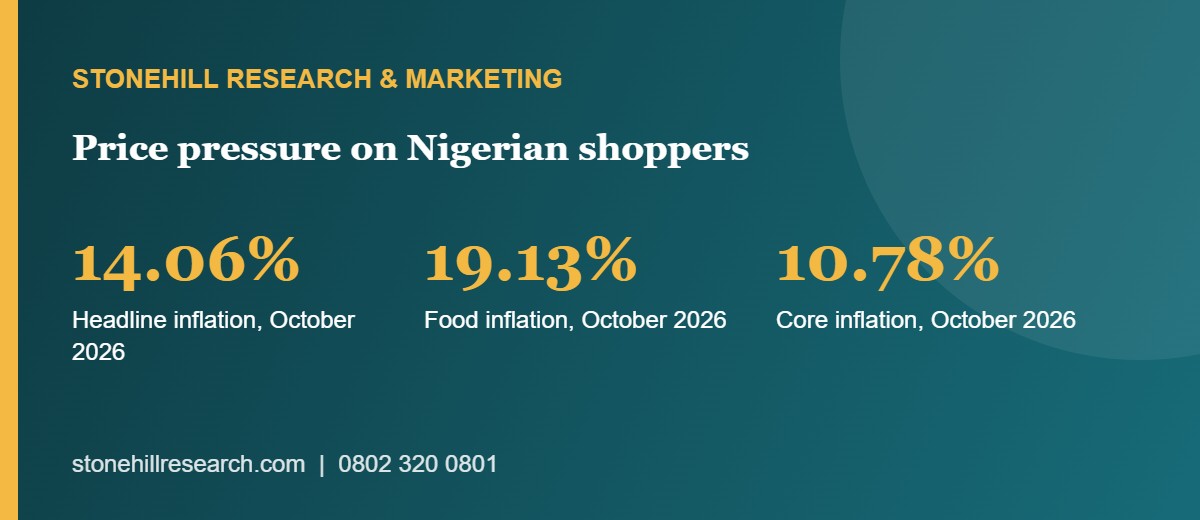
Price pressure has not gone away. Headline inflation eased to 14.06% in October 2026, but food inflation stood at 19.13% and core inflation at 10.78%, according to National Bureau of Statistics figures reported by Nairametrics. Input costs, transport and power still move faster than most household incomes. Every brand manager will face another pricing decision in 2027.
Pricing research takes the guesswork out of that decision. It tells you how far you can move before shoppers walk, which pack sizes protect volume, and how your price sits against the brands shoppers compare you with. It costs a fraction of one bad price change.
This guide explains the main pricing research methods, when to use each, how to run them well in Nigeria, and how to turn the results into a price list your sales team can defend.
Why pricing by instinct fails in Nigeria
Three features of the Nigerian market make instinct a poor guide.
- Shoppers trade down fast. Under pressure, consumers move to smaller packs, value brands or open-market alternatives. A 10% price rise can trigger a much bigger volume loss if a credible substitute sits on the next shelf.
- Prices vary by channel. The same product sells at different prices in a Lekki supermarket, an open market in Onitsha and a kiosk in Kano. A national price change lands differently in each.
- Price points matter more than percentages. Shoppers remember ₦100, ₦200 and ₦500. Crossing a familiar point can hurt more than the percentage suggests.
Pricing research measures these effects before you commit. It replaces “we think” with “we tested”.
The main pricing research methods
No single method answers every question. Choose based on the decision you face.
| Method | Question it answers | Best for | Typical sample |
|---|---|---|---|
| Van Westendorp Price Sensitivity Meter | What price range feels acceptable? | New products, repositioning | 300 to 600 per segment |
| Gabor-Granger | How does purchase intent fall as price rises? | Price increases on existing products | 300 to 500 per segment |
| Conjoint analysis | How do shoppers trade price against brand, pack and features? | Range and pack architecture | 500 to 1,000 |
| Pack-price ladder testing | Which pack sizes and price points protect volume? | FMCG pack redesign, shrinkflation decisions | 400 to 800 |
| In-market price test | What happens to real sales at a new price? | Final validation in selected outlets | 20 to 60 outlets |
Van Westendorp Price Sensitivity Meter
Respondents answer four questions about a product:
- At what price would it be so cheap you would doubt the quality?
- At what price would it be a bargain?
- At what price would it start to feel expensive, though you might still buy?
- At what price would it be too expensive to consider?
Plotting the answers gives an acceptable price range and an optimal price point. The method is quick and easy to run on mobile surveys. It works best for new products or when you are not sure where the market sits. Its weakness is that it does not ask about purchase directly, so pair it with an intent question.
Gabor-Granger
Respondents see the product at a price and say whether they would buy. The price then moves up or down, depending on the answer. The output is a demand curve and a revenue-maximising price.
Gabor-Granger suits price increases on existing products. A brand can see how many buyers it loses at ₦450, ₦500 and ₦550 and which point maximises revenue. It is simple to explain to a board.
Conjoint analysis
Conjoint shows respondents a series of product profiles that vary by price, brand, pack size and features. They choose the one they prefer each time. Statistical modelling then shows how much each feature is worth and how sensitive shoppers are to price.
Conjoint is the most powerful method and the most demanding. It needs larger samples and careful design. Use it when you are redesigning a whole range or entering a crowded category.
Pack-price ladder testing
In Nigeria, pack size is often a better lever than price. A brand that cannot raise the price of its 400g pack may launch a 250g pack at a familiar price point, or a sachet for daily buyers.
Pack-price testing shows shoppers a shelf of options and asks what they would buy. It reveals which combinations protect volume and which cannibalise your best sellers. It also shows whether shoppers notice and resent a shrunken pack.
In-market price testing
Survey methods measure stated behaviour. In-market tests measure real sales. Change the price in a set of test outlets, keep a matched set as control, and track sales for six to eight weeks. Use retail audit or distributor data to measure the effect.
In-market tests are the gold standard before a national change. They take longer and need distributor cooperation.
Designing pricing research that works in Nigeria
Good pricing research reflects how Nigerians shop. These design choices make the difference.
Sample the right shoppers
Survey the people who buy the category, not the general public. For FMCG, that often means the household’s main shopper. For B2B products, it means the person who signs off the purchase. Set quotas by region, income band and channel. A Lagos-only sample will mislead a national pricing decision.
Cover the channels where you sell
Include open-market shoppers, not just supermarket shoppers. Face-to-face interviews near markets reach buyers that online panels miss. Mixed-mode designs, combining mobile surveys with field interviews, give better coverage.
Show realistic competitors
Price is always relative. Show the brands shoppers actually compare you with, at their current shelf prices. Collect those prices through store checks in the same weeks as fieldwork, because prices move quickly.
Test familiar price points
Build your test grid around the price points Nigerian shoppers recognise. Test ₦450, ₦500 and ₦550, not ₦487 and ₦512.
Respect data protection rules
Pricing surveys collect personal data, even if only phone numbers and locations. The Nigeria Data Protection Act 2023 requires a lawful basis, usually consent, and clear notice about how you use the data. Use a research partner whose fieldwork and data handling meet those requirements.
Turning results into a pricing decision
Research results only matter if they change the decision. Use a simple framework.
| Step | Question | Output |
|---|---|---|
| 1. Set the objective | Are you protecting volume, margin or market share? | A clear goal agreed by finance and marketing |
| 2. Read the curve | Where does demand fall sharply? | The price ceiling for each segment |
| 3. Check the competition | Where does your new price sit against key rivals? | A price index by channel |
| 4. Model the P&L | What happens to revenue and gross margin at each option? | A shortlist of two or three options |
| 5. Plan the trade response | How will distributors and retailers react? | Trade terms, margins, communication plan |
| 6. Validate | Can you test in market before going national? | A test-and-learn plan |
Share the results with sales early. A price change that the sales team understands and believes is far easier to land with distributors.
Worked example: a seasoning cube brand
This example is illustrative. The brand and figures are for explanation only.
A mid-sized seasoning brand sells a 10-cube pack at ₦500. Input costs have risen, and finance wants a 15% price increase to ₦575.
The brand commissions a Gabor-Granger study with 600 category shoppers across Lagos, Kano, Onitsha and Port Harcourt. It adds a pack-price ladder test.
Gabor-Granger results:
| Price | Share who would buy | Revenue index |
|---|---|---|
| ₦500 | 72% | 100 |
| ₦550 | 61% | 93 |
| ₦575 | 49% | 78 |
| ₦600 | 38% | 63 |
Buyers fall sharply above ₦550. The ₦575 price would cut revenue by about a fifth.
Pack-price ladder results: An 8-cube pack at ₦450 kept 68% of buyers. Shoppers noticed the smaller count but accepted it at the lower price point. The 10-cube pack at ₦550 held well with larger households.
Decision: The brand moves the 10-cube pack to ₦550 and launches an 8-cube pack at ₦450 for price-sensitive shoppers and open markets. It tests both in 40 outlets for eight weeks before the national rollout. The test confirms the research within a few percentage points.
The result is a margin gain close to finance’s target with far less volume loss than the original plan.
Common mistakes to avoid
- Asking “Would you pay more?” Shoppers always say no. Use structured methods instead.
- Testing in one city. Lagos results do not represent Kano or Aba.
- Ignoring channel differences. Open-market and modern-trade shoppers react differently.
- Using old competitor prices. Shelf prices move monthly. Collect them during fieldwork.
- Skipping the trade. Distributors and retailers need margin. A price that works for shoppers can fail if trade margins collapse.
- Changing price and pack at the same time without testing both. You will not know which change drove the result.
- Treating research as the final word. Validate big changes in market before going national.
Pricing research by sector
The methods stay the same across sectors, but the questions change.
| Sector | Typical pricing question | Recommended method |
|---|---|---|
| FMCG | How far can we raise price, and which pack sizes protect volume? | Gabor-Granger plus pack-price ladder |
| Banking and fintech | Which account fees or bundles will customers accept? | Conjoint on fee and feature bundles |
| Private education | How much can we raise school fees without losing families? | Van Westendorp with parent segments |
| Healthcare | What will patients pay for a new service or test? | Van Westendorp plus purchase intent |
| Power and energy | How do customers value reliability against tariff? | Conjoint on hours of supply and price |
In services, price often comes as a bundle. A bank customer weighs monthly fees, transfer charges and card fees together. Conjoint suits these decisions because it measures the trade-offs rather than one price at a time.
How often to repeat pricing research
Prices in Nigeria do not stay still, so neither should your evidence. As a guide:
- Run a full pricing study before any major price change or new launch.
- Track shelf prices for your brand and key competitors monthly through retail audits.
- Refresh price sensitivity measures at least once a year in fast-moving categories.
- Re-test after a major shock, such as a sharp currency move or a fuel price change.
Frequently asked questions
What is the best pricing research method for a price increase?
Gabor-Granger is often the best starting point for a price increase on an existing product. It shows how purchase intent falls as price rises and which point maximises revenue. Pair it with an in-market test before a national rollout.
How much does pricing research cost in Nigeria?
Cost depends on method, sample size, regions and fieldwork mode. A focused Gabor-Granger or Van Westendorp study is far cheaper than a full conjoint study. Ask for a quote based on your specific decision and target shoppers.
How long does a pricing study take?
A survey-based study usually takes four to six weeks from design to results. An in-market price test adds six to eight weeks of tracking.
Can we run pricing research online only?
Online panels work for urban and digital shoppers. For national FMCG decisions, combine online surveys with face-to-face interviews to reach open-market and lower-income shoppers.
Should we change pack size or price?
Test both. In many Nigerian categories, a new pack at a familiar price point protects volume better than a price rise on the existing pack. Pack-price ladder research shows which option works for your shoppers.
Which pricing method works best for services such as banking or education?
Conjoint analysis suits services sold as bundles, such as bank accounts with several fees. Van Westendorp works well for school fees and new healthcare services, especially when paired with a purchase intent question.
Work with Stonehill Research
Stonehill Research & Marketing designs and runs pricing research for FMCG, banking, power, healthcare and education clients across Nigeria. We run Van Westendorp, Gabor-Granger, conjoint and pack-price studies, collect shelf prices during fieldwork and reach shoppers in modern trade and open markets. We then turn the results into price lists, pack architecture and trade plans your sales team can use.
Explore our market research services, our consumer surveys, our segmentation and profiling work and our competitor analysis.
To plan your next pricing study, call 0802 320 0801 or 0807 576 5799, email info@stonehillresearch.com, or visit our contact page.
This article is general guidance. Examples are illustrative and do not represent any real brand. Research design should reflect your category, shoppers and objectives.