


Healthcare Market Research in Nigeria: Understanding Patients, Prescribers and Payers
Nigeria’s healthcare market is large, fragmented and changing fast. Private hospitals and diagnostic centres are expanding in Lagos, Abuja and Port Harcourt. Pharmaceutical companies face rising costs for imported inputs. Health maintenance organisations are adjusting to the National Health Insurance Authority Act 2022, which made health insurance mandatory in principle, although coverage remains low. Telemedicine and health apps are reaching patients who once had no access to a specialist.
For companies operating in this market, decisions carry high stakes. A hospital that builds the wrong service line wastes capital. A pharmaceutical company that misreads prescriber behaviour loses market share. An HMO that misjudges what employers and enrollees value loses renewals. A health technology startup that does not understand how patients pay will struggle to grow.
Healthcare market research provides the evidence for these decisions. This guide explains what makes healthcare research different, who to research, which methods work in Nigeria, and how to stay ethical and compliant.
Why healthcare research is different
Healthcare is not like selling soap. Several features make research more complex:
- Multiple decision-makers. Patients, doctors, pharmacists, nurses, hospital administrators, HMOs, employers and regulators all influence choices.
- Information gaps. Patients often rely on professionals to choose treatments, so the prescriber matters as much as the patient.
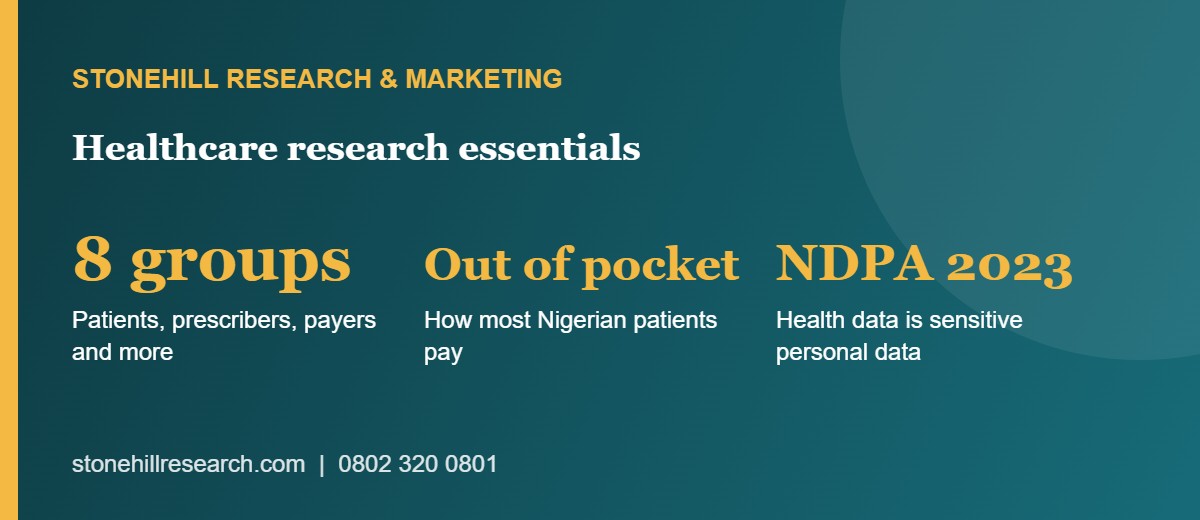
- Out-of-pocket payment. Most health spending in Nigeria is paid directly by patients and families rather than through insurance. Price sensitivity and ability to pay shape decisions.
- Sensitivity. Health topics can be personal and stigmatised, which affects how people answer questions.
- Regulation. NAFDAC, the Pharmacists Council of Nigeria, the Medical and Dental Council of Nigeria and state health ministries regulate products, professionals and facilities.
- Ethics. Research involving patients or health data must protect participants and may require ethics approval.
Who to research
| Group | What you learn |
|---|---|
| Patients and caregivers | Needs, symptoms, care pathways, choice of facility, ability and willingness to pay |
| Doctors and specialists | Prescribing behaviour, treatment preferences, referral patterns, brand perceptions |
| Pharmacists and patent medicine vendors | Product recommendations, stock decisions, substitution, pricing |
| Nurses and community health workers | Patient behaviour, adherence, barriers to care |
| Hospital and clinic administrators | Procurement, service line economics, partnerships |
| HMOs and insurers | Enrollee behaviour, provider networks, claims patterns |
| Employers | Health benefit priorities and budgets |
| Regulators and policymakers | Policy direction, approval requirements |
Most studies combine several groups. A pharmaceutical launch study, for example, might interview specialists, general practitioners, pharmacists and patients.
Common healthcare research questions
Market sizing and opportunity. How many people need a service or product, in which locations, and how much can they pay?
Patient journey. How do patients recognise a problem, where do they seek care first, how do they move between pharmacies, clinics and hospitals, and where do they drop out?
Prescriber behaviour. Which products do doctors prescribe, why, and how do they respond to price, evidence and promotion?
Brand and service perception. How do patients and professionals see your hospital, product or HMO compared with competitors?
Pricing. What will patients, employers or HMOs pay, and how does price affect uptake?
Service quality. How satisfied are patients with waiting times, staff attitude, cleanliness, communication and outcomes?
Channel and distribution. How do products reach patients through wholesalers, pharmacies, patent medicine vendors and hospitals, and where are the gaps?
Methods that work in Nigeria
Quantitative surveys
Structured surveys measure patterns across large samples. Face-to-face interviews remain important for reaching patients outside major cities and those with low digital use. Telephone and online surveys work well for doctors, pharmacists and urban patients.
In-depth interviews
One-to-one interviews with doctors, pharmacists and administrators reveal reasoning behind decisions. Busy professionals often prefer short, scheduled interviews at their workplace or by phone.
Focus groups
Group discussions with patients or caregivers explore attitudes and experiences. For sensitive topics, single-sex groups and trained moderators help participants speak openly.
Patient exit interviews
Interviews with patients as they leave a facility capture fresh impressions of service quality.
Mystery shopping
Trained researchers pose as patients or customers to assess pharmacy advice, hospital service or contact centre responses. Use this method carefully and ethically, avoiding any risk to real patients or misuse of clinical resources.
Retail and pharmacy audits
Audits of pharmacies and patent medicine stores track product availability, pricing and brand share.
Desk research and secondary data
Published data from health surveys, regulators and international organisations provide context and help size markets.
Ethics and compliance
Healthcare research must protect participants. Key principles include:
- Informed consent. Explain the purpose, what participation involves, and the right to withdraw.
- Confidentiality. Protect identities and health information.
- Data protection. Health information is sensitive personal data under the Nigeria Data Protection Act 2023. Collect only what you need, secure it and limit access.
- Ethics approval. Research involving patients, clinical information or vulnerable groups may need approval from a recognised health research ethics committee, such as those operating under the National Health Research Ethics Committee framework or at teaching hospitals.
- Fair incentives. Compensate participants for their time without creating pressure to take part.
- Pharmaceutical promotion rules. Research must not be used as disguised promotion to prescribers.
Regional differences matter
Nigeria’s health landscape varies sharply by region. Disease burden, facility density, income, insurance coverage, culture and language differ between Lagos, Kano, Enugu, Maiduguri and rural communities. Insecurity affects access to some northern areas. Research designs should sample across regions where the business decision requires it, and avoid assuming that Lagos findings apply nationwide.
A worked example
A private hospital group in Lagos planned to open a dedicated cardiac centre. Management assumed demand would come mainly from insured corporate employees.
Research combined interviews with 40 cardiologists and general practitioners, a survey of 1,200 adults in Lagos and Ogun States, and interviews with eight HMOs. The findings showed that most potential patients would pay out of pocket rather than through insurance, that referrals from general practitioners were the main route to specialist care, and that HMOs covered only limited cardiac procedures under standard plans.
The hospital revised its plan. It designed transparent package pricing for common procedures, built a referral programme with general practitioners, and negotiated enhanced cardiac benefits with two HMOs for corporate clients. The centre reached its patient volume targets earlier than projected.
Figures are illustrative.
Turning research into decisions
Good healthcare research ends with clear recommendations:
- Which patient segments and locations to prioritise.
- How to price and package services or products.
- How to reach and influence prescribers and pharmacists.
- Which service quality issues to fix first.
- How to position against competitors.
- What partnerships, such as with HMOs or employers, to pursue.
Present findings in a way that clinicians and finance teams both understand. Evidence wins arguments in healthcare boardrooms.
Common mistakes
- Researching patients but not prescribers, or the reverse.
- Assuming insurance pays when most patients pay out of pocket.
- Using Lagos results to plan national rollouts.
- Ignoring ethics and data protection requirements.
- Asking sensitive questions without trained interviewers.
- Producing findings without clear recommendations.
Researching health insurance and HMOs
The National Health Insurance Authority Act 2022 aims to expand health insurance coverage, but most Nigerians still pay for care directly. HMOs, employers and policymakers need evidence on:
- Why employers choose and switch HMOs.
- What enrollees value in a health plan, such as hospital networks, approval speed and coverage of specific conditions.
- Why enrollees use or avoid their benefits.
- What informal sector workers would pay for health cover, and how they prefer to pay.
- How providers experience HMO payment and approval processes.
Research with employers, enrollees and providers together gives HMOs a full view of where their service breaks down.
Pharmaceutical launch research
Launching a medicine in Nigeria requires understanding the full route to the patient. Pre-launch research should cover:
- Disease and treatment landscape. How the condition is diagnosed and treated today, and where current treatments fall short.
- Prescriber needs. What doctors look for in a new product: efficacy, safety, price, availability and evidence.
- Pharmacy dynamics. How pharmacists recommend and substitute products, and what margins and terms influence stocking.
- Patient affordability. What patients can pay, and how price affects adherence.
- Competitor positioning. How existing brands and generics are perceived.
Post-launch tracking measures awareness, trial, prescribing and pharmacy availability, so the company can adjust promotion and distribution.
Patient satisfaction research for hospitals
Hospitals compete on trust. Patient satisfaction research helps them understand what drives choice and loyalty. Measure the full journey: booking, waiting, registration, consultation, diagnostics, pharmacy, billing and follow-up. Ask about communication from doctors and nurses, cleanliness, privacy, cost transparency and outcomes.
Combine surveys with complaint analysis and staff feedback. Share results with clinical and administrative teams, and track changes over time. Hospitals that act on patient feedback improve reputation and referrals.
Research for health technology companies
Telemedicine platforms, pharmacy delivery apps, health records systems and diagnostic startups need evidence on adoption barriers. Common research questions include whether patients trust remote consultations, how they prefer to pay, what devices and data they have, and how doctors view digital tools. Usability testing with real patients, including older users and those outside major cities, prevents costly design mistakes.
Choosing a sample size
Sample size depends on the decision. A national prevalence estimate needs a large, carefully designed sample. A study of specialist prescribing in Lagos may need only 30 to 50 in-depth interviews. Balance precision with cost, and make sure each segment you want to compare has enough respondents. A survey of 1,000 patients split across ten states gives only about 100 per state, which may be too few for state-level decisions. Agree the analysis plan before fieldwork, so the sample supports the conclusions you need.
Reporting for clinical audiences
Doctors and pharmacists respect evidence. Present healthcare research with clear methods, sample details and limitations, and avoid overstating findings from small samples.
Frequently asked questions
What is healthcare market research?
Research that gathers evidence from patients, healthcare professionals, payers and other stakeholders to inform decisions about health services, products, pricing and strategy.
Who should be included in healthcare research in Nigeria?
Depending on the question, patients and caregivers, doctors, pharmacists, patent medicine vendors, nurses, hospital administrators, HMOs, employers and regulators.
Does healthcare research need ethics approval in Nigeria?
Research involving patients, clinical information or vulnerable groups may require approval from a recognised health research ethics committee. Take advice early.
How do you reach doctors for research?
Through scheduled short interviews at their workplace or by phone, professional networks and associations, with fair compensation for their time.
Why is out-of-pocket payment important for healthcare research?
Because most Nigerian patients pay directly for care, price, ability to pay and value for money strongly influence choices of facility, treatment and product.
What should pharmaceutical launch research cover in Nigeria?
The disease and treatment landscape, prescriber needs, pharmacy dynamics, patient affordability and competitor positioning, followed by post-launch tracking of awareness, prescribing and availability.
Work with Stonehill Research
Stonehill Research & Marketing conducts healthcare market research in Nigeria for hospitals, pharmaceutical companies, HMOs, health technology firms and development organisations. We interview patients, professionals and payers, run pharmacy audits and patient satisfaction studies, and follow strict ethics and data protection standards. See our healthcare access and equity research and consumer surveys.
Discuss your next study: call 0802 320 0801 or 0807 576 5799, email info@stonehillresearch.com, or visit stonehillresearch.com/contact-us.
This article is general information based on research practice.