


Customer Experience Research for Nigerian Banks: How to Measure NPS and Act on It
Nigerian banking customers have more choice than ever. Fintech apps open accounts in minutes. Mobile money operators and payment service banks reach customers in places branches never did. Digital lenders offer credit without collateral. And switching is easy: a customer unhappy with failed transfers or poor service can move salary payments to another bank in a day.
At the same time, banks are under pressure to raise capital under the CBN’s recapitalisation programme, cut costs and grow deposits. Customer experience has become a competitive weapon. Banks that understand what their customers want, and fix what frustrates them, keep deposits and grow share of wallet. Banks that guess lose customers quietly.
Customer satisfaction research gives banks the evidence they need. This guide explains how Nigerian banks, microfinance banks and fintechs can measure customer experience, which metrics matter, how to design surveys that produce useful results, and how to turn findings into action.
Why customer experience matters more in Nigerian banking now
Switching is easier. Bank Verification Numbers, instant transfers and digital onboarding make it simple to open a new account. Customers often keep several accounts and move activity to the one that serves them best.
Digital channels dominate. Most transactions now happen through mobile apps, USSD, cards and agent networks rather than branches. Failed transactions, app downtime and slow reversals shape perceptions more than branch decor.
Complaints are public. Customers post complaints on social media within minutes. A single viral complaint can damage a bank’s reputation.
Regulators are watching. The CBN’s consumer protection framework sets expectations for complaint handling and fair treatment. Banks that handle complaints poorly face regulatory attention.
Deposits are under pressure. In a high-interest environment, customers move money to higher-yielding options. Service quality affects whether they keep operational accounts with you.
What to measure
Net Promoter Score
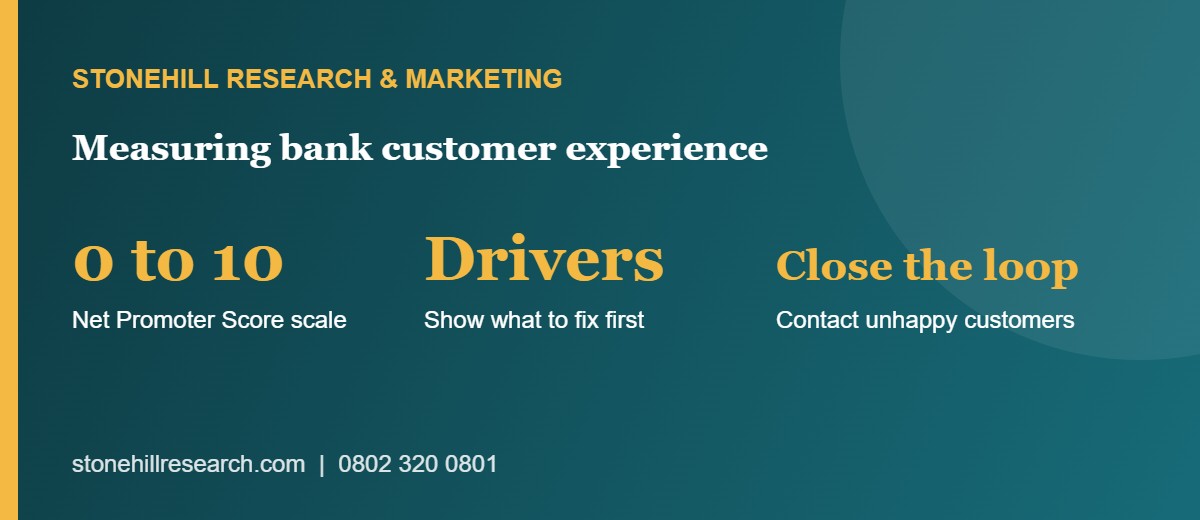
Net Promoter Score asks customers how likely they are, on a scale of 0 to 10, to recommend the bank to a friend or colleague. Customers who score 9 or 10 are promoters, 7 or 8 are passives, and 0 to 6 are detractors. The score is the percentage of promoters minus the percentage of detractors.
NPS is simple and widely understood. It works best as a headline measure tracked over time and compared across segments, branches and channels.
Customer satisfaction
Customer satisfaction scores ask how satisfied customers are with a specific interaction or service, such as account opening, a branch visit or a complaint resolution. They are useful for measuring particular touchpoints.
Customer effort
Customer effort scores ask how easy it was to complete a task, such as resolving a failed transaction. In banking, effort is a strong predictor of loyalty. Customers forgive problems that are fixed quickly and easily. They leave when they have to call five times and visit a branch.
Driver analysis
Headline scores tell you how you are doing. Driver analysis tells you why. Ask customers to rate specific attributes, such as app reliability, transaction speed, charges, staff courtesy, complaint handling and branch waiting time. Statistical analysis then shows which attributes most strongly influence overall satisfaction and NPS.
Touchpoints to research in Nigerian banking
| Touchpoint | Typical issues |
|---|---|
| Account opening | Documentation requirements, time taken, digital onboarding failures |
| Mobile app and internet banking | Downtime, failed transfers, login problems, slow reversals |
| USSD | Session timeouts, charges, failed transactions |
| Cards and ATMs | Cash availability, card failures, disputed debits |
| Branches | Queues, staff attitude, cash withdrawal limits |
| Agent banking | Agent availability, cash shortages, trust |
| Contact centre | Waiting times, first-call resolution, staff knowledge |
| Complaints | Speed of resolution, communication, fairness |
| Loans | Approval time, transparency of charges, recovery practices |
| Charges | Clarity, perceived fairness, unexpected debits |
Choose the touchpoints most relevant to your strategy and customer segments.
Designing a banking customer survey
Define objectives
Start with the decisions the research should inform. Are you choosing which digital improvements to fund? Evaluating branch performance? Understanding why customers are leaving? Clear objectives keep the survey focused.
Segment customers
Experience differs by segment. Retail customers, SMEs, corporate clients, salary account holders, students and high-net-worth customers have different needs. Sample enough customers in each segment to compare results reliably.
Choose the right methods
- Transactional surveys sent shortly after a specific interaction, such as an SMS or in-app survey after a complaint is resolved.
- Relationship surveys conducted periodically to measure overall perception.
- Telephone interviews for deeper feedback and for customers less comfortable with digital surveys.
- Face-to-face interviews at branches or agent locations, useful for reaching customers in areas with low digital use.
- Focus groups and in-depth interviews to explore issues in depth.
- Mystery shopping to assess branch and contact centre service against standards.
Write clear questions
Keep surveys short, especially on mobile. Use simple language. Translate into Yoruba, Hausa, Igbo or Pidgin where relevant. Avoid leading questions. Include at least one open question asking what the bank could do better.
Protect customer data
Customer research involves personal data. Follow the Nigeria Data Protection Act 2023: tell customers how their data will be used, keep it secure, and use it only for the stated purpose. Customers trust research more when they know responses are confidential.
From findings to action
Research only pays off when it changes something. Effective banks:
- Share results widely. Put customer feedback in front of executives, branch managers and digital teams.
- Prioritise. Use driver analysis to focus on issues that most affect loyalty.
- Close the loop. Contact detractors to understand and fix their problems. A customer who sees action often becomes loyal.
- Assign ownership. Each improvement area needs an owner and a deadline.
- Track progress. Measure the same indicators regularly to see whether actions work.
- Link to incentives. Include customer experience metrics in performance scorecards for relevant staff.
A worked example
A mid-sized Nigerian bank saw its NPS fall over two quarters, while digital transaction volumes grew. Management assumed that branch service was the problem and planned a staff training programme.
Research told a different story. Driver analysis of 3,200 customer interviews showed that the strongest driver of detractors was the time taken to reverse failed transfers, followed by unexpected charges. Branch service ranked well below these issues. Open-ended comments repeated the same frustration: customers waited days for their money to return and had to call repeatedly.
The bank redirected investment to automate reversals, published a clear charges guide, and introduced proactive SMS updates on failed transactions. Within two quarters, NPS recovered, complaint volumes fell and contact centre costs dropped.
Figures are illustrative.
Common mistakes
- Measuring NPS without driver analysis, so nobody knows what to fix.
- Surveying only digital-savvy customers and missing those who rely on branches, USSD or agents.
- Long surveys that customers abandon.
- Collecting feedback but never closing the loop with unhappy customers.
- Comparing branches without adjusting for location and customer mix.
- Treating research as a once-a-year exercise.
Researching SME and corporate customers
Business customers judge banks differently from retail customers. SMEs care about access to credit, speed of loan decisions, relationship managers who understand their business, and reliable payment and collection services. Corporate clients care about treasury services, trade finance, foreign exchange access, transaction banking and responsiveness of senior relationship teams.
Research with business customers usually works best through in-depth interviews with owners, finance directors and treasurers, supported by short structured surveys. Ask about the whole relationship: account opening, credit processes, transaction services, foreign exchange, digital platforms and relationship management. Business customers are often frank about where competitors serve them better, and that insight is valuable for winning share of wallet.
Benchmarking against competitors
Measuring your own customers tells you how you are doing. Benchmarking tells you how you compare. A competitive study surveys customers of several banks, including yours, using the same questions. It shows where you lead, where you lag, and what competitors do better.
Benchmarking is especially useful for:
- Setting realistic targets for NPS and satisfaction.
- Identifying attributes where competitors outperform you.
- Understanding why customers choose or leave each bank.
- Spotting emerging threats from fintechs and digital-only banks.
Run competitive benchmarks independently, with the client bank not revealed to respondents, so answers are not biased.
Researching fintech and digital products
Digital products need research at every stage. Before launch, concept testing and usability research show whether customers understand the product and can use it easily. After launch, in-app surveys, behavioural data and interviews with customers who abandon onboarding reveal friction points.
Combine what customers say with what they do. App analytics show where users drop off. Research explains why. A bank that sees 40% of users abandon account opening at the identity verification step needs to know whether the problem is technical, a lack of documents, or distrust of sharing personal data.
Linking research to staff and branches
Customer experience research works best when frontline staff see the results. Share branch-level findings with branch managers, celebrate high performers, and support those who struggle with coaching. Combine customer surveys with mystery shopping and employee feedback for a complete picture. Staff who feel unsupported rarely deliver great service, and employee research often explains customer complaints.
Reporting that drives action
Senior executives need clear dashboards, not 200-page reports. Effective reporting shows headline scores and trends, key drivers, performance by segment and channel, verbatim comments that bring the data to life, and a short list of recommended actions. Update dashboards monthly or quarterly so the organisation sees progress.
Listening to complaints as research
Complaint data is a free source of insight. Categorise complaints by type, channel, branch and product, and track trends monthly. Combine complaint analysis with survey results to see whether the issues customers raise in surveys match what they complain about. Rising complaint categories often signal problems before survey scores fall.
Frequently asked questions
What is Net Promoter Score in banking?
A measure of customer loyalty based on how likely customers are to recommend the bank on a scale of 0 to 10. It is calculated as the percentage of promoters minus the percentage of detractors.
How often should banks measure customer satisfaction?
Transactional surveys can run continuously after key interactions. Relationship surveys are usually run quarterly or twice a year.
What drives customer satisfaction in Nigerian banking?
It varies by bank and segment, but common drivers include transaction reliability, speed of resolving failed transactions, clarity of charges, ease of digital channels and complaint handling.
How can banks reach customers who do not use apps?
Use telephone interviews, face-to-face interviews at branches and agent locations, and surveys in local languages.
How should banks act on customer research?
Share results, prioritise issues that drive loyalty, contact unhappy customers, assign owners for improvements and track progress over time.
Should banks benchmark customer experience against competitors?
Yes. Independent competitive benchmarking shows where a bank leads or lags, sets realistic targets and reveals why customers choose or leave each bank.
Work with Stonehill Research
Stonehill Research & Marketing designs and runs customer experience research for Nigerian banks, microfinance banks and fintechs, including NPS and satisfaction tracking, driver analysis, mystery shopping and focus groups. We collect data across digital, telephone and face-to-face channels, in English and local languages. See our customer satisfaction surveys and data collection and surveys services.
Discuss your next study: call 0802 320 0801 or 0807 576 5799, email info@stonehillresearch.com, or visit stonehillresearch.com/contact-us.
This article is general information based on research practice.