

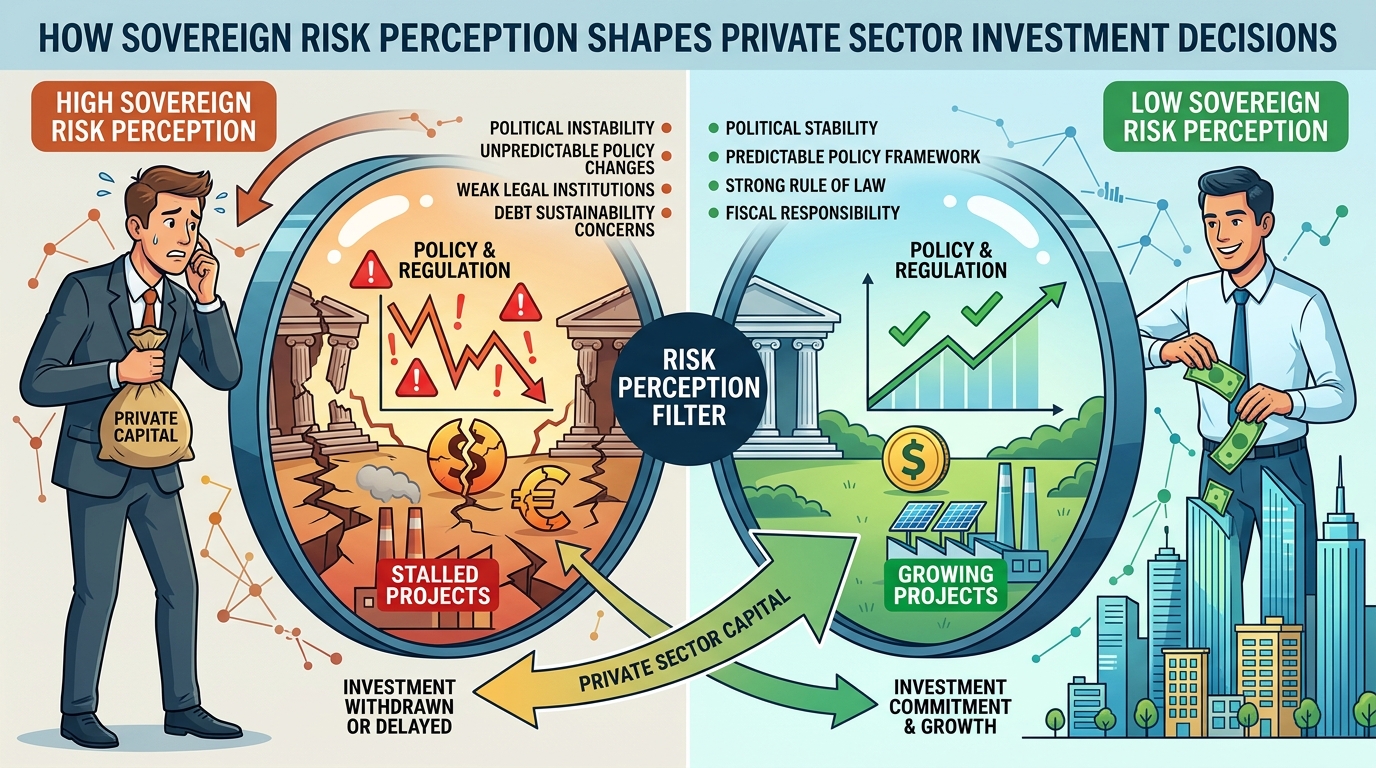
How Sovereign Risk Perception Shapes Private Sector Investment Decisions
Private investors face a tough world. Cross-border investments are risky.
The biggest fear? Sovereign risk. The chance that a government will default on its debts or change policies that hurt foreign investors.
Understanding how investors perceive sovereign risk is essential. For businesses. For policymakers. For anyone navigating emerging markets.
Let me show you what drives these perceptions and how to manage them.
Stonehill Research provides Sovereign Risk Assessment and Country Analysis to help investors make informed decisions.
Understanding sovereign risk: a clear definition
Before we go further, let us define what sovereign risk actually means.
Here is the simple version.
Sovereign risk is not just about debt default. It includes currency devaluation, capital controls, expropriation of assets, regulatory changes, and political instability.
For private investors, sovereign risk represents a fundamental uncertainty. It can dramatically alter expected returns.
The assessment of sovereign risk has evolved. It now includes governance quality, institutional strength, social stability, and geopolitical factors. This multifaceted nature makes it one of the most challenging yet essential considerations in international investment.
Key mechanisms through which sovereign risk affects investment decisions
1. Cost of capital and required returns
When investors perceive higher sovereign risk, they demand higher returns. This risk premium directly increases the cost of capital.
The relationship operates through several channels. Sovereign risk perceptions influence interest rates on government bonds, which serve as the risk-free rate benchmark. When sovereign bond yields rise due to perceived risk, the hurdle rate for private investments automatically increases. Currency risk associated with sovereign instability adds another layer of required compensation.
2. Investment horizon and project selection
Higher perceived risk typically shortens investment horizons. Investors seek quicker returns to minimise exposure.
In stable, low-risk environments, investors commit to long-term infrastructure projects, manufacturing facilities, and other capital-intensive ventures with returns that materialise over decades. As sovereign risk rises, capital shifts toward shorter-duration opportunities. Extractive industries with rapid payback. Trading operations. Service businesses with minimal fixed assets.
The sectoral implications are profound. High sovereign risk countries often struggle to attract patient capital needed for transformative infrastructure development. This creates a self-reinforcing cycle. Inadequate infrastructure perpetuates economic challenges that maintain elevated risk perceptions.
3. Portfolio diversification and geographic allocation
Investment managers typically employ country limits and risk budgets that restrict exposure to higher-risk sovereigns. A country downgrade by major rating agencies can trigger automatic portfolio rebalancing, forcing the sale of assets regardless of individual merit.
This creates volatility and can lead to market overshooting. Sovereign risk perceptions become self-fulfilling through capital flight.
Recent developments in 2024 to 2025 have highlighted the growing importance of sovereign Environmental, Social, and Governance (ESG) factors in these allocation decisions. Investors increasingly view climate resilience, social cohesion, and governance quality as integral components of sovereign risk.

4. Risk mitigation strategies and investment structuring
Sophisticated investors employ various mechanisms to mitigate sovereign exposure while still capturing economic opportunities.
These strategies include political risk insurance, cross-border collateral arrangements, offshore holding structures, and contractual protections under international law. Joint ventures with local partners, export-oriented business models that generate hard currency revenues, and agreements with multilateral institutions all serve to reduce sovereign risk exposure.
In moderately risky environments, insurance and structural protections can adequately address concerns. In severely distressed situations, no amount of structuring can fully compensate for fundamental sovereign instability, leading to complete capital withdrawal.
Read our Sovereign Risk in African Markets 2026 for regional analysis.
The evolving sovereign risk landscape
Geopolitical fragmentation and supply chain resilience
The trend toward deglobalisation and geopolitical realignment has introduced new dimensions to sovereign risk assessment. The US-China strategic competition, conflicts in Ukraine and the Middle East, and the formation of competing economic blocs have made traditional country risk analysis more complex.
Investors now weigh not just a country’s economic fundamentals but also its geopolitical positioning and vulnerability to sanctions or trade restrictions. Supply chain resilience has emerged as a critical consideration. Companies are willing to accept higher costs to reduce dependence on geopolitically vulnerable suppliers.
Climate change as sovereign risk multiplier
Climate change has rapidly evolved from an environmental concern to a mainstream sovereign risk factor. Physical climate risks including extreme weather events, sea level rise, and agricultural disruption directly impact countries’ economic viability and debt sustainability.
Recent sovereign debt restructurings in Caribbean nations and Pacific islands have explicitly incorporated climate vulnerability into negotiations. Major credit rating agencies now systematically integrate climate risk into their sovereign assessments. Several countries have faced downgrades specifically due to climate exposure.
Digital currency and monetary sovereignty
The emergence of Central Bank Digital Currencies (CBDCs) and the continued evolution of cryptocurrency markets present both opportunities and risks. Several countries launched or piloted CBDCs in 2024 to 2025, seeking to modernise payment systems and strengthen monetary policy transmission.
However, the adoption of digital currencies also introduces new sovereign risks. Poorly designed CBDCs could facilitate capital flight during crises. The parallel existence of decentralised cryptocurrencies challenges traditional capital controls. Investors must now assess governments’ digital currency strategies as part of sovereign risk evaluation.
Debt sustainability in a higher interest rate environment
The shift from ultra-low interest rates to a normalised or elevated rate regime in 2024 to 2025 has fundamentally altered sovereign debt dynamics. Many countries that accumulated substantial debt during the pandemic now face challenging refinancing conditions.
Advanced economies with deep capital markets and reserve currency status have generally managed the transition. However, numerous emerging and frontier markets face genuine debt distress, with several undergoing restructuring processes. The International Monetary Fund has reported an increase in countries seeking debt relief programs.
African sovereign risk developments
African markets have experienced particularly dynamic sovereign risk conditions during 2024 to 2025. Several countries including Kenya, Nigeria, and Ethiopia have undertaken significant economic reforms to address fiscal imbalances and improve sovereign creditworthiness.
Nigeria’s fuel subsidy removal and foreign exchange market reforms represent ambitious efforts to restore macroeconomic stability, though implementation challenges and social pressures remain. Kenya has faced sovereign stress from elevated debt levels, requiring careful fiscal management and international support. Conversely, countries like Côte d’Ivoire and Rwanda have maintained relatively stable risk profiles through prudent economic management.
These divergent trajectories highlight the importance of country-specific analysis rather than treating Africa as a monolithic risk category.
Our Political Risk Insurance Advisory helps investors protect against sovereign risk exposure.
Practical implications for private sector investors
Developing comprehensive risk assessment frameworks
Successful investors in emerging and frontier markets employ multi-layered sovereign risk assessment processes that go beyond credit ratings. These frameworks typically incorporate quantitative metrics (debt-to-GDP ratios, foreign exchange reserves, current account balances) alongside qualitative assessments of political stability, institutional quality, and policy credibility.
Leading practice involves scenario analysis that stress-tests investments against various sovereign risk events: currency devaluation, capital controls, regulatory changes, or political transitions. This approach helps identify investments with resilience across multiple scenarios rather than optimising for a single expected outcome.
Engagement and active risk management
Rather than purely defensive positioning, sophisticated investors increasingly engage with sovereigns to shape outcomes and manage risks proactively. This includes participating in policy dialogues, supporting governance improvements, and advocating for investment-friendly regulatory frameworks.
Such engagement is particularly relevant for large institutional investors and multinational corporations whose substantial presence gives them constructive influence. By helping governments understand investor concerns and supporting capacity building in areas like financial regulation or dispute resolution, investors can contribute to risk reduction while protecting their interests.
However, this approach requires careful calibration to avoid perceptions of inappropriate influence or interference in domestic policy matters.
Sector-specific considerations
Different sectors exhibit varying sensitivity to sovereign risk. Export-oriented manufacturing with hard currency revenues demonstrates greater resilience than domestic consumer businesses dependent on local currency purchasing power. Infrastructure projects backed by multilateral institutions carry different risk profiles than purely private ventures.
Understanding these sector-specific dynamics allows investors to construct portfolios that balance sovereign exposure with diversification benefits. It also informs decisions about which sectors to enter in higher-risk markets, focusing on those with natural hedges against sovereign stress or where structural protections prove most effective.
Building local partnerships and knowledge
Long-term success in markets with elevated sovereign risk often depends on deep local knowledge and relationships that no amount of external analysis can replicate. Partnerships with established local businesses, engagement with civil society, and investment in local talent development provide early warning signals and adaptation capabilities when sovereign conditions shift.
These partnerships also demonstrate commitment to local development, potentially providing political protection during periods of sovereign stress. Governments facing difficult economic decisions are more likely to preserve investments that employ significant local workforces, transfer technology and skills, and contribute visibly to national development.
Related post: Check out Managing Political Risk in Nigerian Investments for country-specific guidance.
The role of international financial institutions and risk mitigation tools
Multilateral development banks and co-investment
Institutions like the World Bank, African Development Bank, and International Finance Corporation serve dual functions. They provide direct financing and de-risk private investments through their involvement. Their participation signals due diligence and provides some political protection, as governments typically prioritise relationships with multilateral institutions.
For private investors, co-investment alongside these institutions offers access to better information, stronger contractual protections, and implicit sovereign risk mitigation. The expansion of blended finance structures combining concessional public capital with commercial private investment has created new opportunities to access higher-risk markets with improved risk-return profiles.
Recent initiatives in 2024 to 2025 have seen multilateral institutions expand their guarantee instruments and first-loss capital provisions specifically to mobilise private investment in climate adaptation and infrastructure in vulnerable countries.

Political risk insurance markets
The market for political risk insurance has evolved significantly. It offers coverage against expropriation, currency inconvertibility, political violence, and breach of contract. Both public agencies like the Multilateral Investment Guarantee Agency (MIGA) and private insurers provide these products, creating a competitive market with improving coverage and pricing.
For certain investment types and countries, political risk insurance transforms economics by reducing required risk premiums. However, coverage has limits. Insurers exclude certain countries entirely, cap coverage amounts, and impose covenants that may restrict operational flexibility. The insurance market itself reflects sovereign risk perceptions, with coverage costs and availability serving as useful signals.
International arbitration and legal protections
Bilateral investment treaties and international arbitration mechanisms provide investors with recourse against discriminatory treatment or expropriation. The availability and credibility of these legal protections factor importantly into sovereign risk assessment and investment structuring.
Looking forward: emerging trends in sovereign risk and private investment
As we progress through 2025 and beyond, several trends will likely shape the relationship between sovereign risk and private sector investment decisions.
Integration of non-traditional risk factors
The boundaries of sovereign risk assessment continue to expand beyond traditional macroeconomic indicators. Social cohesion metrics, demographic trends, technological capabilities, and ecosystem health are increasingly recognised as fundamental determinants of long-term sovereign stability.
This expansion challenges investors to develop more sophisticated analytical capabilities and to integrate insights from diverse disciplines. Political science. Sociology. Environmental science. Technology. Those who successfully incorporate these broader perspectives will identify risks and opportunities that purely financial analysis overlooks.
Technology and real-time risk monitoring
Advances in data analytics, satellite imagery, social media monitoring, and artificial intelligence enable increasingly granular and timely sovereign risk assessment. Rather than relying on quarterly reports and annual reviews, investors can now track real-time indicators of economic activity, political sentiment, and social stability.
This technological evolution enables more dynamic investment strategies, with faster responses to changing conditions. However, it also risks overreaction to short-term noise rather than fundamental trends, requiring discipline to distinguish meaningful signals from temporary fluctuations.
Sustainable finance and sovereign ESG performance
The integration of sustainability considerations into investment decision-making increasingly extends to sovereign risk assessment. Countries with strong ESG performance (effective governance, social inclusion, environmental protection) demonstrate greater resilience to shocks and more predictable policy environments.
This trend creates positive incentives for sovereign issuers to improve ESG metrics, potentially creating a virtuous cycle where improved governance reduces sovereign risk, attracts investment, and supports further development. However, the measurement and standardisation of sovereign ESG performance remains contested, with ongoing debates about appropriate metrics and assessment methodologies.
Our Scenario Planning and Stress Testing helps investors test resilience against sovereign risk events.
The bottom line
Sovereign risk perception fundamentally shapes private sector investment decisions. The cost of capital. Investment horizons. Geographic allocation. Risk mitigation strategies. All are influenced.
For investors seeking opportunities in emerging and frontier markets, developing sophisticated approaches to sovereign risk assessment and management is not optional. It is essential.
The sovereign risk landscape of 2024 to 2025 reflects increasing complexity. Traditional economic indicators are now supplemented by geopolitical positioning, climate vulnerability, digital currency developments, and broader governance considerations. Successful investors recognise this complexity and employ comprehensive, dynamic frameworks that balance risk awareness with opportunity recognition.
Rather than viewing sovereign risk purely as a barrier to investment, leading practitioners understand it as a dimension of opportunity. Markets with elevated sovereign risk often offer superior returns for those who can accurately assess conditions, structure investments appropriately, and manage exposure actively. The key lies in disciplined analysis, appropriate risk mitigation, and the patience to allow carefully selected investments to mature.
As global capital flows continue to evolve and new dimensions of sovereign risk emerge, the relationship between country-level stability and private investment will remain central to international business strategy. Those who master this relationship, neither paralysed by risk nor blind to it, will be best positioned to capitalise on the opportunities that global markets present.
Related services from Stonehill Research
-
Sovereign Risk Assessment and Country Analysis – Comprehensive frameworks for evaluating sovereign risk in emerging markets.
-
Political Risk Insurance Advisory – Protecting investments against expropriation, currency inconvertibility, and political violence.
-
Scenario Planning and Stress Testing – Testing investment resilience against sovereign risk events.
Recommended reading from the Stonehill Research blog
-
Sovereign Risk in African Markets 2026 – Regional analysis and country-specific insights.
-
Managing Political Risk in Nigerian Investments – Practical strategies for Nigerian market entry.
-
ESG and Sovereign Risk: What Investors Need to Know – Integrating sustainability into sovereign risk assessment.
Let’s work together
At Stonehill Research, we specialise in helping investors, businesses, and policymakers navigate the complex landscape of sovereign risk in emerging markets. Our comprehensive research and advisory services provide the insights you need to make informed investment decisions in Africa and beyond.
Contact us today:
📧 Email: info@stonehillresearch.com
📞 Phone: +234 802 320 0801
📍 Address: 5, Ishola Bello Close, Off Iyalla Street, Alausa, Ikeja, Lagos, Nigeria
Contact Stonehill Research to schedule a consultation.
Let us help you transform sovereign risk from a barrier into a source of competitive advantage.
Stonehill Research – Your Partner in Sovereign Risk Intelligence
References
-
Investopedia. Definition of Sovereign Risk. https://www.investopedia.com/terms/s/sovereignrisk.asp [VERIFY: link active]
-
International Monetary Fund. World Economic Outlook Database 2025. imf.org [VERIFY: source]
-
World Bank Group. Sovereign ESG Data Portal 2024. worldbank.org [VERIFY: source]
-
Bank for International Settlements. Sovereign Risk and Financial Stability. bis.org [VERIFY: source]
-
Institute of International Finance. Emerging Markets Debt Monitor 2025. iif.com [VERIFY: source]
-
African Development Bank. African Economic Outlook 2025. afdb.org [VERIFY: source]
-
Multilateral Investment Guarantee Agency (MIGA). World Investment and Political Risk Report 2025. miga.org [VERIFY: source]
-
International Finance Corporation. Blended Finance and Sovereign Risk. ifc.org [VERIFY: source]
-
United Nations Conference on Trade and Development (UNCTAD). Bilateral Investment Treaties Database. unctad.org [VERIFY: source]
-
Principles for Responsible Investment (PRI). Sovereign ESG Integration Guide. unpri.org [VERIFY: source]
There are no comments