

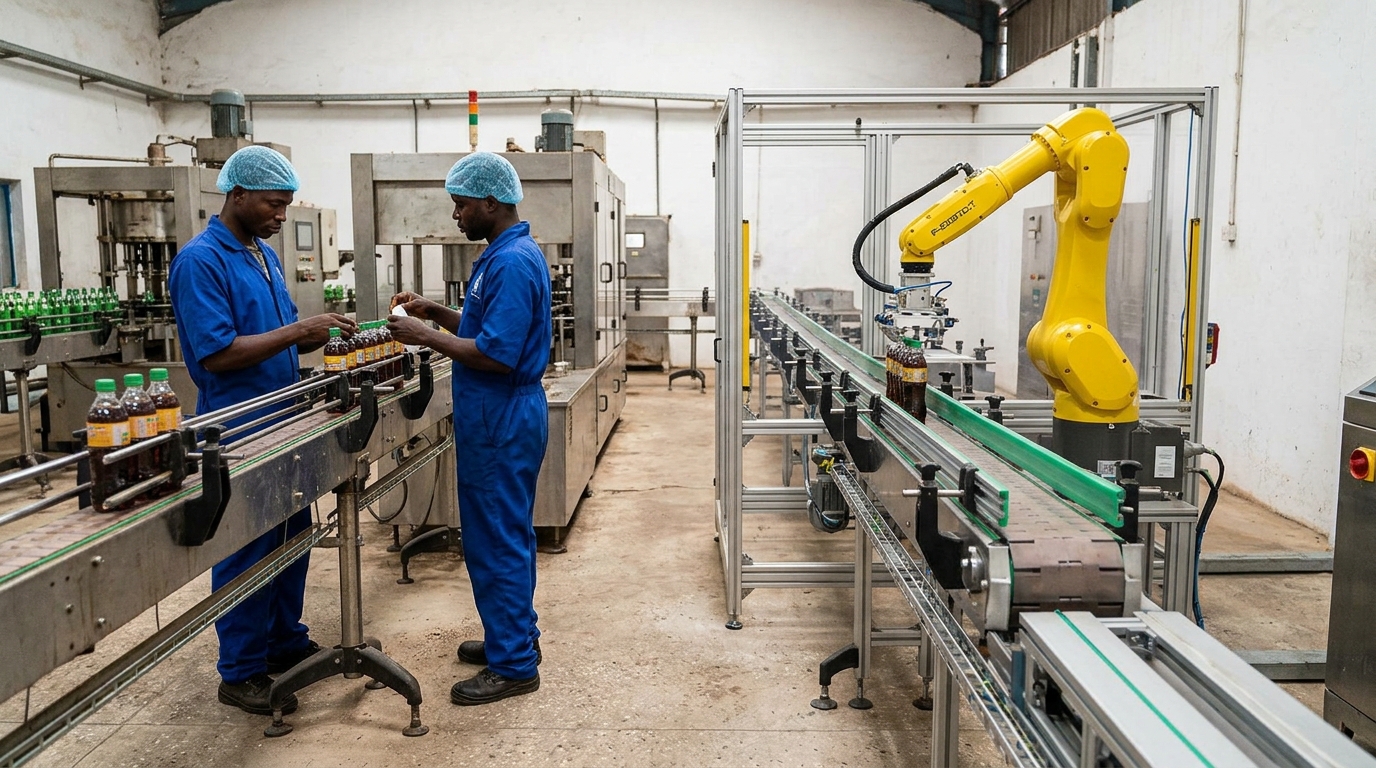
Smart Manufacturing: How Nigerian Factories Are Adopting Automation
Nigeria’s factories are changing. Fast.
For decades, manufacturing relied on manual labour. Workers stood at assembly lines. Inspectors checked products by eye. Managers made decisions based on gut feeling.
Not anymore. Automation is transforming Nigerian factories. Industry 4.0 is here. Productivity is rising. Quality is improving. Competitiveness is growing.
Let me walk you through how Nigerian manufacturers are adopting smart manufacturing technologies.
Stonehill Research helps Nigerian manufacturers navigate automation. Our Automation Feasibility Studies service evaluates where automation delivers the greatest impact.
What is smart manufacturing?
Smart manufacturing combines IoT sensors, artificial intelligence, machine learning, robotics, and cloud computing. It enables factories to make data driven decisions, predict maintenance needs, and adapt quickly to market changes.

The current state of automation in Nigerian manufacturing
Nigeria’s manufacturing sector is gradually adopting automation. While the country still lags behind global manufacturing hubs, recent developments indicate growing commitment to modernisation.
Traditional manufacturing processes that relied heavily on manual labour are being supplemented and in some cases replaced by automated systems.
Companies like Dangote Group, Nestle Nigeria, and Nigerian Breweries have invested significantly in automated production lines, quality control systems, and inventory management solutions.
The adoption rate varies across industries. Larger corporations are moving faster than SMEs. However, government initiatives and private sector partnerships are working to bridge this gap.
Read our State of Nigerian Manufacturing Report 2026 for comprehensive industry data.
Key technologies driving smart manufacturing in Nigeria
Robotics and automated assembly lines
Industrial robots are increasingly common in Nigerian factories, particularly in automotive assembly, food processing, and packaging operations. These robots perform repetitive tasks with precision and consistency, reducing human error and increasing production speed.
Collaborative robots that work alongside human operators are also gaining traction, offering flexibility without completely replacing human workers.
Internet of Things sensors
IoT devices are being deployed throughout Nigerian manufacturing facilities to monitor equipment performance, track inventory in real time, and optimise energy consumption.
These sensors provide continuous data streams that enable predictive maintenance, reducing costly downtime.
Artificial intelligence and machine learning
AI powered systems are helping Nigerian manufacturers analyse production data, identify patterns, and make intelligent decisions. Machine learning algorithms optimise production schedules, predict quality issues before they occur, and enable dynamic resource allocation.
Cloud based management systems
Cloud computing platforms allow Nigerian factories to access powerful software solutions without massive upfront investments in IT infrastructure.
ERP systems, Manufacturing Execution Systems, and Supply Chain Management tools hosted in the cloud provide real time visibility across operations.
Advanced analytics and big data
Data analytics platforms process vast amounts of manufacturing data to uncover insights that drive continuous improvement. Nigerian manufacturers use these tools to identify bottlenecks, reduce waste, and optimise production parameters.
Our Technology Assessment and Vendor Selection service helps identify the right automation solutions for your factory.
Benefits Nigerian factories are experiencing
Increased productivity
Automated systems operate around the clock with minimal downtime. Nigerian factories report productivity gains of 25% to 40% after implementing automation in key production areas.
Improved product quality
Automated quality control systems using computer vision and AI can detect defects with greater accuracy than human inspectors. This results in fewer product recalls, reduced waste, and enhanced brand reputation.
Cost reduction
While initial investment costs are substantial, automation delivers long term savings through reduced labour costs, lower error rates, decreased material waste, and minimised energy consumption.
Nigerian manufacturers typically see return on investment within 2 to 4 years.
Enhanced workplace safety
Robots handle dangerous tasks such as working with hazardous materials, operating in extreme temperatures, or performing repetitive motions that could cause injury. This reduces workplace accidents and creates safer environments.

Greater flexibility and responsiveness
Smart manufacturing systems enable Nigerian factories to quickly reconfigure production lines for different products, respond rapidly to market changes, and implement mass customisation strategies.
Competitive advantage in export markets
Automation enables Nigerian manufacturers to meet international quality standards more consistently, compete on delivery times, and price products competitively against imports and regional competitors.
Challenges facing automation adoption
High initial capital investment
The upfront costs of purchasing and installing automated equipment can be prohibitive, especially for SMEs. Limited access to affordable financing further complicates this challenge.
Skills gap and training needs
Nigeria faces a shortage of workers trained in robotics, automation systems, data analytics, and other specialised skills. Educational institutions are gradually adapting curricula, but the gap remains significant.
Infrastructure limitations
Unreliable electricity supply continues to be a major constraint. Automated systems require consistent power, and frequent outages can damage sensitive equipment. Limited internet connectivity in some industrial areas hampers cloud based solutions.
Resistance to change
Cultural factors and concerns about job displacement create resistance to automation among workers and even some management teams. Overcoming this requires effective change management, transparent communication, and retraining programmes.
Lack of local technical support
Most advanced manufacturing equipment is imported. Local technical support for maintenance and repairs is often limited, creating dependencies on foreign technicians and longer downtimes.
Cybersecurity concerns
As factories become more connected, they become more vulnerable to cyberattacks. Many Nigerian manufacturers lack robust cybersecurity frameworks to protect their operational technology and sensitive data.
Our Cybersecurity Risk Assessment for Manufacturing service helps protect your automated systems.
Government initiatives and support
The Federal Government’s Industrial Revolution Plan aims to transform Nigeria into a manufacturing hub for Africa. This includes incentives for companies investing in modern equipment and technology.
The Central Bank of Nigeria has established intervention funds specifically for manufacturing sector development, offering lower interest rates for automation related investments.
The Nigerian Export Promotion Council provides grants and technical assistance to manufacturers seeking to upgrade their facilities to meet export standards.
Public private partnerships with organisations like the Manufacturers Association of Nigeria (MAN) are creating training programmes to address the skills gap.
Special Economic Zones and Free Trade Zones offer tax breaks and streamlined regulations for companies establishing automated manufacturing facilities.
Recent policy updates in 2024 and 2025 include the National Digital Economy Policy which explicitly supports Industry 4.0 adoption, and increased customs duty waivers on imported manufacturing equipment that meet automation criteria.
Read Government Incentives for Manufacturing Automation in Nigeria 2026 for funding opportunities.
Success stories: Nigerian companies leading the way
Dangote Cement
Dangote Cement has invested billions of naira in automated production technologies across its Nigerian plants. The company uses advanced process control systems, automated quality testing, and robotic palletising.
These investments have helped Dangote become Africa’s largest cement producer.
Nestle Nigeria
Nestle’s factories in Nigeria feature highly automated production lines with minimal human intervention in core manufacturing processes. The company employs sophisticated inventory management systems and automated packaging lines.
This automation enables Nestle Nigeria to maintain consistent quality across millions of units produced daily.
Innoson Vehicle Manufacturing
Nigeria’s premier indigenous automobile manufacturer has incorporated robotic welding, automated painting systems, and computerised assembly line management.
Innoson represents a successful example of a Nigerian company building automation capabilities from the ground up.
Nigerian Breweries
Part of the Heineken Group, Nigerian Breweries operates some of the most automated beverage production facilities in West Africa.
The company uses automated brewing systems, robotic packaging, and sophisticated supply chain management technologies. Real time monitoring systems optimise every stage of production.
Flour Mills of Nigeria
This agro-allied conglomerate has modernised its flour milling operations with automated grain handling, computerised milling processes, and robotic packaging systems.
The company’s investment in automation has significantly improved production capacity and product consistency.
Check out Nigerian Manufacturing Success Stories: Automation Case Studies for detailed examples.
The future of smart manufacturing in Nigeria
5G technology deployment
As 5G networks expand across Nigeria, manufacturers will gain access to ultra reliable, low latency connectivity that enables more advanced IoT applications, real time remote monitoring, and augmented reality training systems.
Digital twins
Nigerian manufacturers are beginning to explore digital twin technology, creating virtual replicas of physical factories to simulate changes, test scenarios, and optimise operations before implementing them in the real world.

Additive manufacturing
3D printing is gradually entering Nigerian factories, particularly for prototyping, spare parts production, and small batch custom manufacturing. This technology reduces lead times and inventory costs.
Sustainable manufacturing
Automation is enabling Nigerian factories to implement more sustainable practices through precise resource management, waste reduction, and energy optimisation. This aligns with global sustainability trends and export market requirements.
Industry analysts predict that Nigeria’s smart manufacturing market will grow at a compound annual growth rate of 12% to 15% through 2030. This growth will be driven by increased foreign investment, government support, and growing awareness of automation’s benefits.
Recommendations for Nigerian manufacturers
Start with assessment. Conduct a thorough analysis of current operations to identify processes where automation would deliver the greatest impact. Focus on bottlenecks, quality issues, and safety concerns.
Adopt a phased approach. Rather than attempting complete automation overnight, implement changes incrementally. This reduces financial risk, allows workforce adaptation, and enables learning from early implementations.
Invest in people. Automation succeeds when workers are properly trained and involved in the transformation. Invest in upskilling programmes, create clear career pathways, and communicate transparently about changes.
Partner with experienced providers. Work with technology vendors and consultants who understand the Nigerian business environment and can provide local support. Consider partnerships with companies that have successfully implemented similar systems.
Prioritise cybersecurity. Build security into automation systems from the start. Implement firewalls, regular updates, employee training, and incident response plans.
Plan for infrastructure challenges. Install backup power systems, invest in reliable internet connectivity, and design systems that can operate with some degree of autonomy during infrastructure failures.
Measure and optimise. Establish clear metrics to track automation performance. Use data analytics to continuously refine processes and demonstrate return on investment to stakeholders.
Where to start tomorrow
Do not try to automate your entire factory at once.
Start with one process. One bottleneck. One quality issue. Prove the concept.
Assess your current operations. Where are your biggest pain points?
Train your people before you buy equipment. Skills gaps will kill automation projects.
Partner with experienced providers. Do not go it alone.
Plan for power. Backup generators. Uninterrupted power supplies. Both are essential.
Start small. Scale gradually. Learn as you go.
Final word
Nigeria’s manufacturing sector is at an exciting crossroads.
The adoption of smart manufacturing and automation technologies is more than operational improvement. It is a fundamental transformation that will define the country’s industrial competitiveness for decades.
Challenges remain. Infrastructure, skills development, and financing are real obstacles. But the momentum is undeniable.
Nigerian manufacturers who embrace automation now will thrive. Those who delay risk falling behind international competitors and regional rivals.
The factories being built and upgraded today will determine whether Nigeria leads or follows in the next industrial revolution.
Related services from Stonehill Research
-
Automation Feasibility Studies – Evaluate which processes would benefit most from automation.
-
Technology Assessment and Vendor Selection – Identify the right automation solutions for your factory.
-
Cybersecurity Risk Assessment for Manufacturing – Protect your automated systems from cyber threats.
Recommended reading from the Stonehill Research blog
-
State of Nigerian Manufacturing Report 2026 – Comprehensive industry data and trends.
-
Government Incentives for Manufacturing Automation in Nigeria 2026 – Funding opportunities and policy updates.
-
Nigerian Manufacturing Success Stories: Automation Case Studies – Real-world examples from leading companies.
Let’s work together
Ready to transform your manufacturing operations? Stonehill Research specialises in helping Nigerian manufacturers navigate their automation journey. Our team of experts provides comprehensive market research, feasibility studies, and strategic planning services tailored to your specific industry and business needs.
Contact us today:
📧 Email: info@stonehillresearch.com
📞 Phone: +234 802 320 0801
📍 Address: 5, Ishola Bello Close, Off Iyalla Street, Alausa, Ikeja, Lagos, Nigeria
Contact Stonehill Research to schedule a consultation.
Let us build the future of Nigerian manufacturing together.
Stonehill Research – Your Partner in Smart Manufacturing
References
-
National Institute of Standards and Technology (NIST). Smart Manufacturing. https://www.nist.gov/programs-projects/smart-manufacturing
There are no comments