

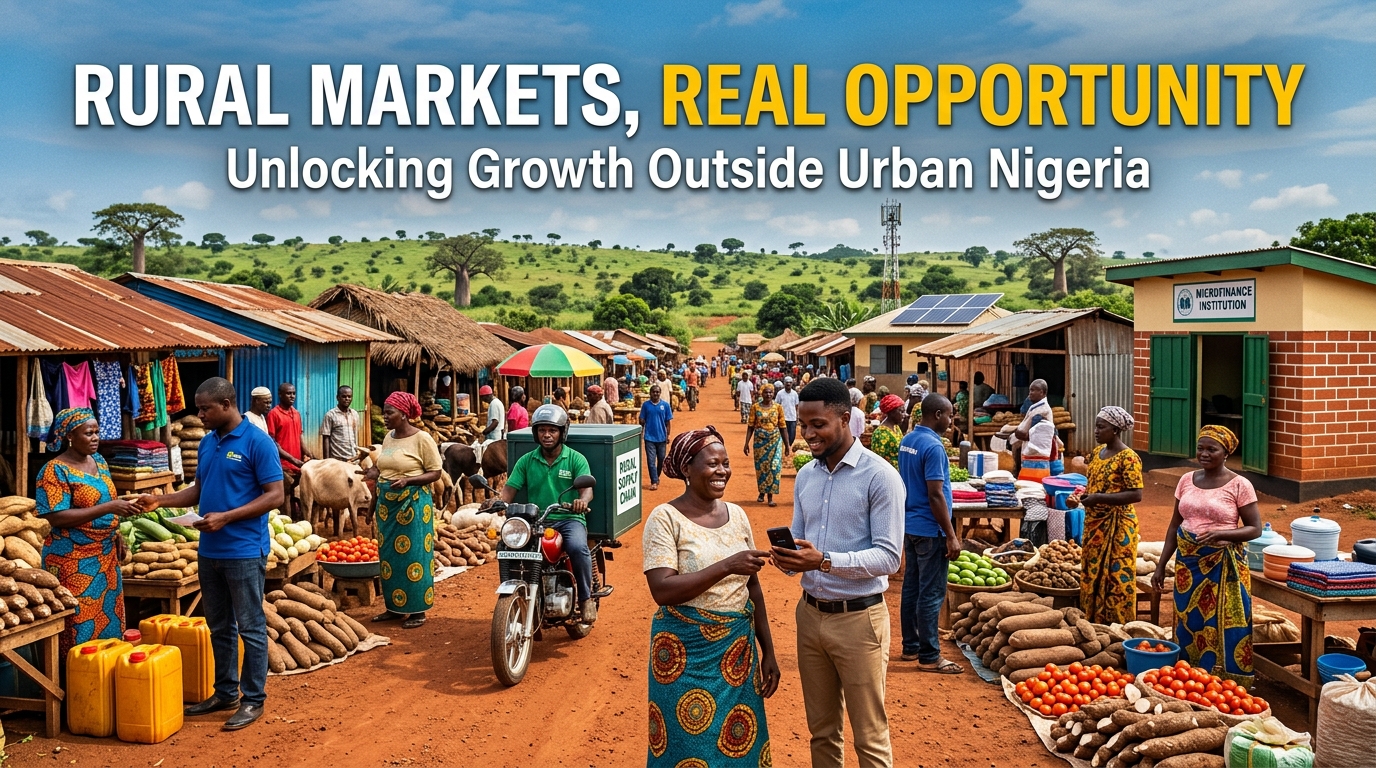
Rural Markets, Real Opportunity: Unlocking Growth Outside Urban Nigeria
Lagos is crowded. Abuja is competitive. Port Harcourt is saturated.
But beyond these urban centres lies an untapped goldmine. Rural Nigeria is home to approximately 48% of the country’s population, over 95 million people. Their aggregate purchasing power exceeds ₦15 trillion annually.
As competition intensifies in cities, the question is no longer whether to engage rural consumers. It is how to do so effectively and sustainably.
Stonehill Research helps businesses navigate Nigeria’s rural market landscape. Our Rural Market Entry Strategy service provides customised roadmaps for rural penetration.
Understanding the rural Nigerian consumer
Market size and economic potential
The aggregate purchasing power in these regions exceeds ₦15 trillion annually. Average rural household income ranges from ₦250,000 to ₦600,000 annually. Mobile penetration rate is 67%, up from 52% in 2021. Banking access has reached 42% of rural adults. The youth population aged 15 to 35 years is approximately 55% of rural residents.

Defining market segmentation
Market segmentation refers to the process of dividing a broad consumer or business market into sub groups based on shared characteristics such as demographics, needs, priorities, common interests, and psychographic or behavioral criteria.
In rural Nigerian contexts, effective segmentation goes beyond traditional demographic factors to include agricultural activity and income cycles, access to infrastructure and technology, cultural and linguistic preferences, and community influence and decision-making patterns.
Consumer behaviour patterns
Rural purchasing power fluctuates significantly with agricultural seasons. Post-harvest periods, typically October to December and March to May, see increased consumer spending. Planting seasons require capital allocation toward farm inputs.
Unlike individualistic tendencies common in urban areas, rural purchasing decisions often involve family consultations and community influence. Word-of-mouth recommendations carry exceptional weight. Community leaders or respected figures can significantly impact brand adoption.
A common misconception is that rural consumers prioritise price above all else. While value is important, rural Nigerians are increasingly discerning about quality, particularly for items related to health, children’s needs, and productive assets.
Rural consumers demonstrate remarkable brand loyalty once trust is established. However, this loyalty must be earned through consistent quality, appropriate pricing, and genuine engagement.
Read our Understanding Nigeria’s Rural Consumer: A Research Report for deeper behavioural insights.
Infrastructure and distribution challenges
Transportation and road networks
According to the Federal Ministry of Works and Housing, only 31% of rural roads are in good condition. Approximately 40% are classified as poor or impassable during rainy seasons.
Source: Federal Ministry of Works and Housing. National Roads Infrastructure Report. [VERIFY: source]
Delivery costs to rural areas can be 2 to 3 times higher than urban deliveries. Product damage rates increase due to poor road conditions. Seasonal inaccessibility affects supply chain reliability. Transportation time can add 3 to 7 days compared to urban deliveries.
Last mile distribution complexity
The last mile in rural Nigeria often extends to challenging terrain. Traditional distribution models struggle with fragmented retail networks, dispersed population centres, and limited infrastructure for storage and refrigeration.
Recent developments have shown promising solutions. Companies like Unilever Nigeria and Nestle have established rural distribution hubs in market towns, from which micro distributors on motorcycles serve surrounding villages. This reduces central logistics costs while creating local employment.
Progressive brands are partnering with motorcycle and tricycle transport unions to leverage existing informal logistics networks. Some FMCGs have deployed mobile sales vans that visit rural communities on market days, combining distribution with direct consumer engagement.
Technology and connectivity infrastructure
The digital divide between urban and rural Nigeria is narrowing but remains significant. According to the Nigerian Communications Commission, 67% mobile phone penetration exists in rural areas. 3G coverage is available to approximately 58% of rural populations. 4G coverage reaches 32% of rural areas, up from 18% in 2022.
Source: Nigerian Communications Commission. Telecommunications Industry Statistics. [VERIFY: source]
Average data costs remain 25% to 30% higher in rural areas due to infrastructure costs.
Related service: Our Distribution Network Mapping service helps identify optimal partners and channels for rural reach.
Strategic entry points and success models
The agricultural value chain approach
Agriculture remains the backbone of rural economies. Positioning your brand within this value chain offers natural market entry.
Heritage Bank’s rural banking initiative established agency banking networks in 127 rural communities across 15 states in 2024. By positioning agents in agricultural markets and cooperating with farmers’ cooperatives, they onboarded over 180,000 rural customers while maintaining a default rate below 3.2%.
The market day strategy
Rural market days are cultural and economic focal points where communities gather, trade, and socialise. These represent concentrated opportunities for brand visibility, direct sales, and consumer engagement.
Coca-Cola HBC Nigeria expanded its Market Day Activation programme to 340 rural markets across the Middle Belt and Northern regions. The initiative increased brand penetration by 23% in targeted communities within six months.
The community ambassador model
Recruiting and empowering local brand ambassadors leverages the community-centric nature of rural societies. Local ambassadors should be respected community members, such as teachers, health workers, successful farmers, or youth leaders, who genuinely believe in your product.
Promasidor’s Cowbell Ambassador programme in Southwestern rural communities trained 230 local ambassadors on dairy nutrition and product benefits. The programme contributed to a 34% increase in rural sales in programme areas during 2024.
The public-private partnership approach
Collaborating with government initiatives, NGOs, or international development organisations provides credibility, risk sharing, and access to established rural networks.
In 2024, the federal government launched the Digital Villages initiative, partnering with telecommunications companies and technology providers to establish digital hubs in 100 rural communities. Early private sector partners include Opay, Konga, and Jumia.
Check out Case Studies in Successful Rural Market Entry Nigeria for real-world examples.

Product adaptation and pricing strategies
Right-sizing and packaging innovation
Rural purchasing patterns favour smaller, more frequent purchases due to cash flow realities and storage limitations. Single-serve and small-format packaging addresses these needs.
Flour Mills of Nigeria introduced Week Pack sizes for Golden Penny products, portions designed for a family’s weekly consumption rather than monthly bulk purchases. The innovation increased rural penetration by 18% while improving inventory turnover for rural retailers.
Value-based pricing psychology
Pricing in rural markets requires balancing affordability with quality perception. Price alone does not drive decisions. Perceived value, the relationship between cost and benefit, determines purchase behaviour.
Research shows rural consumers associate very low prices with counterfeit or substandard products, particularly for health and children’s products. Pricing too low can signal inferior quality.
Localisation of product benefits
The same product may solve different problems in rural versus urban contexts. Effective marketing articulates benefits relevant to rural lifestyles and aspirations.
Telecommunications companies have shifted from urban messaging like “streaming your favourite shows in HD” to rural adaptation like “video calling your children studying in the city” or “checking crop prices before market day.”
Our Product Adaptation and Packaging Innovation service helps tailor offerings for rural consumers.
Communication and marketing approaches
Traditional media effectiveness
Radio reaches over 80% of rural households, making it the most effective mass medium for rural audiences. Local radio stations broadcasting in indigenous languages command loyal audiences.
Strategic positioning of weatherproof billboards at market entrances, major road junctions, and community gathering points provides consistent visibility. Traditional announcers using megaphones remain effective for time-sensitive messages.
Digital and mobile marketing
WhatsApp has become rural Nigeria’s primary social platform. Brands creating community groups for customers, distributors, or interest-based segments can share product information, collect feedback, and build relationships.
Nestle Nigeria launched Mother’s Corner, a WhatsApp-based nutrition education programme targeting rural mothers. Using voice notes in Hausa, Yoruba, and Igbo, the programme shares child nutrition tips twice weekly. It has attracted over 85,000 rural mothers.
Read Marketing to Rural Nigeria: Channels That Actually Work for practical channel strategies.
Building distribution networks
Retailer relationship management
Rural retailers typically operate with extremely limited working capital, often ₦50,000 to ₦200,000 total inventory. They have multi product portfolios with very thin margins, cash only operations with limited credit access, and personal relationships with most customers.
Unilever Nigeria’s Preferred Partner programme for rural retailers includes quarterly business training, access to working capital loans through partner microfinance banks, and performance bonuses. Over 4,200 rural retailers participated, with participating retailers showing 28% higher sales.
Leveraging informal distribution networks
Nigeria has extensive informal transport networks moving goods and people. Partnering with motorcycle rider associations, commercial tricycle operators, and mini bus networks can solve last mile challenges.
Max.ng, a motorcycle ride-hailing company, expanded into rural goods delivery, allowing small retailers to order inventory via app for next-day delivery. The service operates in 18 rural LGAs across 6 states.
Overcoming common barriers
The trust deficit
Many rural communities have experienced exploitation by businesses making promises without follow through. Skepticism toward new brands is rational self protection.
Consistent presence builds trust more than flashy launches. Showing up through supply continuity, regular visits, and sustained communication demonstrates commitment. Partnering with trusted community institutions transfers some of their credibility to your brand.
Counterfeit and adulteration concerns
Counterfeit products plague rural markets, making consumers wary. Holograms, scratch and verify codes, or unique packaging elements help consumers identify genuine products.
Teach customers how to identify genuine products through packaging details, texture, or smell. Partnering with NAFDAC and law enforcement to raid counterfeit operations sends deterrent signals.
Payment and credit challenges
Platforms like Opay, Palmpay, and Moniepoint have significant rural penetration. Integrating these payment options reduces cash handling and enables digital transaction tracking.
Some agribusinesses accept payment in crops at pre agreed conversion rates, enabling farmer consumers to transact when cash poor but crop rich.
Measuring success: relevant rural KPIs
Market penetration indicators. Household penetration rate measures percentage of households in target communities using your product at least monthly. Retailer network density shows number of active stocking retailers per 1,000 population.
Relationship and loyalty metrics. Repeat purchase rates indicate product satisfaction and trust building. Retailer retention rates show channel satisfaction.
Financial performance indicators. Customer acquisition cost in rural areas often exceeds urban. Tracking this helps optimise spending. Unit economics by region reveal which markets warrant expansion.
Our Rural Market Performance Measurement service establishes appropriate KPIs for rural initiatives.
Future trends shaping rural markets (2025 to 2027)
4G coverage is expected to reach 60% of rural areas by end of 2026. Smartphone ownership in rural households is projected to exceed 75% by 2027. Digital payment adoption is growing 40% annually in rural markets.
12,000 km of rural roads are scheduled for rehabilitation. Expansion of the National Broadband Plan to 90% rural coverage is underway. Rural electrification is targeting 5 million new connections.
Where to start tomorrow
Do not try to cover all rural markets at once.
Start with one region. One language group. One agricultural cycle.
Visit the markets. See conditions first hand. Talk to retailers. Listen to consumers.
Partner locally. Transport unions. Market associations. Community leaders.
Adapt your product. Packaging sizes. Pricing. Messaging.
Measure what matters. Household penetration. Repeat rates. Word of mouth.
Be patient. Rural markets take time. But the loyalty lasts longer.
Final word
Rural Nigeria is one of Africa’s most compelling growth frontiers. Nearly half the nation’s population. Growing connectivity. Improving infrastructure. Evolving consumer aspirations.
Success requires more than extending urban strategies. It demands genuine understanding of rural realities, authentic engagement with communities, innovative distribution models, and patient investment.
The brands that will win in rural Nigeria view these markets not as charity cases or afterthoughts, but as strategic priorities worthy of customised approaches and sustained commitment.
The question is not whether rural markets matter. It is whether you are prepared to engage them with the seriousness, creativity, and long term perspective they deserve.
Related services from Stonehill Research
-
Rural Market Entry Strategy – Customised roadmaps for rural penetration based on your industry and capabilities.
-
Distribution Network Mapping – Identification and evaluation of optimal distribution partners and channels.
-
Rural Market Performance Measurement – Establishment of appropriate KPIs and tracking systems for rural initiatives.
Recommended reading from the Stonehill Research blog
-
Understanding Nigeria’s Rural Consumer: A Research Report – Deeper behavioural insights for market entry.
-
Case Studies in Successful Rural Market Entry Nigeria – Real-world examples and lessons learned.
-
Marketing to Rural Nigeria: Channels That Actually Work – Practical channel strategies for rural reach.
Let’s work together
Ready to unlock rural market opportunities? At Stonehill Research, we specialise in helping businesses navigate Nigeria’s complex rural market landscape. Our team combines deep local insights with rigorous research methodologies to deliver actionable intelligence that drives rural market success.
Contact us today:
📧 Email: info@stonehillresearch.com
📞 Phone: +234 802 320 0801
📍 Address: 5, Ishola Bello Close, Off Iyalla Street, Alausa, Ikeja, Lagos, Nigeria
Contact Stonehill Research to schedule a consultation.
Let us discuss how we can support your rural market ambitions. Together, we will unlock the real opportunities waiting beyond urban Nigeria.
Stonehill Research – Your Partner in Rural Market Intelligence
References
-
American Marketing Association. Market Segmentation. https://www.ama.org/the-definition-of-marketing-what-is-marketing/
-
National Bureau of Statistics. Nigeria Gross Domestic Product Report.
-
Federal Ministry of Works and Housing. National Roads Infrastructure Report.
-
Nigerian Communications Commission. Telecommunications Industry Statistics: Rural Penetration Analysis.
-
Central Bank of Nigeria. Financial Inclusion Survey Report.
There are no comments