

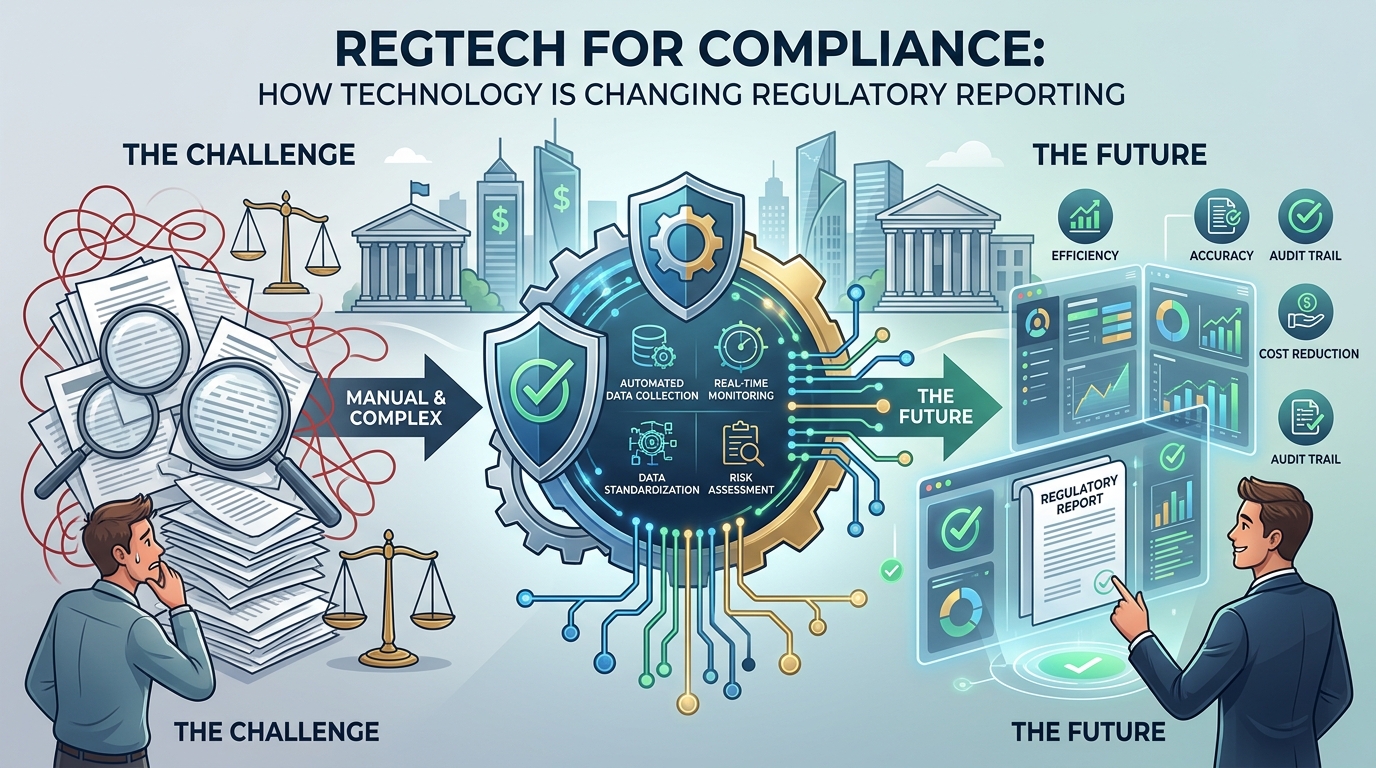
RegTech for Compliance: How Technology Is Changing Regulatory Reporting
Regulations are multiplying. Reporting requirements are growing. Manual processes cannot keep up.
Spreadsheets are not compliance systems. Email trails are not audit trails. Periodic checks miss risks that emerge between reviews.
Enter RegTech. Regulatory technology is transforming how organisations manage compliance and reporting.
Let me walk you through what RegTech is, how it works, and why your organisation needs it.
Related service: Stonehill Research helps organisations navigate the RegTech landscape. Our RegTech Solution Assessment service identifies the right tools for your compliance needs.
What is RegTech?
According to the Financial Conduct Authority (FCA), RegTech is defined as “a subset of FinTech that focuses on technologies that may facilitate the delivery of regulatory requirements more efficiently and effectively than existing capabilities.”
Source: Financial Conduct Authority (FCA). RegTech. https://www.fca.org.uk/publication/research/regtech-developing-digital-regulatory-reporting.pdf
RegTech solutions use advanced technologies like artificial intelligence, machine learning, big data analytics, blockchain, and cloud computing. They automate and streamline compliance processes.
These tools enable organisations to monitor transactions in real time, identify suspicious activities, generate accurate reports, and adapt quickly to regulatory changes.
The evolution of regulatory compliance
Following major financial crises and corporate scandals, regulators worldwide have introduced stricter rules and heightened reporting requirements.
Organisations now face the complexity of cross-border regulations, the volume of data requiring analysis, the speed at which regulatory changes occur, and the substantial costs of non-compliance.
Traditional compliance approaches relied on manual data collection, human interpretation of regulations, periodic rather than continuous monitoring, and reactive rather than proactive risk management.
These methods proved time-consuming, error-prone, and inadequate.
Related post: Read our Compliance Automation Guide for Nigerian Financial Institutions for practical implementation steps.

How RegTech is transforming regulatory reporting
Automation of data collection and reporting
RegTech platforms automatically gather data from multiple sources across an organisation. They eliminate manual data entry and reduce the risk of human error.
These systems can generate regulatory reports in required formats with minimal human intervention, ensuring consistency and accuracy. Automated workflows streamline the entire reporting process from data collection to submission.
Real-time monitoring and surveillance
Modern RegTech solutions provide continuous monitoring of transactions and activities. Organisations can detect potential compliance issues as they occur rather than discovering them weeks or months later.
Advanced algorithms identify unusual patterns or suspicious activities that may indicate fraud, money laundering, or other compliance violations. This real-time capability allows organisations to respond immediately to potential issues.
Enhanced risk management
RegTech platforms utilise sophisticated analytics to assess and quantify compliance risks across the organisation. Predictive modelling helps identify areas of potential vulnerability before they become actual problems.
These systems provide comprehensive dashboards and visualisation tools that give compliance officers and executives clear insights into the organisation’s risk profile.
Regulatory change management
One of the most challenging aspects of compliance is keeping pace with constantly evolving regulations. RegTech solutions monitor regulatory updates across multiple jurisdictions, automatically flagging changes that affect the organisation.
Some platforms use natural language processing to interpret new regulations and assess their impact on existing processes. This helps organisations adapt quickly and maintain continuous compliance.
Cost reduction and efficiency
By automating routine compliance tasks, RegTech significantly reduces the labour costs associated with regulatory reporting. Organisations can redirect human resources from manual data processing to higher value activities such as strategic analysis and risk mitigation.
The reduction in compliance errors also helps avoid costly penalties and reputational damage.
Key technologies driving RegTech innovation
Artificial intelligence and machine learning
AI and ML enable systems to learn from historical data, improve detection accuracy over time, and identify complex patterns that would be impossible for humans to recognise manually. These technologies power predictive analytics that help organisations anticipate and prevent compliance issues.
Big data analytics
Big data analytics allows organisations to process and analyse massive volumes of structured and unstructured data from diverse sources. This capability is essential for comprehensive compliance monitoring and reporting in today’s data rich environment.
Blockchain technology
Blockchain provides immutable, transparent records of transactions, enhancing auditability and reducing the risk of data manipulation. Some organisations are exploring blockchain for regulatory reporting to create tamper proof audit trails.
Cloud computing
Cloud computing offers scalable infrastructure that can adapt to changing data volumes and processing requirements. Cloud based RegTech solutions provide flexibility, reduce upfront technology investments, and enable easier integration with existing systems.
Natural language processing
NLP helps interpret regulatory texts, extract relevant requirements, and even draft compliance reports. This technology bridges the gap between complex regulatory language and operational compliance requirements.
Our Compliance Process Automation service helps organisations implement these technologies effectively.
Recent updates and trends in RegTech
Integration of generative AI
Generative AI technologies are being incorporated into RegTech platforms to automate the creation of compliance documentation, generate regulatory reports from raw data, and provide natural language interfaces for compliance queries. These capabilities make compliance processes more accessible to non-technical staff.
Enhanced focus on ESG compliance
ESG reporting requirements have expanded dramatically. RegTech providers are developing specialised solutions to help organisations track, measure, and report on ESG metrics. These platforms integrate data from across the organisation to provide comprehensive sustainability reporting.
Collaborative RegTech ecosystems
Regulators are increasingly working directly with RegTech providers to develop solutions that benefit both regulated entities and regulatory agencies. Some jurisdictions are establishing regulatory sandboxes where RegTech innovations can be tested in controlled environments.

Increased cross-border regulatory harmonisation
RegTech platforms are becoming more sophisticated in handling multi-jurisdictional compliance requirements. As international regulatory bodies work toward greater harmonisation of standards, RegTech solutions are positioning themselves to support global compliance strategies.
Advanced threat detection
With the rise of sophisticated financial crimes and cyber threats, RegTech solutions are incorporating more advanced threat detection capabilities. Behavioural analytics and anomaly detection algorithms can identify emerging risks before they materialise into compliance violations.
Check out ESG Reporting Requirements for Nigerian Companies 2026 for emerging compliance trends.
Challenges and considerations
Data privacy and security
RegTech systems process sensitive information. Organisations must ensure that their RegTech solutions comply with data protection regulations and implement robust cybersecurity measures.
Integration complexity
Implementing RegTech solutions within existing IT infrastructure can be challenging. Organisations need to carefully plan integration strategies and may require significant technical resources to ensure smooth deployment.
Regulatory acceptance
Regulatory acceptance varies across jurisdictions. While some regulators actively encourage RegTech adoption, others maintain more conservative approaches. Organisations must verify that their chosen RegTech solutions meet regulatory requirements in all relevant jurisdictions.
Skills and training
Successful RegTech implementation requires staff who understand both compliance requirements and the technology platforms. This necessitates investment in training and potentially new hiring.

The future of regulatory reporting
Increased regulatory participation
Regulators themselves are adopting technology to enhance their supervisory capabilities. This SupTech (Supervisory Technology) will enable more efficient reporting and faster regulatory responses.
Greater standardisation
Industry wide efforts to standardise data formats and reporting protocols will facilitate more seamless RegTech implementation and reduce compliance complexity, particularly for organisations operating across multiple jurisdictions.
Predictive compliance
Future RegTech solutions will move beyond reactive monitoring to truly predictive compliance. They will use advanced analytics to forecast regulatory risks and recommend preventive actions before violations occur.
Democratisation of compliance
As RegTech solutions become more sophisticated yet user friendly, smaller organisations will gain access to compliance capabilities previously available only to large enterprises. This will level the playing field and raise overall compliance standards.
Where to start tomorrow
Do not try to replace your entire compliance system overnight.
Start with one pain point. Anti money laundering monitoring. Regulatory reporting. Customer due diligence.
Identify the data you already have. You may be sitting on valuable information.
Research RegTech solutions for your specific need. Many offer free trials or demos.
Run a pilot in one department before expanding organisation wide.
Train your compliance team. Technology is only as good as the people using it.
Measure your results. Time saved. Errors reduced. Risks identified.
Final word
RegTech is a fundamental shift in how organisations approach regulatory compliance.
By leveraging advanced technologies to automate processes, enhance monitoring, and improve risk management, RegTech solutions help organisations navigate increasingly complex regulatory landscapes more efficiently.
As regulations continue to evolve and regulatory expectations increase, organisations that embrace RegTech will be better positioned to maintain compliance, reduce costs, and focus resources on strategic growth rather than administrative burden.
The transformation of regulatory reporting through technology is not just a trend. It is becoming a necessity.
Organisations that invest in RegTech today are investing in their compliance readiness for tomorrow.
Related services from Stonehill Research
-
RegTech Solution Assessment – Identify the right RegTech tools for your organisation’s specific compliance needs.
-
Compliance Process Automation – Implement technology-driven solutions to streamline regulatory reporting.
-
Compliance Training and Change Management – Upskill your team for successful RegTech adoption.
Recommended reading from the Stonehill Research blog
-
Compliance Automation Guide for Nigerian Financial Institutions – Practical implementation steps for local context.
-
ESG Reporting Requirements for Nigerian Companies 2026 – Emerging compliance trends you need to know.
-
Building a Future-Proof Compliance Function in Nigeria – Strategic guidance for long-term success.
Let’s work together
Ready to transform your compliance strategy? At Stonehill Research, we understand the complexities of modern regulatory compliance and the transformative potential of RegTech solutions.
Our team of experts can help you navigate the RegTech landscape, identify solutions tailored to your organisation’s needs, and implement technology-driven compliance strategies that reduce risk while improving efficiency.
Contact us today:
📧 Email: info@stonehillresearch.com
📞 Phone: +234 802 320 0801
📍 Address: 5, Ishola Bello Close, Off Iyalla Street, Alausa, Ikeja, Lagos, Nigeria
Contact Stonehill Research to schedule a consultation.
Let us help you turn regulatory compliance from a burden into a competitive advantage.
Stonehill Research – Your Partner in RegTech Excellence
References
-
Financial Conduct Authority (FCA). RegTech. https://www.fca.org.uk/publication/research/regtech-developing-digital-regulatory-reporting.pdf [VERIFY: link active]
-
Deloitte. RegTech is transforming the financial services industry. [VERIFY: source]
-
PwC. RegTech: A new era in regulatory compliance. [VERIFY: source]
-
EY. How RegTech can help manage regulatory reporting. [VERIFY: source]
-
IBM. RegTech and the future of compliance. [VERIFY: source]
-
KPMG. RegTech and the future of regulatory compliance. [VERIFY: source]
-
McKinsey & Company. The RegTech revolution: How technology is reshaping compliance. [VERIFY: source]
-
Thomson Reuters. 2025 RegTech Outlook Report. [VERIFY: source]
-
Forbes. How RegTech is changing compliance for financial institutions. [VERIFY: source]
-
Gartner. Market Guide for RegTech Solutions. [VERIFY: source]
There are no comments