

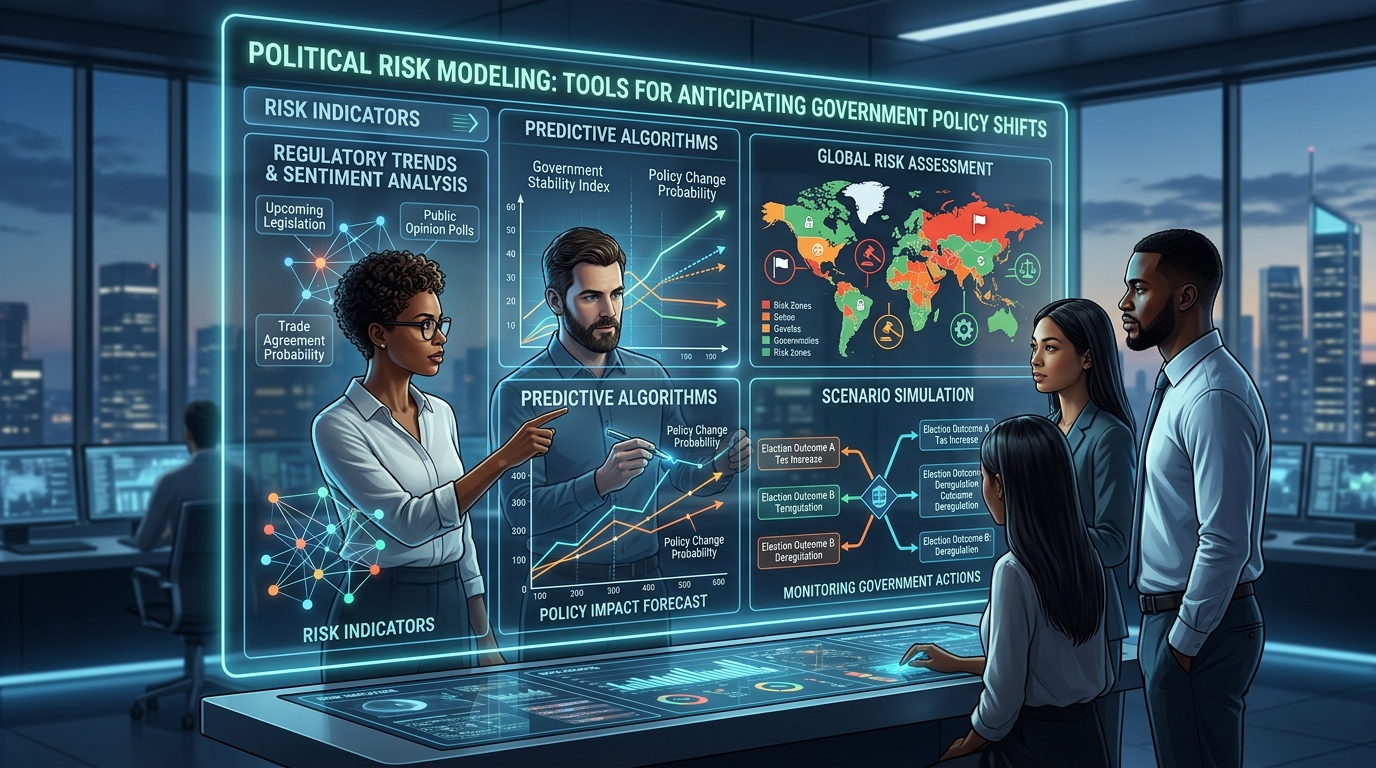
Political Risk Modelling: Tools for Anticipating Government Policy Shifts
Governments change policies unexpectedly. Regulations shift overnight. Political instability disrupts markets.
Businesses that anticipate these shifts survive. Those that do not suffer losses, closures, or forced exits.
Political risk modelling gives you the tools to see around corners. Let me walk you through how to build a system that works.
Stonehill Research helps organisations anticipate policy shifts. Our Political Risk Assessment service provides actionable intelligence for uncertain environments.
Understanding political risk: a foundation for strategic planning
Corporate Finance Institute. Political Risk. https://corporatefinanceinstitute.com/resources/economics/political-risk/
Political risk covers everything from changes in government leadership and policy reforms to civil unrest, regulatory shifts, and international sanctions.
For businesses operating across borders or in emerging markets, this risk can manifest as expropriation of assets, currency controls, trade restrictions, changes in tax policies, or complete market closures.
Understanding these risks is the first step toward building an effective mitigation strategy.
Core components of political risk modelling
Data collection and intelligence gathering
The foundation of any political risk model lies in comprehensive data collection. Organisations must establish robust systems for gathering information from multiple sources.
Government publications and policy documents including official statements, white papers, budget proposals, and legislative agendas provide insights into planned policy directions.
News media and expert analysis from both local and international outlets offer real time updates on political developments.
Economic indicators such as GDP growth rates, inflation figures, unemployment statistics, and foreign exchange reserves often signal underlying political pressures.

Social media and sentiment analysis can reveal public sentiment and early warning signs of social unrest.
Stakeholder mapping and analysis
Understanding the political landscape requires identifying and analysing key stakeholders who influence policy decisions.
Map government institutions, political parties, and influential politicians. Identify business groups, labour unions, and civil society organisations.
Analyse the power dynamics and relationships between different stakeholders. Assess the interests, motivations, and likely behaviours of each group.
Monitor changes in stakeholder positions and alliances.
Scenario planning and forecasting
Political risk modelling must account for multiple potential futures rather than attempting to predict a single outcome.
Develop base case, optimistic, and pessimistic scenarios. Assign probabilities to different policy outcomes.
Create decision trees that map potential government responses to various triggers. Identify early warning indicators for each scenario.
Establish contingency plans for rapid response.
Read our Scenario Planning for Nigerian Businesses: A Practical Guide for actionable forecasting techniques.
Advanced tools and technologies for political risk assessment
Artificial intelligence and machine learning
AI powered platforms can process vast amounts of unstructured data from news articles, social media, and government documents to identify patterns and predict policy shifts.
Machine learning algorithms can detect subtle changes in government rhetoric and priorities, identify emerging political coalitions and opposition movements, predict election outcomes based on polling data and historical trends, and forecast the likelihood of specific policy changes.
Recent updates in 2024 and 2025 have seen AI models incorporating natural language processing capabilities that can analyse speeches, press releases, and legislative debates in real time.
Big data analytics platforms
Specialised political risk platforms aggregate data from thousands of sources globally.
They offer real-time monitoring of political events and policy announcements, customisable alert systems for specific risk factors, historical data analysis to identify patterns and precedents, and country-by-country risk ratings and rankings.
Geospatial intelligence tools
GIS and satellite imagery analysis provide visual insights into political developments.
They enable monitoring of protests, military movements, and infrastructure projects. They track resource conflicts and territorial disputes. They analyse economic activity patterns that may influence policy and assess the impact of natural disasters on political stability.
Network analysis software
Understanding political networks and influence patterns is crucial for anticipating policy shifts.
Network analysis helps map relationships between politicians, business leaders, and other influencers. It identifies power brokers and key decision makers. It tracks the flow of information and influence and predicts coalition formations and policy alliances.
Economic modelling tools
Political decisions are often driven by economic pressures, making economic modelling an essential component.
Models include debt sustainability analysis to predict fiscal policy changes, trade flow analysis to anticipate protectionist measures, currency risk models to forecast exchange controls, and commodity price forecasting for resource dependent economies.
Emerging trends in political risk modelling
Integration of climate risk factors
Political risk models are increasingly incorporating climate related variables as environmental challenges drive policy shifts.
Governments worldwide are implementing carbon taxes, renewable energy mandates, and climate adaptation regulations. Models now factor in climate vulnerability indices, energy transition policies, and green finance regulations.
Cryptocurrency and digital asset regulations
As digital currencies gain prominence, governments are racing to establish regulatory frameworks.
The latest political risk models now include assessments of central bank digital currency implementation timelines, cryptocurrency taxation and reporting requirements, cross border digital payment regulations, and technology sovereignty policies affecting blockchain infrastructure.

Artificial intelligence governance
With the rapid advancement of AI technologies, governments are developing new regulatory frameworks.
Risk models must now account for AI safety regulations and compliance requirements, data localisation and sovereignty laws, algorithmic transparency mandates, and restrictions on AI applications in sensitive sectors.
Geopolitical fragmentation and decoupling
The trend toward economic nationalism and strategic competition between major powers has intensified.
Updated political risk models emphasise supply chain vulnerability assessments in the context of trade wars, technology transfer restrictions and export controls, foreign investment screening mechanisms, and sanctions risk and secondary boycott exposure.
Social media regulation and digital sovereignty
Governments are asserting greater control over digital platforms and online content, creating new regulatory risks.
These include platform liability laws and content moderation requirements, data privacy regulations, cybersecurity mandates and technology standards, and cross border data flow restrictions.
Our Strategic Intelligence Briefing service delivers customised risk assessments for your specific operating environment.
Implementing a political risk framework: practical steps
Step one: Establish a dedicated risk function
Create a team or designate individuals responsible for political risk monitoring and analysis.
This team should report directly to senior leadership, have cross functional representation from legal, finance, operations, and strategy, maintain relationships with external experts and consultants, and regularly brief decision makers on emerging risks.
Step two: Define risk appetite and tolerance
Different organisations have different capacities for absorbing political risk.
Clearly articulate which types of political risk are acceptable, threshold levels for various risk categories, red lines that would trigger divestment or exit, and risk adjusted return expectations for different markets.
Step three: Integrate risk assessment into strategic planning
Political risk analysis should inform all major business decisions including market entry and expansion strategies, capital allocation and investment decisions, supply chain design and diversification, partnership and joint venture structures, and contract negotiations and legal protections.
Step four: Develop early warning systems
Establish mechanisms to detect political changes before they materialise.
Define key risk indicators with defined thresholds. Implement automated monitoring and alert systems. Conduct regular stakeholder consultations and ground intelligence gathering. Establish scenario triggers that activate contingency plans.
Step five: Create response protocols
Prepare detailed action plans for different risk scenarios.
Develop communication strategies for engaging with government officials. Establish legal and financial hedging mechanisms. Create operational continuity plans. Prepare stakeholder engagement and public relations approaches.
Case studies: political risk modelling in action
Energy sector: anticipating nationalisation risk
A multinational oil company operating in Latin America used political risk modelling to anticipate growing resource nationalism.
By monitoring populist rhetoric, analysing election polling data, and tracking commodity price trends, the company identified elevated expropriation risk.
They proactively renegotiated contract terms, secured political risk insurance, and diversified operations to other regions.
When the government later moved to increase state control over the sector, these actions proved prescient.
Technology industry: navigating data localisation requirements
A global cloud services provider built a sophisticated model tracking data sovereignty legislation across 50 countries.
The model incorporated parliamentary activities, regulatory consultations, and geopolitical tensions to forecast where data localisation mandates would emerge.
This foresight enabled the company to preemptively establish local data centres and adjust service architectures, maintaining market access while competitors faced sudden compliance challenges.
Financial services: managing sanctions risk
An international bank implemented comprehensive political risk monitoring focused on sanctions and compliance.
Their model tracked diplomatic tensions, international incidents, and legislative activities in major economies.
When early indicators suggested imminent sanctions on a particular country, the bank accelerated the review of its exposure and client relationships, avoiding significant losses and regulatory penalties that impacted less prepared competitors.

Building resilience: beyond prediction to adaptation
Portfolio diversification
Spread exposure across multiple markets, political systems, and regulatory environments. No single political event should threaten organisational viability.
Flexible operational models
Design operations that can be rapidly reconfigured in response to political changes.
Modular supply chains with alternative sourcing options. Adaptable organisational structures that can scale or relocate. Technology infrastructure that supports remote or distributed operations. Financial arrangements that provide liquidity and flexibility.
Strategic relationships
Cultivate relationships with diverse stakeholders across the political spectrum.
Government officials at multiple levels. Industry associations and business coalitions. Civil society organisations and community leaders. International institutions and diplomatic channels.
Continuous learning and adaptation
Political risk management is not a one time exercise.
Conduct post mortems on risk events to improve future assessments. Update models regularly based on new data and methodologies. Invest in staff training and professional development. Share lessons learned across the organisation.
Our Crisis Preparedness and Response service helps organisations build adaptive capabilities.
Where to start tomorrow
Do not try to build a perfect political risk model overnight.
Start with your highest risk markets. Where are you most exposed?
Identify your key risk indicators. What signals would warn you of trouble?
Set up monitoring. Government publications. News feeds. Social media sentiment.
Build simple scenarios. Best case. Worst case. Most likely case.
Create response plans for each scenario. Do not wait until a crisis hits.
Get external intelligence. No organisation can do this alone.
Final word
Political risk modelling has evolved from a specialised niche to a core strategic capability.
The tools available today provide unprecedented capacity to anticipate government policy shifts. But technology alone cannot substitute for deep contextual understanding, experienced judgment, and ethical decision making.
The most effective political risk strategies combine cutting-edge analytical tools with human expertise, local networks, and adaptive organisational cultures.
Organisations that master these disciplines will not only protect themselves from political shocks but will also identify opportunities that others overlook.
The question is not whether political risks will materialise. It is whether your organisation is prepared when they do.
Related services from Stonehill Research
-
Political Risk Assessment – Comprehensive analysis of political, economic, and regulatory environments across Africa and emerging markets.
-
Strategic Intelligence Briefing – Customised risk assessments and early warning systems for your specific operating environment.
-
Crisis Preparedness and Response – Action plans and response protocols for political risk scenarios.
Recommended reading from the Stonehill Research blog
-
Scenario Planning for Nigerian Businesses: A Practical Guide – Actionable forecasting techniques for uncertain environments.
-
Emerging Markets Risk Outlook 2026: Africa Edition – Region-specific insights and forecasts.
-
How to Build an Early Warning System for Political Risk – Step-by-step implementation guide.
Let’s work together
Understanding political risk is complex, but you do not have to navigate it alone.
At Stonehill Research, we specialise in providing actionable intelligence and strategic advisory services that help organisations anticipate policy shifts, manage regulatory changes, and make informed decisions in uncertain political environments.
Contact us today:
📧 Email: info@stonehillresearch.com
📞 Phone: +234 802 320 0801
📍 Address: 5, Ishola Bello Close, Off Iyalla Street, Alausa, Ikeja, Lagos, Nigeria
Contact Stonehill Research to schedule a consultation.
Let us help you transform political uncertainty into strategic clarity.
Stonehill Research – Your Partner in Political Risk Intelligence
References
-
Corporate Finance Institute. Political Risk. https://corporatefinanceinstitute.com/resources/economics/political-risk/ [VERIFY: link active]
There are no comments