
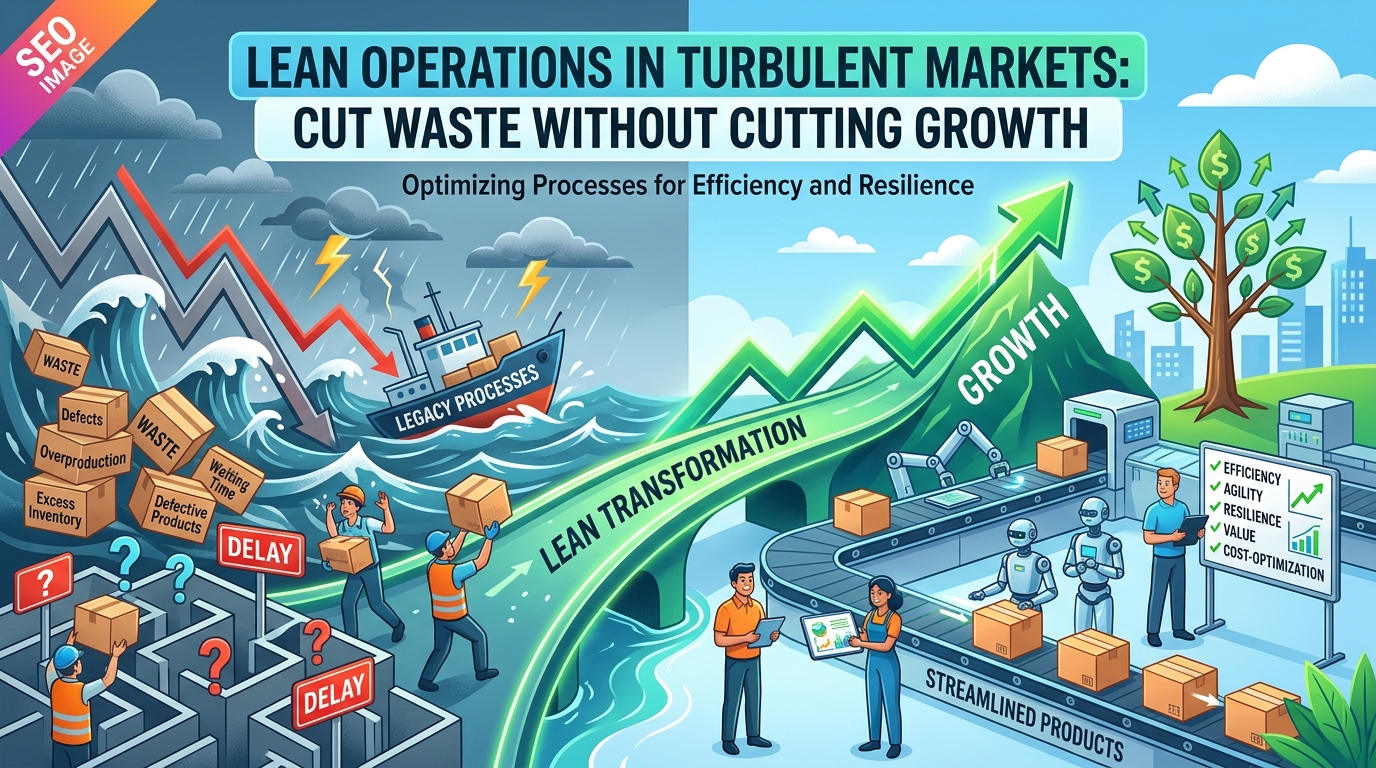
Lean Operations in Turbulent Markets: Cut Waste Without Cutting Growth
Businesses are under pressure. Supply chain disruptions. Inflation. Shifting consumer behavior. Geopolitical uncertainty.
The traditional response? Across-the-board budget cuts. But that often sacrifices long-term growth for short-term savings.
There is a better way. Lean operations.
It is not about doing more with less until people burn out. It is about systematically eliminating waste while preserving value creation.
Let me show you how.
Stonehill Research provides Lean Operations Implementation Support to help organisations cut waste without cutting growth.
Understanding lean operations: a clear definition
Before we go further, let us define what lean operations actually means.
Here is the simple version.
Lean operations focus on maximizing customer value while minimizing waste. You create more value with fewer resources.
The philosophy originated from the Toyota Production System. It has evolved into a comprehensive management approach applicable across industries. Manufacturing. Healthcare. Software development. Professional services.
The five core principles of lean
Lean operations rest on five fundamental principles.
Value. Define value from the customer’s perspective. What are they truly willing to pay for?
Value stream. Map the entire value stream for each product or service. Identify every step that contributes to delivering value.
Flow. Ensure that value-creating steps flow smoothly without interruptions, delays, or bottlenecks.
Pull. Produce only what customers demand, when they demand it. Do not push products based on forecasts.
Perfection. Pursue continuous improvement relentlessly. Recognise that the journey toward zero waste is ongoing.

The seven wastes: identifying what to eliminate
Understanding what constitutes waste is critical. In turbulent markets, these wastes become even more costly.
The traditional seven wastes (TIMWOOD)
Transportation. Unnecessary movement of products, materials, or information between processes.
Inventory. Excess raw materials, work-in-progress, or finished goods that tie up capital and storage space.
Motion. Unnecessary movement of people or equipment that does not add value.
Waiting. Idle time when resources, materials, or information are not available when needed.
Overproduction. Creating more than customers demand or producing earlier than needed.
Over-processing. Doing more work or adding features beyond what customers value or require.
Defects. Errors, rework, or quality issues that require additional resources to correct.
The eighth waste: untapped human potential
Modern lean thinking recognises an eighth critical waste. Failing to utilise employees’ skills, creativity, and ideas. In turbulent markets, this waste becomes particularly damaging. Companies need every team member’s innovative thinking to adapt and survive.
Read our Operational Excellence in Nigerian Manufacturing for local implementation examples.
Strategic cost reduction vs. traditional cost cutting
The distinction between strategic lean implementation and conventional cost-cutting is crucial.
The traditional cost-cutting approach
Traditional cost-cutting typically involves across-the-board percentage reductions. Headcount reductions without process analysis. Delayed maintenance and capital expenditures. Reduced training and development budgets. Cutting innovation and R&D investments.
While these measures provide immediate financial relief, they often damage employee morale and engagement. Reduce capacity to serve customers effectively. Eliminate capabilities needed for future growth. Create hidden costs that emerge later. Weaken competitive positioning.
The lean operations alternative
Lean operations takes a fundamentally different approach. It is process-focused, eliminating waste in how work gets done, not just reducing inputs. It is value-preserving, protecting activities that customers value while removing those they do not. It is employee-engaging, involving frontline workers in identifying improvements. It is capability-building, developing organisational skills in problem-solving and continuous improvement. It is growth-enabling, freeing up resources to invest in strategic initiatives.
In turbulent markets, this approach allows companies to simultaneously reduce costs and strengthen their competitive position. Achieving what seems paradoxical through traditional thinking.
Implementing lean in turbulent markets: key strategies
1. Start with value stream mapping
In uncertain times, many companies lose sight of what actually creates value. Value stream mapping provides clarity by visualising every step in delivering products or services.
Implementation steps. Select critical product or service lines to map first. Document current state processes from customer order to delivery. Identify value-adding versus non-value-adding activities. Calculate lead times, processing times, and waste metrics. Design future state with waste eliminated and flow optimised. Create an implementation roadmap with quick wins and strategic initiatives.
During market turbulence, prioritise value streams that are most critical to customer retention and profitability. Companies implementing value stream mapping typically identify 30% to 50% of activities as non-value-adding, presenting immediate improvement opportunities.
2. Optimise inventory management
Excess inventory represents one of the most expensive forms of waste. It is particularly problematic in turbulent markets where demand volatility increases obsolescence risk.
Lean inventory strategies. Implement just-in-time (JIT) principles where feasible. Use kanban systems to signal actual consumption. Establish minimum and maximum inventory levels based on actual demand patterns. Improve supplier relationships for faster, more reliable deliveries. Implement safety stock strategically only for critical, volatile items. Use demand forecasting analytics to anticipate rather than react.
In 2025’s environment, companies are balancing JIT principles with strategic inventory buffers for critical items. They are creating hybrid models that maintain flow while managing supply chain risks.
3. Eliminate bottlenecks and smooth flow
Bottlenecks restrict output and create costly waiting time throughout the value stream. Turbulent markets often create new bottlenecks or exacerbate existing ones.
Flow optimisation techniques. Apply the Theory of Constraints to identify and address the primary bottleneck. Balance workload across resources to prevent overburden. Implement cellular manufacturing or service delivery where appropriate. Cross-train employees to provide flexibility. Use visual management to make bottlenecks immediately visible. Create standard work procedures to ensure consistency.
Companies successfully navigating market turbulence are using digital tools to monitor flow in real time. This allows rapid response to emerging bottlenecks before they significantly impact delivery.
4. Implement pull systems
Push systems based on forecasts become increasingly problematic in turbulent markets where demand predictability decreases. Pull systems align production or service delivery with actual customer demand.
Pull system elements. Establish demand triggers that signal when to produce or replenish. Size production batches based on actual consumption patterns. Create supermarkets (controlled inventory points) for commonly used items. Implement level loading to smooth production despite demand variation. Use takt time (the rate of customer demand) to pace operations. Connect operations through kanban signals.
The shift to pull systems typically reduces inventory by 25% to 50% while improving delivery reliability. These are critical achievements when cash flow is constrained and customer satisfaction is paramount.
5. Pursue quality at the source
Quality defects multiply costs throughout the value stream and damage customer relationships precisely when retention is most critical. Lean operations emphasises preventing defects rather than detecting and correcting them.
Quality-at-source practices. Implement mistake-proofing (poka-yoke) devices and procedures. Empower workers to stop production when defects are detected. Use root cause analysis to prevent recurrence. Establish standard work that embeds quality checks. Implement visual controls that make quality status obvious. Measure first-pass yield and cost of quality.
Companies that build quality into processes rather than inspecting it afterward typically see defect rates drop by 80% or more while reducing quality-related costs significantly.
6. Leverage employee engagement and continuous improvement
The most successful lean transformations treat employees as problem-solvers rather than simply labour resources. This becomes even more critical in turbulent markets where adaptation speed determines survival.
Employee engagement strategies. Create improvement teams focused on specific value streams. Implement suggestion systems that act quickly on employee ideas. Conduct kaizen events (focused improvement workshops) on priority issues. Train employees in lean tools and problem-solving methodologies. Share improvement results and celebrate successes. Connect improvements to strategic goals so employees see their impact.
Organisations with strong continuous improvement cultures generate hundreds of implemented improvements annually per employee. This creates competitive advantages that competitors struggle to replicate.
Our Strategic Assessments identify your highest-impact improvement opportunities.
Common pitfalls and how to avoid them
Pitfall 1: treating lean as a cost-cutting program
Positioning lean primarily as cost reduction creates employee resistance and misses the methodology’s true potential. Workers perceive it as justification for headcount reduction rather than process improvement.
The solution. Frame lean as improving flow, quality, and customer value. Commit to redeploying rather than eliminating employees freed from waste activities. Show how improvements benefit everyone. Customers get better service. Employees work in better conditions. The organisation becomes more secure.
Pitfall 2: implementing tools without understanding principles
Organisations adopt lean tools (5S, kanban boards, visual management) without understanding underlying principles. This creates superficial changes that do not deliver sustainable results.
The solution. Invest in education before implementation. Ensure leadership and employees understand lean philosophy, not just techniques. Connect every tool to the principle it supports and the problem it solves.
Pitfall 3: lacking leadership commitment and involvement
Leaders delegate lean to middle management or quality departments while continuing business as usual. This signals that lean is not truly important and undermines transformation efforts.
The solution. Require leadership participation in gemba walks (going to where work happens), improvement events, and problem-solving. Make lean performance a component of leadership evaluation. Visibly celebrate lean successes.
Pitfall 4: focusing only on manufacturing or operations
Restricting lean to production floors or service delivery while ignoring waste in administration, sales, product development, and support functions limits potential impact.
The solution. Apply lean thinking enterprise-wide. Administrative processes often contain more waste than production processes. Product development, procurement, finance, and human resources all benefit from lean principles.
Pitfall 5: seeking perfection instead of progress
Waiting for comprehensive planning and perfect conditions before beginning creates analysis paralysis. Market turbulence demands action and adaptation.
The solution. Start with pilot projects on critical value streams. Learn by doing, adjust based on results, then expand. Embrace the lean principle of continuous improvement. Every improvement is a step forward, even if not perfect.

Building long-term resilience through lean thinking
While lean operations deliver immediate cost savings, its greatest value lies in building organisational capabilities that create sustainable competitive advantage.
Creating an adaptive organization
Lean organisations respond to market changes faster than traditional hierarchies. Decision-making moves closer to customers. Frontline employees empowered to solve problems respond immediately rather than escalating through layers of management. Processes are designed for flexibility. Shorter changeover times, cross-trained workers, and modular processes allow rapid adaptation to demand shifts. Information flows faster. Visual management and standard communication protocols ensure everyone sees changes quickly and understands implications. Problem-solving becomes reflexive. Regular practice at identifying and addressing issues builds organisational muscle memory that accelerates improvement.
Developing continuous improvement culture
Sustainable lean operations requires cultural transformation where continuous improvement becomes “how we work” rather than special projects or programs.
Cultural characteristics of mature lean organisations include problems being opportunities to improve, not failures to hide. Experimentation is encouraged with clear learning from both successes and failures. Everyone participates in improvement regardless of role or level. Standardisation and innovation coexist, with standards providing the baseline for improvement. Customer value guides decision-making at all levels. Long-term thinking balances short-term financial pressures.
Building this culture takes years, not months, but creates competitive advantages extremely difficult for competitors to replicate. Culture cannot be copied from a manual or purchased from a consultant.
The future of lean operations: trends and emerging practices
Integration with digital technologies
Artificial Intelligence and Machine Learning are augmenting lean methodologies by predicting equipment failures before they occur, enabling true preventive maintenance. Identifying complex patterns in quality data that humans might miss. Optimising scheduling and resource allocation across multiple constraints. Personalising customer experiences at scale while maintaining efficiency.
Digital Twins allow organisations to test process changes virtually before physical implementation. Simulate various scenarios to understand impacts before committing resources. Train employees in virtual environments that replicate actual conditions. Optimise entire value streams considering interdependencies.
Internet of Things (IoT) sensors enable real-time visibility into equipment performance, environmental conditions, and process parameters. Automatic data collection that eliminates manual tracking waste. Immediate alerts when processes deviate from standards. Granular tracking of materials and products throughout value streams.
Sustainability and circular economy integration
Lean’s waste elimination philosophy aligns naturally with sustainability goals. Lean processes inherently use fewer materials, energy, and water per unit of output. Circular design extends lean thinking to product design, considering end-of-life reuse and recycling from the beginning. Supply chain transparency, with lean’s focus on value streams, drives visibility into environmental and social impacts throughout supply networks. As environmental regulations tighten globally, lean organisations find compliance easier because they have already eliminated waste.
Companies leading this integration find that “green and lean” creates both operational advantages and market differentiation, particularly with environmentally conscious customers.
Taking the first steps: your lean journey begins now
Phase 1: Assessment and foundation (months 1-3)
Leadership education. Ensure executives understand lean philosophy, not just tools. Workshops with experienced lean practitioners. Site visits to mature lean organisations. Reading foundational texts. Engaging with lean consultants or advisors for perspective.
Current state assessment. Honestly evaluate where your organisation stands. Map 1 to 2 critical value streams. Identify obvious waste and quick-win opportunities. Assess organisational readiness and potential resistance points.
Vision and goals. Define what success looks like. Specific targets for key metrics. Strategic objectives lean will support. Timeline expectations realistic given organisational capacity. Communication plan for engaging the entire organisation.
Phase 2: pilot implementation (months 4-9)
Select pilot project. Choose a value stream where pain points are obvious and acknowledged, success will be visible, leadership support is strong, quick wins are possible, and learning will be transferable.
Form improvement team. Include value stream stakeholders from multiple functions, frontline employees who do the work daily, a dedicated facilitator with lean experience, and an executive sponsor with authority to remove obstacles.
Execute rapid improvement. Conduct detailed current state analysis. Design future state eliminating waste. Implement changes in rapid cycles (days or weeks, not months). Measure results against baseline. Document lessons learned.
Demonstrate results. Share pilot outcomes widely. Quantify improvements in financial and operational terms. Highlight employee contributions. Show customer impact. Explain how the approach applies elsewhere.
Phase 3: expansion and scaling (months 10-24)
Expand to additional value streams. Apply learnings from pilot systematically. Prioritise based on strategic importance and improvement potential. Build internal capability through each successive project. Create a cadence of improvement activity.
Develop internal expertise. Reduce dependence on external consultants. Train internal lean practitioners and coaches. Create communities of practice for knowledge sharing. Develop standard approaches while allowing flexibility.
Embed in management systems. Make lean sustainable. Incorporate lean metrics into regular business reviews. Tie performance evaluation to lean behaviours and results. Align budget processes with lean priorities.
Our Executive Coaching develops lean leadership at all levels of your organisation.
The bottom line
Turbulent markets present both danger and opportunity. Organisations that react with panicked cost-cutting often damage their competitive position precisely when they can least afford it. Those that embrace lean operations as a strategic capability discover something remarkable. They can simultaneously reduce costs and strengthen their ability to serve customers, innovate, and grow.
Lean operations are not about doing more with less in a way that burns out employees and degrades quality. It is about doing the right things in the right way, eliminating waste so that every resource contributes to creating customer value. In uncertain times, this focus becomes more important, not less.
The journey requires commitment, patience, and cultural change that some organisations find uncomfortable. But the results, improved financial performance, enhanced competitive position, and organisational capabilities that compound over time, justify the investment many times over.
Your competitors face the same turbulent market conditions you do. The question is who will emerge stronger. Those who cut indiscriminately, or those who systematically eliminate waste while preserving and enhancing value creation.
Lean operations provides the methodology to be in the latter group.
The time to begin is now. Market turbulence creates urgency and opens minds to change. Use this moment to transform how your organisation operates, building the lean capabilities that will serve you not just through the current challenges but through the inevitable cycles of turbulence ahead.
Related services from Stonehill Research
-
Lean Operations Implementation Support – Building your internal capabilities while driving results.
-
Strategic Assessments – Identifying your highest-impact improvement opportunities.
-
Executive Coaching – Developing lean leadership at all levels of your organisation.
Recommended reading from the Stonehill Research blog
-
Operational Excellence in Nigerian Manufacturing – Local implementation examples and case studies.
-
Common Lean Implementation Mistakes in Nigerian Firms – Lessons learned from local organisations.
-
Sustainable Lean: Cutting Waste and Carbon Together – Green lean strategies for modern businesses.
Let’s work together
At Stonehill Research, we specialise in helping organisations navigate complex market challenges through evidence-based strategies and operational excellence. Our team brings deep expertise in lean operations implementation, from initial assessment through mature continuous improvement cultures.
Contact us today:
📧 Email: info@stonehillresearch.com
📞 Phone: +234 802 320 0801
📍 Address: 5, Ishola Bello Close, Off Iyalla Street, Alausa, Ikeja, Lagos, Nigeria
Contact Stonehill Research to schedule a consultation.
Don’t let market turbulence dictate your future. Take control through lean operations.
Stonehill Research – Your Partner in Operational Excellence
References
-
Lean Enterprise Institute. Definition of Lean Operations. https://www.lean.org/explore-lean/what-is-lean/ [VERIFY: link active]
-
Toyota Production System. The Five Core Principles of Lean. toyota-global.com [VERIFY: source]
-
McKinsey & Company. The Eight Wastes in Lean Operations. mckinsey.com [VERIFY: source]
-
Harvard Business Review. Strategic Cost Reduction vs Traditional Cost Cutting. https://hbr.org/topic/cost-reduction [VERIFY: link active]
-
MIT Sloan. Just-in-Time Inventory in Turbulent Markets. mitsloan.mit.edu [VERIFY: source]
-
IndustryWeek. Pull Systems and Kanban Implementation. industryweek.com [VERIFY: source]
-
Kaizen Institute. Employee Engagement and Continuous Improvement. kaizen.com [VERIFY: source]
-
Lean Enterprise Research Centre. Lean Implementation Case Studies. leanenterprise.org.uk [VERIFY: source]
-
Journal of Operations Management. Lean Implementation Pitfalls. elsevier.com [VERIFY: source]
-
Stonehill Research. Lean Operations Maturity Framework. stonehillresearch.com [VERIFY: source]
There are no comments