

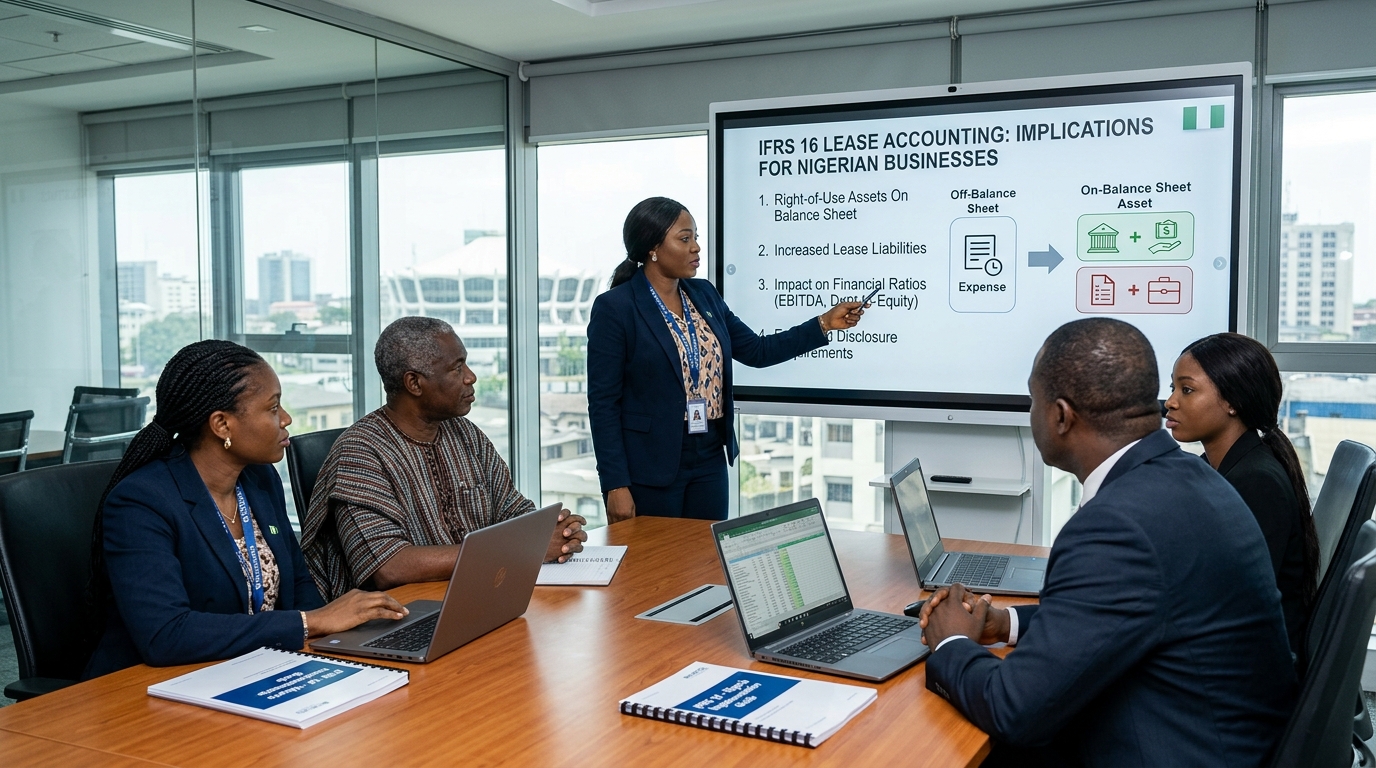
IFRS 16 Lease Accounting: What Nigerian Businesses Must Know
Leases used to be easy to hide. Not anymore.
Under the old rules, you could sign a 10-year office lease and keep it off your balance sheet. Just a rental expense on the income statement. Your debt looked lower than it really was.
IFRS 16 changed all that. Now, most leases go straight onto the balance sheet.
If your business leases property, vehicles, or equipment, you need to understand this standard. Let me break it down for you.

What is IFRS 16 and why does it matter?
Here is the simple version.
The standard eliminated the distinction between operating and finance leases for lessees. Most leases now go on the balance sheet. No more hiding.
Nigeria adopted IFRS for publicly listed companies and significant public interest entities in 2012. IFRS 16 became effective from January 1, 2019. The Financial Reporting Council of Nigeria mandates compliance.
Access our IFRS compliance advisory services to ensure your lease accounting meets regulatory requirements.
Key changes from IAS 17 to IFRS 16
The old approach under IAS 17.
Businesses classified leases as either operating or financing. Operating leases were treated as rental expenses with no balance sheet recognition. Finance leases were recognised as assets and liabilities. This dual classification allowed companies to keep significant lease obligations off the balance sheet.
The new reality under IFRS 16.
IFRS 16 introduces a single lessee accounting model. You must recognise right-of-use assets representing the right to use the leased item. You must record lease liabilities showing the obligation to make lease payments. Only short-term leases of 12 months or less and low-value assets qualify for exemption. Depreciate the right-of-use asset systematically. Recognise interest expense on the lease liability.
Which Nigerian sectors are most affected?
Nigerian companies in retail, telecommunications, aviation, and logistics are particularly affected. They have extensive lease portfolios for stores, base stations, aircraft, and vehicles.

Core components of IFRS 16 lease accounting
Lease identification
Not every contract is a lease under IFRS 16. You must assess whether a contract conveys the right to control the use of an identified asset for a period of time in exchange for consideration.
Ask three questions:
-
Is there an identified asset?
-
Does the customer have the right to obtain substantially all economic benefits?
-
Does the customer have the right to direct how and for what purpose the asset is used?
Common Nigerian examples include:
-
Office space rental in Lagos, Abuja, or Port Harcourt
-
Vehicle fleet leases for company operations
-
Equipment rentals for manufacturing or construction
-
Telecommunications tower lease agreements
-
Data centre capacity agreements
Initial measurement
At lease commencement, you must measure the right-of-use asset and the lease liability.
The right-of-use asset includes:
-
The initial lease liability amount
-
Lease payments made at or before commencement
-
Initial direct costs incurred
-
Estimated costs of dismantling or restoring the asset
The lease liability includes:
-
Fixed lease payments less incentives receivable
-
Variable payments based on an index or rate
-
Amounts expected to be payable under residual value guarantees
-
Exercise price of purchase options if reasonably certain to exercise
-
Termination penalty payments if reasonably certain to terminate
Subsequent measurement
The right-of-use asset is depreciated using the straight-line method over the shorter of the asset’s useful life or lease term. It is subject to impairment testing under IAS 36.
The lease liability is increased by interest expense using the effective interest method. It is reduced by lease payments made. It is remeasured when there are changes in future lease payments, lease term, or purchase option assessment.
Lease term determination
The lease term includes the non-cancellable period, periods covered by extension options if reasonably certain to exercise, and periods covered by termination options if reasonably certain not to exercise.
Factors to consider in the Nigerian context include:
-
Economic incentives like leasehold improvements and relocation costs
-
Business strategy and long-term plans
-
Market conditions and availability of alternative properties
-
Termination penalties and their significance
-
Historical exercise patterns

Exemptions available to Nigerian businesses
Short-term leases
Leases with a term of 12 months or less from the commencement date, with no purchase option, qualify for the short-term lease exemption.
Nigerian applications include:
-
Temporary warehouse rentals during peak seasons
-
Short-term equipment hires for specific projects
-
Seasonal retail space during festivals like Christmas and Sallah
-
Conference room or event space rentals
Accounting treatment: Recognise lease payments as an expense on a straight-line basis.
Low-value asset leases
Common examples in Nigeria include:
-
Office furniture like individual desks and chairs
-
Laptops and tablets
-
Mobile phones
-
Small office equipment like printers and scanners
-
IT peripherals
This exemption is assessed on a per-asset basis, not on a portfolio basis.
Impact on Nigerian financial statements
Balance sheet impact
Assets increase due to the recognition of right-of-use assets. The impact is typically largest in the year of adoption. New additions occur as new leases commence.
Liabilities increase as lease liabilities equal the present value of future payments. Current and non-current classification is required. There is a potential impact on debt covenants and loan agreements.
Real Nigerian example: A retail chain with 50 store leases averaging ₦5 million annual rent over 5-year terms could recognise approximately ₦200 to ₦250 million in additional assets and liabilities.
Income statement impact
Operating expenses decrease as lease rental expenses are eliminated. They are replaced by depreciation and interest.
Depreciation expense increases as right-of-use asset depreciation is recognised on a straight-line basis. Interest expense increases as interest on the lease liability is calculated using the effective interest method, creating a front-loaded expense pattern higher in early years.
Net impact: Total expense over the lease term remains the same, but timing and classification change. EBITDA and other key metrics are affected.
Cash flow statement impact
Operating cash flows improve because lease payments are no longer classified as operating activities except for short-term and low-value leases. Better operating cash flow metrics result.
Financing cash flows decrease as the principal portion of lease payments is classified as financing activities. The interest portion may be classified as operating or financing depending on accounting policy choice.
Tax implications in Nigeria
Companies’ Income Tax
Lessees can:
-
Claim capital allowances on qualifying leased assets
-
Deduct operating lease rentals for tax purposes
-
Deduct interest expense on finance leases
-
Note that depreciation on right-of-use assets may not be tax-deductible
Value Added Tax
-
Lease of commercial properties is VAT exempt
-
Equipment and vehicle leases are subject to 7.5% VAT
-
Input VAT recovery depends on the nature of business use
-
Lease classification affects VAT treatment
Withholding Tax
-
10% WHT applies to rent payments for Nigerian landlords
-
5% WHT applies to rent on equipment
-
2.5% WHT applies to foreign rent payments
-
Proper documentation is required for WHT credit claims
Consult with tax advisors to develop tax-efficient lease structures and ensure proper documentation.
Our tax advisory services can help you navigate the complex tax implications of IFRS 16.
Practical implementation steps
Step one: Lease inventory and data collection
Compile a complete inventory of all lease contracts. Gather historical lease agreements from various departments. Identify embedded leases in service contracts. Document lease terms, payment schedules, and options. Centralise lease data in a single repository.
Nigerian challenges include:
-
Leases managed across multiple locations and departments
-
Paper-based contracts without digital records
-
Informal lease arrangements lacking proper documentation
-
Multiple currencies, including Naira and foreign currency leases
Step two: Accounting policy decisions
Choose practical expedients, including:
-
Use of a portfolio approach for similar leases
-
Hindsight application for lease term and impairment
-
Exclusion of initial direct costs from right-of-use asset measurement
-
Application of a single discount rate to a portfolio
Make presentation decisions, including:
-
Right-of-use asset presentation as a separate line or within property, plant and equipment
-
Interest classification in the cash flow statement as operating or financing
Step three: Systems and technology
Requirements include:
-
Lease accounting software capable of IFRS 16 calculations
-
Integration with existing ERP systems like SAP, Oracle, or Microsoft Dynamics
-
Data validation and reconciliation tools
-
Reporting capabilities for financial statements and disclosures
Available solutions for Nigerian businesses include:
-
Cloud-based lease management platforms
-
Excel-based calculation tools for smaller portfolios
-
Big 4 accounting firm proprietary software
-
Local Nigerian fintech lease management solutions
Step four: Discount rate determination
Use the interest rate implicit in the lease if readily determinable. Use the lessee’s incremental borrowing rate if the implicit rate is not available.
Nigerian considerations include:
-
High interest rate environment with CBN monetary policy rate
-
Currency of the lease in Naira versus foreign currency
-
Lease term alignment with borrowing term
-
Credit risk and collateral considerations
-
Consultation with banks and financial advisors
Typical Nigerian incremental borrowing rates currently range from 15% to 30%, depending on company creditworthiness and lease term.
Step five: Training and change management
Key stakeholders to train include:
-
Finance and accounting teams
-
Procurement and facilities management
-
Legal and contracts personnel
-
Senior management and board members
-
External auditors
Training topics include:
-
IFRS 16 principles and requirements
-
System usage and data entry
-
Contract review and lease identification
-
Financial impact analysis
-
Disclosure requirements
Our capacity building services can provide the training your team needs for successful IFRS 16 implementation.

Common challenges and solutions
Incomplete lease data
Problem: Many Nigerian companies lack centralised lease records. Agreements are scattered across departments and locations.
Solution: Conduct a comprehensive organisation-wide lease inventory. Engage internal audit to identify all lease arrangements. Review procurement records and payment histories. Contact landlords and lessors for missing documentation. Establish a centralised lease management function.
Determining discount rates
Problem: Nigerian companies struggle to determine appropriate incremental borrowing rates in a high-interest, volatile environment.
Solution: Consult with relationship banks on indicative borrowing rates. Consider lease term and currency alignment. Document methodology and assumptions clearly. Apply a portfolio approach where appropriate. Review and update rates periodically.
Foreign currency leases
Problem: Naira volatility creates measurement challenges for USD, EUR, and GBP-denominated leases.
Solution: Determine the lease currency at inception. Remeasure lease liabilities at each reporting date using the spot exchange rate. Recognise foreign exchange gains and losses in profit or loss. Consider natural hedging strategies. Document foreign exchange accounting policies.
Embedded leases
Problem: Identifying leases embedded in service contracts, outsourcing agreements, and supply arrangements.
Solution: Review all significant service contracts. Assess whether contracts contain identified assets. Evaluate control over asset use. Separate lease and non-lease components. Document conclusions with supporting analysis.
Technology limitations
Problem: Existing accounting systems may not support IFRS 16 calculations and reporting.
Solution: Evaluate lease accounting software options. Consider cloud-based solutions for scalability. Ensure integration with existing ERP systems. Implement robust data validation controls. Train finance teams on new systems.
At Stonehill Research , we help businesses overcome these implementation challenges with practical, tailored solutions.
Disclosure requirements
Quantitative disclosures
Balance sheet disclosures include:
-
Carrying amounts of right-of-use assets by class
-
Additions to right-of-use assets
-
Depreciation charge for right-of-use assets
-
Lease liabilities by maturity analysis
Income statement disclosures include:
-
Depreciation of right-of-use assets
-
Interest expense on lease liabilities
-
Expense for short-term leases
-
Expense for low-value asset leases
-
Variable lease payments not included in lease liability
Cash flow statement disclosures include:
-
Total cash outflow for leases
Other required information includes:
-
Maturity analysis of lease liabilities
-
Potential future cash outflows for extension and termination options not included
-
Residual value guarantees
-
Leases not yet commenced with significant commitments
Qualitative disclosures
Nigerian businesses must also disclose:
-
Lease accounting policies and judgments
-
The nature of leasing activities
-
Variable lease payment arrangements
-
Extension and termination options
-
Restrictions or covenants imposed by leases
-
Sale and leaseback transactions
Best practices for Nigerian businesses
Establish a lease governance framework. Centralise lease management under a dedicated function. Implement approval hierarchies for new leases. Conduct quarterly lease portfolio reviews. Maintain a comprehensive lease database. Monitor compliance with accounting policies.
Invest in technology. Deploy fit-for-purpose lease accounting software. Ensure system integration with ERP. Implement automated controls and validations. Enable self-service reporting capabilities. Plan for scalability as your lease portfolio grows.
Build internal capabilities. Develop IFRS 16 expertise within your finance team. Cross-train procurement and legal personnel. Establish knowledge-sharing forums. Subscribe to technical updates and guidance. Participate in industry working groups.
Maintain strong documentation. Keep complete lease contract files. Document all accounting judgments and estimates. Prepare detailed calculation workpapers. Maintain audit trails for all adjustments. Archive historical lease information.
Communicate proactively. Brief the board and audit committee regularly. Educate investors and lenders on IFRS 16 impact. Align with external auditors early. Coordinate with tax advisors. Engage stakeholders throughout implementation.
Where to start tomorrow
Do not wait for your year-end audit to address IFRS 16.
Start with a lease inventory. Find every lease agreement across your organisation. Centralise them in one place.
Assess your data gaps. Which leases have complete information? Which are missing key terms?
Choose your discount rate. Consult your bank for indicative borrowing rates. Document your methodology.
Select your tools. Evaluate lease accounting software. Even Excel can work for small portfolios at the beginning.
Train your team. Make sure finance, procurement, and legal understand the requirements.
Talk to your auditor. Get early alignment on your approach. Prevent surprises at year end.
Frequently Asked Questions
Q1: What is IFRS 16?
A: IFRS 16 is an International Financial Reporting Standard that requires lessees to recognise assets and liabilities for most leases. It eliminated the distinction between operating and finance leases, bringing most leases onto the balance sheet.
Q2: When did IFRS 16 become effective in Nigeria?
A: IFRS 16 became effective from January 1, 2019. Nigeria adopted IFRS for publicly listed companies and significant public interest entities in 2012, and the Financial Reporting Council of Nigeria mandates compliance.
Q3: What are the exemptions under IFRS 16?
A: Two main exemptions exist: short-term leases (12 months or less with no purchase option) and low-value asset leases (assets worth approximately USD 5,000 or less when new). These can continue to be treated as rental expenses.
Q4: How does IFRS 16 affect Nigerian financial statements?
A: Balance sheets show increased assets (right-of-use assets) and liabilities (lease liabilities). Income statements show depreciation and interest expense instead of rental expense. Cash flow statements show improved operating cash flows and reduced financing cash flows.
Q5: What discount rate should Nigerian companies use?
A: Use the interest rate implicit in the lease if readily determinable. Otherwise, use the incremental borrowing rate. Nigerian incremental borrowing rates typically range from 15% to 30%, depending on company creditworthiness and lease term.
Q6: How does IFRS 16 affect Nigerian taxes?
A: IFRS 16 affects accounting profits but may not directly affect taxable profits. FIRS follows capital allowances rules. Operating lease rentals remain deductible for tax purposes. Interest expense on finance leases is tax-deductible. Consult a tax advisor for specific guidance.
Q7: How can Stonehill Research help with IFRS 16?
A: Stonehill Research provides lease inventory and assessment, accounting policy development, discount rate determination, system implementation support, financial impact analysis, staff training, disclosure preparation, and ongoing compliance support.
The Bottom Line
IFRS 16 changed the game. No more hiding leases off the balance sheet.
For Nigerian businesses with significant lease portfolios, the impact is real. Balance sheets get bigger. Financial ratios change. EBITDA improves. Interest expense increases.
But compliance is not optional. The Financial Reporting Council mandates IFRS 16. Investors and lenders expect it.
Get your lease inventory right. Choose appropriate discount rates. Implement proper systems. Train your people.
The businesses that embrace IFRS 16 proactively will have better lease management, more transparent financial statements, and stronger stakeholder confidence.
Start now.
About Stonehill Research
Stonehill Research specialises in helping Nigerian businesses achieve full compliance with International Financial Reporting Standards, including comprehensive IFRS 16 implementation support.
Our IFRS 16 Services Include:
-
Lease Inventory and Assessment – Comprehensive identification of all lease arrangements across your organisation
-
Accounting Policy Development – Customised IFRS 16 policies tailored to your business needs
-
Discount Rate Determination – Expert calculation of incremental borrowing rates aligned with Nigerian market conditions
-
System Implementation Support – Assistance in selecting and configuring lease accounting software
-
Financial Impact Analysis – Detailed modelling of balance sheet, income statement, and cash flow effects
-
Staff Training and Capacity Building – Practical workshops for finance, procurement, and legal teams
-
Disclosure Preparation – Comprehensive note preparation meeting all IFRS 16 requirements
-
Ongoing Compliance Support – Regular reviews and updates to maintain compliance
Why Choose Stonehill Research?
-
Deep Nigerian Market Expertise – We understand the unique challenges facing Nigerian businesses
-
Technical Excellence – Our team includes IFRS-certified professionals with Big 4 experience
-
Practical Approach – We focus on implementable solutions, not just theoretical compliance
-
Technology Enabled – We leverage the latest lease accounting software and tools
-
End-to-End Support – From initial assessment through ongoing compliance and beyond
Let’s Work Together
Don’t let IFRS 16 complexity hold your business back. Contact our expert team today for a complimentary consultation to discuss your lease accounting needs and how we can support your compliance journey.
Contact us today:
📧 Email: info@stonehillresearch.com
📞 Phone: +234 802 320 0801
📍 Address: 5, Ishola Bello Close, Off Iyalla Street, Alausa, Ikeja, Lagos, Nigeria
Contact us today to schedule your free IFRS 16 assessment.
Take the first step toward IFRS 16 compliance excellence. Reach out to Stonehill Research today.
Recommended reading from the Stonehill Research blog
-
Audit Exemptions for Small Companies in Nigeria: Who Qualifies in 2026? – Understanding financial reporting requirements for smaller entities
-
Filing Annual Returns with CAC: Deadlines and Penalties Every Nigerian Company Must Know – Corporate compliance beyond lease accounting
-
Corporate Governance: Why Every Nigerian Company Needs It – Board oversight of financial reporting and lease obligations
Related services from Stonehill Research
-
IFRS Compliance Advisory – Full suite of IFRS implementation and compliance services
-
Tax Advisory Services – Navigating the tax implications of lease accounting
-
Audit and Assurance Services – Independent verification of your IFRS 16 compliance
-
Capacity Building – Training your team on IFRS 16 requirements
-
Financial Reporting Advisory – Disclosure preparation and review
References
-
International Financial Reporting Standards Foundation. “IFRS 16 Leases.”
-
Institute of Chartered Accountants of Nigeria. “IFRS 16 Implementation Guide for Nigerian Businesses.”
-
Deloitte. “IFRS 16 Leases: A Guide to the New Standard.”
-
PwC Nigeria. “Navigating IFRS 16: Practical Implementation Challenges.”
-
Federal Inland Revenue Service. “Tax Treatment of Lease Transactions under IFRS 16.”
-
Ernst & Young. “Leases: A Project to Consider Now.”
-
KPMG. “IFRS 16: The Leases Standard.”
-
Grant Thornton Nigeria. “IFRS 16 Handbook: Nigerian Perspective.”
-
Financial Reporting Council of Nigeria. “Nigerian Code of Corporate Governance 2018.”
-
Central Bank of Nigeria. “Prudential Guidelines for Deposit Money Banks in Nigeria.”
There are no comments