

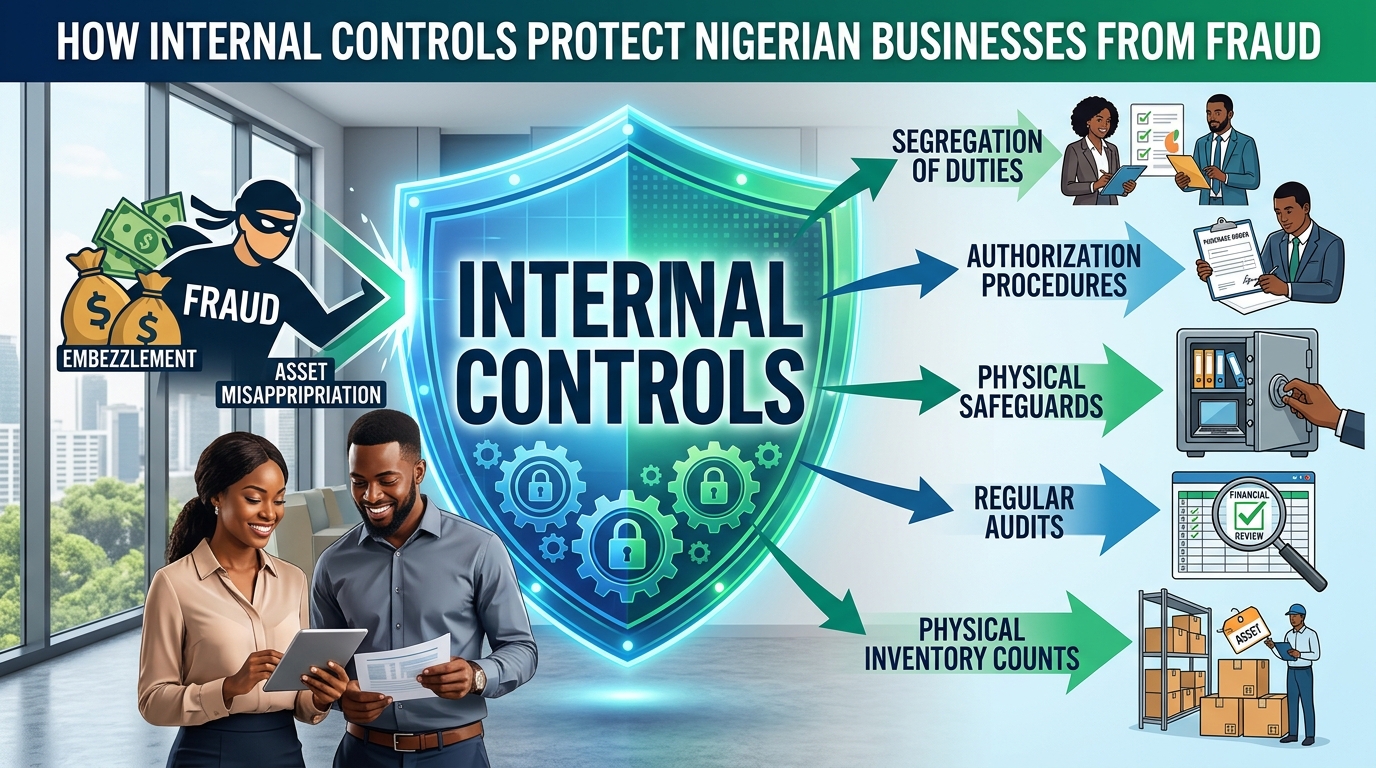
How Internal Controls Protect Nigerian Businesses from Fraud
Fraud destroys businesses quietly. Then suddenly.
A trusted employee steals small amounts over the years. A procurement officer colludes with a fake vendor. A finance manager diverts customer payments.
By the time you notice, millions are gone.
Internal controls are your first line of defence. They prevent fraud before it happens. They detect problems early when they do occur. They protect your assets, your reputation, and your future.
Let me explain what internal controls are, why they matter for Nigerian businesses, and how to build a system that actually works.
Access our internal control advisory services to start building your fraud defence today.

What are internal controls?
Here is the simple version.
Internal controls are the systems, policies, and procedures you put in place to protect your business. They safeguard assets from theft. They ensure financial information is accurate. They promote operational efficiency. They keep you compliant with laws and regulations.
Why internal controls matter in Nigeria
The Nigerian business environment presents unique challenges that make strong controls critical.
Fraud prevalence is high. Nigerian businesses report higher-than-average fraud incidents compared to global benchmarks. Prevention is essential.
Regulatory bodies, including FRCN, CBN, SEC, and CAC mandate internal controls for various entity types. Compliance is not optional.
Investors look for strong controls. They signal professional management and financial integrity. In Nigeria’s competitive landscape, this matters.

Our fraud risk assessment services can help you understand your specific vulnerabilities.
The COSO internal control framework
The COSO framework is the global standard for internal controls. It has five components that must work together.
Component one: Control environment
This sets the tone of your organisation. It influences the control consciousness of everyone.
Key elements include leadership commitment to integrity and ethical values. Board oversight. Management philosophy. Organisational structure. Accountability mechanisms.
In Nigerian businesses, the control environment is often the weakest component. Pressure for results sometimes overrides ethical considerations. Strengthening tone at the top is critical.
Source: COSO. “Internal Control – Integrated Framework.” [3]
Component two: Risk assessment
You cannot control risks you have not identified.
Organisations must identify and analyse risks to achieving objectives. Specify clear objectives at different levels. Identify internal and external risks. Assess likelihood and impact. Determine risk responses. Consider fraud risk specifically.
Nigerian businesses face unique risks. Foreign exchange volatility. Regulatory changes. Infrastructure challenges. Cybersecurity threats. Systematic assessment and response is essential.
Component three: Control activities
These are the actions established through policies and procedures. They ensure management directives are carried out.
Key activities include authorisation and approval procedures. Segregation of duties preventing single-person control. Physical controls over assets. Reconciliations and reviews. Information processing controls. Performance reviews.
Small Nigerian businesses often struggle with segregation of duties due to limited personnel. Compensating controls and enhanced oversight become essential.
Component four: Information and communication
Pertinent information must be captured and communicated in a timeframe that enables people to carry out their responsibilities.
Quality information must support control functioning. Internal communication channels must enable information flow. External communication with stakeholders must be effective. Technology must support information processing.
Nigerian businesses increasingly leverage technology for information management. But the digital divide creates capability gaps across different company sizes and sectors.
Component five: Monitoring activities
Internal control systems must be monitored through ongoing evaluations and periodic assessments. Deficiencies must be communicated to responsible parties.
Ongoing monitoring is built into business processes. Periodic separate evaluations include internal audits and management reviews. Control deficiencies must be reported to appropriate levels. Corrective action must follow.
Effective Nigerian organisations combine internal audit functions with management self-assessment. This creates a comprehensive monitoring approach.
Our internal audit services can help you establish effective monitoring activities.
Common fraud schemes targeting Nigerian businesses
Understanding prevalent fraud types helps you design controls that address specific threats.
Asset misappropriation
This is theft or misuse of organisational assets. It is the most common fraud category.
Cash theft includes skimming (theft before recording), larceny (theft after recording), fraudulent disbursements through fake vendors, and payroll fraud including ghost employees.
Cash-intensive businesses like retail, hospitality, and transportation face heightened risk. Limited banking penetration in some areas necessitates cash handling requiring strong controls.
Prevention controls include segregation of cash handling, recording, and reconciliation duties. Surprise cash counts. Dual authorisation for disbursements. Vendor verification. Automated payroll with independent checks.
Inventory theft includes physical theft by employees or customers. False shipping documents diverting goods. Purchase fraud involving kickbacks. Inventory write-offs concealing theft.
Prevention controls include physical security with locks, surveillance, and access controls. Perpetual inventory systems with cycle counting. Segregation between purchasing, receiving, and inventory custody. Vendor relationship monitoring.
Financial statement fraud
This involves intentional misstatement or omission of information to deceive users.
Revenue manipulation includes recording fictitious sales, premature revenue recognition, concealing sales returns, and round tripping. Pressure to meet budget targets or secure financing can motivate manipulation.
Prevention controls include segregation between sales, shipping, and accounting functions. Management review of unusual transactions. Revenue recognition policies. Independent verification of significant transactions.
Expense and liability manipulation includes understating expenses, capitalising costs that should be expensed, omitting liabilities, and manipulating reserves. These schemes often involve management override of controls.
Prevention controls include clear policies on capitalisation versus expense treatment. Independent review of significant judgments. Audit committee oversight. Whistleblower mechanisms.
Corruption and bribery
These schemes involve employees using influence for unauthorised personal benefit.
Vendor fraud and kickbacks happen when purchasing employees receive payments from suppliers. Bid rigging favours particular vendors. Inflated invoicing includes rebates to employees. Shell companies owned by employees win contracts.
Nigerian challenge: corruption perception and some cultural acceptance create environments where kickback schemes can flourish without strong controls and ethical leadership.
Prevention controls include vendor prequalification and approval processes. Competitive bidding for significant purchases. Rotation of purchasing personnel. Conflict of interest disclosures. Vendor relationship analytics. Anonymous reporting hotlines.
Business email compromise
Fraudsters impersonate executives requesting urgent wire transfers. They compromise vendor email accounts to redirect payments. They divert payroll through fraudulent email requests.
BEC schemes have caused significant losses to Nigerian businesses. Fraudsters often impersonate executives travelling abroad or unavailable.
Prevention controls include multi-factor authentication for email access. Verbal verification for payment requests, especially urgent ones. Digital signatures. Employee training on social engineering tactics. Banking controls requiring multiple approvals for wire transfers.
Designing effective internal controls
Implementing controls requires a systematic approach considering your business size, industry, and specific risk profile.
Use a risk-based approach
Design controls that address your most significant risks. Do not implement generic controls without regard to actual threats.
Identify key business processes and objectives. Assess inherent risks to each. Prioritise risks based on likelihood and impact. Design controls addressing priority risks. Allocate resources proportionate to risk significance.
For Nigerian businesses, resource constraints make risk-based prioritisation essential. Focus limited control resources where they provide greatest risk reduction.
Segregate duties properly
Separate incompatible functions so no single person controls transactions from inception through recording and asset custody.
Key segregations include authorisation versus execution. Custody versus record keeping. Execution versus review. IT system access versus data entry.
Small businesses face challenges with complete segregation. Compensating controls include enhanced management oversight, mandatory vacations that reveal schemes, and rotation of responsibilities.
Require appropriate authorisation
Ensure transactions and activities receive proper authorisation based on established criteria and authority levels.
Create clear authorisation matrices defining who can approve what. Require documented approval evidence. Set authorisation limits appropriate to roles and risk levels. Require special authorisation for unusual or high-risk transactions. Review authorisation privileges periodically.
Written authorisation policies prevent confusion and provide evidence for audits and investigations.
Document everything
Maintain adequate documentation supporting transactions, controls, and business activities.
Use pre-numbered forms preventing omissions. Record transactions promptly. Keep supporting documentation for all significant transactions. Follow retention policies complying with regulatory requirements. Store securely preventing loss or alteration.
Electronic documentation systems improve efficiency but require appropriate access controls and backup procedures.
Implement physical safeguards
Protect physical assets through appropriate security measures.
Use locks, safes, and secure storage areas. Install access control systems limiting facility access. Use surveillance cameras monitoring high-risk areas. Keep inventory in locked warehouses. Secure IT equipment in locked server rooms. Escort and log visitors.
Verify independently
Implement checking and review procedures that provide independent verification of accuracy and compliance.
Perform reconciliations of accounts and records. Conduct management review of reports and exception listings. Use internal and external audit examinations. Perform surprise counts of cash and inventory. Use system-generated exception reports.
Review performance regularly
Regular analysis of business performance can identify control failures or irregularities.
Use budget versus actual variance analysis. Review trend analysis identifying unusual patterns. Perform ratio analysis highlighting anomalies. Benchmark against industry standards. Monitor key performance indicators.
Our audit and assurance services can provide the independent verification your controls need.
Implementation strategies by business size
Different organisation sizes face different control challenges requiring tailored approaches.
Micro and small businesses
Limited resources make extensive controls difficult. Segregating duties is hard with small staff. But controls are still essential.
Appropriate controls include: owner oversight and review of key transactions. Mandatory vacations for employees handling cash or assets. External accountant or bookkeeper providing independent review. Simple reconciliation procedures. Basic authorisation requirements. Physical safeguards for cash and inventory. Cloud accounting software with access controls.
Priority focus should be cash controls, basic segregation where possible, and owner involvement in oversight.
Medium businesses
Sufficient staff enables meaningful segregation. Resources exist for dedicated finance functions. More sophisticated controls become feasible.
Appropriate controls include: formal authorisation policies with delegated authorities. Segregation of duties across critical functions. Regular reconciliations and reviews. Internal audit program (in-house or outsourced). Written policies and procedures. IT access controls and system logs. Management review of performance analytics.
Priority focus is establishing formal control structure with documentation, segregation, and monitoring.
Large businesses and enterprises
Dedicated internal audit, compliance, and risk management functions exist. Sophisticated IT systems have embedded controls. Multiple layers of review and authorisation operate. Board audit committee provides oversight.
Appropriate controls include: enterprise-wide control framework. Risk-based internal audit program. Automated controls embedded in systems. Continuous monitoring and exception reporting. Regular control self-assessment programs. Whistleblower hotlines and investigation procedures. Comprehensive policies covering all business areas. Board and audit committee oversight.
Priority focus is maintaining control effectiveness as the organisation grows and preventing control gaps.
Technology’s role in modern internal controls
Technology transforms both control capabilities and the control environment itself.
Automated controls embedded in systems
Modern business systems incorporate controls directly into software applications.
Preventive automated controls include system-enforced segregation of duties through role-based access. Required field validations preventing incomplete data entry. Range checks rejecting out-of-bounds values. Automated matching of purchase orders, receipts, and invoices. Approval workflows routing transactions to appropriate authorities. Duplicate payment prevention algorithms.
Detective automated controls include exception reports highlighting unusual transactions. Automated reconciliations identifying discrepancies. Analytics identifying statistical anomalies. Trend analysis reports. System access logs and audit trails. Failed login attempt monitoring.
The advantages are consistency, efficiency, completeness, and real-time operation. But system configurations must be correct. Change management is critical. IT general controls are essential.
Data analytics for fraud detection
Advanced analytics identify fraud indicators in large datasets.
Continuous monitoring analyses 100% of transactions rather than samples. Real-time alerting flags suspicious activities. Pattern recognition works across multiple data sources. Benchmarking compares against normal behaviour baselines.
Common analytical techniques include Benford’s Law analysis detecting manipulation. Duplicate payment detection. Vendor master file analysis identifying suspicious vendors. Journal entry testing for unusual characteristics. Employee expense analysis. Inventory shrinkage analysis by location.
As Nigerian businesses adopt ERP systems and business intelligence tools, analytical controls become increasingly feasible even for mid-sized companies.
Cybersecurity controls
Protecting information systems is now fundamental to internal control.
Access controls include user authentication through passwords, biometrics, and multi-factor authentication. Authorisation through role-based permissions. Account management for provisioning, de-provisioning, and review.
Network security includes firewalls blocking unauthorised access. Intrusion detection and prevention systems. Virtual private networks for remote access. Network segmentation isolating sensitive systems.
Data protection includes encryption of sensitive data at rest and in transit. Data loss prevention technologies. Backup and recovery procedures. Secure disposal of data and equipment.
Operational security includes patch management keeping systems updated. Antivirus and anti-malware software. Security monitoring and logging. Incident response procedures.
At Stonehill Research , we help businesses implement technology-enabled controls that work.
Monitoring and testing internal controls
Controls are only effective if they function properly and consistently. Monitoring and testing verify effectiveness.
Ongoing monitoring activities
Continuous processes provide real-time or near real-time feedback on control effectiveness.
Management reviews include regular review of financial statements and operational reports. Variance analysis explaining significant deviations. Performance indicator monitoring. Exception report review and follow-up.
Reconciliations include bank reconciliations daily, weekly, or monthly. Intercompany account reconciliations. General ledger to subsidiary ledger reconciliations. Inventory perpetual to physical reconciliations.
Supervisory reviews include manager approval of subordinate work. Second-person review of critical activities. Random transaction sampling and verification.
Periodic separate evaluations
Focused assessments conducted periodically rather than continuously.
Internal audit uses risk-based audit plans addressing high-risk areas. Detailed testing of control design and operating effectiveness. Written reports with findings and recommendations. Management action plans for remediation. Follow-up audits verifying implementation.
Self-assessment programs have management completing control questionnaires. Process owners documenting and evaluating controls. Certifications regarding control effectiveness. Independent review of self-assessments.
External audit includes statutory audits testing controls relevant to financial reporting. Management letters communicating control deficiencies. Specialised compliance audits for tax and regulatory matters.

Building a strong control culture
Controls are most effective when supported by organisational culture that emphasises integrity and compliance.
Tone at the top
Leadership behaviour sets expectations for the entire organisation.
Board and executive commitment includes explicit endorsement of control importance. Demonstration of ethical behaviour. Zero tolerance for control violations. Resources allocated to control infrastructure. Control effectiveness included in executive objectives.
Communication strategies include regular leadership messages emphasising control and compliance. Stories highlighting positive control behaviours. Consequences communicated when controls are violated. Town halls addressing control culture directly.
Code of conduct and ethics
Written standards define expected behaviours.
Content includes core organisational values. Specific prohibited behaviours. Guidance on common ethical dilemmas. Resources for seeking advice. Reporting mechanisms for violations. Protection for those reporting in good faith.
Implementation includes distribution to all employees. Acknowledgment required upon hire and annually. Training on code provisions. Reinforcement in performance management. Consistent enforcement regardless of seniority.
Training and awareness
Effective controls require employees understanding their responsibilities.
Onboarding training covers control environment and expectations. Specific control procedures relevant to the role. How to identify and report concerns. Consequences of control violations.
Ongoing training includes annual refresher on code of conduct. Updates when controls or policies change. Fraud awareness and red flag identification. Industry-specific risks and controls. Technology security awareness.
Whistleblower mechanisms
Channels enabling employees to report concerns without fear of retaliation.
Hotline services include independent third-party providers. Multiple reporting channels through phone, web, and email. Anonymous reporting option. 24/7 availability.
Investigation protocols include prompt investigation of all reported concerns. Confidentiality maintained to extent possible. Documented investigation process and findings. Corrective action when warranted.
Anti-retaliation policies include explicit prohibition on retaliation. Multiple reporting avenues if retaliation occurs. Consequences for those who retaliate. Protection for good-faith reporters.
In Nigeria, the Whistleblower Protection Act provides a legal framework. But cultural factors may inhibit reporting. Organisations must work to create a safe environment for speaking up.
Source: Whistleblower Protection Act. Federal Republic of Nigeria. [5]
Our capacity building services can help you train your team on fraud awareness and control responsibilities.
Common internal control mistakes to avoid
Frequent pitfalls weaken control effectiveness.
Mistake one: Focusing only on detective controls. Overreliance on controls that detect problems after they occur. Prevention is more cost-effective than detection and correction. Balance detective controls with preventive controls.
Mistake two: Implementing controls without risk assessment. Generic controls without assessing actual business risks. Resources wasted on low-risk areas. High-risk areas remain under-controlled. Begin with thorough risk assessment.
Mistake three: Over-controlling low-risk areas. Elaborate controls for immaterial or low-risk activities. Reduced efficiency and employee frustration. Resources diverted from high-risk areas. Apply cost-benefit analysis. Implement simple controls for low-risk areas.
Mistake four: Allowing management override. Managers bypass controls without adequate justification or monitoring. Controls rendered ineffective. Require documented justification. Monitor overrides through exception reporting. Provide audit committee oversight.
Mistake five: Neglecting IT general controls. Focusing only on application controls while ignoring IT infrastructure. Application controls circumvented through system access. Implement comprehensive IT general controls. Regular IT control assessments.
Mistake six: Failing to update controls. Static controls despite business, technology, or risk changes. Controls become obsolete. Regular control effectiveness reviews. Update when business changes.
Mistake seven: Documentation gaps. Poorly documented controls difficult to understand and test. Inconsistent application. Comprehensive policies and procedures. Regular documentation updates.
Mistake eight: Ignoring small frauds. Dismissing small frauds as immaterial without investigation. Culture develops where small frauds are acceptable. Control weaknesses enabling small frauds enable larger ones. Investigate all fraud regardless of amount. Communicate zero tolerance.
Source: Institute of Internal Auditors (IIA). “International Standards for the Professional Practice of Internal Auditing.”
Where to start tomorrow
Do not try to implement everything at once.
Assess your current state. Honestly evaluate your control environment. Identify strengths and gaps.
Prioritise based on risk. Focus first on areas with highest fraud risk and business impact.
Design appropriate controls. Implement controls proportionate to risks. Consider cost-benefit and operational impact.
Leverage technology. Use available technology to automate controls and enable monitoring.
Build control culture. Invest in leadership commitment, employee training, and ethical culture.
Monitor and test. Regularly verify controls operate effectively through management review and independent assessment.
Respond to deficiencies. When gaps are identified, implement corrective action promptly and thoroughly.
Seek expert guidance. Engage qualified professionals for objective assessment, technical expertise, and implementation support.
Frequently Asked Questions
Q1: What are internal controls according to COSO?
A: According to COSO, internal control is “a process, effected by an entity’s board of directors, management, and other personnel, designed to provide reasonable assurance regarding the achievement of objectives relating to operations, reporting, and compliance.”
Q2: What are the five components of the COSO internal control framework?
A: The five components are: Control Environment (tone at the top, ethical culture), Risk Assessment (identifying and analysing risks), Control Activities (policies and procedures), Information and Communication (quality data capture and sharing), and Monitoring Activities (ongoing evaluations and assessments).
Q3: What are the most common fraud schemes affecting Nigerian businesses?
A: The most common fraud schemes include asset misappropriation (cash theft, inventory theft), financial statement fraud (revenue manipulation, expense manipulation), corruption and bribery (vendor kickbacks, bid rigging), and business email compromise.
Q4: How can small businesses with limited staff implement effective controls?
A: Small businesses can implement owner oversight of key transactions, mandatory vacations for employees handling cash, external accountant independent review, basic reconciliation procedures, physical safeguards, and cloud accounting software with access controls.
Q5: What is the role of technology in internal controls?
A: Technology enables automated controls embedded in systems (preventive and detective), data analytics for fraud detection, cybersecurity controls for information protection, and continuous monitoring capabilities that analyse 100% of transactions rather than samples.
Q6: What are common internal control mistakes to avoid?
A: Common mistakes include focusing only on detective controls, implementing controls without risk assessment, over-controlling low-risk areas, allowing management override, neglecting IT general controls, failing to update controls, documentation gaps, and ignoring small frauds.
Q7: How can Stonehill Research help with internal controls?
A: Stonehill Research provides control environment assessment, control framework design and implementation, fraud risk assessment, internal audit services, technology and cybersecurity controls, anti-fraud programs, control monitoring and testing, regulatory compliance controls, and training and capacity building.
The Bottom Line
Internal controls are not bureaucratic obstacles. They are essential foundations for sustainable business success.
Fraud is real and costly. Nigerian businesses face significant threats from internal and external sources. Strong internal controls are your primary defence.
Controls support business objectives beyond fraud prevention. They promote operational efficiency, ensure reporting accuracy, support compliance, and enable stakeholder confidence.
Culture matters most. Technical controls alone are insufficient. Ethical culture, tone at the top, and organisational values determine whether controls function as intended.
Technology enables modern controls. Cloud systems, analytics, and automation make sophisticated controls accessible even to mid-sized Nigerian businesses.
Continuous improvement is required. Controls cannot be implemented once and forgotten. Business evolution, technology changes, and emerging threats demand continuous monitoring, testing, and updating.
Your business is too valuable to leave unprotected. Start building your control framework today.
About Stonehill Research
Stonehill Research provides comprehensive internal control advisory services helping Nigerian businesses build resilient control frameworks that prevent fraud, enhance efficiency, and support business objectives.
Our Internal Control Services include:
-
Control Environment Assessment – Comprehensive evaluation of existing internal controls, gap analysis, benchmarking, and risk-based prioritisation
-
Control Framework Design and Implementation – COSO framework implementation, custom control design, policies and procedures documentation
-
Fraud Risk Assessment – Identification of fraud schemes, vulnerability analysis, red flag documentation, fraud awareness training
-
Internal Audit Services – Risk-based audit planning, control testing, operational audits, compliance audits, management reporting
-
Technology and Cybersecurity Controls – IT general controls assessment, access control framework, cybersecurity risk assessment, data protection controls
-
Anti-Fraud Programs – Fraud prevention policy development, whistleblower hotline implementation, fraud investigation services
-
Control Monitoring and Testing – Control self-assessment programs, ongoing monitoring processes, periodic control testing, data analytics
-
Regulatory Compliance Controls – Controls addressing Nigerian regulatory requirements, industry-specific compliance frameworks, audit committee support
-
Training and Capacity Building – Internal control fundamentals training, fraud awareness programs, train-the-trainer programs
Why Choose Stonehill Research?
-
Nigerian Business Understanding – Deep familiarity with Nigerian business environment and common fraud schemes
-
Cross-Industry Experience – Proven expertise across banking, oil and gas, telecommunications, manufacturing, retail, and professional services
-
Practical Approach – Controls that work in real business environments, balancing protection with operational efficiency
-
Technology Leverage – Expertise in control automation, data analytics, and technology-enabled monitoring
-
Certified Professionals – Team includes Certified Internal Auditors, Certified Fraud Examiners, and Chartered Accountants
-
Proven Track Record – Successfully helped over 150 Nigerian organisations strengthen internal controls
-
Relationship-Based Service – Long-term partnership rather than one-time assessments
Let’s Work Together
Protect your business from fraud with expert internal control solutions. Build the control foundation your business needs.
Contact us today:
📧 Email: info@stonehillresearch.com
📞 Phone: +234 802 320 0801
📍 Address: 5, Ishola Bello Close, Off Iyalla Street, Alausa, Ikeja, Lagos, Nigeria
Contact us today to schedule your consultation.
Stonehill Research – Protecting Nigerian Businesses Through Control Excellence.
Recommended reading from the Stonehill Research blog
-
COSO Framework Explained for Nigerian Businesses: Simple Breakdown of Five Components – Understanding the internal control framework that prevents fraud
-
ICFR: The New Compliance Mandate in Nigeria – What Every CFO Must Know – Regulatory requirements for internal controls over financial reporting
-
How to Prepare for FIRS Audit in Nigeria: A Comprehensive Guide – How strong controls support audit readiness
Related services from Stonehill Research
-
Internal Control Advisory – COSO framework implementation and optimisation
-
Fraud Risk Assessment – Identifying and mitigating fraud vulnerabilities
-
Internal Audit Services – Independent testing of control effectiveness
-
Audit and Assurance Services – External verification of controls
-
Capacity Building – Training on internal controls and fraud awareness
References
-
Committee of Sponsoring Organizations of the Treadway Commission (COSO). “Guidance on Internal Control.”
-
Association of Certified Fraud Examiners (ACFE). “Report to the Nations: Global Study on Occupational Fraud and Abuse.”
-
COSO. “Internal Control – Integrated Framework.”
-
Economic and Financial Crimes Commission (EFCC). “Fraud Prevention Guidelines for Nigerian Businesses.”
-
Whistleblower Protection Act. Federal Republic of Nigeria.
-
Institute of Internal Auditors (IIA). “International Standards for the Professional Practice of Internal Auditing.”
-
Companies and Allied Matters Act (CAMA). Federal Republic of Nigeria.
-
Financial Reporting Council of Nigeria (FRCN). “Nigerian Code of Corporate Governance.”
-
Central Bank of Nigeria (CBN). “Corporate Governance Guidelines for Banks and Discount Houses.”
-
Nigerian Data Protection Act. Federal Republic of Nigeria.
There are no comments