

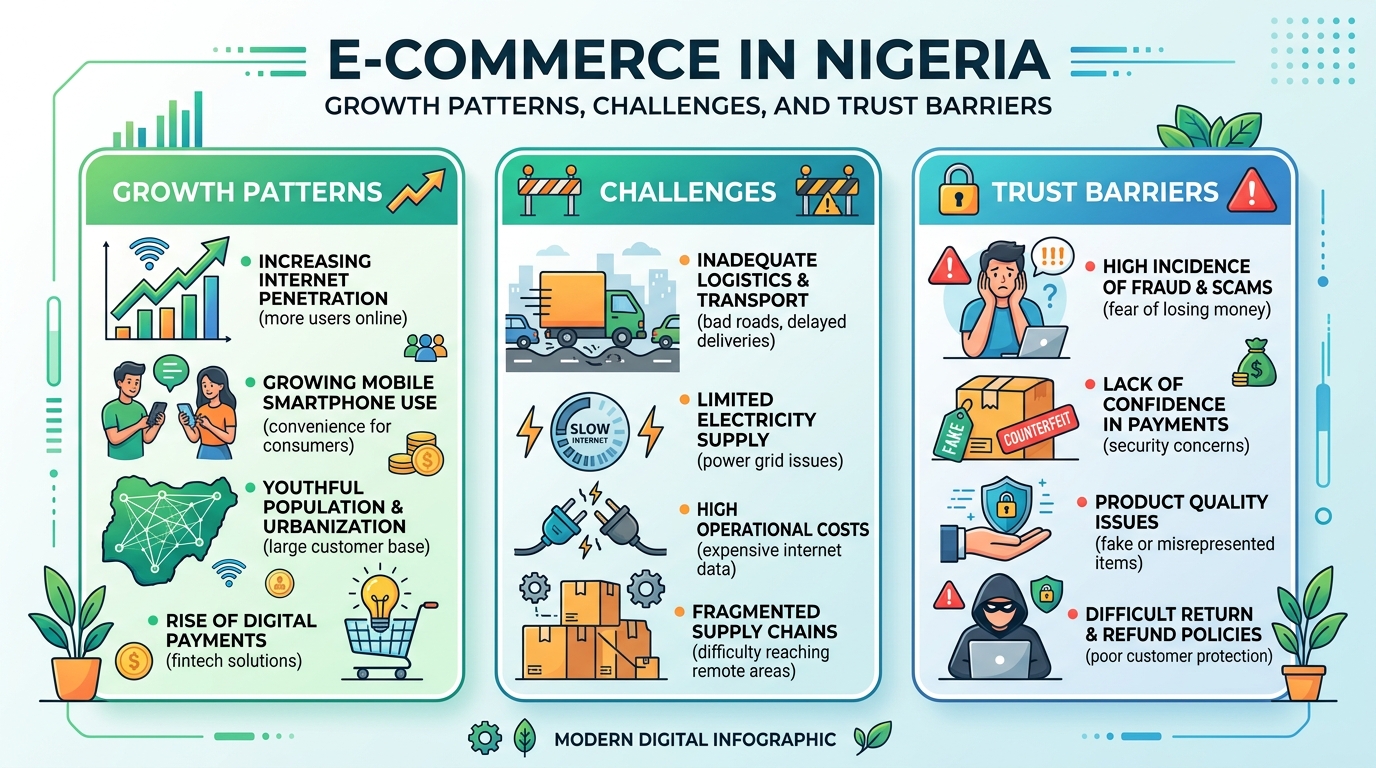
E-commerce in Nigeria: Growth Patterns, Challenges, and Trust Barriers
Nigeria’s e-commerce market is booming.
In 2025, it was worth 9.54billion.By2030,itisprojectedtohit16.68 billion.
Millions of Nigerians now buy and sell goods online. The sector has become a critical part of the digital economy.
But rapid growth brings big challenges. Trust remains the biggest barrier of all.
Let me show you what is happening, what is holding the market back, and how businesses can succeed.
Stonehill Research provides E-commerce Market Entry and Expansion Strategy to help businesses navigate Nigeria’s digital retail landscape.
Understanding e-commerce: a clear definition
Before we go further, let us define what e-commerce actually means.
Here is the simple version.
E-commerce covers everything sold online. From browsing products on websites to final delivery. It includes payment processing, inventory management, and logistics coordination.
Nigeria’s e-commerce market: current state and growth
Nigeria’s e-commerce sector has grown remarkably over the past decade. It is now the largest digital marketplace in sub-Saharan Africa.
Key market statistics
The Nigerian e-commerce market reached 9.54billionin2025.Projectionsshowgrowthto16.68 billion by 2030. The sector maintains a compound annual growth rate (CAGR) of 11.82% during the forecast period (2025 to 2030).

Internet penetration is approximately 42% to 45% of Nigeria’s population, up from 28% in 2018. Over 103 million internet users exist, with 89% of them making online purchases. Mobile commerce accounts for over 82% of all e-commerce transactions.
Recent developments
Several significant developments are shaping the industry.
Infrastructure expansion. In June 2024, Jumia unveiled a state-of-the-art warehouse and logistics network in Isolo, Lagos. It spans 30,000 square meters with 17,000 square meters of covered storage space. This investment demonstrates commitment to addressing logistics challenges.
Buy Now, Pay Later (BNPL) revolution. May 2024 marked a pivotal moment when Jumia launched two new BNPL collaborations with Newedge (Easybuy) and CredPal. These partnerships expanded flexible payment options for Nigerian consumers, making purchases more accessible amid inflationary pressures.
Market consolidation. Major players including Jumia, Konga, and Temu jointly accounted for approximately 54% of the market in 2024. Meanwhile, specialised platforms continue to emerge, targeting niche segments and underserved markets.
Read our Nigeria E-commerce Outlook 2026 for forward-looking analysis.
Growth drivers
Several interconnected factors fuel Nigeria’s e-commerce expansion.
Smartphone penetration
With over 97 million Nigerians having smartphone access and projections exceeding 140 million by 2025, mobile-first commerce has become the dominant channel. Mobile devices generated 82% of orders in 2024, projected to grow at a 13.2% CAGR.
Social commerce explosion
Social shopping has transformed from a supplementary marketing tool into a primary sales engine. With approximately 36.8 million social users dedicating nearly four hours daily to platforms with embedded checkout features, social commerce transaction value is projected to nearly double from 2.04billionin2025to3.96 billion in 2030.
Digital payment evolution
Young, tech-savvy population
Nigeria’s demographic advantage with a median age significantly below the global average creates a natural affinity for digital commerce.
Segmentation and market dynamics
Business model distribution
The B2C segment dominated with 87% market share in 2024. Consumer electronics commanded 28% of revenue, while beauty and personal care products are advancing at a 16.8% CAGR through 2030.
The B2B segment, while currently smaller, is projected to expand at an impressive 18.5% CAGR through 2030. Recent entrants like Zandaux, which expanded into Nigeria and Kenya in February 2024, demonstrate growing interest in B2B digital commerce.

Product category performance
E-commerce revenue distribution across product categories reveals consumer priorities. Consumer electronics hold 28% of revenue. Fashion and apparel is a significant segment. Beauty and personal care is the fastest growing at 16.8% CAGR. Home and garden, food and groceries, and other categories make up the remainder.
The success of food delivery startups like Glovo and Chowdeck post-COVID-19 demonstrates how changing consumer behaviours create opportunities for specialised platforms.
Regional variations
E-commerce penetration varies significantly across Nigeria. Urban centers like Lagos, Abuja, and Port Harcourt show high adoption rates with robust infrastructure. Secondary cities show growing markets with improving connectivity. Rural areas have limited penetration due to infrastructure constraints, representing significant untapped potential.
Persistent challenges facing Nigeria’s e-commerce sector
Let me be honest about the obstacles.
Infrastructure deficiencies
Last-mile delivery accounts for 50% of total logistics costs in African e-commerce. Poor road networks, inadequate addressing systems, and unreliable transportation infrastructure complicate timely deliveries, particularly outside major urban centers. Only about 40% of Nigerians have reliable internet access, severely limiting e-commerce reach in rural areas.
Inconsistent electricity hampers warehouse operations, technology infrastructure, and consumer access to online platforms. Despite improvements, internet penetration remains at 42% to 45%, with significant urban-rural disparities. Slow connection speeds and intermittent service frustrate users and limit platform functionality.
Payment system challenges
Despite digital payment growth, 65% of payments and 23% of online sales in Nigeria still occur through cash-on-delivery. This is one of the highest rates in the Middle East and Africa. This preference reflects deep-seated trust issues with digital transactions.
Over 40% of online shoppers express concerns about payment security. This apprehension stems from high-profile data breaches and fraud cases, inadequate security measures on some platforms, limited consumer education about digital payment safety, and weak enforcement of consumer protection regulations.
Debit cards dominate the payment landscape, with credit cards remaining uncommon. This limitation affects purchasing power and transaction flexibility.
Our Consumer Trust and Payment Behaviour Research helps businesses understand and address trust barriers.
Trust and security barriers
Consumer trust is the most critical challenge.
Real-world experiences shape consumer perceptions. Stories like Terver Dominic’s, who lost money to a fraudulent Facebook advertisement for guinea fowl, illustrate how scams undermine trust. When delivery never arrived despite payment, such experiences discourage future online purchases.
Regulatory and compliance issues
Multiple agencies regulate different aspects of e-commerce, creating compliance complexities. The Central Bank of Nigeria’s (CBN) “Regulation on Electronic Payments and Collections for Public and Private Sectors in Nigeria 2019” provides guidelines, but enforcement and coordination between sectors often prove inadequate.
Evolving policies on digital taxes for non-resident sellers and unclear frameworks for cross-border transactions create compliance uncertainties for businesses.
Despite regulations like the CBN’s Consumer Protection Regulations, implementation weaknesses mean many consumers prefer engaging private firms to resolve disputes rather than relying on official channels.
The Electronic Transaction Bill, 2023 seeks to provide legal frameworks for electronic transactions and enhance data security, but its full implementation and impact remain to be seen.
Currency volatility
Naira volatility affects pricing strategies, inventory costs, and consumer purchasing power. Businesses must balance competitive pricing with currency risk management, particularly for imported goods.
Check out Building Trust in Nigerian E-commerce: A Merchant’s Guide for practical strategies.
Building trust: the foundation for future growth
Trust is the fundamental currency of e-commerce success in Nigeria. Without it, technological advancement and infrastructure investment cannot reach their full potential.
Current state of consumer trust
Research indicates significant trust deficits. Approximately 35% of Nigerians prefer shopping in physical stores due to online fraud fears. Nearly 40% of users worry about fraud and data security in digital payments. 82% of online purchases use offline payment methods, reflecting digital transaction reluctance.
Trust issues are cited as a primary reason only 15% pay online despite 74% browsing and 56% selecting products online.
Security measures and innovations
E-commerce platforms and payment providers are implementing various security enhancements. Technical security solutions include OTP (One-Time Password) authentication, end-to-end encryption for transactions, SSL certificates for secure connections, multi-factor authentication systems, and real-time fraud detection algorithms.
Integration of trusted international payment systems (PayPal, Stripe) alongside local solutions (Paystack, Flutterwave) provides customers with secure, familiar options. These platforms implement robust security protocols that protect financial information during transactions.
Major platforms are implementing seller verification, product authentication programs, and transparent review systems to build credibility.
Building trust through transparency
Successful platforms prioritise clear communication about product authenticity and sourcing, delivery timelines and tracking, return and refund policies, data privacy practices, and customer support accessibility.
While digital payment adoption grows, cash-on-delivery serves as a transitional mechanism allowing hesitant consumers to build confidence gradually. This method enables product verification before payment, fostering trust.
Real-time messaging, customer reviews, and social media engagement enable consumers to verify products before purchase. Community-led influence through content creators adds authenticity to purchasing decisions.
Consumer education initiatives
Long-term trust building requires comprehensive consumer education. Digital literacy programs must teach safe online shopping practices, recognizing fraudulent platforms and scams, protecting personal and financial information, and understanding consumer rights in digital transactions.
Platforms must educate users about security features like encryption, secure payment indicators, and how to verify website authenticity.
Our Competitor Analysis and Market Positioning helps e-commerce platforms identify competitive advantages.
Opportunities and future outlook
Despite challenges, Nigeria’s e-commerce sector presents exceptional opportunities.
Untapped markets
With 55% to 58% of the population lacking internet access, rural markets represent massive growth potential. Improving connectivity and developing appropriate delivery models could unlock millions of new customers.
Tailoring solutions for specific demographics like seniors, small business owners, and rural entrepreneurs can expand market reach significantly.
Technological innovation
AI-powered personalisation, chatbots, and predictive analytics can enhance customer experiences and operational efficiency.
Virtual fitting rooms and product visualisation tools address concerns about buying products sight-unseen. The global virtual fitting room market is projected to reach $15 billion by 2029.
As smartphone adoption grows, voice-activated shopping presents new accessibility opportunities, particularly for users with limited digital literacy.
Decentralised technologies like blockchain could address trust issues by providing transparent, immutable transaction records. Cryptocurrency adoption may offer alternatives to traditional payment challenges.
Cross-border commerce
The African Continental Free Trade Area (AfCFTA) creates opportunities for cross-border e-commerce expansion. If implemented efficiently with reduced tariffs, Nigerian businesses could access broader African markets, while consumers gain access to more diverse product selections.
Sustainability and ethical sourcing
Growing global focus on sustainability presents opportunities for platforms emphasising ethical sourcing, environmentally friendly packaging, and transparent supply chains. Nigerian consumers, particularly younger demographics, increasingly value these considerations.
Financial inclusion
The bottom line
Nigeria’s e-commerce journey reflects both the promise and complexity of digital transformation in emerging markets. With market valuations approaching $10 billion and projections suggesting near-doubling by 2030, the sector’s growth trajectory remains compelling.
Yet this growth cannot reach its full potential without addressing fundamental challenges. Trust deficits keep consumers reliant on cash payments and hesitant about digital transactions.
Success depends on multiple stakeholders working collaboratively.
For businesses, investing in robust security infrastructure, transparent operations, excellent customer service, and consumer education creates competitive advantages while building sector-wide trust.
For policymakers, strengthening regulatory enforcement, improving infrastructure, supporting digital literacy initiatives, and creating conducive business environments accelerate growth while protecting consumers.
For technology providers, developing localised solutions addressing Nigeria’s unique challenges like intermittent connectivity, limited digital literacy, and trust concerns ensures technology serves rather than constrains adoption.
For consumers, embracing digital literacy, understanding security measures, and engaging with reputable platforms accelerates personal benefit from e-commerce convenience while driving market maturation.
The confluence of smartphone penetration, social commerce growth, payment innovation, and demographic advantages positions Nigeria’s e-commerce sector for continued expansion.
As infrastructure improves, trust mechanisms strengthen, and digital literacy expands, Nigeria’s e-commerce sector stands poised to fulfill its promise as a cornerstone of the digital economy.
The journey from cash-on-delivery to fully digital commerce mirrors Nigeria’s broader transformation toward a technology-enabled future. One transaction, one trust-building moment at a time.
Related services from Stonehill Research
-
E-commerce Market Entry and Expansion Strategy – Navigating Nigeria’s digital retail landscape.
-
Consumer Trust and Payment Behaviour Research – Understanding and addressing trust barriers.
-
Competitor Analysis and Market Positioning – Identifying competitive advantages in e-commerce.
Recommended reading from the Stonehill Research blog
-
Nigeria E-commerce Outlook 2026 – Forward-looking analysis and projections.
-
Building Trust in Nigerian E-commerce: A Merchant’s Guide – Practical strategies for trust-building.
-
Logistics Innovation for Nigerian E-commerce – Operational solutions for delivery challenges.
Let’s work together
Stonehill Research provides comprehensive market intelligence and strategic insights for businesses navigating Nigeria’s dynamic digital economy. Our research helps stakeholders understand market trends, consumer behaviour, and emerging opportunities in e-commerce, fintech, and digital transformation.
Contact us today:
📧 Email: info@stonehillresearch.com
📞 Phone: +234 802 320 0801
📍 Address: 5, Ishola Bello Close, Off Iyalla Street, Alausa, Ikeja, Lagos, Nigeria
Contact Stonehill Research to schedule a consultation.
Let us help you succeed in Nigeria’s e-commerce revolution.
Stonehill Research – Your Partner in Digital Commerce Intelligence
References
-
TechTarget. Definition of E-commerce. https://www.techtarget.com/searchcio/definition/e-commerce [VERIFY: link active]
-
Mordor Intelligence. Nigeria E-commerce Market Size 2025-2030. https://www.mordorintelligence.com/industry-reports/nigeria-ecommerce-market [VERIFY: link active]
-
Statista. eCommerce Nigeria Market Forecast 2025. https://www.statista.com/outlook/emo/ecommerce/nigeria [VERIFY: link active]
-
Research and Markets. Nigeria E-commerce Market Share Analysis 2025. https://www.researchandmarkets.com/reports/5601277/nigeria-e-commerce-market-share-analysis [VERIFY: link active]
-
Go-Globe. E-Commerce in Nigeria: Growth and Future Trends 2024. https://www.go-globe.com/e-commerce-in-nigeria-growth-and-future-trends/ [VERIFY: link active]
-
Carnegie Endowment. Security and Trust in Africa’s Digital Financial Inclusion. https://carnegieendowment.org/research/2024/03/security-and-trust-in-africas-digital-financial-inclusion-landscape [VERIFY: link active]
-
Veri Africa. From Brick to Click: E-commerce and the Future of Retail. verivafrica.com [VERIFY: source]
-
Novatia Consulting. E-Commerce Market Research in Nigeria. https://novatiaconsulting.com/e-commerce-market-research-in-nigeria/ [VERIFY: link active]
-
TechCabal Insights. The Future of African Commerce 2025 and Beyond. https://insights.techcabal.com/the-future-of-african-commerce-for-2025-and-beyond/ [VERIFY: link active]
-
234Digest. Nigeria’s E-Commerce Boom. https://www.234digest.com/p/nigeria-s-e-commerce-boom-who-wins-who-struggles-and-what-s-next-ac60 [VERIFY: link active]
There are no comments