

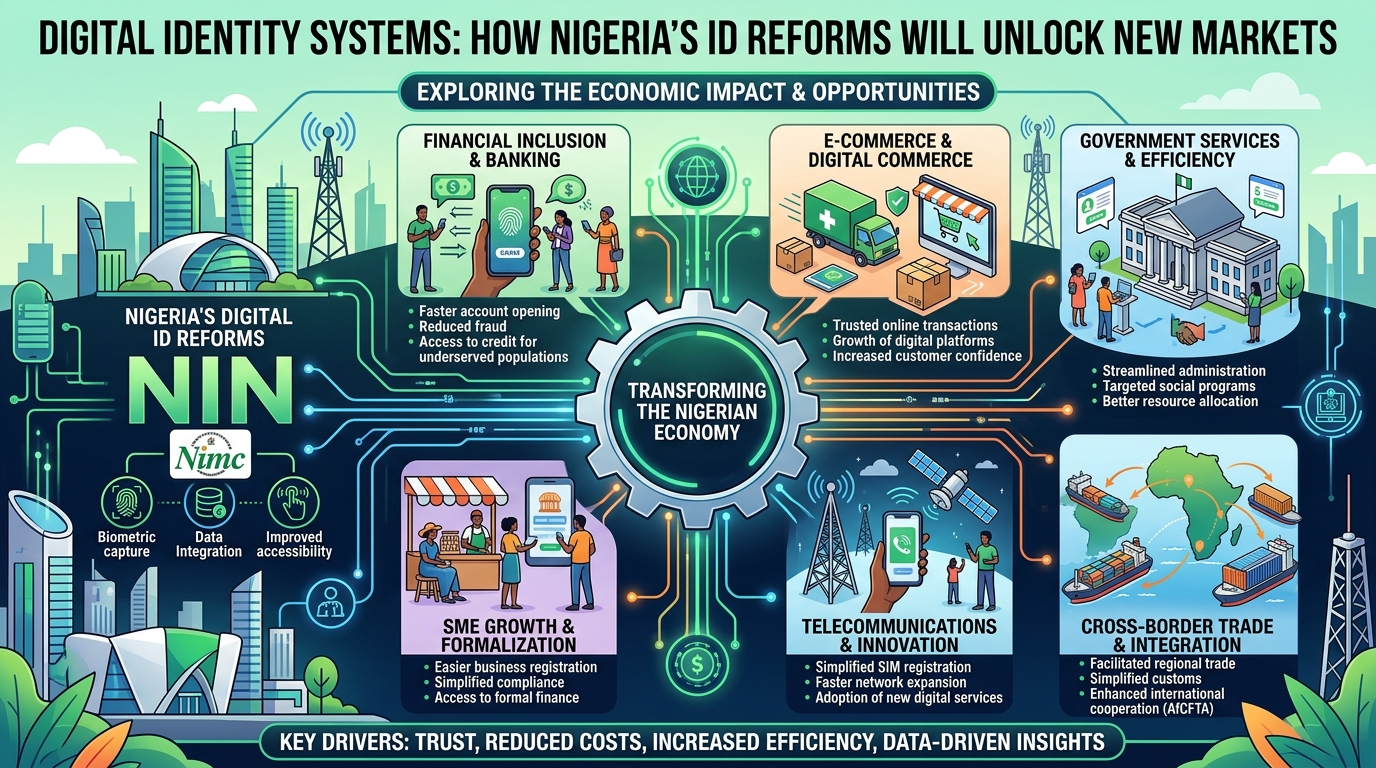
Digital Identity Systems: How Nigeria’s ID Reforms Will Unlock New Markets
Nigeria is in the middle of a digital revolution.
Over 121 million National Identification Numbers (NINs) have been issued as of June 2025. That is more than half the population.
These ID reforms are not just administrative updates. They are a fundamental transformation. They will unlock economic opportunities. Streamline public services. Position Nigeria as a leader in Africa’s digital economy.
The World Bank has extended its Digital Identity for Development (ID4D) project to 2026 with an expanded target of 180 million NINs.
The stakes have never been higher.
Let me explain what is happening and why it matters for your business.

What Is Digital Identity? A Clear Definition
Before we go further, let us define what digital identity actually means.
Source: Wikipedia. “Digital identity.”
https://en.wikipedia.org/wiki/Digital_identity
Here is the simple version.
Your digital identity includes all the data produced by your activities online. Usernames and passwords. Search histories. Dates of birth. Social security numbers. Records of online purchases.
In Nigeria’s case, the National Identification Number (NIN) serves as the foundational digital identity. It gives citizens a unique identifier that can be used across government and private sector platforms to verify identity and access services securely.
The Evolution of Nigeria’s Digital ID Program
From Fragmentation to Integration
Nigeria’s journey toward comprehensive digital identity has been decades in the making. The concept first emerged in 1977 but failed due to inadequate infrastructure and political commitment.
A revival in 2003 under the Directorate of National Civic Registration saw approximately 54 million Nigerians registered. But the system remained fragmented.

The establishment of the National Identity Management Commission (NIMC) in 2007 marked a turning point. Since then, Nigeria has worked systematically to create a unified digital identity ecosystem centered around the NIN.
Today, this system has become one of the three pillars of Nigeria’s Digital Public Infrastructure (DPI), alongside digital payments and data exchange. [
Recent Milestones and Progress
The momentum has accelerated significantly.
December 2020 saw a government mandate requiring NIN for SIM registration. This led to a surge from 46.4 million NINs in January 2021 to 94.03 million by December 2022.
March 2025 saw the launch of Nigeria’s Digital Public Infrastructure Framework, establishing clear protocols for identity verification across sectors.
June 2025 achieved 121 million NINs, representing over half of Nigeria’s population.
August 2024 achieved 96% SIM-to-NIN linkage compliance rate, demonstrating successful integration with telecommunications.
Read our Nigeria E-commerce Outlook 2026 for forward-looking analysis.
The World Bank ID4D Project: Expanding Ambitions
A $430 Million Investment in Nigeria’s Future
The Identity for Development (ID4D) project represents one of the largest investments in digital identity infrastructure in Africa. Funded jointly by the World Bank (115million),theFrenchDevelopmentAgency(100 million), and the European Investment Bank ($215 million), this initiative aims to achieve universal NIN coverage.
Originally launched in February 2020 with a target of 148 million NINs by June 2024, the project has been restructured following Nigeria’s demonstration of commitment to implementation.
In December 2024, the World Bank increased the target to 180 million NINs and extended the project deadline to December 31, 2026. [3]
Infrastructure Upgrades and Technical Improvements
The project restructuring includes significant technical enhancements.
The Expanded Automated Biometric Identification System (ABIS) is being upgraded to accommodate storage for 250 million NINs, scheduled for completion by March 2025. A new National Identity Management System is being developed as an open-source, interoperable platform building on the recent $83 million modernization initiative.
Enhanced enrollment infrastructure means multiplication of registration centers, particularly in rural and underserved areas.
Legislative reforms include amendment of the NIMC Act to promote an inclusive and non-discriminatory legal framework, with presidential assent expected by February 2025.
Key Challenges Facing Digital Identity Adoption
Let me be honest about the obstacles.
The Rural-Urban Divide
The digital divide between urban and rural areas presents one of the most critical challenges. Broadband coverage is just under 48% as of March 2025. Many rural communities lack the internet connectivity necessary for enrollment, which requires online data capture.
Rural populations also face limited awareness about the NIN’s importance and reduced access to enrollment facilities. This creates a vicious cycle. Those who could benefit most from digital identity are least likely to obtain it.
Cybersecurity and Data Protection Concerns
The integrity of Nigeria’s digital identity system depends entirely on the security of the data it holds. In June 2024, unauthorized websites were illicitly selling sensitive personal data of Nigerian citizens, including the NIN.
To address these concerns, Nigeria has taken several steps.
February 2024 saw amendment of the 2015 Cybercrimes Act, introducing a 72-hour incident reporting requirement and strengthening identity verification.
June 2024 saw a presidential order designating specific computer systems and infrastructure as critical, placing them under enhanced oversight.
June 2023 saw enactment of comprehensive data protection legislation to safeguard personal information. [5]
Interoperability Limitations
While the NIN’s integration with financial services and telecommunications has been relatively successful, its adoption in other critical sectors remains inconsistent. Healthcare. Education. Social protection.
This fragmentation limits the system’s utility and prevents Nigeria from realizing the full potential of its digital identity infrastructure.
Market Opportunities Unlocked by Digital Identity
Financial Services and Fintech Innovation
The establishment of reliable digital identity verification opens transformative possibilities for Nigeria’s financial sector.
With the NIN as a trusted identifier, financial institutions can accelerate customer onboarding. Streamline Know Your Customer (KYC) processes. Reduce the time and cost of account opening.
They can expand financial inclusion to reach the unbanked and underbanked populations, particularly in rural areas. Enable digital lending by facilitating credit scoring and risk assessment for previously invisible populations. Reduce fraud by improving transaction security and minimizing identity-related financial crimes.
Nigeria’s fintech sector, already one of Africa’s most vibrant, stands to benefit enormously from standardized digital identity verification. [6]
Healthcare Transformation
Digital identity provides the foundation for comprehensive Electronic Health Records (EHR) systems.
With NIN integration, healthcare providers can create unified patient records accessible across different facilities. Improve prescription management and reduce medication errors. Enable telemedicine services with verified patient identities. Streamline health insurance claims processing. Facilitate public health monitoring and disease surveillance.
Education and Human Capital Development
The education sector can leverage digital identity to maintain verifiable academic credentials and certificates. Facilitate seamless enrollment across institutions. Enable online learning platforms with authenticated users. Support scholarship and student loan programs with verified identities. Track educational outcomes for policy planning.
E-Commerce and Digital Economy
For businesses operating in Nigeria’s growing digital economy, reliable identity verification enables secure online transactions and reduced payment fraud. Age verification for restricted products. Enhanced customer trust and confidence. Personalized services based on verified user profiles. Streamlined cross-border transactions.
Government Services and Social Protection
Digital identity dramatically improves the efficiency and reach of government programs. Targeted social welfare distribution with reduced leakage. Efficient tax collection and compliance. Streamlined voting registration and electoral processes. Simplified passport and documentation services. Enhanced national security and border management.
Strategic Imperatives for Success
Promoting Inclusive Access
To achieve the ambitious target of 180 million NINs by 2026, NIMC must maintain monthly enrollments of approximately 3.3 million people starting from January 2025.
This requires geographic expansion, deploying additional registration centers in rural and hard-to-reach areas. Mobile enrollment units to bring enrollment services to remote communities. Incentivizing agents to work in underserved areas through appropriate compensation. Community outreach with robust awareness campaigns explaining the benefits and importance of NIN registration. Infrastructure development to expand broadband coverage enabling enrollment in areas with limited connectivity.
Ensuring Data Integrity and Security
Building public trust requires demonstrating that the digital identity system is secure and that personal data is protected.
Key measures include implementing end-to-end encryption for sensitive identity data. Regular security audits and penetration testing. Compliance with international data protection standards. Transparent privacy policies and user rights. Swift response mechanisms for data breaches. Public education on cybersecurity best practices.
Advancing Interoperability
To maximize the value of digital identity, Nigerian policymakers must make the NIN the most reliable source of identity across government and private platforms. Extending to sectors such as healthcare, education, and social protection.
The March 2025 launch of Nigeria’s Digital Public Infrastructure Framework provides a foundation. Structures like the Nigerian Data Exchange (NgDX) and the Nigerian Digital Public Infrastructure Centre (NgDPIC) facilitate real-time identity verification across sectors, standardized APIs for third-party integration, secure data sharing with appropriate consent mechanisms, and common protocols for authentication and authorization.
Our Consumer Trust and Payment Behaviour Research helps businesses understand and address trust barriers.
Recent Policy Developments and Legislative Reforms
The National Digital Economy and E-Governance Bill
Nigeria is developing comprehensive legislation to strengthen its digital economy. The National Digital Economy and E-Governance Bill aims to address critical aspects including e-signatures and their legal validity, e-commerce regulations and consumer protection, cybersecurity requirements for digital services, and data sharing frameworks between public and private entities.
Enhanced Cybersecurity Framework
In September 2022, the National Information Technology Development Agency (NITDA) issued a code of practice for interactive computer service platforms. This requires compliance with local laws and removal of unlawful content within 48 hours. This regulatory framework ensures that digital identity systems operate within secure and accountable environments.

Enforcement and Market Regulation
Nigeria has demonstrated its commitment to protecting digital identity and user data through enforcement actions. In July 2024, the Federal Competition and Consumer Protection Commission (FCCPC) and Nigeria Data Protection Commission (NDPC) fined Meta $220 million for data protection non-compliance and abusing its dominant market position. This signals that authorities are serious about safeguarding citizens’ digital identities. [9]
Future Outlook: What’s Next for Nigeria’s Digital Identity
The General Multipurpose Card (GMPC)
Nigeria is preparing to introduce the General Multipurpose Card (GMPC), a significant upgrade to the identity management system. Developed by NIMC in collaboration with the Central Bank of Nigeria and the Nigeria Inter-bank Settlement System, the GMPC will serve as more than just an ID card. It will function as a gateway to financial, social, and government services.
This card represents the convergence of identity verification, payment capabilities, and service access into a single, secure platform.
Integration with Emerging Technologies
Nigeria’s digital identity system is positioned to leverage cutting-edge technologies.
Artificial Intelligence: The August 2024 publication of the draft National AI Strategy outlines how AI can enhance identity verification and fraud detection.
Blockchain: Exploring decentralized identity models for enhanced security and user control.
Biometric Authentication: Expanding the use of facial recognition, fingerprint, and iris scanning for multi-factor authentication.
Internet of Things: Integrating identity verification with smart devices and IoT networks.
Regional Leadership and Cross-Border Opportunities

As Nigeria develops its digital identity infrastructure, opportunities emerge for regional integration. Standardized digital identity systems could facilitate cross-border trade and movement within ECOWAS, regional financial integration and payment systems, mutual recognition of credentials and qualifications, and coordinated approaches to cybersecurity and data protection.
The Bottom Line
Nigeria’s digital identity reforms represent more than a technological upgrade. They constitute a fundamental reimagining of how citizens interact with their government, access services, and participate in the economy.
With 121 million NINs already issued and a clear path to 180 million by 2026, Nigeria is building the infrastructure for a truly digital economy.
The challenges are significant. Bridging the rural-urban divide. Ensuring robust cybersecurity. Achieving full interoperability. Maintaining public trust.
However, the opportunities far outweigh these obstacles. Financial inclusion. Healthcare transformation. Education enhancement. E-commerce growth. Digital identity provides the foundation for Nigeria’s next phase of development.
For businesses, investors, and policymakers, the message is clear. Nigeria’s digital identity reforms are unlocking new markets and creating opportunities across every sector of the economy.
Those who understand and engage with this transformation early will be best positioned to benefit from Africa’s most populous nation as it enters the digital age.
The future of Nigeria’s economy is digital. And its digital future begins with identity.
Related services from Stonehill Research
-
E-commerce Market Entry and Expansion Strategy – Navigating Nigeria’s digital retail landscape.
-
Consumer Trust and Payment Behaviour Research – Understanding and addressing trust barriers.
-
Competitor Analysis and Market Positioning – Identifying competitive advantages in e-commerce.
Recommended reading from the Stonehill Research blog
-
Nigeria E-commerce Outlook 2026 – Forward-looking analysis and projections.
-
Building Trust in Nigerian E-commerce: A Merchant’s Guide – Practical strategies for trust-building.
-
Logistics Innovation for Nigerian E-commerce – Operational solutions for delivery challenges.
Call To Action
Are you ready to leverage Nigeria’s digital identity revolution for your business?
At Stonehill Research, we provide cutting-edge market intelligence and strategic insights to help businesses navigate Nigeria’s rapidly evolving digital economy.
Our team of analysts tracks the latest developments in digital identity, fintech, regulatory frameworks, and emerging technologies to keep you ahead of the curve.
How we can help you:
-
Market Entry Strategy: Understand how digital identity reforms create opportunities in your sector
-
Regulatory Compliance: Navigate Nigeria’s evolving data protection and cybersecurity landscape
-
Competitive Intelligence: Track how industry leaders are leveraging digital identity systems
-
Partnership Identification: Connect with key stakeholders in Nigeria’s digital ecosystem
-
Custom Research: Tailored analysis of digital identity impacts on your specific business model
Get in touch:
📧 Email: info@stonehillresearch.com
📞 Phone: +234 802 320 0801
📍 Address: 5, Ishola Bello Close, Off Iyalla Street, Alausa, Ikeja, Lagos, Nigeria
Don’t miss out on the opportunities emerging from Africa’s largest digital identity transformation. Contact Stonehill Research today for expert insights that drive strategic decision-making.
Reference
[1] Wikipedia – Definition of Digital Identity
https://en.wikipedia.org/wiki/Digital_identity
[2] Digital Policy Alert – Nigeria Digital Digest 2025
https://digitalpolicyalert.org/digest/dpa-digital-digest-nigeria
[3] Nairametrics – ID4D World Bank Increases NIN Target to 180 Million 2024
https://nairametrics.com/2024/12/24/id4d-world-bank-increases-nin-target-to-180-million-says-nigeria-is-making-progress/
[4] Biometric Update – Nigeria Must Issue 59M Digital IDs in 18 Months 2025
https://www.biometricupdate.com/202508/nigeria-must-issue-59m-digital-ids-in-18-months-to-meet-world-bank-target
[5] Global Development Blog – What’s Next for Nigeria’s Digital ID Program 2025
https://globaldev.blog/whats-next-for-nigerias-digital-id-program/
[6] TechCabal – NIMC Must Enroll 3.3 Million Nigerians Monthly to Hit 2026 Target
https://techcabal.com/2025/08/22/nimc-nigeria-digital-identity-2026-deadline/
[7] World Bank – Nigeria Digital Identification for Development Project Document
[VERIFY: worldbank.org – Nigeria ID4D project details]
[8] Federal Ministry of Communications – National Digital Economy and E-Governance Bill 2024
https://fmcide.gov.ng/wp-content/uploads/2024/07/National-Digital-Economy-and-E-Governance-Bill-2024-Draft.pdf
[9] ID Tech – World Bank Expands Nigeria’s Digital ID Target to 180 Million 2024
https://idtechwire.com/world-bank-expands-nigerias-digital-id-target-to-180-million-extends-project-to-2026/
[10] Aratek – The New Nigeria ID Card: A More Inclusive Digital Identity
https://www.aratek.co/news/the-new-nigeria-id-card-a-more-inclusive-digital-identity
There are no comments