

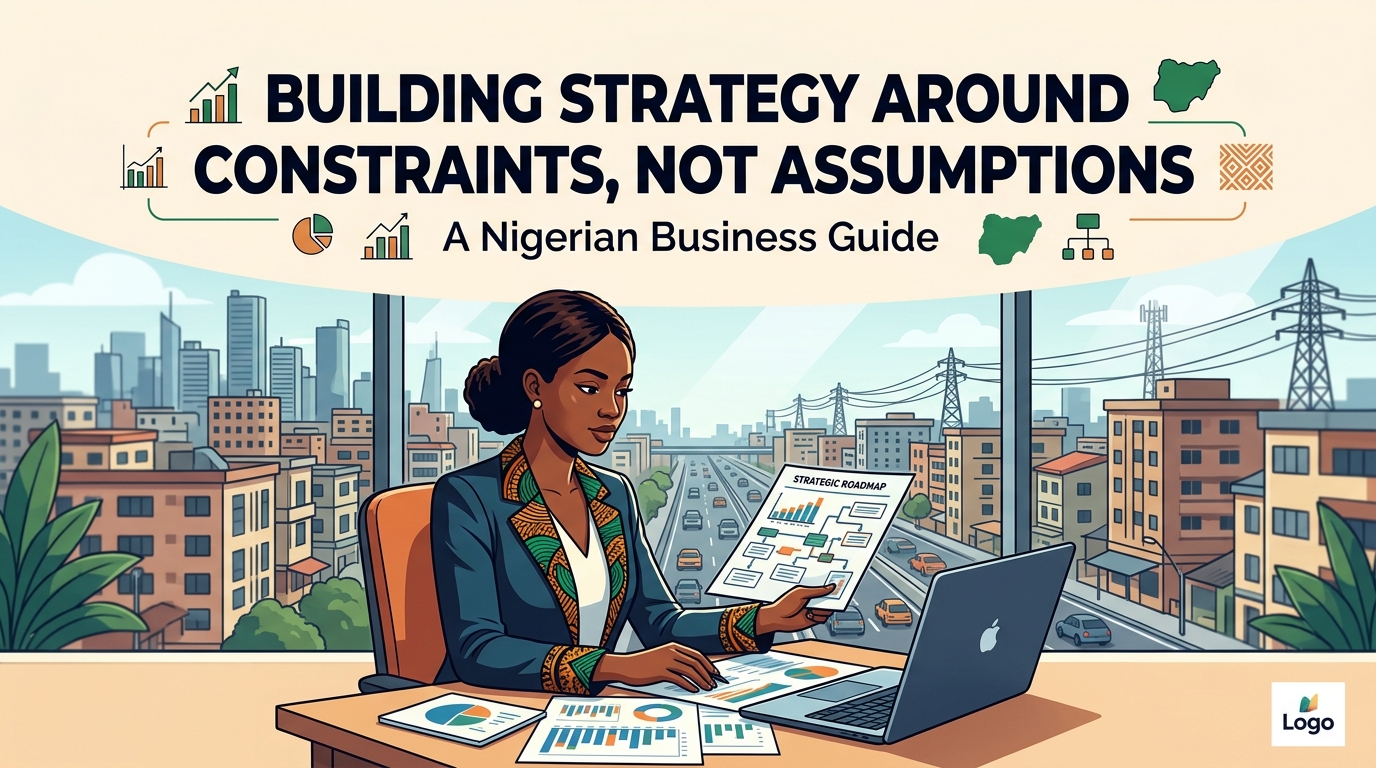
Building Strategy Around Constraints, Not Assumptions: A Nigerian Business Guide
Most companies get strategy backwards.
They start with dreams. They assume ideal conditions. They plan for the best case.
Then reality hits. Budgets get cut. People leave. Markets shift. The beautiful plan falls apart.
There is a better way.
Build your strategy around constraints. Start with what you actually have. Work with real limitations, not wishful thinking.
Let me show you how.

Understanding Strategic Constraints: A Clear Definition
Before we go further, let us define what strategic constraints actually are.
Definition: According to the Harvard Business Review, a constraint is “a factor that limits the organization’s ability to achieve its objectives and represents a real, measurable limitation rather than a perceived barrier.”
Here is the simple version.
Assumptions are beliefs you hold without verification. Constraints are tangible realities you cannot wish away.
You can test assumptions. You might prove them wrong. But constraints must be acknowledged and navigated.
The Assumption Trap: Why Traditional Planning Fails
Let me explain why most strategic planning falls short.
Organisations start by asking “What do we want to achieve?” They skip the crucial first question: “What are we actually working with?”
This leads to predictable failures.
Overestimation of resources. You assume you will have more money, more people, more time than reality provides.
Underestimation of challenges. You assume implementation will be smoother than it ever is.
Beautiful paper plans. They look impressive in boardrooms. They crumble under real-world conditions.
Assumption-based planning relies on wishful thinking about market conditions. Unverified beliefs about customer behaviour. Optimistic timelines ignoring operational realities.
The 2024 to 2025 business environment has made this approach especially dangerous. Economic volatility. Rapid technological disruption. Shifting consumer behaviours.
Assumptions that held true 18 months ago are now completely outdated. Companies that built strategies on pre-pandemic assumptions about remote work, supply chains, or digital adoption found themselves scrambling. [2]
Recent studies show that nearly 67% of strategic initiatives fail to meet their objectives. Assumption-based planning is a primary contributor. Organisations spend countless hours developing elaborate plans. They abandon or significantly revise them within the first quarter of implementation.

The Power of Constraint-Based Strategy
Embracing constraints as your foundation changes everything. It paradoxically opens up more possibilities than assumption-based approaches.
When you build strategy around constraints, you start with reality. You acknowledge budget limitations. Talent gaps. Technological infrastructure. Competitive pressures. Regulatory environment.
This honest assessment creates a solid foundation. Instead of asking “What could we do in an ideal world?” you ask “What can we achieve given our actual circumstances?”
Constraints force creativity.Nigeria’s New Economic Zones: What Investors Need to Know in 2026 Some of the most breakthrough innovations emerged from severe limitations.
Twitter’s 140-character limit was not a design preference. It was a constraint imposed by SMS technology. That constraint became a defining feature that shaped an entire platform and communication style.
Southwest Airlines built its entire business model around constraints. They could not compete with major carriers on routes, amenities, or airport access. So they embraced these limitations. They created a point-to-point model with secondary airports, no assigned seating, and no meal service. Those constraint-driven decisions became competitive advantages that revolutionised the airline industry.
In 2024 to 2025, we are seeing constraint-based innovation everywhere. Supply chain disruptions forced manufacturers to develop more resilient, localised production networks. Talent shortages accelerated automation and reskilling initiatives. Budget constraints drove more efficient digital transformation approaches focused on high-impact areas.
Identifying Your Real Constraints

The first step is honest identification. This requires rigorous analysis and often uncomfortable conversations.
Financial constraints. Go beyond simple budget numbers. Understand your cash flow patterns. Capital allocation priorities. Realistic funding timelines.
In the current economic climate, access to capital has tightened. Higher interest rates. More cautious investors. Extended sales cycles. Account for all of these.
Human capital constraints. Assess not just headcount. Look at actual skills, capacity, and engagement levels.
The post-pandemic talent landscape has shifted fundamentally. Increased competition for specialised skills. Changing expectations around remote work. Higher turnover rates in many sectors.
Your constraint is not just “how many people.” It is “what capabilities exist, what can be developed, and what must be acquired.”
Technological constraints. Evaluate your current systems honestly. Integration capabilities. Technical debt.
Many organisations in 2025 are grappling with legacy systems that cannot easily integrate with modern solutions. This creates constraints around digital transformation efforts. Rapid advancement of AI and automation has also created new constraints around data infrastructure and algorithmic governance. [5]
Market constraints. Understand competitive dynamics. Customer willingness to pay. Distribution challenges. Regulatory requirements.
Recent developments in data privacy regulations, environmental compliance, and industry-specific oversight have created new constraints. Incorporate these into your strategic planning.
Time constraints. Recognise realistic implementation timelines. Based on organisational capacity and change management realities.
The accelerated pace of business in 2025 has created tension. The need for speed versus the reality of organisational change constraints.
Here is a practical exercise. Map your resources across these categories. Stress-test them against your strategic ambitions. Where are the gaps? What cannot be easily changed?
Those immovable elements are your true constraints.
Turning Constraints Into Competitive Advantages
The most sophisticated strategic thinkers do not just acknowledge constraints. They actively leverage them for competitive differentiation.
Focus and specialisation. Constraints force you to make choices. When you cannot be everything to everyone, you become exceptional at specific things.
Budget constraints might force you to focus on a narrower market segment. This allows you to develop deeper expertise and stronger relationships than better-funded competitors spreading themselves thin.
Consider niche SaaS companies in 2024 to 2025. Rather than trying to compete with enterprise platforms, they embrace limited resources. They focus on specific verticals or use cases. This constraint-driven focus allows superior features for their target market. Stronger community engagement than generalist competitors. [6]
Efficiency and innovation. Resource constraints breed efficiency. Companies with unlimited budgets waste resources on low-impact initiatives. Constrained organisations must prioritise ruthlessly.
This leads to leaner operations and more innovative problem-solving.
The emergence of “lean AI” strategies in 2025 exemplifies this. Organisations with constraints around computing power and data infrastructure are developing more efficient AI models. These deliver comparable results to resource-intensive approaches. These constraint-driven innovations are now influencing the broader market.
Authenticity and differentiation. Your unique combination of constraints creates a strategic position competitors cannot easily replicate.
Your geographic location. Founding team backgrounds. Existing customer relationships. Accumulated expertise. These are all constraints that shape your strategic options but also create distinctive capabilities.
When external shocks occur, constraint-aware organisations adapt more quickly. They are already operating within realistic parameters. Not optimistic assumptions.
Organisations that built constraint-based strategies proved more resilient during recent disruptions. They had already developed operational flexibility within their known limitations. Adaptation was less traumatic than for organisations whose strategies assumed ideal conditions. [7]
Practical Framework for Constraint-Based Strategy Development
Let me give you a structured approach.
Step 1: Comprehensive constraint audit. Begin with a thorough assessment across financial, human, technological, market, and time dimensions.
Involve cross-functional teams. Capture constraints that might not be visible from a single departmental perspective. Document not just the constraints themselves but their interdependencies.
Step 2: Constraint prioritisation. Not all constraints are equally important.
Distinguish between constraints that are truly immovable versus those that might be addressed with strategic investment. Identify which constraints most significantly limit your strategic options. Identify which create the most meaningful opportunities for differentiation.
Step 3: Opportunity mapping within constraints. Once constraints are clearly understood, map possible strategic directions that work within these parameters.
Ask “Given these specific limitations, what becomes possible?” Not “What limitations prevent us from achieving our ideal vision?”
Step 4: Constraint-leverage strategy formulation. Develop strategic initiatives that explicitly leverage constraints as advantages.
For each major constraint, ask how it might be reframed from limitation to distinctive capability. Document how your constraint profile creates strategic positions unavailable to differently-constrained competitors.
Step 5: Implementation with constraint monitoring. Execute strategy with ongoing constraint monitoring.
As constraints evolve, budgets change, new talent is acquired, technologies improve, strategy should adapt accordingly. Establish regular constraint review cycles. Quarterly is often appropriate.
Step 6: Learning and refinement. Build feedback loops that capture learnings about how constraints shaped outcomes.
This organisational learning becomes valuable strategic knowledge for future planning cycles. [8]
Case Study: Constraint-Driven Success in Nigeria
Let me share a real example.
A mid-sized Nigerian fintech company faced significant constraints. Regulatory approval timelines were long. Venture funding was limited compared to international competitors. Infrastructure challenges around internet connectivity and digital literacy were severe in target markets.
They could have viewed these as insurmountable obstacles.
Instead, they built their entire strategy around these constraints.
Limited funding drove a capital-efficient growth model. They focused on organic customer acquisition through exceptional user experience. Not expensive marketing campaigns.
Infrastructure constraints pushed them to develop offline-capable features. Simplified interfaces that worked on basic devices. These innovations became major competitive advantages in underserved markets.
By 2025, features originally developed to work around constraints had become core differentiators. Their offline capabilities and simplified UX attracted international attention and partnership opportunities.
The result? 340% year-over-year growth in 2024. Profitability ahead of investor expectations. A strategic position that larger competitors with different constraint profiles find difficult to replicate.
Moving Forward: Embracing Reality as Strategy
The shift from assumption-based to constraint-based strategy is more than a planning methodology. It is a fundamental mindset change about how organisations create value and competitive advantage.
In our work at Stonehill Research, we have consistently found that organisations embracing their constraints outperform those attempting to transcend them.
The most successful businesses we have studied do not have fewer constraints. They have more sophisticated approaches to leveraging the constraints they possess.
As you develop strategy for the remainder of 2025 and beyond, challenge your planning processes. Start with constraints rather than aspirations.
Audit your actual resources, capabilities, and limitations honestly. Map the strategic territory available within those parameters. Identify how your unique constraint profile creates opportunities unavailable to differently-constrained competitors.
The businesses that thrive in today’s volatile environment are not those with the fewest constraints. They are those that most skilfully transform constraints into strategic advantages.

Your limitations, properly understood and strategically leveraged, may be your greatest assets.
Related services from Stonehill Research
-
E-commerce Market Entry and Expansion Strategy – Navigating Nigeria’s digital retail landscape.
-
Consumer Trust and Payment Behaviour Research – Understanding and addressing trust barriers.
-
Competitor Analysis and Market Positioning – Identifying competitive advantages in e-commerce.
Recommended reading from the Stonehill Research blog
-
Nigeria E-commerce Outlook 2026 – Forward-looking analysis and projections.
-
Building Trust in Nigerian E-commerce: A Merchant’s Guide – Practical strategies for trust-building.
-
Logistics Innovation for Nigerian E-commerce – Operational solutions for delivery challenges.
Call To Action
Ready to Transform Your Strategic Approach?
At Stonehill Research, we specialise in helping organisations develop resilient, constraint-based strategies that drive sustainable growth.
Our team brings deep expertise in strategic planning, market analysis, and organisational development. We help you identify your true constraints and leverage them for competitive advantage.
How we can help:
-
Strategic constraint audits
-
Opportunity mapping within your limitations
-
Constraint-leverage strategy formulation
-
Implementation and monitoring support
-
Organisational learning and refinement
Whether you are navigating market uncertainty, planning for growth within resource limitations, or seeking to differentiate in a crowded market, we can help you build strategy grounded in reality and designed for results.
Contact us today:
📧 Email: info@stonehillresearch.com
📞 Phone: +234 802 320 0801
📍 Address: 5, Ishola Bello Close, Off Iyalla Street, Alausa, Ikeja, Lagos, Nigeria
Let us turn your constraints into competitive advantages.
Reference
[1] Harvard Business Review – Definition of Strategic Constraint
https://hbr.org/topic/subject/theory-of-constraints
[2] McKinsey & Company – Strategic Planning Failure Rates 2024
[VERIFY: mckinsey.com – Strategic initiative success and failure data]
[3] MIT Sloan Management Review – Constraint-Based Strategy
https://sloanreview.mit.edu/article/strategy-in-the-age-of-constraints/
[4] Harvard Business Review – Southwest Airlines Business Model
https://hbr.org/1996/09/lessons-from-the-legendary-southwest-airlines
[5] World Bank – Digital Infrastructure in Nigeria 2025
https://www.worldbank.org/en/country/nigeria/publication/digital-economy-nigeria
[6] Forbes – Niche SaaS Companies and Constraint-Driven Focus
forbes.com – SaaS industry trends and focus strategies
[7] Deloitte – Organisational Resilience 2025 Report
deloitte.com – Resilience and constraint-based strategy
[8] Strategy+Business – Framework for Constraint-Based Planning
strategy-business.com – Strategic constraint audit methodology
[9] Nigerian Fintech Report 2025 – Stonehill Research Case Study
stonehillresearch.com – Nigerian fintech success data
[10] African Business Review – Constraint-Driven Innovation in Africa 2025
africanbusinessreview.com – Leveraging limitations for competitive advantage
There are no comments