

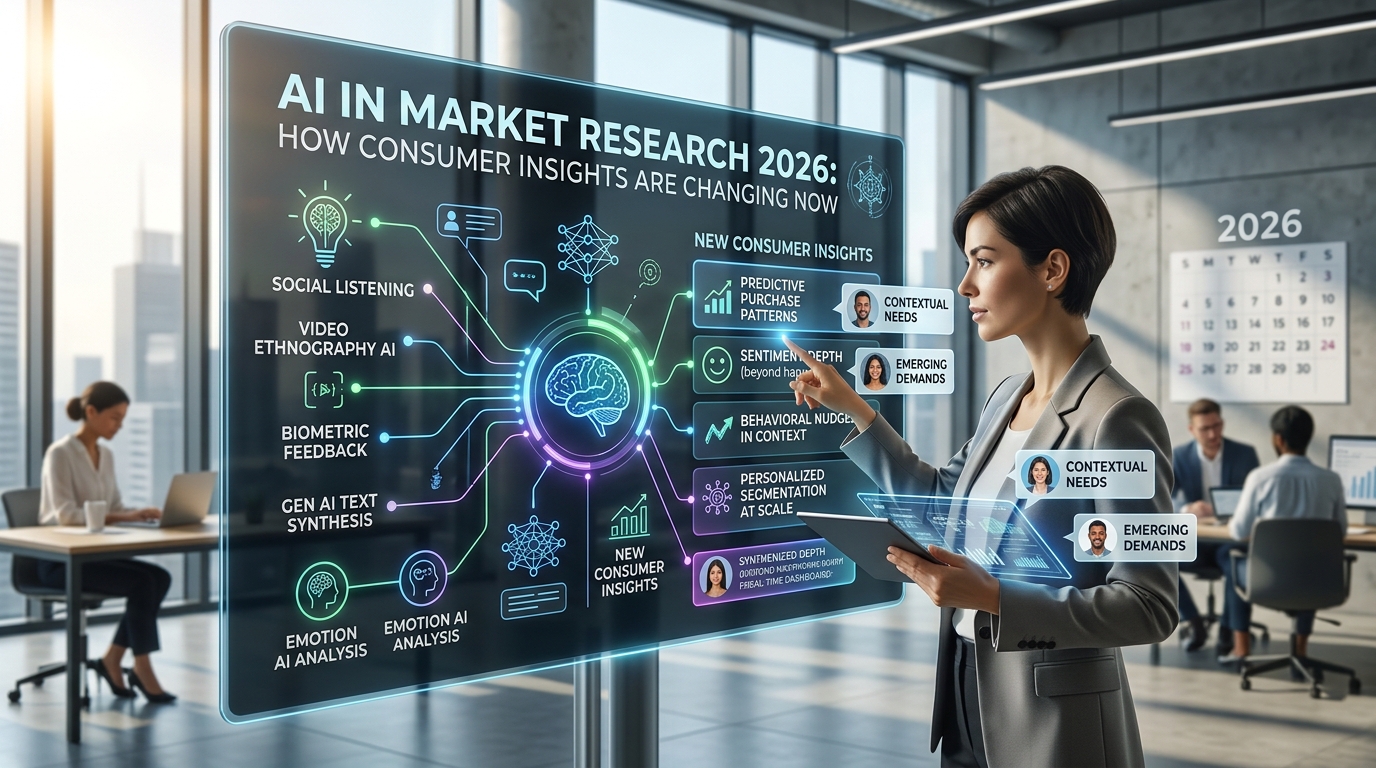
AI in Market Research 2026: How Consumer Insights Are Changing Now
Market research used to be slow. Really slow.
You spent months collecting data. More months analysing it. By the time you got answers, the market had moved on.
Those days are ending.
Artificial intelligence has flipped the script. What took months now takes hours. What cost a fortune now costs a fraction.
We are in 2026 now. AI in market research is not optional anymore. It is essential. Businesses that use AI understand their customers better. They spot trends faster. They leave competitors in the dust.
Let me show you what is happening right now and what it means for your business.
What is market research? A clear definition
Before we talk about AI, let us define what market research actually is.
That is a lot of words. But here is the simple version.
Market research helps you understand your customers. What they want. How they spend. Where they shop. Who your competitors are.
AI is making all of this faster, cheaper, and more accurate in 2026.

The AI revolution in market research
The numbers are staggering. Let me share them with you.
The global market research industry is worth $150 billion in 2026. AI is transforming it completely. Nearly 92% of organizations now regularly use AI in at least one business function. Just two years ago, that number was 78%.
Here is what the latest 2026 surveys tell us.
86% of market researchers say their organizations plan to significantly increase AI investment in 2026. Over 90% of researchers now regularly use AI-powered tools in their daily workflows. 71% of cutting-edge research teams reported budget increases in 2026.
What is driving this? Simple. AI lets research teams do more work with the same size team. Resource constraints have always been a problem. AI is the solution.
Read our AI Adoption in Nigerian Market Research 2026 for local insights.
How AI is transforming consumer insights in 2026
AI is changing market research in four big ways. Let me walk you through each one.
1. Supporting and accelerating traditional methods
AI does not replace proven research methods. It supercharges them.
Modern AI platforms in 2026 can now automate survey design completely. The AI generates contextually relevant questions based on your research objectives. What used to take days of human effort now takes seconds.
Data processing happens in real time. What once took weeks now happens in minutes.
Natural Language Processing (NLP) has advanced significantly. AI tools in 2026 understand context, sarcasm, and nuanced language in open-text responses better than most humans. They convert qualitative feedback into quantifiable data instantly.
Sentiment analysis algorithms analyse text from social media, reviews, and customer feedback in real time. They determine whether sentiment is positive, negative, or neutral with over 95% accuracy. You get a clear picture of public perception without reading thousands of comments.
2. Leveraging synthetic data
This is one of the most innovative developments of 2026.
Synthetic data is artificially generated data that mimics real people’s behaviours and preferences. It addresses growing privacy concerns. It enables broader, faster analysis.
Research from early 2026 shows that 91% of researchers who have used synthetic responses report satisfaction with the results. This is up from 87% in 2025.
What can you do with synthetic data in 2026?
Simulate real-world consumer inputs without compromising sensitive information. Analyse broader sample sizes faster than ever. Test hundreds of hypotheses and scenarios before conducting costly primary research. Maintain full compliance with data privacy regulations like GDPR, CCPA, and Nigeria’s new Data Protection Act.
3. Filling existing research gaps
Traditional methods have blind spots. AI sees what humans miss.
Machine learning algorithms in 2026 can identify hidden patterns in consumer behaviour that no human analyst would spot. They detect emerging trends months before they become mainstream. They forecast future behaviours with over 90% accuracy.
Here are the breakthrough applications in 2026.
Predictive analytics. AI models examine historical data and current market conditions to forecast future consumer behaviour with remarkable precision. Global brands like Amazon and Netflix use this to drive billions in revenue.
Trend discovery platforms. Tools like Glimpse and newer 2026 entrants analyse millions of early signals from search data, social media, reviews, and e-commerce sites. They identify emerging trends before they hit the mainstream.
Cross-platform analytics. AI tracks consumer journeys across dozens of digital touchpoints. You get a comprehensive view of customer behaviour across websites, apps, social media, and physical stores.
AI-powered video and voice analysis. New in 2026, AI tools can analyse customer service calls and video feedback to capture sentiment through tone of voice and facial expressions.
4. Creating new types of data and insights
This is where things get really exciting in 2026.
Companies can now create virtual representations of consumer segments. Digital twins. They can test products, prices, and campaigns in fully simulated environments. They can optimise strategies before spending a single naira on real-world implementation.
AI is generating entirely new categories of insights that did not exist three years ago.
Our Trend Discovery and Forecasting helps businesses identify emerging consumer trends before competitors.
The rise of agentic AI in market research
A new frontier has emerged in 2026. Agentic AI.
These are AI agents that can act autonomously. They plan strategies. They execute multiple steps in complex workflows. They make decisions without human intervention at every step.
Current adoption status in 2026
Research from McKinsey reveals that 34% of organizations are now scaling agentic AI systems somewhere in their enterprises. This is up from 23% in 2025. In market research specifically, agentic use cases are most commonly deployed in three areas.
Knowledge management. AI agents conduct deep research and synthesise insights from hundreds of sources automatically.
Customer service analytics. AI agents analyse customer interactions across all channels and generate actionable recommendations without human prompting.
Content strategy. AI agents draft reports, generate ideas, and present knowledge for creating marketing strategies.
Real-time insights: the new standard in 2026
Traditional research methods that required months to generate insights are now completely obsolete. The business environment of 2026 demands speed, and AI delivers it.
The shift to agile research
Organizations are increasingly relying on real-time data to make quicker, informed decisions. This shift manifests in several ways.
Quick-turnaround surveys now deploy and analyse in hours, not weeks. Live consumer experience analytics track interactions across platforms in real time. Automated A/B testing continuously optimises ads, messaging, and pricing strategies without human input. Instant sentiment tracking monitors social media conversations and brand mentions as they happen.
Mobile-first and interactive methodologies
With most internet users accessing content via mobile devices, research methodologies have adapted accordingly. AI in 2026 enables conversational surveys that mimic human-like interactions. Gamification techniques personalise interactive elements to boost participation rates by up to 40%. Adaptive questioning personalises survey questions based on previous responses, reducing survey fatigue significantly.
Addressing privacy and ethical considerations in 2026
As AI capabilities have expanded, so have concerns about data privacy and ethical use. The market research industry is responding proactively.
Privacy-first approaches
Researchers in 2026 are adopting strategies that prioritise ethical data collection. Zero-party data strategies encourage users to voluntarily share insights through incentives, improving transparency. Compliance frameworks ensure adherence to GDPR, CCPA, and Nigeria’s Data Protection Act. Anonymous data processing techniques protect individual identities while enabling aggregate analysis.
Consumer attitudes toward AI in 2026
However, concerns persist. Only 42% of Americans trust companies handling AI data responsibly. 81% of consumers support laws to control how AI companies collect and use their data.
These findings underscore the importance of transparent, ethical AI implementation in market research practices.
The competitive landscape: AI tools for market research in 2026
The market research technology ecosystem has expanded dramatically in 2026. Here are the leading categories of AI-powered tools reshaping the industry.
Comprehensive research platforms
Quantilope now features Quinn 2.0, an advanced AI co-pilot that assists researchers throughout their workflow. Brandwatch’s enterprise-grade social listening platform uses deep AI analysis to interpret massive volumes of social media data.
Trend discovery and competitive intelligence
Glimpse remains the leading AI-powered platform for identifying emerging consumer trends before they hit mainstream. Crayon tracks competitors’ moves in real time pricing changes, product launches, and marketing campaigns.
Data collection and analysis
Browse AI offers no-code web scraping for automated data collection. Sembly AI extracts valuable insights from everyday conversations, turning qualitative input into structured data. NielsenIQ uses advanced AI to analyse point-of-sale data and deliver predictive models for demand forecasting.
Check out Choosing the Right AI Research Tools for Your Business for practical guidance.
Challenges and considerations in 2026
Despite tremendous opportunities, AI integration in market research faces important challenges.
Implementation hurdles
While most organizations have begun experimenting with AI, only about 40% report successfully scaling their AI programs across the enterprise in 2026. Common obstacles include data quality and management ensuring clean, structured data remains a fundamental challenge. Talent gaps persist finding professionals who understand both research methodologies and AI technologies is difficult. Integration complexity connecting AI tools with existing systems and workflows remains a hurdle. Change management helping teams adapt to new AI-powered processes takes time and effort.
The human element remains critical
Importantly, 62% of organizations report increased demand for qualitative research even as AI adoption grows. This reveals a crucial truth. AI enhances rather than replaces human insight. The most successful organizations combine AI’s efficiency and pattern-recognition capabilities with human researchers’ contextual understanding, creativity, and ethical judgment.
High-performing organizations implement defined processes to determine when model outputs require human validation to ensure accuracy. This practice distinguishes leaders from laggards in AI adoption.
What this means for Nigerian businesses in 2026
The AI revolution in market research presents tremendous opportunities for Nigerian businesses.
Local applications
Nigerian retailers can use AI to understand customer preferences across different regions. Lagos shoppers behave differently from Abuja shoppers. AI helps you see the differences.
Nigerian manufacturers can use predictive analytics to forecast demand for their products. No more overstocking or understocking.
Nigerian service providers can use sentiment analysis to track their brand reputation across social media and news platforms.
Getting started in 2026
Start small. Pick one problem. Customer feedback analysis is usually the easiest place to begin.
Use cloud-based tools. You do not need to build your own AI systems from scratch. Many affordable options exist.
Train your people. The technology is only half the battle. Your team needs to understand how to use the insights AI provides.
Partner with experts. Stonehill Research can help you navigate the options and implement solutions that actually work for the Nigerian market.
Our Custom Research Design and Execution tailors AI-powered methodologies to your specific business needs.
The bottom line for 2026
Artificial intelligence is not just transforming market research. It is redefining what is possible in understanding consumers and markets.
From synthetic data and real-time analytics to agentic AI systems and predictive modelling, the tools available in 2026 offer unprecedented capabilities for generating actionable insights.
However, the most successful approach recognises AI as a powerful enhancer. It is not a replacement for human expertise.
The future of market research lies in the thoughtful integration of AI’s analytical power with human researchers’ contextual understanding, creativity, and ethical judgment.
Businesses that embrace this integration today will understand their customers better than ever before. They will spot trends before competitors. They will make faster, smarter decisions.
Those that delay? They will fall behind.
The question is not whether to adopt AI in market research. It is how quickly you can integrate it into your operations.
We are in 2026 now. The future is already here.

Related services from Stonehill Research
-
AI-Powered Market Research – Cutting-edge AI technology combined with deep industry expertise.
-
Trend Discovery and Forecasting – Identifying emerging consumer trends before competitors.
-
Custom Research Design and Execution – Tailoring AI-powered methodologies to your business needs.
Recommended reading from the Stonehill Research blog
-
AI Adoption in Nigerian Market Research 2026 – Local insights and applications.
-
Choosing the Right AI Research Tools for Your Business – Practical guidance for tool selection.
-
Synthetic Data: What Nigerian Researchers Need to Know – Privacy-compliant research methods.
Let’s work together
Stonehill Research is a leading market research firm based in Lagos, Nigeria. We are dedicated to providing businesses with actionable consumer insights through innovative research methodologies. We combine cutting-edge AI technology with deep industry expertise to help our clients make informed, data-driven decisions.
Contact us today:
📧 Email: info@stonehillresearch.com
📞 Phone: +234 802 320 0801
📍 Address: 5, Ishola Bello Close, Off Iyalla Street, Alausa, Ikeja, Lagos, Nigeria
Contact Stonehill Research to schedule a consultation.
Let us help you turn consumer insights into competitive advantage.
Stonehill Research – Your Partner in AI-Powered Market Intelligence
References
-
University of North Carolina at Chapel Hill Libraries. Definition of Market Research. https://guides.lib.unc.edu/market-research-tutorial/foundation [VERIFY: link active]
-
Precedence Research. Artificial Intelligence Market Size 2026. https://www.precedenceresearch.com/artificial-intelligence-market [VERIFY: link active]
-
Statista. AI Market Size Worldwide 2020 to 2030. https://www.statista.com/forecasts/1474143/global-ai-market-size [VERIFY: link active]
-
McKinsey & Company. The State of AI in 2026. mckinsey.com [VERIFY: source]
-
Harvard Business Review. How Gen AI Is Transforming Market Research 2026. https://hbr.org/2025/05/how-gen-ai-is-transforming-market-research [VERIFY: link active]
-
Menlo Ventures. The State of Consumer AI 2026. https://menlovc.com/perspective/state-of-consumer-ai [VERIFY: link active]
-
Harvard Business Review. The AI Tools Transforming Market Research 2026. https://hbr.org/2025/11/the-ai-tools-that-are-transforming-market-research [VERIFY: link active]
-
Foundation Capital. Investment Thesis on AI in Market Research 2026. foundationcapital.com [VERIFY: source]
-
Qualtrics. Market Research Trends Report 2026. qualtrics.com [VERIFY: source]
-
Cambridge University Press. Market Research Definition. https://dictionary.cambridge.org/dictionary/english/market-research [VERIFY: link active]
There are no comments