


Ad Testing in Nigeria: How to Pre-Test and Post-Test Campaigns Before the Festive Spend
December is the most crowded month in Nigerian advertising. Banks, telcos, beverage brands, retailers and fintechs all compete for attention during the festive season. Media rates rise, clutter rises with them and every weak advert costs more than usual.
Most brands still judge a campaign by instinct. The marketing team likes the script, the agency likes the visuals and the managing director approves it. Then the campaign runs and nobody can say what it achieved beyond reach figures.
Ad testing changes that. Pre-testing tells you whether an advert will work before you buy media. Post-testing tells you what it did after it ran. Together they turn advertising from a gamble into an investment you can manage.
This guide explains how ad testing works in Nigeria, which methods suit which budgets, what to measure, and how to read results. It includes a worked example and the mistakes we see most often.
Why ad testing matters more now
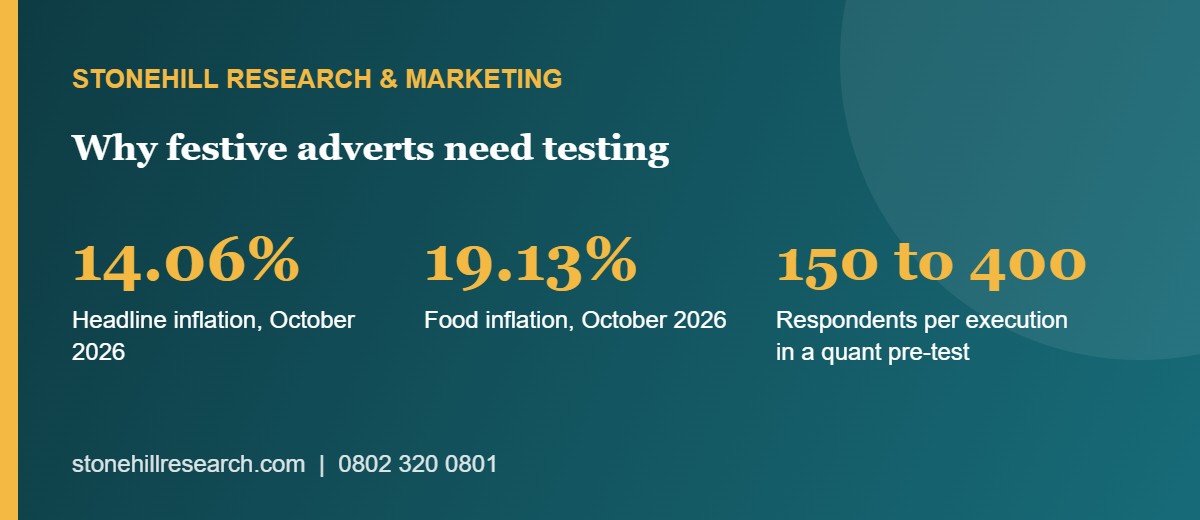
Nigerian consumers are still under price pressure. The National Bureau of Statistics put headline inflation at 14.06% in October 2026, with food inflation at 19.13%. Households watch every naira, so they reward brands that speak clearly to their needs and ignore those that do not.
Three trends make testing more valuable:
- Fragmented media. Audiences split across TV, radio, outdoor, YouTube, Instagram, TikTok, X and WhatsApp. A creative that works on TV may fail on a phone screen.
- Regulatory review. The Advertising Regulatory Council of Nigeria (ARCON) requires adverts to be vetted and approved before exposure. Late changes after testing can delay approval, so test early.
- Pressure on budgets. Finance teams want evidence that spend produces results. Testing provides it.
Pre-testing and post-testing compared
| Feature | Pre-testing | Post-testing |
|---|---|---|
| When | Before media buying, ideally at script or animatic stage | During or after the campaign |
| Main question | Will this advert work? | Did this advert work? |
| Typical measures | Comprehension, branding, appeal, persuasion, likely action | Recall, recognition, brand linkage, attitude shift, sales effect |
| Cost of a bad result | Low, since you can still fix it | High, since the money is spent |
| Best for | New campaigns, big launches, risky ideas | Learning for the next campaign, proving ROI |
Strong brands do both. Pre-testing protects the spend. Post-testing proves the return and improves the next brief.
What to measure in an advert
A good test answers a short list of questions. Keep them consistent across campaigns so you can compare results over time.
- Attention. Does the advert stop people? Do they watch, listen or read to the end?
- Branding. Do viewers know which brand it was for? Many memorable adverts fail here.
- Comprehension. Do people understand the main message in their own words?
- Relevance. Does the message matter to the target audience?
- Credibility. Do people believe the claim?
- Emotional response. How does the advert make people feel, and is that feeling linked to the brand?
- Persuasion. Are people more likely to consider, try or switch after seeing it?
- Cultural fit. Does the language, humour, music and casting land well across target regions?
In Nigeria, cultural fit deserves extra care. A joke that works in Lagos may fall flat in Kano or Enugu. Pidgin, Yoruba, Hausa and Igbo versions can perform very differently from an English master.
Pre-testing methods and budgets
Focus groups
Six to eight target consumers watch the advert and discuss it with a trained moderator. Focus groups reveal why people react as they do. They suit early scripts and rough cuts. Run separate groups by region, age or income where the audience is varied.
In-depth interviews
One-to-one interviews suit senior audiences such as business owners, doctors or high-net-worth bank customers who will not join a group.
Quantitative pre-tests
A sample of 150 to 400 target consumers per cell sees the advert online or on a tablet in a central location, then answers a structured questionnaire. This gives scores you can compare against benchmarks or against alternative executions.
A/B tests on digital platforms
For social and online adverts, run two or more versions to small matched audiences and compare click-through, view-through and conversion. This is fast and cheap but measures behaviour, not understanding. Combine it with a short survey where possible.
| Method | Typical sample | Best use | Limitation |
|---|---|---|---|
| Focus groups | 4 to 8 groups | Early ideas, cultural fit | Small samples, groupthink |
| In-depth interviews | 10 to 20 | Senior or niche audiences | Cost per interview |
| Quantitative pre-test | 150 to 400 per execution | Go or no-go decisions | Less depth on why |
| Digital A/B test | Platform audience | Social and online creative | Measures clicks, not meaning |
Post-testing methods
Post-testing tracks what the campaign did in the market.
- Campaign recall surveys. Ask a representative sample whether they saw advertising for the category, then which brands. Prompted and unprompted recall show different things.
- Recognition tests. Show stills or audio clips and ask whether people saw them and which brand they belonged to.
- Brand tracking. Compare awareness, consideration and preference before and after the campaign.
- Sales and retail data. Link campaign timing to sales, distributor orders or retail audit data where available.
- Digital analytics. Track search volume, site visits, app downloads and social engagement during the flight.
Always measure a baseline before the campaign starts. Without it, you cannot tell what changed.
A worked example
This example is illustrative. The brand, samples and scores are invented to show the method.
A malt drink brand plans a festive TV and social campaign. The agency presents two scripts. Script A is a humorous family scene in Lagos. Script B is an emotional story about a young man returning home to the east for Christmas.
The brand runs a pre-test in three stages:
- Focus groups. Six groups in Lagos, Onitsha and Kano. Script A gets laughs in Lagos but confuses viewers in Kano. Script B moves viewers in Onitsha and Lagos. Several respondents in all cities cannot name the brand after Script A.
- Animatic quantitative test. 300 target consumers per script.
- Social A/B test. Two 15-second cut-downs run to small matched audiences.
| Measure | Script A | Script B |
|---|---|---|
| Correct brand identification | 48% | 71% |
| Main message understood | 55% | 74% |
| More likely to buy | 31% | 44% |
| 15-second view-through rate on social | 22% | 29% |
The brand chooses Script B and adds the product earlier in the edit to raise branding further. It also produces a Hausa voice-over version for northern stations. After the campaign, a recall survey of 1,000 consumers measures prompted campaign recall and brand consideration against the pre-campaign baseline.
Common mistakes
- Testing too late. Testing a finished advert days before airing leaves no time to fix problems or clear ARCON review.
- Testing with the wrong people. Staff, agency teams and friends are not the target market.
- Ignoring branding scores. An advert people love but cannot attribute to your brand helps competitors.
- Lagos-only samples for national campaigns. Regional differences in language and culture are large.
- Leading questions. “Did you enjoy this great advert?” produces useless data.
- No baseline. Without pre-campaign measures, post-testing cannot show change.
- Treating digital clicks as the whole story. Clicks do not show whether people understood or remembered the brand.
- Not acting on results. Testing has value only if the creative changes when the data says it should.
How to build ad testing into your marketing calendar
- Agree standard measures for every campaign with your agency.
- Budget for testing as a fixed share of production and media cost.
- Test at script or animatic stage for every major campaign.
- Run quantitative pre-tests for launches and festive campaigns.
- Measure a baseline two to four weeks before launch.
- Run post-tests within two weeks of the campaign ending.
- Keep a database of scores so each new advert has a benchmark.
Testing by media type
Each medium needs a slightly different test, because people consume it in different ways.
Television and online video
Test the full spot and every cut-down. A 60-second film often loses its brand cue when edited to 15 or 6 seconds. Check whether the brand and the key message appear in the first five seconds of shorter versions, since many viewers skip or scroll after that.
Radio
Radio remains a major channel across Nigeria, especially outside Lagos and in commercial vehicles. Test audio-only, without visuals or scripts in front of respondents. Measure whether listeners can name the brand, repeat the offer and recall any phone number, shortcode or USSD string.
Outdoor
Billboards are seen for a few seconds from a moving vehicle. Show the design for three to five seconds, then ask what the brand was and what the message said. Long copy, small logos and low colour contrast fail this test most often.
Social media and influencer content
Test native formats on a phone screen, with sound off as well as on. For influencer content, test whether viewers recognise the post as advertising and whether the creator’s audience matches your target market. Credibility scores matter more here than polish.
Sector notes
Different sectors face different testing priorities.
| Sector | Priority measures | Common issue |
|---|---|---|
| FMCG | Branding, pack recognition, price-value message | Brand lost in a crowded festive scene |
| Banking and fintech | Trust, clarity of offer, security reassurance | Too many features in one advert |
| Healthcare | Credibility, comprehension, compliance with claims rules | Medical claims that confuse or overpromise |
| Power and utilities | Clarity, fairness, practical guidance | Messages that ignore real service problems |
| Education | Parent trust, proof of outcomes, fee clarity | Emotional imagery with no evidence |
A bank advert that scores high on appeal but low on trust is a risk. An FMCG advert that scores high on trust but low on branding wastes spend. Read the scores against the job the advert must do.
Reading the results
Do not judge an advert on one number. Look at the pattern:
- High appeal, low branding. Strengthen brand cues, show the product earlier and say the brand name sooner.
- High branding, low comprehension. Simplify the message to one idea.
- High comprehension, low persuasion. The message is clear but not motivating. Revisit the benefit or the proof.
- Strong in one region, weak in another. Consider regional versions or language adaptations.
Share results with the agency as a working session, not a verdict. Creative teams use specific findings far better than a single pass or fail score.
Frequently asked questions
What is ad pre-testing?
Ad pre-testing is research that measures how target consumers respond to an advert before it runs. It checks attention, branding, comprehension, appeal and persuasion so a brand can fix weak points or choose between options before buying media.
How much does ad testing cost in Nigeria?
Cost depends on method, sample size and regions. Focus groups and digital A/B tests suit smaller budgets. Quantitative pre-tests across several cities cost more. Most brands find testing costs a small share of the media budget it protects.
Does ARCON approval replace ad testing?
No. ARCON vetting checks that an advert complies with the advertising code and the law before exposure. It does not measure whether the advert will persuade consumers. Test first, then submit the final version for approval.
Should we test adverts in local languages?
Yes, when the campaign targets regional audiences. Language, humour and music can change how an advert performs. Testing English, Pidgin, Yoruba, Hausa or Igbo versions with the right audiences reduces the risk of a message failing in key markets.
When should post-testing happen?
Measure a baseline before launch, then run the post-test within about two weeks of the campaign ending, while memories are fresh. Long campaigns can add a mid-flight check to adjust creative or media.
Can small brands afford ad testing?
Yes. A small brand can run two or three focus groups or a short online survey with a few hundred target consumers, and use low-cost social A/B tests for digital creative. Even a simple test catches branding and comprehension problems before media money is spent.
Work with Stonehill Research
Stonehill Research and Marketing helps Nigerian brands test advertising before and after it runs. We design focus groups, quantitative pre-tests and recall studies across Lagos, Abuja, the north, the east and the south-south, for FMCG, banking, healthcare, power, education and digital brands. We turn the results into clear creative and media recommendations.
Explore our campaign management services, our consumer surveys and our media planning support.
To test your next campaign, call 0802 320 0801 or 0807 576 5799, email info@stonehillresearch.com, or visit our contact page.
This article is general guidance on advertising research as at November 2026. The worked example is illustrative. Confirm current advertising approval requirements with ARCON before running any campaign.