


Social Media Listening for Nigerian Brands: Turning Online Conversations Into Insight
Nigerians talk about brands online every minute of the day. They praise a bank’s new app on X, complain about a telecoms network on Instagram, review a restaurant on TikTok, and share frustrations about a delivery company in WhatsApp groups. They compare prices, recommend products and call out poor service, often in Pidgin, Yoruba, Hausa, Igbo or a mix of languages.
These conversations are a goldmine of insight for brands that know how to listen. Social media listening goes beyond counting likes and followers. It means systematically collecting and analysing what people say about your brand, competitors, products and category, then using those insights to improve products, service, marketing and reputation.
Many Nigerian brands monitor social media only to respond to complaints. Few turn the data into strategic insight. This guide explains how social listening works, what to track, the special challenges of Nigerian online conversation, and how to turn listening into decisions.
Monitoring versus listening
Social media monitoring tracks mentions of your brand so you can respond. It is reactive: a customer complains, and the team replies.
Social media listening analyses conversations over time to understand patterns, sentiment, drivers and trends. It is strategic: it tells you why people feel the way they do, what they want, and how perceptions are shifting.
Both matter. Monitoring protects customer relationships day to day. Listening informs decisions that shape the business.
What to listen for
Brand perception
What do people say about your brand? Which words appear most often? Is sentiment improving or worsening? Which topics drive positive and negative conversation?
Customer experience issues
Recurring complaints reveal operational problems: failed transactions, delivery delays, product quality issues, poor customer service. Listening shows which issues generate the most frustration and whether fixes are working.
Competitor intelligence
What do customers say about competitors? Which competitor features or campaigns attract praise? Where do competitors disappoint, creating openings for you?
Category trends
What are people discussing in your category? Emerging needs, new product ideas, changing preferences and price sensitivity often appear in social conversation before they show up in sales data.
Campaign performance
How do audiences react to your advertising and promotions? Beyond reach and engagement, what do people actually say? Do they understand the message? Do they like it?
Crisis signals
A sudden spike in negative mentions can signal an emerging crisis. Early detection gives brands time to respond before an issue spreads.
Influencers and advocates
Who drives conversation about your brand and category? Which creators, commentators and customers have influence with your target audience?
The Nigerian challenge: language, slang and context
Nigerian online conversation is rich, fast and culturally specific. That creates challenges for listening tools built for other markets.
- Pidgin and local languages. Many automated sentiment tools misread Nigerian Pidgin or miss Yoruba, Hausa and Igbo content entirely.
- Sarcasm and humour. Nigerian social media is famously witty. “This network is too sweet” may be praise or biting sarcasm depending on context.
- Slang that changes fast. New expressions appear and spread quickly.
- Code-switching. People mix English, Pidgin and local languages in the same post.
- Private channels. Much conversation happens in WhatsApp groups, which are private and not available to listening tools.
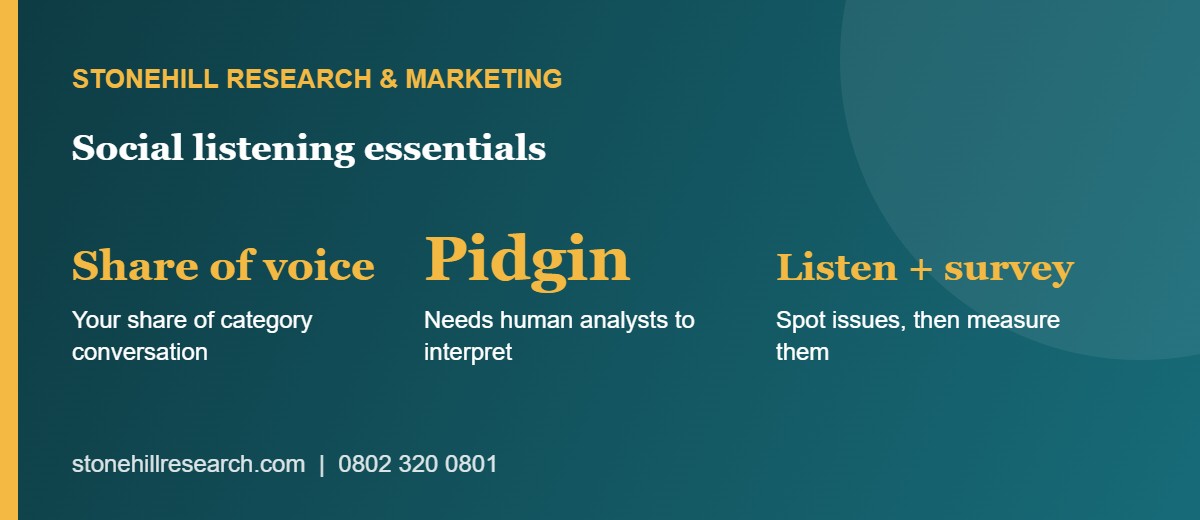
Automated tools are useful for collecting and organising data at scale, but human analysts who understand Nigerian language and culture are essential for accurate interpretation. A hybrid approach, with technology for scale and people for meaning, gives the best results.
Building a listening programme
1. Define objectives
What decisions will listening inform? Brand health tracking, service improvement, competitive monitoring, campaign evaluation or crisis management? Clear objectives shape what you collect and how you analyse it.
2. Choose keywords and sources
List brand names, product names, common misspellings, nicknames, campaign hashtags, competitor names and category terms. Include Pidgin and local language variants. Decide which platforms matter for your audience: X, Instagram, TikTok, Facebook, YouTube, news sites, forums and review platforms.
3. Select tools
Choose tools that cover the platforms you need, handle Nigerian content reasonably well, and allow export for deeper analysis. Budget for human analysis alongside software.
4. Set up categories
Create a coding framework for topics, such as pricing, product quality, customer service, delivery, app performance and advertising, and for sentiment. Train analysts to code consistently.
5. Analyse and report
Report regularly with clear insights, not just volumes. Show trends over time, key drivers of sentiment, notable conversations, competitor comparisons and recommended actions.
6. Act and close the loop
Share insights with the teams who can act: customer service, product, operations, marketing and leadership. Track whether actions change the conversation.
Metrics that matter
| Metric | What it shows |
|---|---|
| Share of voice | Your brand’s share of category conversation compared with competitors |
| Net sentiment | Balance of positive and negative mentions |
| Topic drivers | Which issues drive positive and negative sentiment |
| Complaint themes | Most common customer issues and their trends |
| Response time | How quickly the brand responds to customer posts |
| Campaign reaction | Volume and sentiment of conversation about campaigns |
| Influencer reach | Who shapes conversation and how far it travels |
Focus on metrics linked to business decisions, not vanity numbers.
Combining listening with other research
Social media users are not a perfect mirror of all customers. They tend to be younger, more urban and more digitally active. People who post are often those with strong opinions, especially complaints. Use listening alongside surveys, focus groups and sales data to get a balanced view. Listening is excellent for spotting issues and themes. Surveys are better for measuring how widespread they are.
Privacy and ethics
Public posts are visible, but the people who write them still have rights. Under the Nigeria Data Protection Act 2023, information that identifies individuals is personal data. Analyse data in aggregate, avoid building profiles of individuals without a lawful basis, store data securely, and do not publish identifiable posts in reports without care. Respect platform terms of service.
A worked example
A Nigerian food delivery company saw its app ratings fall and assumed the problem was competitor pricing. It commissioned a three-month listening study covering X, Instagram and TikTok, with human analysis of Pidgin and English content.
The study found that negative sentiment was driven mainly by late deliveries in specific Lagos areas during evening peaks and by poor handling of refunds, not by price. Positive conversation centred on the variety of restaurants and promotional codes. Competitors faced similar complaints about delivery times, but one competitor received praise for proactive delay notifications.
The company added riders in the worst-affected zones during peak hours, introduced automated delay notifications and simplified refunds. Over the following quarter, negative mentions about delivery fell and app ratings recovered.
Figures are illustrative.
Common mistakes
- Treating listening as complaint handling only.
- Relying entirely on automated sentiment scores that misread Pidgin and sarcasm.
- Tracking only your own brand and ignoring competitors and category.
- Reporting volumes without insight.
- Assuming social media represents all customers.
- Collecting insights that nobody acts on.
Listening during crises
When a brand faces a crisis, such as a service outage, product recall, data breach or viral complaint, listening becomes a real-time management tool. Track volume and sentiment hourly, identify the main narratives and influential voices, and monitor how audiences respond to the brand’s statements. Listening shows whether a response is calming concerns or making them worse, and helps the team adjust messaging quickly.
Prepare before a crisis happens. Agree who monitors, who decides, and who responds. Set thresholds that trigger escalation, such as a sudden rise in negative mentions or a post from a high-reach account. Brands that have a listening and response plan in place respond faster and more consistently.
Sector applications in Nigeria
Banking and fintech. Track complaints about failed transactions, app downtime, charges and fraud. Compare sentiment across banks and digital platforms.
Telecoms. Monitor network quality complaints by location, data pricing conversations and reactions to tariff changes.
FMCG. Listen for product quality issues, price reactions, pack size changes and conversations about value. Track campaign reactions and influencer content.
Healthcare. Monitor patient experiences, misinformation about medicines and public health topics, and reputation of hospitals and pharmacies.
Power and utilities. Track complaints about outages, billing and metering by area, and reactions to tariff announcements.
Education. Listen to parent conversations about fees, safety, results and school events.
Building internal capability
Some brands run listening in-house. Others outsource. A common model combines both: an external partner provides tools, analysis and regular reports, while an internal team handles daily monitoring and responses. Whichever model you choose, make sure someone senior owns the insights and has the authority to act on them.
Measuring the return on listening
Listening costs money, so measure its value. Track issues identified through listening and the actions taken, changes in complaint volumes and sentiment after fixes, campaign adjustments made based on audience reaction, and crises detected early. Over time, these examples show how listening protects revenue and reputation.
Getting started
Brands new to listening should start small. Pick one objective, such as tracking customer service complaints, set up keywords for your brand and two main competitors, and review findings monthly for three months. Use what you learn to refine keywords, categories and reporting before expanding. A focused programme that produces action beats a large one that produces reports nobody reads.
Reporting rhythm
Agree a reporting rhythm that matches decision cycles: daily alerts for customer service and crisis signals, monthly insight reports for marketing and product teams, and quarterly brand health reviews for leadership.
Keep humans in the loop
Automated dashboards are a starting point. The value comes from analysts who read real posts, understand context and explain what the numbers mean for the business.
Frequently asked questions
What is social media listening?
The systematic collection and analysis of online conversations about a brand, competitors and category to understand perceptions, issues and trends, and to inform business decisions.
How is social listening different from monitoring?
Monitoring tracks and responds to individual mentions. Listening analyses patterns over time to produce strategic insight.
Can social listening tools understand Nigerian Pidgin?
Many tools struggle with Pidgin, local languages and Nigerian sarcasm. Human analysts familiar with Nigerian language and culture are needed for accurate interpretation.
Which platforms should Nigerian brands monitor?
It depends on the audience, but common platforms include X, Instagram, TikTok, Facebook and YouTube, along with news sites and review platforms.
Is social media listening legal under Nigerian data protection law?
Yes, when done responsibly. Analyse data in aggregate, avoid profiling individuals without a lawful basis, secure the data and respect platform terms.
How does social listening help during a brand crisis?
It tracks volume, sentiment and narratives in real time, identifies influential voices, and shows whether the brand’s response is calming concerns, so the team can adjust messaging quickly.
Work with Stonehill Research
Stonehill Research & Marketing provides social media listening and brand tracking for Nigerian brands, combining listening tools with analysts who understand Nigerian language and culture. We integrate listening with surveys and focus groups for a complete view of brand health. See our brand communication surveys and advertising and media services.
Discuss your next study: call 0802 320 0801 or 0807 576 5799, email info@stonehillresearch.com, or visit stonehillresearch.com/contact-us.
This article is general information based on research practice.