

Concept and Pack Testing in Nigeria: How to Test New Products Before Launch
A new product launch in Nigeria is an expensive bet. Production runs, packaging, distributor margins, NAFDAC registration and media all cost money before the first sale. If shoppers do not want the product, or do not understand the pack, that money is gone.
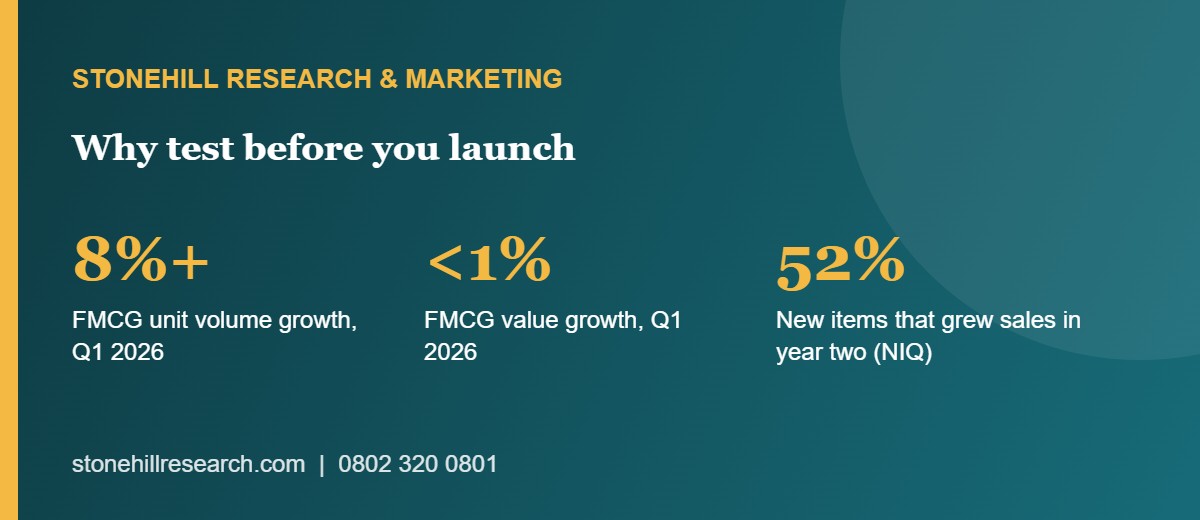
Shopping habits are shifting fast. Worldpanel by Numerator reported in May 2026 that unit volumes in Nigeria’s FMCG market grew by more than 8% in the first quarter of 2026 while value grew by less than 1%. It advised brands to optimise pack-price architecture. Shoppers are buying more, smaller and cheaper. A pack size that worked in 2023 may be wrong for 2027.
Concept and pack testing reduce the risk. They show which ideas shoppers want, which pack formats they will pay for and which claims they believe, before you commit to a full launch. NielsenIQ’s BASES unit studied more than 60,000 innovations and found that 52% of nationally distributed new items grew sales in their second year. Testing helps put your launch in the half that grows.
This guide explains how to design concept and pack tests that work in Nigeria, how to read the results and what regulations affect the final pack.
What concept and pack testing measure
| Test | Question it answers | Typical measures |
|---|---|---|
| Concept screening | Which of several ideas should we develop? | Appeal, uniqueness, relevance, purchase intent |
| Full concept test | Will this idea succeed and with whom? | Purchase intent, price acceptance, likes and dislikes, expected frequency |
| Pack test | Does the pack stand out, communicate and persuade? | Shelf visibility, findability, message recall, brand fit, purchase intent |
| Price test | What will shoppers pay for each pack size? | Purchase intent at price points, price sensitivity |
| Product test | Does the product deliver on the promise? | Liking, taste or performance, match to concept |
Concept tests come first, before major investment. Pack and price tests follow once the product is close to final.
Choosing a test design
Monadic
Each respondent sees one concept only. This removes order effects and gives the cleanest read of how a concept would perform alone. It needs a larger total sample because each concept needs its own cell.
Sequential monadic
Each respondent sees two or more concepts in random order and rates each one. The sample is smaller and costs fall, but the first concept can colour views of the next.
Paired comparison
Respondents see two options side by side and choose. This works well for pack design choices, such as two colour routes.
For a final go or no-go decision, use monadic cells. For early screening of many ideas, use sequential monadic.
Designing the test for Nigeria
- Define the target shopper. Main household shopper, young urban professional, mother of under-fives or another defined group.
- Cover the right regions. Include Lagos, the North and the South East or South South where the brand will sell. Tastes, languages and price sensitivity differ.
- Reach the mass market. Use face-to-face interviews in markets, homes or central locations for low-income and rural shoppers. Online panels skew urban and higher income.
- Show realistic stimulus. Use a clear concept board with a picture, a short description, the price and the pack size. For packs, use physical mock-ups or photographs on a simulated shelf with competitors.
- Test real price points. Include the price per pack and the price per unit. Shoppers notice when small packs cost more per gram.
- Ask the right questions. Purchase intent on a five-point scale, likes and dislikes in their own words, believability of claims, and expected frequency of purchase.
- Benchmark results. Compare against a known product or past tests in the same category. A score has meaning only against a benchmark.
Reading purchase intent carefully
Stated purchase intent overstates real buying. Research by Morwitz, Steckel and Gupta in the International Journal of Forecasting showed that intentions must be calibrated before they predict sales. Practitioners commonly focus on the share of respondents who say they will “definitely” or “probably” buy, often called the top-two-box score, and weight “definitely” more heavily.
Look beyond the headline number:
- Which groups like the concept most?
- What do people dislike, in their own words?
- Do respondents believe the main claim?
- Does purchase intent hold at the planned price?
- Would buyers switch from their current brand or simply add the new product occasionally?
Pack testing in a sachet economy
Small packs dominate many Nigerian categories. BusinessDay reported in January 2025 on ₦50 to ₦500 pay-as-you-go packs of rice, beans and garri, and noted consumer advocates’ concern that these often cost more per gram. A 2025 FMCG review by law firm Jackson, Etti & Edu described sachetisation as “even more pronounced”.
Pack tests should answer five questions:
- Can shoppers find the pack quickly on a crowded shelf or hawker tray?
- Do they recognise the brand at a glance?
- Do they understand the product and size?
- Do they believe the main claim?
- Will they pay the price for this size?
Test the full range of sizes together. A new small sachet can grow total brand sales or simply move buyers down from a more profitable size.
Regulatory checks before the final pack
Testing shows what shoppers want. The final pack must also meet the law.
| Requirement | Source |
|---|---|
| Labelling of pre-packaged food, including name, ingredients and nutrition information | Pre-packaged Food (Labelling) Regulations 2023 |
| NAFDAC registration number, English as primary language, manufacture and best-before dates in DD/MM/YYYY | NAFDAC labelling requirements |
| Product registration, valid for five years | NAFDAC Foods and Related Products Registration Regulations 2025 |
| No misleading trade descriptions on goods or packaging | Federal Competition and Consumer Protection Act 2018, section 116 |
| MANCAP certification for locally manufactured products under SON standards | Standards Organisation of Nigeria |
NAFDAC announced on 16 November 2026 that it would cut registration fees by 50% for businesses with five or fewer staff. That lowers one barrier for small brands testing new products.
Worked example
This example is illustrative. The brand and figures are invented.
Sunrise Foods plans a new instant pap (ogi) product. It tests three concepts with 900 main household shoppers in Lagos, Ibadan, Kano and Enugu, using monadic cells of 300 each.
| Concept | Definitely buy | Probably buy | Top-two-box | Main dislike |
|---|---|---|---|---|
| A: Plain instant pap, 500g tin | 14% | 31% | 45% | Price too high |
| B: Fortified instant pap with milk, 50g sachet | 26% | 38% | 64% | None strong |
| C: Flavoured pap for children, 200g pouch | 18% | 30% | 48% | Doubts about flavours |
Concept B wins clearly, driven by mothers in Lagos and Kano who value fortification and the low sachet price. Sunrise then runs a pack test on two sachet designs on a simulated hawker tray. Design 2 is found faster and its “fortified with vitamins” claim is better believed. A price test shows purchase intent holds at ₦150 but falls sharply at ₦200.
Sunrise launches Concept B in Design 2 at ₦150, with a 500g family pack added six months later for established buyers.
Testing claims and messages
Claims drive purchase decisions. Shoppers in a price-sensitive market look for proof of value, such as fortification, larger quantity or longer-lasting performance. Test claims before they go on the pack.
- List candidate claims. For a fortified food, these might include “fortified with vitamins A and D”, “extra milk” or “keeps children full longer”.
- Measure appeal and believability. Ask respondents how appealing and how believable each claim is. A claim that appeals but is not believed adds little.
- Check substantiation. Confirm the company can prove each claim with test results or formulation records. Section 116 of the FCCPA bans misleading trade descriptions.
- Test in local languages. Where packs or adverts will use Hausa, Yoruba, Igbo or Pidgin, test the claim in that language.
- Keep the strongest one or two. Packs crowded with claims communicate nothing.
Getting trade feedback
Shoppers decide whether they buy. Retailers, wholesalers and distributors decide whether shoppers ever see the product. Add a short trade module to the research. Ask market traders, supermarket buyers and key distributors how they would stock, display and price the product, what margin they expect and which pack sizes move fastest in their outlets. A pack that shoppers love but traders refuse to stock will not sell. Trade feedback also helps the sales team prepare for launch conversations.
From test results to launch plan
A test is only useful if it shapes decisions. Turn results into a clear plan.
| Result | Decision |
|---|---|
| Strong purchase intent, strong price acceptance | Proceed to launch planning |
| Strong appeal, weak price acceptance | Revisit pack size, formulation cost or price point |
| Appeal concentrated in one region or group | Launch regionally first, then expand |
| Weak believability of main claim | Change the claim or add proof on pack |
| Pack hard to find on shelf | Redesign colour, logo size or shape and retest |
| Weak results overall | Stop and redirect investment |
Write a one-page launch brief that records the winning concept, pack, price, target shopper and regions, and the evidence behind each choice. Use it to brief sales, distributors and agencies.
Budgeting and timing a testing programme
Testing works best as a series of small steps rather than one large study at the end.
| Stage | Typical research | When |
|---|---|---|
| Idea screening | Quick sequential monadic test of five to ten ideas | Early in development |
| Concept refinement | Monadic test of two or three refined concepts | Before formulation is final |
| Product test | Home use or central location tasting | When prototypes are ready |
| Pack and price test | Shelf simulation and price testing | Before packaging is printed |
| Post-launch tracking | Awareness, trial and repeat measures | Three to six months after launch |
Allow time for NAFDAC registration and packaging lead times after the pack test. A rushed pack test that leaves no time to act on the findings wastes money.
Keep a record of every test and its results. Over time these become your own benchmarks, which make future tests cheaper and faster to read.
Common mistakes
- Testing only in Lagos for a national brand.
- Using online panels alone for a mass-market product.
- Showing concepts without a price.
- Reading top-two-box scores without a benchmark.
- Testing packs in isolation instead of on a shelf with competitors.
- Ignoring how a new size affects sales of existing sizes.
- Making claims on the pack that cannot be substantiated.
- Finalising packs before checking NAFDAC labelling rules.
Frequently asked questions
How many respondents does a concept test need in Nigeria?
It depends on the number of concepts and the groups you need to read. Monadic designs commonly use a few hundred respondents per concept. Add more if you need separate results for regions or income groups.
What is the difference between monadic and sequential monadic testing?
In a monadic test each respondent sees one concept. In a sequential monadic test each respondent sees several concepts in random order. Monadic gives a cleaner read but needs a larger sample.
When should a company run a pack test?
After the product and concept are close to final and before printing packaging at scale. Pack tests catch problems with visibility, communication and claims while changes are still cheap.
Does a high purchase intent score guarantee a successful launch?
No. Stated intent overstates real buying. Distribution, price, advertising and product delivery all affect results. Calibrate intent against benchmarks and past launches.
Do test packs need NAFDAC registration?
Research mock-ups shown to respondents are not sold, but any product sold in market tests or at launch must meet NAFDAC registration and labelling rules. Check requirements with NAFDAC or a regulatory adviser before any in-market trial.
Work with Stonehill Research
Stonehill Research & Marketing designs and runs concept tests, pack tests, price tests and product tests for brands across Nigeria. We cover FMCG, banking, power, healthcare, education and social media, with face-to-face fieldwork in markets, homes and central locations across urban and rural Nigeria. Our team turns results into clear launch recommendations.
Learn more about our product development and innovation research, consumer surveys and launch strategy and planning.
To test your next product before launch, call 0802 320 0801 or 0807 576 5799, email info@stonehillresearch.com, or visit our contact page.
Sources: NielsenIQ BASES on innovation vitality, Worldpanel by Numerator on Nigeria FMCG volume growth and NAFDAC Foods Registration Regulations 2025.
This article is general guidance at November 2026. Figures in the illustrative example are invented. Seek regulatory advice before launching any product.