

Nigeria’s Electricity Customer Evidence Gap: Why Independent Research Matters Now
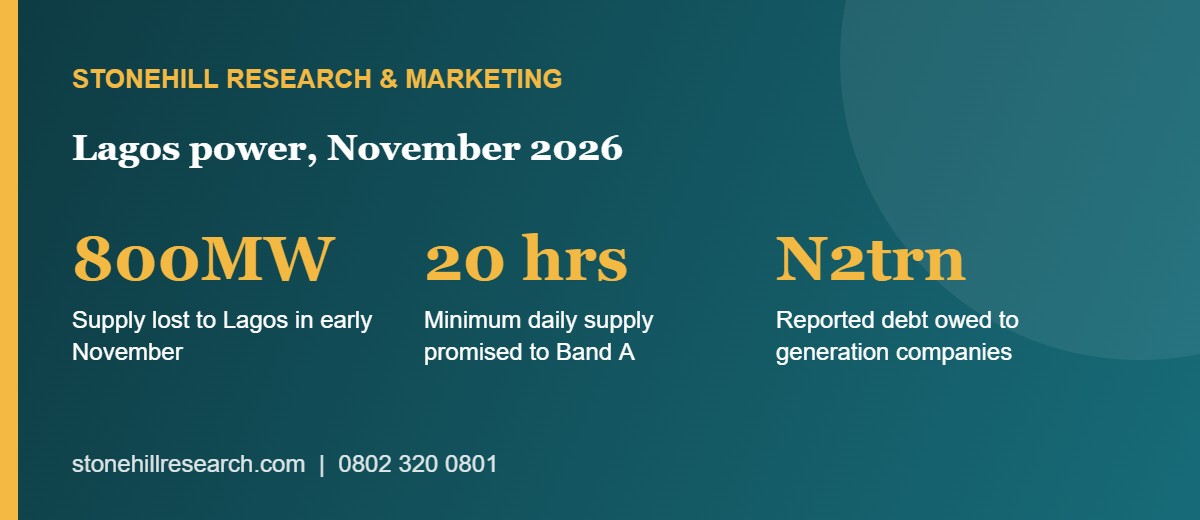
In early November 2026, Lagos lost a large share of its power supply. Power Minister Joseph Tegbe apologised to the public and said the blackouts were not a grid collapse. He linked them to planned maintenance at the Egbin power station and a vandalised 330kV transmission line. Together these took about 800MW away from Lagos. By 9 November, supply had recovered to about 1,000MW, according to The Nigeria Brief of 10 November 2026. The same report noted that generation companies are owed about N2 trillion, which the minister says will be paid next year.
The arguments that followed told a familiar story. Distribution companies (DisCos) questioned NNPC and the Nigerian Independent System Operator (NISO) over conflicting accounts of what caused the outages, according to an OsunDefender newspaper review on the same day. Each party had its own version. Nobody had a shared, independent picture of what customers actually went through.
That is the evidence gap. Engineers measure megawatts at substations. Finance teams track collections. Regulators publish tariff orders. Yet few people in the sector can say, with confidence, how many hours of supply a Band A household on a given feeder really received last month. Or how many customers on estimated bills dispute them. Or how much a small business spends on diesel because the grid failed. A well-designed electricity customer satisfaction survey in Nigeria can answer those questions. This article explains what to measure, how to design the study, and how the results serve DisCos, the regulator and large power users.
Why customer evidence matters more under service-based tariffs
The Nigerian Electricity Regulatory Commission (NERC) moved the market towards service-based tariffs. Customers sit in bands from A to E. Each band carries a minimum daily supply commitment, set out in NERC’s tariff guidance:
| Band | Minimum daily supply |
|---|---|
| A | 20 hours |
| B | 16 hours |
| C | 12 hours |
| D | 8 hours |
| E | 4 hours |
Band A customers pay the highest tariff because they are promised the most supply. This structure links price directly to service. That link only works if someone checks the service. When a DisCo bills a customer at the Band A rate but delivers 14 hours, the customer pays for a promise that was not kept. NERC has acted on this before, ordering DisCos to downgrade feeders and compensate customers where supply fell short.
Feeder data from DisCos and NERC’s own monitoring are essential. But they show supply at the feeder head. They do not always reflect what reaches each street, each building or each meter. A transformer fault, a phase imbalance or a local cable theft can leave a group of customers in the dark while the feeder looks healthy on paper. Customer research fills that last-mile gap.
Recent events show the stakes. When 800MW drops out of a city’s supply, every band feels it. Customers want to know whether their tariff band still reflects reality. DisCos want proof that the shortfall came from upstream. Regulators want to know whether the band commitments are being honoured. Independent customer evidence speaks to all three.
What customer research can measure
A good study goes beyond a single satisfaction score. It breaks the customer experience into parts that management and regulators can act on. Here are the six areas that matter most.
1. Supply hours by band against tariff band promises
Ask customers to report their supply hours over a defined period, such as the past seven days. Match each response to the customer’s billing band and feeder. You can then compare reported hours with the band commitment. Diary methods and short daily SMS check-ins improve accuracy, because people forget outage patterns quickly. Where possible, pair self-reports with a sample of smart meter or data logger readings to validate them.
2. Billing accuracy and estimated billing
Many Nigerian customers still lack meters. They receive estimated bills, and disputes are common. NERC has issued orders to cap estimated bills for unmetered customers. Research can measure how many respondents receive estimated bills, how those bills compare with the caps, and how often customers feel overcharged. For metered customers, you can measure whether bills match token purchases and meter readings.
3. Metering experience
Metering programmes have been a major policy focus. Customer research can track the full journey. How long did the customer wait for a meter? Did they pay for it upfront? Were they promised a refund through energy credits? Did installation happen on time? Does the meter work, and can the customer buy tokens easily? This journey data shows where bottlenecks sit, which matters for both DisCos and metering asset providers.
4. Complaint resolution
Measure how customers raise complaints, how long resolution takes and whether the outcome satisfies them. Track the share of complaints that reach the NERC Forum Offices after DisCo channels fail. Ask whether the customer received a reference number and a follow-up. These measures reveal process failures that internal ticket systems can hide, because a closed ticket is not always a resolved problem.
5. Willingness to pay
Tariff debates often assume what customers can or will pay. Research can test this directly. Contingent valuation and conjoint methods ask customers to choose between combinations of price and supply hours. The results show how much extra supply is worth to different segments. A tailor in Ibadan, a cold room operator in Kano and a family in Lekki will answer very differently. Tariff design should reflect that.
6. Self-generation spend
Nigerian households and businesses spend heavily on petrol and diesel generators, inverters and solar systems. That spend is the true cost of unreliable supply. Measure monthly fuel spend, generator maintenance and backup equipment investment. Compare it with grid bills. This figure helps make the case for tariff adjustments tied to better service. It also helps DisCos understand the competitive threat from off-grid solutions.
Study designs that work in Nigeria
No single method answers every question. The right design depends on the decision the client needs to make. These four approaches cover most needs in the power sector.
Household and SME surveys. Structured surveys remain the backbone of customer research. Face-to-face interviews reach customers who are not online and allow interviewers to verify meter types and bill copies with consent. Telephone surveys cost less and work well for tracking. Online surveys suit large commercial users. Separate questionnaires for households and small businesses are worth the effort, because their consumption patterns, pain points and spend differ sharply.
Mystery shopping of customer care. Trained researchers pose as customers. They call contact centres, visit customer care offices and use digital channels. They log wait times, staff knowledge, accuracy of information and whether complaints are recorded properly. Mystery shopping gives DisCos an honest view of their front line. It also gives regulators a consistent way to compare service standards across DisCos.
Panel tracking. A panel follows the same customers over months or years. It shows how experience changes after a tariff review, a metering push or a major outage. Panels are ideal for measuring the effect of a specific intervention. They require careful management to limit drop-out, and incentives must be fair and transparent.
Feeder-level sampling. Sampling by feeder ties customer evidence directly to the network. Researchers draw samples within selected feeders across Bands A to E. Results can then be compared with DisCo feeder reports and NERC band classifications. This design is the most useful for service-based tariff compliance, because it lets analysts say whether a particular feeder delivers its band commitment from the customer’s side.
A sample survey question set
The questions below show how a household module might look. Adapt wording, languages and answer codes to the area and the client’s needs. Pilot every question before fieldwork.
- Which company supplies electricity to this home? (Record DisCo name.)
- Which tariff band appears on your most recent bill or token receipt? (A, B, C, D, E, Don’t know)
- Do you have a working electricity meter? (Yes prepaid, Yes postpaid, No meter, Don’t know)
- In the past seven days, about how many hours of grid supply did you receive on a typical day? (Record hours)
- On how many of the past seven days did you have no grid supply at all? (0 to 7)
- Was your last bill an estimated bill? (Yes, No, Don’t know)
- How fair do you think your last bill was? (Very fair, Fair, Neither, Unfair, Very unfair)
- In the past three months, did you make a complaint to your DisCo? (Yes, No)
- If yes, was the complaint resolved to your satisfaction? (Yes fully, Partly, No, Still open)
- How many days did resolution take? (Record days)
- How much did your household spend on generator fuel in the past month? (Record naira amount)
- If your supply rose by four hours a day, how much more would you pay each month? (Show price cards)
- Overall, how satisfied are you with your electricity supply? (Five-point scale)
- How likely are you to recommend your DisCo to a friend? (0 to 10)
For SMEs, add questions on business hours lost to outages, spoilage of stock, equipment damage from voltage swings and the share of operating costs spent on backup power.
How results feed tariff reviews
NERC conducts periodic tariff reviews under the Multi-Year Tariff Order (MYTO) framework. These reviews weigh costs, investment needs and consumer protection. Customer evidence strengthens each step.
Willingness-to-pay data helps the regulator test whether proposed tariffs are realistic for each band. Supply-hour data shows whether band classifications match reality. Billing and metering data reveal whether customers are paying for what they consume. Self-generation spend shows the cost customers already bear when the grid fails.
DisCos benefit too. A DisCo that brings independent customer evidence to a tariff review strengthens its case. It shows the regulator that it understands its customers and tracks service honestly. That credibility counts when the DisCo asks for tariff adjustments or performance targets.
Consumer groups and state governments are also stakeholders. Since the 2023 constitutional amendment allowed states to regulate electricity markets within their borders, several states have set up their own regulators. These new bodies need baseline customer data to set rules and track progress. Independent research gives them a neutral starting point.
Service-based tariff compliance
Compliance monitoring is the most direct use of customer research in today’s market. The logic is simple. If a customer pays for Band A, they should receive Band A supply.
A compliance study samples customers within feeders across each band. It records supply hours over a fixed period, using diaries, SMS check-ins or logger devices. Analysts compare the results with the band minimums and with the DisCo’s own feeder data. Gaps get flagged for investigation.
This approach protects all sides. Customers gain evidence when they are overcharged. DisCos gain evidence when they are blamed for failures that started upstream at generation or transmission level. Regulators gain an independent check that does not depend on any operator’s self-reporting.
The November 2026 outages show why this matters. When DisCos, NNPC and NISO give conflicting accounts, customer-side evidence becomes a neutral reference point. It cannot say where in the chain a fault began. It can say exactly what customers experienced, where and when.
Investor due diligence
Investors look closely at Nigerian power assets. They study DisCo acquisitions, metering projects, embedded generation, mini-grids and solar businesses. Financial models rest on assumptions about demand, collection rates and willingness to pay. Those assumptions need testing.
Customer research gives investors ground truth. It shows how many customers in a franchise area pay their bills, what they think of the service and how much they spend on alternatives. It reveals the size of the market for backup power and off-grid solutions. It highlights reputational risks before a deal closes.
For lenders and development finance institutions, independent customer data also supports environmental, social and governance reporting. It shows that a project considered the people it serves.
Reputation management for DisCos and large power users
DisCos face intense public scrutiny. Outages, estimated bills and slow complaint handling generate headlines and social media anger. A DisCo that tracks customer sentiment can spot problems early and respond before they escalate.
Regular satisfaction tracking shows which customer groups feel most let down and why. It tells management whether a new metering drive or a revamped contact centre actually improved perceptions. It gives communications teams facts to share instead of defensive statements.
Large power users have a stake as well. Manufacturers, hospitals, universities, banks and telecom operators depend on reliable supply. Many negotiate bilateral contracts or operate as eligible customers. Research among their own staff, tenants or communities can show how power reliability affects their operations and their reputation. A hospital that can document outage impacts makes a stronger case to its DisCo and to regulators.
Data quality and ethics
Customer research is only useful if it is accurate and ethical. Four principles guide good practice.
Sound sampling. Samples must represent the population the client wants to understand. Feeder-level or band-level quotas, proper weighting and transparent margins of error are essential. A survey of only urban, connected or vocal customers will mislead.
Verification. Supervisors should back-check a share of interviews. GPS stamps, time stamps and audio checks, used with consent, catch fabricated data. Where possible, compare self-reported supply hours with logger or meter data.
Neutral questions. Wording must not lead respondents. Questions about blame for outages need special care, because customers often cannot know whether a fault sat with generation, transmission or distribution. Ask about experience, not about who is at fault.
Data protection. The Nigeria Data Protection Act 2023 (NDPA) sets clear rules. Researchers must obtain informed consent, explain the purpose of data collection and tell respondents how their data will be used and stored. Personal data such as names, phone numbers, meter numbers and addresses must be kept secure and used only for the stated purpose. Respondents can withdraw. When a DisCo commissions research, it should receive anonymised or aggregated results unless respondents agree otherwise. An independent research firm acts as a buffer that protects customer privacy and encourages honest answers.
Independence matters for one more reason. Customers speak more freely to a neutral researcher than to the company that bills them. Regulators and investors trust findings more when the fieldwork sits outside the operator. That is why independent customer research carries weight in a sector where trust is scarce.
Neutral evidence in an election season
Power supply is a major issue as the January 2027 elections approach, and every party will make pledges on it. Whatever the targets, customers judge results by what reaches their homes and businesses.
Neutral customer evidence gives every stakeholder a common baseline. It lets the public, the regulator and operators judge progress by measured experience rather than claims. Good research does not take sides. It records what customers live with.
Where to start
A practical first step is a baseline study. Survey households and SMEs across a DisCo franchise or a state, sampled by feeder and band. Add a mystery shopping wave to test customer care. Then repeat the core measures every quarter or after major events such as tariff reviews or large outages.
The sector already collects plenty of engineering and financial data. What it lacks is a steady, independent view of the customer. Closing that gap makes tariff reviews fairer, compliance checks sharper, investment decisions safer and public debate better informed.
Frequently asked questions
What is an electricity customer satisfaction survey in Nigeria?
It is a structured study that measures how customers experience their electricity service. It covers supply hours, billing, metering, complaint handling and overall satisfaction. Results help DisCos, regulators and investors make decisions based on customer evidence.
How does customer research support service-based tariff compliance?
Researchers sample customers within feeders across Bands A to E. They record actual supply hours and compare them with each band’s minimum commitment. Gaps show where customers may be paying for supply they do not receive.
Can a survey show who caused an outage?
No. A survey records what customers experienced, where and when. It cannot pinpoint whether a fault began at generation, transmission or distribution. It does give a neutral reference point when operators give conflicting accounts.
How do you protect respondents’ personal data?
We follow the Nigeria Data Protection Act 2023. Respondents give informed consent, learn how their data will be used and can withdraw. Personal details stay secure, and clients receive anonymised or aggregated results unless respondents agree otherwise.
How often should a DisCo run customer research?
Start with a baseline study. Then track core measures every quarter, and add focused studies after tariff reviews, metering drives or major outages. Regular tracking shows whether changes improve the customer experience.
Work with Stonehill Research
Stonehill Research works across the power sector, alongside banking, healthcare, education, FMCG and social media. Our team designs and runs customer surveys, feeder-level compliance studies, mystery shopping and customer experience research that decision-makers can rely on. See our power sector research, customer satisfaction surveys and data collection and surveys services.
To discuss an independent electricity customer study, call 0802 320 0801 or 0807 576 5799, email info@stonehillresearch.com, or visit our contact page.
This article is general information based on public reports and NERC guidance available on 11 November 2026. Check current NERC orders before relying on any band or billing rule.