

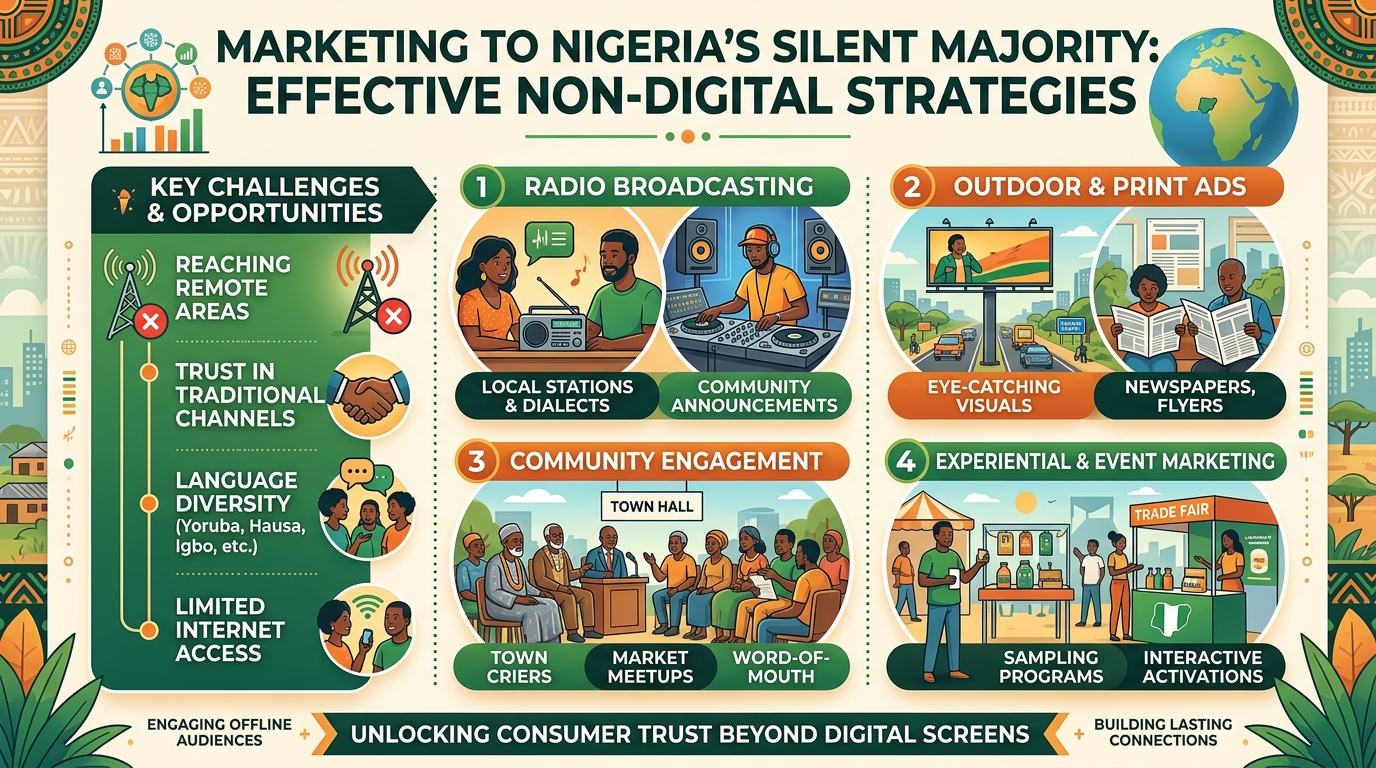
Marketing to Nigeria’s Silent Majority: Insights from Non-Digital Consumers
Most brands chase the same people. Young, urban, smartphone users.
But they are missing something huge.
A vast segment of Nigerian consumers remains invisible in online metrics. Rural communities. Informal economy workers. Traditional market shoppers. They control significant purchasing power.
Understanding these non-digital consumers is not just good business. It is essential for genuine national penetration and sustainable growth.
Let me show you who they are and how to reach them.
Understanding Nigeria’s non-digital consumer landscape
Nigeria’s non-digital majority is not a monolithic group. It is diverse segments united by limited internet access, traditional shopping habits, and community-centered decision-making.
Who are Nigeria’s non-digital consumers?
Nigeria’s non-digital consumers represent approximately 60% to 70% of the population.
Rural communities. Over 80 million Nigerians live in rural areas where internet penetration remains below 30%. These consumers rely on local markets, traveling merchants, and community recommendations for product discovery and purchases.
Informal economy workers. Market traders, artisans, commercial drivers, and street vendors conduct business primarily through cash transactions and face-to-face interactions. Despite significant income generation, their purchasing patterns remain offline.
Older demographic groups. Adults aged 45 and above grew up without digital technology. They maintain preference for traditional shopping experiences, personal interactions, and tangible product evaluation before purchase.
Low-income urban residents. City dwellers lack smartphones or reliable internet access due to economic constraints. Yet they participate actively in consumer markets through alternative channels.
Key characteristics and behaviors
Trust through community. Purchase decisions are heavily influenced by family recommendations, community leaders, religious figures, and trusted local retailers. Word-of-mouth marketing carries exponentially more weight than any advertisement.
Cash-dominant transactions. Despite mobile money growth, the majority of transactions in non-digital segments remain cash-based. Payment flexibility and credit arrangements with known vendors are valued over convenience.
Sensory shopping preferences. These consumers prioritise the ability to touch, smell, taste, and physically examine products before purchase. A digital experience cannot replicate this fundamental need.
Media consumption patterns. Radio remains the primary mass media channel, followed by television in urban areas. Community gatherings, religious institutions, and market days serve as crucial information exchange points.
Related post: Read our Nigeria Consumer Segmentation Study 2026 for detailed demographic analysis.
Traditional marketing channels that still deliver results
While digital marketing dominates industry conversations, traditional channels continue to deliver exceptional ROI when targeting Nigeria’s non-digital majority.
Radio: the unrivaled mass medium
Radio maintains unparalleled reach across Nigeria. It penetrates communities regardless of literacy levels, electricity availability, or economic status.
Local language broadcasting. Nigeria’s linguistic diversity demands localized content. Radio stations broadcasting in Yoruba, Igbo, Hausa, Pidgin English, and numerous regional languages create intimate connections with listeners who feel addressed in their heart language.
Strategic timing. Morning drive-time (6 to 9 AM) and evening slots (5 to 8 PM) capture audiences during commutes and evening routines. Market days require special programming considerations in rural areas.
Sponsored programming. Rather than simple spot advertisements, successful brands sponsor entire programs. Agricultural advice shows. Religious content. Local news segments. Entertainment programs. This creates sustained brand presence and positive association.
Call-in engagement. Interactive radio programs with product giveaways and listener participation create memorable brand experiences that extend through community word-of-mouth networks.

Television in semi-urban and urban areas
Television serves as an aspirational medium. It is particularly effective for products targeting upwardly mobile consumers in Nigeria’s secondary cities and urban neighborhoods.
Prime-time investment. Evening viewing between 7 and 10 PM captures family audiences. Nollywood movies, local news, and popular entertainment shows offer high-engagement environments for brand messages.
Local content integration. Product placement in popular Nigerian TV dramas and movies creates organic brand exposure that feels authentic rather than intrusive. These placements generate conversation and social proof among viewing communities.
Visual storytelling. Television’s visual medium allows demonstration of product benefits. This is particularly valuable for items requiring explanation or those solving specific problems in Nigerian contexts.
Outdoor advertising and environmental branding
Nigeria’s vibrant outdoor advertising landscape offers unique opportunities for persistent brand presence.
Strategic billboard placement. High-traffic corridors, market approaches, motor parks, and religious centers see consistent daily traffic. Billboards in these locations generate repeated impressions over extended periods.
Wall murals and painted signage. In communities where formal billboards are scarce, branded wall paintings on residential and commercial buildings create localized brand presence. These murals often become neighborhood landmarks.
Vehicle branding. Branded commercial vehicles including buses, trucks, and tricycles serve as mobile billboards while also suggesting business success and reliability.
Community-based marketing strategies
The fabric of Nigerian society remains tightly woven around community structures. Community-based marketing is exceptionally effective for reaching non-digital consumers.
Market activation and product demonstrations
Nigerian markets serve as commercial hubs and social centers. They are ideal venues for direct consumer engagement.
Strategic market selection. Focus on major market days in target communities. Research shows that rotating market cycles (every 4 to 5 days in many areas) concentrate purchasing power and foot traffic. This creates optimal activation opportunities.
Live product demonstrations. Cooking demonstrations for food products. Performance tests for household items. Before-after showcases for personal care products. These provide tangible proof of value. Demonstrations attract crowds and generate organic audience growth through curiosity.
Sampling programs. Generous product sampling allows sensory evaluation. This is a critical decision factor for non-digital consumers. Samples should be substantial enough to demonstrate actual value, not mere tastes.
Immediate purchase incentives. Limited-time offers available only during the activation create urgency. Bundle deals, discount structures, and special pricing for bulk purchases resonate strongly with market shoppers.
Leveraging community influencers
Nigeria’s community structure creates organic influence networks that brands can authentically tap into.
Traditional leaders. Engagement with village heads, community chiefs, and traditional rulers opens doors to entire communities. Their endorsement carries weight accumulated over generations of trusted leadership.
Religious leaders. Pastors, imams, and other religious figures wield significant influence over purchasing decisions, particularly for products related to health, family welfare, and moral considerations. Partnerships must be authentic and aligned with religious values to maintain credibility.
Market association leaders. Every major market has organised trader associations with respected leaders. These leaders control access to vendors, can facilitate market-wide promotions, and influence product stocking decisions across numerous stalls.
Local celebrities. Community-level celebrities like successful business owners, popular teachers, and respected elders serve as relatable role models. Their endorsements feel achievable rather than aspirational.
Event sponsorships and community engagement
Community events provide concentrated access to target audiences in contexts of positive association and celebration.
Traditional festivals. Annual cultural celebrations draw entire communities and neighbouring areas. Brand sponsorship through provision of branded merchandise, entertainment support, or prize donations creates lasting positive associations.
Religious celebrations. Sponsoring aspects of Christmas, Eid, Easter, or other religious observances demonstrates cultural understanding and community investment. Support should enhance rather than commercialise these sacred occasions.
Sports tournaments. Local football tournaments, traditional sports competitions, and youth athletics programmes generate passionate engagement. Brand visibility through team sponsorship, trophy provision, and refreshment support builds goodwill.
Educational support. School renovations, scholarship programmes, and educational material donations position brands as community partners invested in future generations. This creates deep-rooted loyalty.
The power of interpersonal communication
Grassroots brand ambassadors
Definition: According to Marketing Schools, Grassroots Brand Ambassadors are “individuals recruited from within target communities who represent brands through authentic, community-level engagement, leveraging their local knowledge, relationships, and cultural fluency to build brand awareness and drive adoption among peers and neighbours.”
Recruitment from target communities. The most effective ambassadors come from the communities they will serve. They bring inherent trust, cultural understanding, and existing relationship networks. They speak local languages, understand unspoken social codes, and navigate community dynamics naturally.
Comprehensive training programmes. Investment in thorough product knowledge, communication skills, and customer service excellence transforms ambassadors into credible brand representatives. Training should cover product benefits, competitive advantages, handling objections, and maintaining brand standards.
Performance incentives. Commission structures, volume bonuses, recognition programmes, and career advancement opportunities motivate sustained excellence. Top performers should receive enhanced training and additional responsibilities.
Ongoing support. Regular restocking, marketing materials, supervision, and problem-solving support ensure ambassadors can focus on selling rather than logistics.
Peer-to-peer recommendations and referral programs
The most trusted marketing message comes from satisfied customers sharing experiences within their networks.
Structured referral incentives. Reward customers who refer others with discounts, free products, or special access. The reward should be meaningful enough to motivate action but proportional to purchase value.
Customer testimony gathering. Document and share authentic success stories from real customers. Video testimonies (when appropriate), written accounts, and before-after comparisons provide social proof that resonates with similar consumers.
User groups and loyalty clubs. Creating formal structures for existing customers to connect, share experiences, and recruit peers builds self-sustaining marketing ecosystems. Monthly meetings, special offers, and exclusive information make membership valuable.
Influencer seeding. Identify naturally influential individuals in target communities. The person everyone asks for advice. The early adopter. The successful business owner. Ensure they experience your product first, creating authentic advocacy.
Our Grassroots Brand Ambassador Network service recruits, trains, and manages field teams representing your brand.
Product packaging and positioning for non-digital markets
In environments where consumers cannot research products online or rely on digital reviews, packaging serves as the primary communication tool at the moment of purchase decision.
Packaging considerations
Clear benefit communication. Package design must instantly communicate the core product benefit through imagery and text. Complex features matter less than obvious value. “Whiter clothes.” “Stronger bones.” “Longer-lasting freshness.”
Vernacular language integration. While English may appear in formal product descriptions, integrating local languages (Yoruba, Igbo, Hausa, Pidgin English) in headlines and key benefit statements dramatically improves comprehension and connection.
Visual literacy considerations. Many non-digital consumers have limited formal education. Packaging should use clear imagery showing product use and benefits rather than relying solely on text. Before-after images, usage illustrations, and visual testimonials communicate effectively across literacy levels.
Durability for market conditions. Packaging must withstand the realities of Nigerian distribution. Hot warehouses. Humid market stalls. Frequent handling. Dusty transportation. Cheap packaging that deteriorates creates negative quality perceptions.
Size and affordability options. Single-use sachets, small-volume packages, and entry-level sizes remove purchase barriers for price-sensitive consumers. Premium sizes for established customers create a natural upgrade path.
Pricing strategies
Penetration pricing. Entry-level pricing that prioritises market access over margin maximises trial among price-sensitive consumers. Once preference is established, brand loyalty can support gradual price optimisation.
Price point psychology. Prices ending in 50 naira increments (₦150, ₦250, ₦450) feel more accessible than round hundreds. However, premium products can use round numbers (₦500, ₦1000) to signal quality.
Volume-based value. Bulk purchasing discounts like “Buy 3, Get 1 Free” appeal to consumers managing tight budgets who can invest when value is clear. These deals also encourage sharing within extended families, expanding trials.
Payment flexibility. Credit arrangements, installment plans (even informal ones through trusted retailers), and “pay small small” options remove immediate cash barriers for higher-value items.

Positioning for local relevance
Problem-solution framing. Marketing should clearly identify a problem the target consumer experiences and position the product as the solution. Abstract benefits mean less than tangible improvements to daily challenges.
Cultural authenticity. Imagery, language, scenarios, and values in marketing materials must reflect authentic Nigerian experiences, not adapted Western templates. Consumers recognise and reject cultural disconnect.
Aspirational yet achievable. Positioning should inspire improvement while remaining believable. Extreme luxury positioning alienates. Modest aspiration like “market trader to shop owner” motivates.
Local success stories. Featuring real Nigerians who have benefited from the product with authentic accents, genuine settings, and relatable circumstances builds trust that celebrity endorsements cannot match.
Check out Packaging That Sells to Rural Nigerian Consumers for design best practices.
Distribution strategies for maximum reach
The most brilliant marketing strategy fails if products are not accessible where non-digital consumers naturally shop.
Multi-tiered distribution networks
Master distributors and regional wholesalers. Partner with established distributors who have existing relationships, logistics infrastructure, and market knowledge in target regions. These intermediaries provide crucial market intelligence alongside distribution capabilities.
Sub-distributors and local wholesalers. Second-tier partners extend reach into secondary cities and large towns where master distributors lack presence. These businesses understand local market dynamics and have established retailer relationships.
Open market traders. The backbone of Nigerian retail, market stalls and shops represent the primary purchase point for most consumers. Direct relationships with these traders, facilitated through wholesalers, ensure product availability and prominent shelf placement.
Provision stores and corner shops. Neighbourhood retailers in residential areas provide convenient access for daily consumables. Despite small individual volumes, collective impact is substantial.
Non-traditional retail channels
Religious centres. Strategically located product availability around churches and mosques capitalises on concentrated foot traffic during services. Partnerships should respect the sacred nature of these spaces.
Transportation hubs. Motor parks, bus stations, and major road junctions see massive daily traffic. Vendors at these locations serve travellers and passersby seeking convenience purchases.
Workplace selling. Direct sales at factories, construction sites, markets, and other employment centres reach consumers during their workday with convenient purchase opportunities.
Mobile vendors. Wheelbarrow pushers, bicycle merchants, and vehicle-based sellers bring products directly to consumers in areas lacking formal retail infrastructure.
Read Distribution Strategies for Nigeria’s Rural Markets for practical implementation guidance.
Measuring success in non-digital campaigns
The absence of click-through rates, impression metrics, and online conversion tracking does not mean non-digital campaigns cannot be measured.
Alternative metrics and KPIs
Distribution depth tracking. Monitor how many retail points stock your product across target regions. Increasing distribution points indicates growing market penetration and retailer confidence.
Sales velocity by location. Track how quickly products move through different retail channels and geographic areas. Velocity changes indicate campaign effectiveness and market response.
Market share movement. Regular retail audits in target markets reveal competitive positioning changes. Increasing shelf presence relative to competitors demonstrates growing market acceptance.
Brand awareness surveys. Periodic community surveys measuring unaided and aided brand awareness provide insights into campaign reach and message penetration. Face-to-face surveys in markets, community centres, and households gather this data.
Inquiry volume tracking. Phone calls, in-person inquiries at distribution points, and requests at retail locations indicate growing interest generated by marketing activities.
Community feedback mechanisms
Retailer conversations. Regular discussions with shop owners and market traders reveal consumer reactions, common questions, competitive movements, and purchase motivations. These frontline insights guide strategy refinement.
Focus group discussions. Organised conversations with representative consumer groups in target communities uncover perceptions, preferences, barriers, and opportunities. Compensation for participation ensures attendance and engagement.
Brand ambassador reports. Field teams interacting daily with consumers provide real-time intelligence on campaign reception, competitor activities, and emerging trends. Structured reporting systems capture these observations systematically.
Customer hotline feedback. Establishing phone lines for consumer inquiries and feedback creates a direct communication channel. Analysis of call patterns, questions, and comments reveals consumer sentiment and concerns.
Our Non-Digital Campaign Measurement service creates robust frameworks for tracking campaign effectiveness.
Emerging trends and hybrid approaches
As we move through 2025, the distinction between digital and non-digital consumers continues to blur.
The rising “feature phone economy”
While smartphones remain economically inaccessible for many Nigerians, basic feature phones with limited internet capability are proliferating.
WhatsApp-based commerce. Simple text-based WhatsApp communication allows ordering, customer service, and payment coordination without requiring sophisticated smartphones or high bandwidth. Forward-thinking brands are establishing WhatsApp business numbers advertised through traditional channels.
USSD integration. Unstructured Supplementary Service Data (USSD) codes work on any mobile phone. They enable transactions, information access, and service delivery through simple menu navigation. Products advertised via radio or print can include USSD codes for immediate ordering.
SMS marketing evolution. While often dismissed as outdated, SMS remains universally accessible. Strategic SMS campaigns tied to radio advertising, events, or product packaging create direct communication lines to non-digital consumers.
Audio-based digital content penetration
Audio content consumption is surging even among non-digital consumers, driven by cheap data plans specifically for music and voice streaming.
Podcast sponsorships in local languages. Nigerian-language podcasts covering topics from religion to business advice to entertainment are reaching audiences previously accessible only through traditional radio. They offer more targeted advertising opportunities.
Voice-based social media. Platforms emphasising voice notes and audio sharing are gaining traction. Brand messages delivered through these channels feel more personal and trustworthy than text-based advertising.
Interactive Voice Response (IVR) systems. Toll-free phone numbers providing product information, customer support, and ordering through automated voice systems bridge traditional marketing and digital convenience.
Community digital hubs
Cyber café evolution. Internet cafés in small towns and urban neighbourhoods now serve as community digital hubs. Consumers research products seen in traditional advertising here, creating a bridge between offline discovery and online investigation.
Agent banking points. Financial inclusion initiatives have created networks of agent bankers in virtually every Nigerian community. These agents increasingly serve as information points and transaction facilitators for various products beyond financial services.
Viewing centres. Communal television viewing locations, particularly popular for sports and entertainment, create opportunities for sponsored screenings and targeted advertising to gathered audiences.
The bottom line
Nigeria’s digital divide is not a temporary inconvenience awaiting infrastructure solutions. It is a persistent market reality reflecting economic inequality, geographic challenges, and cultural preferences that will evolve gradually over decades, not years.
Brands that dismiss non-digital consumers as temporary anachronisms forfeit access to the majority of Africa’s largest market. Meanwhile, competitors willing to engage these consumers build lasting competitive advantages.
The silent majority is neither voiceless nor powerless. They simply communicate through different channels, make decisions using different criteria, and shop in different environments than their digitally connected counterparts.
They control enormous collective purchasing power. They demonstrate fierce brand loyalty once trust is earned. They have money to spend, families to feed, and aspirations to fulfil.
The question is not whether you can afford to market to them. The question is whether you can afford to ignore them.
Related services from Stonehill Research
-
Non-Digital Consumer Insights – Comprehensive studies identifying target non-digital segments, behaviours, preferences, and purchase drivers.
-
Grassroots Brand Ambassador Network – Recruitment, training, and management of field teams representing your brand in target communities.
-
Non-Digital Campaign Measurement – Robust frameworks for tracking campaign effectiveness through alternative metrics.
Recommended reading from the Stonehill Research blog
-
Nigeria Consumer Segmentation Study 2026 – Detailed demographic analysis of Nigeria’s consumer landscape.
-
Packaging That Sells to Rural Nigerian Consumers – Design best practices for non-digital markets.
-
Distribution Strategies for Nigeria’s Rural Markets – Practical implementation guidance for multi-tier distribution.
Let’s work together
Ready to unlock Nigeria’s silent majority for your brand? At Stonehill Research, we specialise in helping brands navigate the complexities of Nigeria’s non-digital consumer landscape. Our team combines deep market intelligence, extensive field research capabilities, and proven strategies for reaching consumers beyond the digital divide.
Contact us today:
📧 Email: info@stonehillresearch.com
📞 Phone: +234 802 320 0801
📍 Address: 5, Ishola Bello Close, Off Iyalla Street, Alausa, Ikeja, Lagos, Nigeria
Contact Stonehill Research to schedule a consultation.
Do not let your competitors capture market share while you focus exclusively on digital channels.
Stonehill Research – Illuminating Nigeria’s Market Realities, Driving Your Brand Growth
References
-
National Bureau of Statistics (NBS). Nigeria Population and Internet Penetration Data. nigerianstat.gov.ng [VERIFY: source]
-
National Broadcasting Commission (NBC). Radio Reach and Audience Data. nbc.gov.ng [VERIFY: source]
-
Manufacturers Association of Nigeria (MAN). Rural Market Activation Best Practices. man.com.ng [VERIFY: source]
-
Marketing Schools. Definition of Grassroots Brand Ambassadors. https://www.marketingschools.org/types-of-marketing/grassroots-marketing/ [VERIFY: link active]
-
Nigerian Communications Commission (NCC). Mobile Phone Penetration Statistics. [VERIFY: source]
-
Retail Intelligence Nigeria. Distribution Network Mapping. [VERIFY: source]
-
Nigerian Institution of Market Research (NIMR). Non-Digital Campaign Measurement. nimr.org.ng [VERIFY: source]
-
GSMA. Mobile Money and Agent Banking in Nigeria. gsma.com [VERIFY: source]
-
Small and Medium Enterprises Development Agency of Nigeria (SMEDAN). Rural Market Case Studies. smedan.gov.ng [VERIFY: source]
-
Nigerian Institute of Marketing (NIMARK). Community Integration Best Practices. nimark.org.ng [VERIFY: source]
There are no comments