

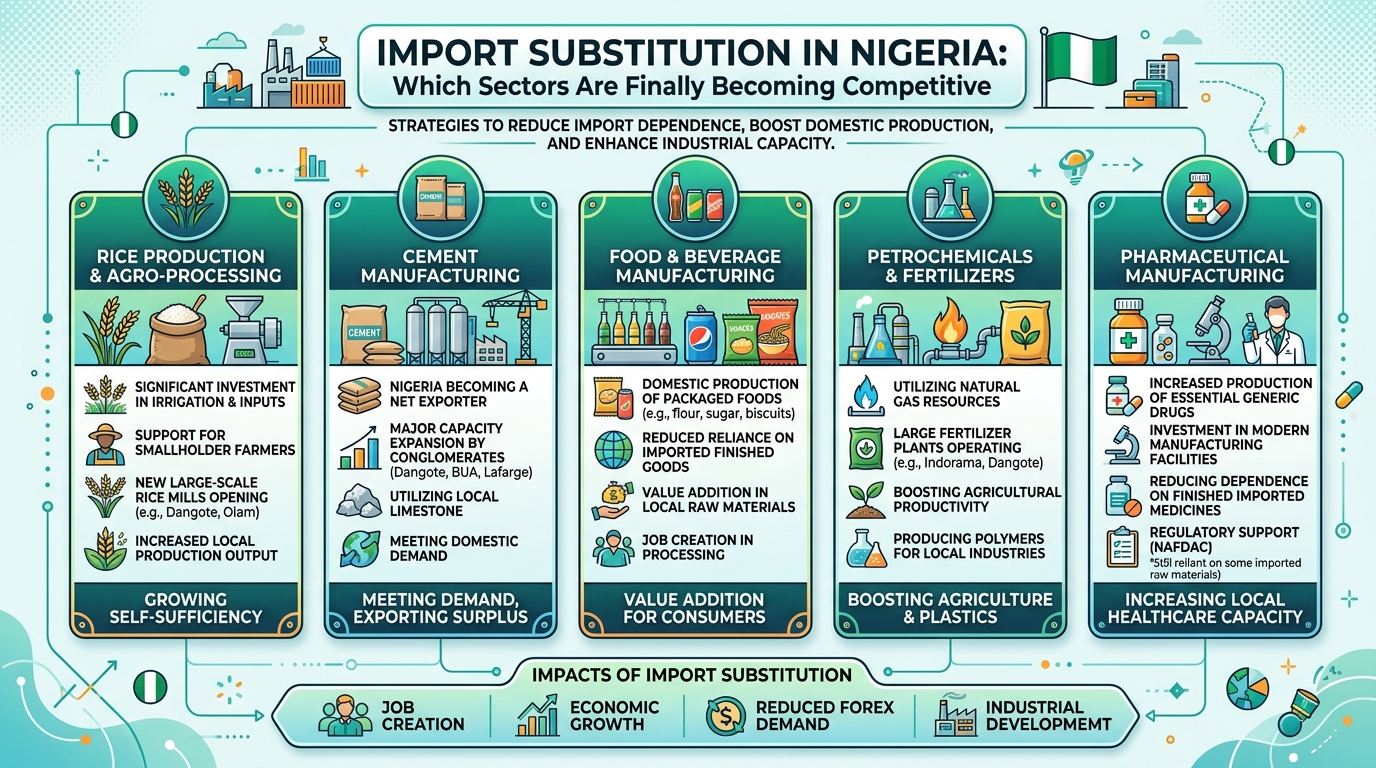
Import Substitution in Nigeria: Which Sectors Are Finally Becoming Competitive
Nigeria’s economy is at a turning point.
After decades of relying on imported goods, the country is making serious moves toward self-sufficiency. President Tinubu’s “Nigeria First Policy” is taking shape. The Dangote Refinery is producing fuel.
The question is no longer whether import substitution can work in Nigeria. It is which sectors are finally gaining competitive ground.
Let me show you where progress is real and where challenges remain.
Understanding import substitution: a clear definition
Before we go further, let us define what import substitution actually means.
Definition: According to Britannica Money, import substitution is “a development strategy focusing on promoting domestic production” that was “pursued mainly from the 1930s through the 1960s in Latin America particularly in Brazil, Argentina, and Mexico and in some parts of Asia and Africa.”
Source: Britannica Money. “Import substitution industrialization (ISI) | Definition & Critiques.” https://www.britannica.com/money/import-substitution-industrialization
Here is the simple version.
Import substitution means making things at home instead of buying them from abroad. The government supports local industries through tariffs, quotas, subsidies, and tax incentives. The goal is to nurture domestic industries until they become competitive enough to export globally.
Nigeria’s import substitution policy framework
Nigeria has tried import substitution before with mixed results. But recent policy initiatives signal a renewed and more structured approach.
The Nigeria First Policy (2025)
Key components include a ban on foreign goods for federal government agencies when spending public funds. Revised procurement rules through the Bureau of Public Procurement will enforce rules favouring local content. Technology transfer requirements mean foreign contracts must include provisions for technology transfer and local production. An Executive Order provides full legal backing to the policy.
Supporting fiscal and monetary measures
To support import substitution, Nigerian policymakers are implementing monetary policy incentives. Preferential credit facilities through the Central Bank of Nigeria provide low-interest loans to local manufacturers. Foreign exchange allocation priorities are set for industries involved in import substitution. Exchange rate stability measures are being pursued.
The persistent challenge: raw material dependence
Despite ambitious policy frameworks, Nigeria faces a fundamental structural challenge.
The raw materials dilemma
Recent data from the National Bureau of Statistics reveals that raw material imports rose by 19.7% year-on-year, reaching ₦3.53 trillion in the first half of 2025, up from ₦2.95 trillion during the same period in 2024. For the full year 2024, manufacturers spent ₦6.64 trillion on raw material imports, with over 70% of manufacturing inputs sourced abroad.nigerianstat.gov.ng
These imports include sugarcane and derivatives for confectionery production, additives for lubricating oils, veneering sheets for furniture and construction, hides and skins for leather goods, and gypsum for cement production.
Why local sourcing remains uncompetitive
Paradoxically, local raw materials which should be cheaper often cost more than imported ones. This discourages manufacturers from buying locally.
This pricing disadvantage stems from inadequate power supply increasing production costs, poor transportation infrastructure, limited local processing capacity, currency depreciation making imports relatively cheaper, and lack of economies of scale in domestic production.
Policy response
The National Assembly recently passed the RMRDC (Establishment) Amendment Bill 2025. It mandates that no raw material be exported without at least 30% local value addition. This measure is expected to reduce the export of unprocessed commodities and stimulate local industries.
Read our Nigeria’s Raw Material Challenge: Causes and Solutions for in-depth analysis.
Sectors showing competitive progress
Despite the raw materials challenge, several sectors are demonstrating genuine progress.
1. Petroleum refining: the Dangote revolution
The petroleum refining sector represents Nigeria’s most dramatic import substitution success story.
Operational milestones. The Dangote Refinery commenced production of diesel and aviation fuel in January 2024. It has fundamentally altered Nigeria’s petroleum products landscape. With a refining capacity of 650,000 barrels per day and plans to expand to 1.4 million barrels per day by 2028, the facility would become the world’s largest petroleum refinery.
Dangote Refinery. Production Capacity and Operational Updates. dangote.com
As of late 2025, the Dangote Refinery is covering as much as 60% of Nigeria’s domestic gasoline demand and producing over 30 million litres per day of gasoline. This has dramatically reduced Nigeria’s reliance on imported refined petroleum products.
Import reduction impact. Nigeria drew just 62,000 barrels per day of gasoline in the first month of 2025, down from a 2024 average of around 200,000 barrels per day. That is a reduction of approximately 69% in gasoline imports.
Economic implications. The refinery’s operations deliver multiple benefits. Foreign exchange conservation from reduced spending on imported petroleum products. Job creation with 135,000 permanent jobs when fully operational. Value chain development supporting industries and services around the refinery. Energy security reduced vulnerability to international supply disruptions.
2. Agriculture: renewed growth momentum
Agriculture remains one of Nigeria’s most significant sectors with substantial import substitution potential.
Recent performance. In Q3 2025, agriculture grew by 3.79%, driven mainly by crop production, which accounted for nearly two-thirds of the sector’s nominal output. The sector contributed 31.21% to real GDP during this period.
Areas of competitive advantage. Nigeria maintains leadership positions in several agricultural products. Cocoa production ranks among the top global producers. Palm oil has significant production capacity despite underutilisation. Cassava makes Nigeria one of the world’s largest producers. Sorghum is a global production leader. Livestock includes 19 million head of cattle, the largest number in Africa.
Import substitution opportunities. The agricultural sector shows promise in several areas. Local sourcing by industry rose from 38% in 1985 to 50% in 1988, demonstrating historical success that could be replicated. Agro-processing investments, such as recent dairy production investments by Danone’s Fan Milk and Arla Foods, indicate growing confidence in local agricultural value chains. Export potential is growing, with agriculture leading non-oil exports through surges in sesame seeds and cocoa.

3. Manufacturing: selective competitiveness
Nigeria’s manufacturing sector shows mixed results, with certain subsectors demonstrating stronger competitive positions.
Overall performance. Manufacturing growth slowed to 1.25% in real terms in Q3 2025, down from 1.74% in Q2 2025, with the sector’s share of real GDP falling to 7.62%. However, this aggregate figure masks pockets of competitiveness.man.com.ng
Competitive subsectors. Historical evidence suggests certain manufacturing subsectors have natural advantages. Textiles industries that were less dependent on imports and had steady demand were less adversely affected by economic pressures. Resource-based processing industries relying on local raw materials including palm kernel processing, cotton seed milling, rubber processing, vegetable oil production, tanning of hides and skins, sorghum malting, and soy milk processing have shown resilience. Cement production, with Dangote’s dominance, demonstrates that import substitution can work when backed by sufficient capital, technology, and market control.
Challenges to manufacturing competitiveness. Despite pockets of success, the manufacturing sector faces significant headwinds. High energy costs due to inadequate power supply. Dependence on imported machinery and components. Limited access to affordable financing. Poor transportation infrastructure. Currency volatility affecting input costs.
4. Information and Communication Technology (ICT): digital economy leadership
Nigeria’s ICT sector represents perhaps the country’s most competitive and globally integrated sector.
Sectoral performance. In Q3 2025, the ICT sector achieved 5.78% real growth, with its contribution rising to 9.10% of GDP. More impressively, in 2024, nitda.gov.ng Nigeria’s digital economy accounted for nearly 20% of GDP in Q2, almost four times oil’s contribution.
Competitive advantages. Nigeria leads Africa’s ICT market, contributing 82% of the continent’s ICT value and 29% of its internet usage. The country is a major tech and startup hub, attracting significant foreign investment across fintech, healthtech, e-commerce, transport and logistics tech, agtech, and edtech.
Infrastructure development. With over 210 million active mobile subscribers and broadband penetration exceeding 40%, Nigeria is expanding its digital infrastructure. The government targets 90% broadband penetration by 2025.
Sectors struggling with competitiveness
While some sectors show progress, others continue to face significant challenges.
Construction sector
Construction grew by 5.57% in real terms in Q3 2025, though this represented a modest decline from the 6.80% posted in 2024. The sector struggles with high costs of imported building materials and equipment.
Pharmaceutical and healthcare products
Nigeria continues to import the vast majority of pharmaceutical products despite having a growing pharmaceutical manufacturing base. The sector faces challenges with quality standards, access to active pharmaceutical ingredients, and regulatory compliance.
Automotive assembly
Although Nigeria has automotive assembly plants, these operations remain heavily dependent on imported components, limiting the true import substitution impact.
Systemic barriers to import substitution success
Several structural factors continue to undermine Nigeria’s import substitution efforts.
1. Infrastructure deficits
2. Foreign exchange volatility
Currency instability undermines long-term planning and investment in local production capacity. The naira’s depreciation has made imports relatively cheaper in some cases while increasing the cost of imported inputs for manufacturers.
3. Policy inconsistency
Challenges such as policy inconsistencies persist, necessitating ongoing efforts to create a more conducive investment climate. Frequent policy reversals create uncertainty that discourages long-term capital investment.
4. Access to finance
High interest rates and limited access to long-term, affordable financing constrain the ability of local manufacturers to invest in capacity expansion and technology upgrades. The Central Bank of Nigeria raised the Monetary Policy Rate by 850 basis points in 2024, from 18.75% in January to 27.25% by September, creating a tighter credit environment.
5. Skills gap
Limited technical skills and managerial capacity in certain sectors reduce productivity and quality standards, making it difficult for local products to compete with imports.
The path forward: recommendations for sustainable import substitution
For Nigeria to achieve meaningful and sustainable import substitution, several strategic interventions are necessary.
1. Targeted sector selection
Rather than attempting broad-based import substitution across all sectors simultaneously, Nigeria should focus on sectors where it has genuine comparative advantages. Agriculture and agro-processing leveraging abundant land and favourable climate. Petroleum products building on Dangote Refinery success. ICT and digital services capitalising on the large domestic market and skilled workforce. Select manufacturing subsectors with access to local raw materials.
2. Infrastructure investment priority
Addressing infrastructure deficits, particularly in power generation and transportation, should be the highest priority. These investments provide benefits across all sectors and are fundamental to competitiveness.
3. Value chain development
Rather than focusing solely on final products, Nigeria should develop complete value chains from raw materials to finished goods. The RMRDC Amendment Bill mandating 30% value addition before export is a step in this direction.
4. Technology transfer and innovation
Foreign contracts should include provisions for technology transfer and local production. Additionally, increased investment in research and development can help improve the quality and competitiveness of locally produced goods.
5. Regional integration
6. Selective protection with performance requirements
While some level of protection may be necessary for infant industries, it should be time-bound with clear sunset provisions, accompanied by performance requirements such as quality standards, export targets, and local content, and subject to regular review and adjustment.
7. Public-private partnerships
Encouraging collaboration between the government and private sector can drive industrial growth, as seen in South Korea where PPPs have played a crucial role in developing major infrastructure projects.
Our Policy Impact Evaluation service helps assess the effectiveness of import substitution policies.

The bottom line
Nigeria’s import substitution journey reveals a complex picture. Selective progress amid persistent structural challenges.
The petroleum refining sector, led by the Dangote Refinery, demonstrates that world-class import substitution is possible with sufficient capital, technology, and market scale. The ICT sector shows how Nigeria can compete globally in knowledge-based industries. Agriculture presents enormous untapped potential that could be unlocked with proper investment and policy support.
However, the continued heavy dependence on imported raw materials reveals that true import substitution requires more than policy pronouncements. It demands comprehensive infrastructure development, consistent policy implementation, access to affordable long-term financing, and strategic focus on sectors where Nigeria has genuine competitive advantages.
The success or failure of Nigeria’s import substitution strategy will ultimately determine whether the country can break free from the cycle of import dependence and achieve sustainable, broad-based economic development.
Early indicators from the petroleum and ICT sectors suggest success is possible. But only with sustained commitment to addressing the fundamental structural barriers that have long constrained Nigerian industry.
Related services from Stonehill Research
-
Sector Competitiveness Analysis – Identify import substitution opportunities and competitive advantages.
-
Import Substitution Opportunity Assessment – Evaluate sectors with genuine competitive potential.
-
Policy Impact Evaluation – Assess the effectiveness of import substitution policies.
Recommended reading from the Stonehill Research blog
-
Nigeria’s Raw Material Challenge: Causes and Solutions – In-depth analysis of structural barriers.
-
Barriers to Industrial Competitiveness in Nigeria – Understanding the challenges facing local manufacturers.
-
The Dangote Refinery Effect: Reshaping Nigeria’s Petroleum Landscape – Case study on import substitution success.
Let’s work together
At Stonehill Research, we provide comprehensive economic analysis and market intelligence to help businesses and policymakers make informed decisions. Our team of experts monitors economic trends, policy developments, and sectoral performance across Nigeria and the wider West African region.
Contact us today:
📧 Email: info@stonehillresearch.com
📞 Phone: +234 802 320 0801
📍 Address: 5, Ishola Bello Close, Off Iyalla Street, Alausa, Ikeja, Lagos, Nigeria
Contact Stonehill Research to schedule a consultation.
Let us help you navigate Nigeria’s evolving import substitution landscape.
Stonehill Research – Your Partner in Economic Intelligence
References
-
Britannica Money. Definition of Import Substitution Industrialization. https://www.britannica.com/money/import-substitution-industrialization [VERIFY: link active]
-
Nigerian Investment Promotion Commission (NIPC). Nigeria First Policy 2025. nipc.gov.ng [VERIFY: source]
-
National Bureau of Statistics (NBS). Raw Material Import Data 2024-2025. nigerianstat.gov.ng [VERIFY: source]
-
Dangote Refinery. Production Capacity and Operational Updates. dangote.com [VERIFY: source]
-
National Bureau of Statistics (NBS). GDP Report Q3 2025. nigerianstat.gov.ng [VERIFY: source]
-
Manufacturers Association of Nigeria (MAN). Manufacturing Sector Report 2025. man.com.ng [VERIFY: source]
-
National Information Technology Development Agency (NITDA). ICT Sector Report 2025. nitda.gov.ng [VERIFY: source]
-
World Bank. Nigeria Infrastructure Assessment. worldbank.org [VERIFY: source]
-
African Development Bank. Nigeria Country Strategy Paper 2025. afdb.org [VERIFY: source]
-
African Continental Free Trade Area (AfCFTA). Nigeria Trade Opportunities. au-afcfta.org [VERIFY: source]
There are no comments