

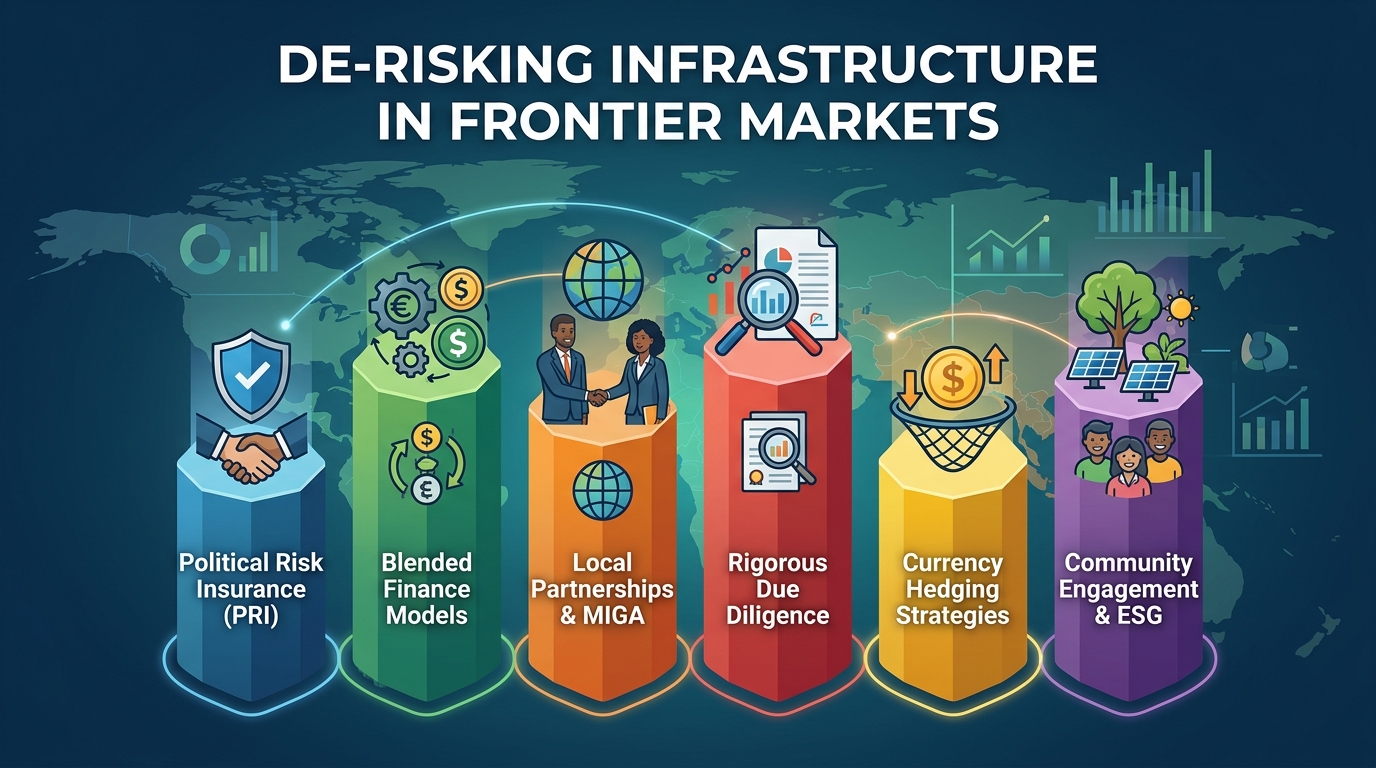
How Investors Can De-risk Infrastructure Projects in Frontier Markets
Frontier markets are growing fast. Really fast.
They need roads, power plants, ports, and internet infrastructure. The funding gap is estimated at $3 trillion every year.
But private investors are nervous. Political instability. Regulatory uncertainty. Currency volatility. Limited financial infrastructure.
The question is not whether frontier markets need investment. It is how to make those investments safe enough for private capital.
In 2025 and 2026, new tools and strategies are emerging. Let me show you what works.
Stonehill Research provides De-risking Strategy Development to help investors navigate frontier market infrastructure investments.
Understanding infrastructure risk in frontier markets
Before implementing de-risking strategies, you need to understand the unique risk profile.
Key risk categories
Political and regulatory risks. Frontier markets often experience political instability, frequent regulatory changes, and weak institutional frameworks. Changes in government can lead to policy reversals, contract renegotiations, or asset nationalisation. Weak legal systems may provide inadequate protection for investor rights.
Financial and economic risks. Currency volatility is a major concern. Infrastructure projects typically generate revenues in local currency while debt may be denominated in hard currencies. High inflation rates, limited access to local currency financing, and shallow capital markets further complicate financial structuring.
Technical and execution risks. Large-scale infrastructure projects in frontier markets face challenges including inadequate feasibility studies, limited local technical expertise, supply chain vulnerabilities, and complex land acquisition processes. These factors lead to cost overruns and project delays.
Market and demand risks. Uncertainty around demand forecasts, affordability constraints among end-users, and limited historical data make revenue projections challenging. Climate change impacts add another layer of complexity.
The power of blended finance
Blended finance has emerged as one of the most effective tools for de-risking infrastructure investments.
What is blended finance? A clear definition
Here is the simple version.
Blended finance uses public or philanthropic money to make projects attractive to private investors. It improves the risk-return profile through first-loss capital, guarantees, technical assistance grants, and concessional loans.
How blended finance reduces risk
Blended finance structures employ several mechanisms.
First-loss capital. Public or philanthropic funds absorb initial losses, protecting private investors from downside risk. This subordinated capital position provides a cushion that makes senior tranches more secure.
Guarantees and risk insurance. Public entities provide assurances against specific risks such as political risk, currency inconvertibility, or breach of contract. These instruments protect investors without requiring large upfront capital deployments.
Technical assistance grants. Grant funding improves project preparation, feasibility studies, and capacity building. This reduces execution risk and makes projects more investment ready.
Concessional loans. Below-market rate loans from development finance institutions improve overall project returns and extend tenors beyond what commercial lenders would typically offer.
Recent success stories
According to Convergence Blended Finance, blended finance has facilitated 392 transactions worth over $50 billion in frontier markets.
During 2013 to 2023, blended finance infrastructure deals attracted 40 cents of private capital for every 1ofpublicorphilanthropicmoneyonaverage.However,approximately102 of private capital for every $1 of concessional funding was achieved by top quartile deals. Structure and execution matter significantly.
Development finance institutions and multilateral development banks saw a 23% year-over-year increase in private mobilisation in 2023.
The Global Infrastructure Facility supported a replicable municipal street lighting PPP program in Brazil that is expected to mobilise $180 million in private capital across 12 transactions, delivering energy savings of 60% while serving 7 million people.
Read our Blended Finance for Nigerian Infrastructure Projects for local application guidance.
Strategic risk mitigation instruments
Beyond blended finance, investors can employ a range of specialised instruments.
Political risk insurance
Currency hedging solutions
Given the long-term nature of infrastructure projects and the volatility of frontier market currencies, effective currency risk management is essential. Options include local currency debt financing through development finance institutions, currency swaps and forward contracts, natural hedging through local currency revenue streams, and the TCX Fund, which provides local currency hedging solutions for emerging markets.
Credit enhancement mechanisms
Development finance institutions offer various credit enhancement tools. Partial credit guarantees covering specific loan tranches. Liquidity facilities providing backup funding. Standby letters of credit. A/B loan structures where DFIs hold the A-loan and syndicate the B-loan to commercial lenders.
Related service: Our Project Due Diligence provides rigorous assessment of technical, financial, and political risks.
Building strong governance and partnerships
Effective de-risking extends beyond financial instruments.
Robust governance frameworks
Strong project governance is foundational to risk mitigation.
Clear legal and contractual structures. Well-drafted concession agreements with clearly defined risk allocation, change-in-law provisions, and dispute resolution mechanisms are essential. International arbitration clauses provide additional investor protection.
Independent technical and financial advisors. Engaging reputable third-party advisors for due diligence, feasibility assessment, and ongoing monitoring reduces information asymmetry and improves decision-making.
Transparent procurement processes. Competitive, transparent procurement builds credibility and reduces the risk of future contract challenges.
Strategic partnership selection
The choice of partners significantly impacts project risk.
Development Finance Institutions (DFIs). Partnership with institutions like the International Finance Corporation, European Investment Bank, or African Development Bank provides risk mitigation through co-investment, technical expertise and advisory support, a signalling effect that attracts other investors, and political risk deterrence given their multilateral status.
Local partners with track record. Experienced local partners bring local market knowledge and networks, government relationships and navigation skills, cultural understanding and community engagement, and operational expertise in local context.
Experienced infrastructure operators. Partnering with established international operators reduces technical and operational risk while building capacity in frontier markets.
Sector-specific de-risking strategies
Different infrastructure sectors present unique risk profiles.
Renewable energy projects
Renewable energy and climate-resilient projects are reshaping investment opportunities.
De-risking strategies include off-take agreements with long-term power purchase agreements with creditworthy counterparties providing revenue certainty. Revenue stabilisation mechanisms like government guarantees, minimum revenue floors, or take-or-pay structures protect against demand shortfalls. Technology risk mitigation uses proven technologies with performance warranties and insurance to reduce execution risk.
Transportation infrastructure
Transport projects face unique demand and regulatory risks.
Traffic risk sharing through minimum revenue guarantees or availability-based payment mechanisms transfers demand risk to the government. Phased development breaks large projects into phases with clear milestones, reducing upfront capital requirements and allowing for market validation. Multi-use facilities that generate revenues from multiple sources (freight, passenger, ancillary commercial) are more resilient.
Water and sanitation
These projects often involve affordability challenges and political sensitivity.
Viability gap funding allows government subsidies to bridge the gap between user affordability and project viability. Output-based aid ties payments to service delivery milestones, ensuring that subsidies achieve intended outcomes. Pro-poor tariff structures use differentiated pricing that cross-subsidises poor users while maintaining project viability.
Digital infrastructure
Digital infrastructure continues to be a key driver of outperformance, consistently exceeding returns of the private infrastructure index by approximately 300 basis points.
Anchor tenants with long-term contracts with major technology companies or telecommunications providers provide revenue certainty for data centres and fibre networks. Modular development builds in phases aligned with demand growth, reducing stranded asset risk. Diversified customer base reduces concentration risk by serving multiple sectors and customers.
Related post: Check out Infrastructure Investment Opportunities in Frontier Africa for regional analysis.
Recent market developments and emerging trends
The infrastructure investment landscape in frontier markets is rapidly evolving.
Policy and regulatory improvements
Cameroon adopted a new PPP Law in 2023 that improved oversight, risk allocation, and budget controls. This demonstrates ongoing improvement in regulatory frameworks across frontier markets.
China’s policies and initiatives focused on clean energy have led to substantial investment flows, with significant capital directed toward wind, solar, and waste-to-energy projects.
Concentration in key markets
While emerging markets broadly show promise, private infrastructure investment is increasingly concentrated. Six countries (China, India, Brazil, Mexico, Turkey, and Indonesia) accounted for 67% of investment in low- and middle-income countries between 2021 and 2024.

This concentration reflects where de-risking mechanisms are most developed and institutional capacity is strongest.
Climate-resilient infrastructure
Sustainable infrastructure outperforms conventional alternatives by over 20% under net-zero scenarios. This is driven by reduced exposure to climate risks and enhanced asset resilience.
Climate adaptation is becoming a critical component of infrastructure planning in frontier markets. Disaster-related financial losses have surged sevenfold since the 1970s, making climate resilience a financial imperative rather than just an environmental consideration.
The challenge of smaller frontier markets
This underscores the continued challenge of channelling capital to the smallest and most vulnerable markets, where de-risking mechanisms remain underdeveloped.
Our ESG and Climate Risk Assessment integrates sustainability and resilience considerations.
Best practices and key success factors
Based on successful projects and recent market developments, several best practices emerge.
Comprehensive due diligence
Thorough upfront work reduces surprises and builds investor confidence. Engage local legal, technical, and market advisors early. Conduct extensive stakeholder mapping and engagement. Stress-test financial models across multiple scenarios. Assess climate risks and resilience requirements. Evaluate political economy and potential for future policy changes.
Right-sizing expectations
Stakeholder engagement and social license
Community opposition and lack of social acceptance represent major project risks. Proactive strategies include early and ongoing community consultation, local content requirements and job creation, environmental and social impact mitigation, benefit-sharing mechanisms with affected communities, and transparent communication about project impacts and benefits.
Adaptive management
Given the dynamic nature of frontier markets, successful projects incorporate flexibility. Regular project reviews and adjustment mechanisms. Contingency reserves for unexpected challenges. Clear escalation procedures for emerging issues. Learning loops to incorporate lessons into future phases.
Long-term perspective
Infrastructure projects in frontier markets require patient capital and long-term commitment. Realistic timelines accounting for local approval processes. Commitment to capacity building and knowledge transfer. Willingness to work through challenges rather than exit at first difficulty. Recognition that demonstration effects and market creation take time.
The role of technology and innovation
Emerging technologies are creating new opportunities for risk reduction.
Digital tools for project management
Real-time monitoring systems reduce information asymmetry. Blockchain enables transparent payment and contract management. Artificial intelligence provides predictive maintenance and demand forecasting. Satellite imagery enables construction monitoring and environmental compliance.
Innovative financial structures
Green bonds and sustainability-linked financing align with ESG goals. Infrastructure asset recycling frees capital for new projects. Securitisation of infrastructure cash flows attracts institutional investors. Crowdfunding and alternative financing platforms support smaller projects.
Data and analytics
Better demand forecasting through big data analytics. Climate risk modelling for infrastructure resilience. Real-time economic and political risk monitoring. Performance benchmarking across similar projects and markets.
Read Technology and Innovation in Frontier Market Infrastructure for emerging tools.

The bottom line
De-risking infrastructure investments in frontier markets requires a sophisticated, multi-layered approach. Combine financial instruments, strategic partnerships, robust governance, and sector-specific strategies.
The toolkit available to investors has expanded considerably. Successful models are emerging across regions.
Public-private collaboration through blended finance and regulatory reforms is critical to overcoming underinvestment and risk barriers. The most successful projects leverage multiple de-risking mechanisms simultaneously, tailored to specific project and market contexts.
As frontier markets continue to improve their regulatory frameworks and innovative financing mechanisms mature, infrastructure investment opportunities will become increasingly accessible to a broader range of investors.
However, success will continue to require careful risk assessment, appropriate mitigation strategies, strong local partnerships, and a long-term commitment to sustainable development.
For investors willing to navigate complexity and deploy appropriate de-risking strategies, frontier market infrastructure offers compelling returns alongside meaningful development impact.
The key is matching risk appetite with appropriate mitigation tools while maintaining realistic expectations and a genuine commitment to the markets and communities being served.
Related services from Stonehill Research
-
De-risking Strategy Development – Customised approaches combining financial instruments, partnerships, and governance structures.
-
Project Due Diligence – Rigorous assessment of technical, financial, and political risks.
-
ESG and Climate Risk Assessment – Integration of sustainability and resilience considerations.
Recommended reading from the Stonehill Research blog
-
Blended Finance for Nigerian Infrastructure Projects – Local application guidance for blended finance mechanisms.
-
Infrastructure Investment Opportunities in Frontier Africa – Regional analysis and country-specific insights.
-
Technology and Innovation in Frontier Market Infrastructure – Emerging tools for risk reduction.
Let’s work together
At Stonehill Research, we specialise in helping investors navigate the complexities of frontier market infrastructure investments. Whether you are exploring your first frontier market investment or expanding your emerging markets portfolio, our expertise can help you identify opportunities, mitigate risks, and achieve attractive risk-adjusted returns while creating meaningful development impact.
Contact us today:
📧 Email: info@stonehillresearch.com
📞 Phone: +234 802 320 0801
📍 Address: 5, Ishola Bello Close, Off Iyalla Street, Alausa, Ikeja, Lagos, Nigeria
Contact Stonehill Research to schedule a consultation.
Let us discuss how we can support your infrastructure investment goals.
Stonehill Research – Your Partner in Frontier Market Infrastructure Intelligence
References
-
World Economic Forum. 5 Things to Know About Investing in Frontier Markets 2024. https://www.weforum.org/stories/2024/04/five-surprising-facts-about-investing-in-frontier-markets/ [VERIFY: link active]
-
UNESCO. Blended Finance Definition. https://www.unesco.org/en/dtc-finance-toolkit-factsheets/blended-finance [VERIFY: link active]
-
Convergence Blended Finance. What is Blended Finance? https://www.convergence.finance/blended-finance [VERIFY: link active]
-
World Bank. How Blended Finance Can Reorient Cautious Private Investors to Infrastructure 2024. https://blogs.worldbank.org/en/ppps/how-blended-finance-can-reorient-cautious-private-investors-to-i [VERIFY: link active]
-
International Finance Corporation. How Blended Finance Works. https://www.ifc.org/en/what-we-do/sector-expertise/blended-finance/how-blended-finance-works [VERIFY: link active]
-
World Bank. Private Capital for Infrastructure: Urgency and Resilience 2025. https://blogs.worldbank.org/en/ppps/private-capital-for-infrastructure–resilience-amid-uncertainty- [VERIFY: link active]
-
CBRE Investment Management. Infrastructure Quarterly: Q2 2025. https://www.cbreim.com/insights/articles/infrastructure-quarterly-q2-2025 [VERIFY: link active]
-
AInvest. Emerging Markets Infrastructure as a Strategic Asset Class 2024. [VERIFY: source]
-
UNCTAD. Global Foreign Investment Falls 3% in First Half of 2025. https://unctad.org/news/global-foreign-investment-falls-3-first-half-2025-hitting-industry-and-infrastructure [VERIFY: link active]
-
AInvest. The Rise of Impact Investing in Emerging Markets 2025. [VERIFY: source]
There are no comments