

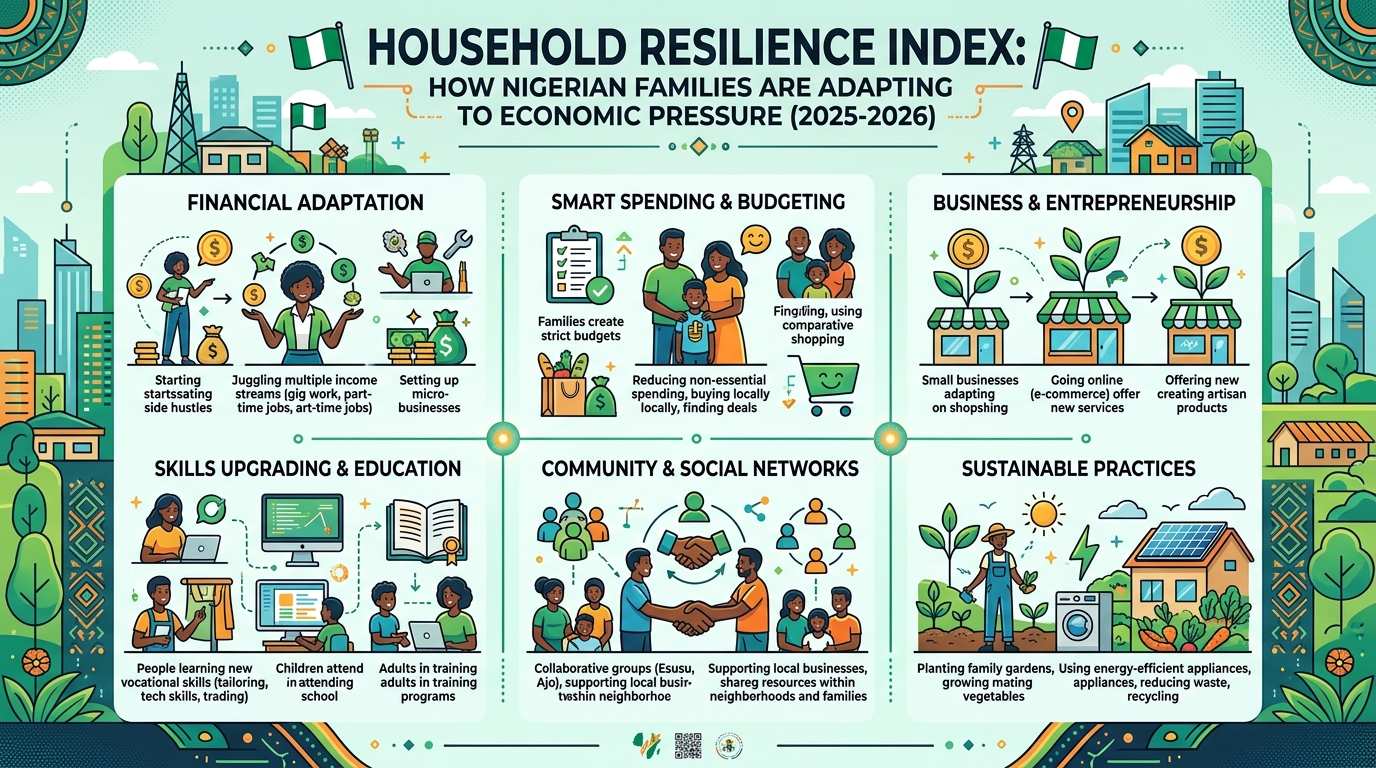
Household Resilience Index: How Nigerian Families Are Adapting to Economic Pressure (2025-2026)
How Nigerian Families Are Surviving the Economic Storm: Resilience Strategies for 2025-2026
Life in Nigeria has been extremely hard.
Over the past two years, families have faced rising prices, a weaker naira, and tough economic reforms. Yet somehow, they keep going.
They are cutting back. Finding new ways to earn. Helping each other survive.
This is not just about statistics. It is about real people finding creative ways to make ends meet in 2025 and now into 2026.
Let me show you how Nigerian families are adapting and what determines who weathers the storm.
Stonehill Research provides Household Resilience and Consumer Behaviour Studies to help understand how Nigerian families are coping with economic pressure.
Understanding household economic resilience: a clear definition
Before we go further, let us define what household economic resilience actually means.
Here is the simple version.
Resilience has three parts. First, the ability to absorb immediate shocks when prices jump overnight. Second, the ability to adapt behaviour and resources in response to changing circumstances. Third, the long-term capability to transform livelihood strategies to prevent future vulnerabilities.
For Nigerian families right now, all three dimensions are being tested at once.

The current economic reality in Nigeria (2025-2026)
Let me give you the real picture as we move through 2025 into 2026.
Macroeconomic indicators and their impact
Nigeria’s economy expanded by 3.9% year-on-year in the first half of 2025. That sounds good. But it has not translated into better living standards for most households.
The inflation picture remains brutal. Annual average inflation surged to 31% in 2024. Causes include naira depreciation, food supply deficit, energy subsidy removal, and high borrowing costs.
There have been recent improvements. Inflation fell to 24% year-on-year in 2025 Q1. But as we enter 2026, the damage to household purchasing power has been substantial.
The food security challenge
Food inflation is the single most devastating factor affecting Nigerian households.
Poor households spend up to 70% of their income on food. The cost of a basic food basket rose fivefold between 2019 and 2024. Five times. Families are being forced to make impossible choices between nutrition and other basic needs.
Selected food prices for 43 staple items in 2024 rose by an average of 99% year-on-year. Basic items such as beans, rice, eggs, yam, and garri increased by more than 100%. These staples form the backbone of Nigerian cuisine and household nutrition.
Read our Nigeria Food Security Report 2026 for in-depth analysis.
Adaptive strategies: how families are coping in 2025-2026
Nigerian families have shown remarkable creativity. Let me share how they are coping as we move through 2025 into 2026.
Expenditure reduction and substitution
The most common adaptation is reducing consumption and substituting cheaper alternatives. Families are making difficult trade-offs. Cutting back on non-essential items first. Increasingly being forced to compromise on essentials as well.
These strategies include purchasing smaller quantities, switching to lower-quality products, and reducing meal frequency or portion sizes.
Income diversification and informal networks
Nigerian families are increasingly relying on multiple income sources and informal support networks.
A new class of Nigerians has emerged. People who reach out to old friends on social media platforms asking for financial favours to make ends meet. This phenomenon represents the activation of social capital as an economic survival mechanism.

The digital economy has also created new, albeit precarious, income opportunities. Some young Nigerians have become “keypad warriors,” spending extensive time on social media following influencers in hopes of receiving financial rewards. This represents a form of digital-age survival strategy.
Market participation adjustments
Households are fundamentally changing how they interact with markets.
Many are reducing their reliance on formal markets. They are turning to informal channels instead. Bulk buying when possible. Engaging in urban agriculture.
Some families have reverted to traditional preservation methods to reduce food waste and extend the usability of purchased goods.
Check out Consumer Coping Strategies During Inflation in Nigeria for practical insights.
Vulnerability factors and inequality
The impact of economic pressure is far from uniform. Let me explain who is most vulnerable in 2025-2026.
Income-based disparities
About 38.9% of Nigerians lived below the poverty line in 2023. That is 87 million people surviving on less than $2 a day.
For these households, even marginal increases in prices can be catastrophic. Food accounts for over 60% of the budgets for Nigeria’s low-income families. Food inflation directly and severely impacts their ability to meet other basic needs.
Wealthier households spend a smaller proportion of their income on food. They have access to financial instruments that can help them hedge against inflation or even benefit from economic volatility through strategic investments.
Gender dimensions
Female respondents reported significantly higher perceived inflation than males.
Why? Women typically manage household budgets and food shopping. They are more acutely aware of price increases. This gender dimension reflects women’s primary role in household provisioning and their closer engagement with day-to-day cost management.
Geographic and sectoral variations
Rural communities face additional challenges. Restricted access to alternative markets. Diminished income-generating options. Elevated transaction costs.
Agricultural households, while producing food, are not insulated from price pressures. They need to purchase inputs, processed foods, and non-food essentials. Farming does not protect you from the crisis.
Our Poverty and Vulnerability Assessments help identify the most at-risk populations.
Policy responses and institutional support
The government and international partners have recognised the need to cushion households.
Social protection initiatives
A cash transfer system developed with the World Bank has reached 5.5 million out of 15 million targeted ultra-poor households. This represents progress. But the gap between those reached and those in need remains substantial as we move through 2025 into 2026.

Monetary and fiscal policy adjustments
The Central Bank of Nigeria has maintained a tight monetary policy stance. Interest rates reached 27.5% in an effort to control inflation. This has helped stabilise the naira and improve external reserves. But it has also increased borrowing costs for households and businesses.
Four landmark tax reforms were enacted in June 2025. They aim to streamline tax administration, enhance non-oil revenue generation, and expand fiscal space. These reforms aim to create sustainable revenue sources that can fund social programs without relying on inflationary deficit financing.
Structural interventions
The World Bank recommends tackling food inflation by removing trade barriers such as import bans and excessive duties. Also by addressing structural bottlenecks in seeds, input supply, security, logistics, and infrastructure.
Addressing these supply-side constraints is essential for bringing down food prices sustainably.
Related post: Read Social Protection Programs in Nigeria: Assessment and Gaps for policy analysis.
Building long-term resilience
Immediate coping strategies are necessary. But genuine long-term resilience requires addressing structural vulnerabilities.
Financial inclusion and access
Expanding access to formal financial services can significantly enhance household resilience. Savings accounts. Insurance products. Affordable credit.
Financial inclusion enables families to smooth consumption across time, invest in productive assets, and protect against catastrophic losses.
Human capital development
Protecting investments in education and healthcare during economic crises is crucial.
When families are forced to pull children from school or forgo medical care due to cost pressures, they sacrifice future earning potential and health outcomes. This perpetuates cycles of vulnerability.
Agricultural productivity and food security
Sustainable solutions to food inflation require investments in agricultural productivity. Improved seeds. Fertiliser access. Irrigation infrastructure. Extension services.
Market infrastructure
Improving market infrastructure can reduce post-harvest losses, lower transaction costs, and smooth price fluctuations.
Transportation networks. Storage facilities. Cold chain systems. All of these contribute to household resilience.
The path forward for 2025-2026
Nigeria’s economy shows signs of stabilisation. International reserves are increasing. The country has successfully returned to international capital markets.
But these macroeconomic gains have yet to translate into tangible improvements in people’s lives as we enter 2026.
The challenge ahead is ensuring that economic recovery reaches households. This requires sustained commitment to reforms, targeted support for vulnerable populations, and addressing the structural constraints that limit resilience.
As the World Bank notes, the true measure of reform success will be improvements in the daily lives of Nigerians, especially the poor and vulnerable.
Related service: Our Social Protection Programme Evaluation helps assess the effectiveness of household support initiatives.
The bottom line
Nigerian families have demonstrated remarkable resilience. They are adapting to economic pressure in creative and determined ways.
But resilience should not be mistaken for thriving. Coping is not the same as prospering.
The goal must be to create conditions where households can move beyond mere survival to genuine prosperity. Where coping strategies give way to opportunity. Where economic growth translates into improved welfare for all Nigerians.
Household Consumption Expenditure dropped by over 60% in real terms. Food prices for basic staples rose by over 100%. These are not just numbers. They are empty stomachs. Skipped meals. Children pulled from school.
The families of Nigeria are doing everything they can. Now it is time for policies and investments that match their effort as we move through 2025 and into 2026.
Related services from Stonehill Research
-
Household Resilience and Consumer Behaviour Studies – Understanding how Nigerian families are coping with economic pressure.
-
Poverty and Vulnerability Assessments – Identifying the most at-risk populations.
-
Social Protection Programme Evaluation – Assessing the effectiveness of household support initiatives.
Recommended reading from the Stonehill Research blog
-
Nigeria Food Security Report 2026 – In-depth analysis of food inflation and household nutrition.
-
Consumer Coping Strategies During Inflation in Nigeria – Practical insights into household adaptation.
-
Social Protection Programs in Nigeria: Assessment and Gaps – Policy analysis and recommendations.
Let’s work together
Stonehill Research is a leading market research and consulting firm providing comprehensive insights into consumer behaviour, market trends, and economic dynamics across Nigeria and Sub-Saharan Africa. Our research-driven approach helps businesses, policymakers, and development organisations make informed decisions based on reliable data and deep market understanding.
Contact us today:
📧 Email: info@stonehillresearch.com
📞 Phone: +234 802 320 0801
📍 Address: 5, Ishola Bello Close, Off Iyalla Street, Alausa, Ikeja, Lagos, Nigeria
Contact Stonehill Research to schedule a consultation.
Let us help you understand Nigerian households and build solutions that work.
Stonehill Research – Your Partner in Consumer and Economic Intelligence
References
-
ResilienceLinks. Definition of Household Economic Resilience. https://www.resiliencelinks.org/building-resilience/economic-resilience [VERIFY: link active]
-
The Junction. Nigeria Economy Grows Amid Household Spending Decline in 2024. https://thejunction.ng/nigeria-economy-grows-amid-household-spending-decline-in-2024/ [VERIFY: link active]
-
World Bank. Positive Economic Momentum in Nigeria, Now Time to Bring Home the Gains 2025. https://www.worldbank.org/en/news/press-release/2025/10/08/positive-economic-momentum-in-nigeria-now-time-to-bring-home-the-gains [VERIFY: link active]
-
International Journal of Research and Innovation in Social Science. Nigerian Consumers’ Perceptions of Inflation 2025. https://rsisinternational.org/journals/ijriss/articles/a-quantitative-study-of-nigerian-consumers-perceptions-of-inflation-and-its-impact-2023-2024/ [VERIFY: link active]
-
Nairametrics. Inflation: Able Nigerians Beg to Survive Economic Hardship. https://nairametrics.com/2024/04/28/inflation-able-nigerians-beg-to-survive-economic-hardship/ [VERIFY: link active]
-
Businessday NG. Nigeria’s Inflation Crisis: How Rising Costs Are Deepening the Divide. https://businessday.ng/editorial/article/nigerias-inflation-crisis-how-rising-costs-are-deepening-the-divide/ [VERIFY: link active]
-
International Monetary Fund. IMF Country Report No. 25/157 Nigeria. https://www.imf.org/-/media/Files/Publications/CR/2025/English/1ngaea2025001-print-pdf.ashx [VERIFY: link active]
-
International Monetary Fund. How Nigeria Can Unleash its Economic Potential 2025. https://www.imf.org/en/news/articles/2025/07/07/cf-how-nigeria-can-unleash-its-economic-potential [VERIFY: link active]
-
Wiley Online Library. How Do Household Coping Strategies Evolve With Increased Food Insecurity? Nigeria’s Food Price Shock. https://onlinelibrary.wiley.com/doi/10.1002/fes3.70012 [VERIFY: link active]
-
PwC Nigeria. Nigeria Economic Outlook 2025. strategyand.pwc.com [VERIFY: source]
There are no comments