

How Election Cycles Shape Business Risk in West Africa: A 2026 Guide
West Africa has just gone through a major political year.
In 2025, several nations went to the polls. Côte d’Ivoire. Guinea-Bissau. Togo. The outcomes are now reshaping the economic and business landscape.
Now in 2026, businesses are dealing with the aftermath. New governments. New policies. New risks.
Understanding how election cycles affect your risk profile is not optional. It is essential.
Let me show you what happened, what is changing, and how to prepare for the next cycle.
Stonehill Research provides Political Risk Assessment to help businesses navigate election cycles and political transitions in West Africa.

Understanding political risk: a clear definition
Before we go further, let us define what political risk actually means for businesses.
Here is the simple version.
Political risk is the chance that politics messes up your business. Sudden policy shifts. Currency devaluations. Contracts cancelled. Regulatory frameworks changed overnight. In extreme cases, political violence or coups.
Understanding these risks is the first step toward managing them.
The 2025-2026 West African electoral landscape: what happened and what comes next
The political calendar for West Africa in 2025 was consequential. Let me break down what happened and what it means for 2026.
Key elections that took place in 2025
Côte d’Ivoire (October 2025). This presidential election was a major test of democratic consolidation in West Africa. President Alassane Ouattara sought a fourth term, enabled by a controversial Constitutional Court ruling. Given the country’s history of post-election violence, particularly the 2010 crisis that led to civil conflict, this election was highly sensitive for businesses.
Outcome and 2026 implications. The election results have now shaped the policy environment for 2026. Businesses are monitoring whether the new term brings policy continuity or unexpected shifts in sectors like cocoa, mining, and infrastructure.
Guinea-Bissau (2025). The electoral environment was marked by turmoil and uncertainty. President Umaro Sissoco Embaló sought reelection against 11 opposition candidates. The election was overshadowed by the controversial Supreme Court exclusion of his primary challenger, Domingos Simões Pereira. The country’s history as a trafficking hub and political instability created unique challenges for businesses.
Outcome and 2026 implications. In 2026, businesses are assessing the stability of the post-election government and monitoring for any policy changes affecting logistics, trade, and foreign investment.
Outcome and 2026 implications. In 2026, Togo remains under extended Gnassingbé leadership. Businesses are watching for any regional backlash or sanctions and assessing the long-term investment climate under continued one-party dominance.
Read our West Africa Political Risk Monitor 2026 for ongoing updates.
Recent electoral developments (2020-2025)
The region witnessed both progress and setbacks.
Successful elections in Ghana (2024) and Senegal (2024) demonstrated progress in democracy. Ghana’s presidential candidates signed a “Peace Pact.” Senegal’s electoral observer missions highlighted the transparency of the process.
Looking ahead to 2026 and beyond
With the major 2025 elections now behind us, 2026 is a year for consolidation and observation. However, businesses must remain vigilant as:
-
Post-election policy implementations take effect
-
New governments complete their first year in office
-
Regional bodies like ECOWAS continue to address democratic backsliding
-
The next election cycle begins to take shape for 2027 and beyond
How election cycles amplify business risk
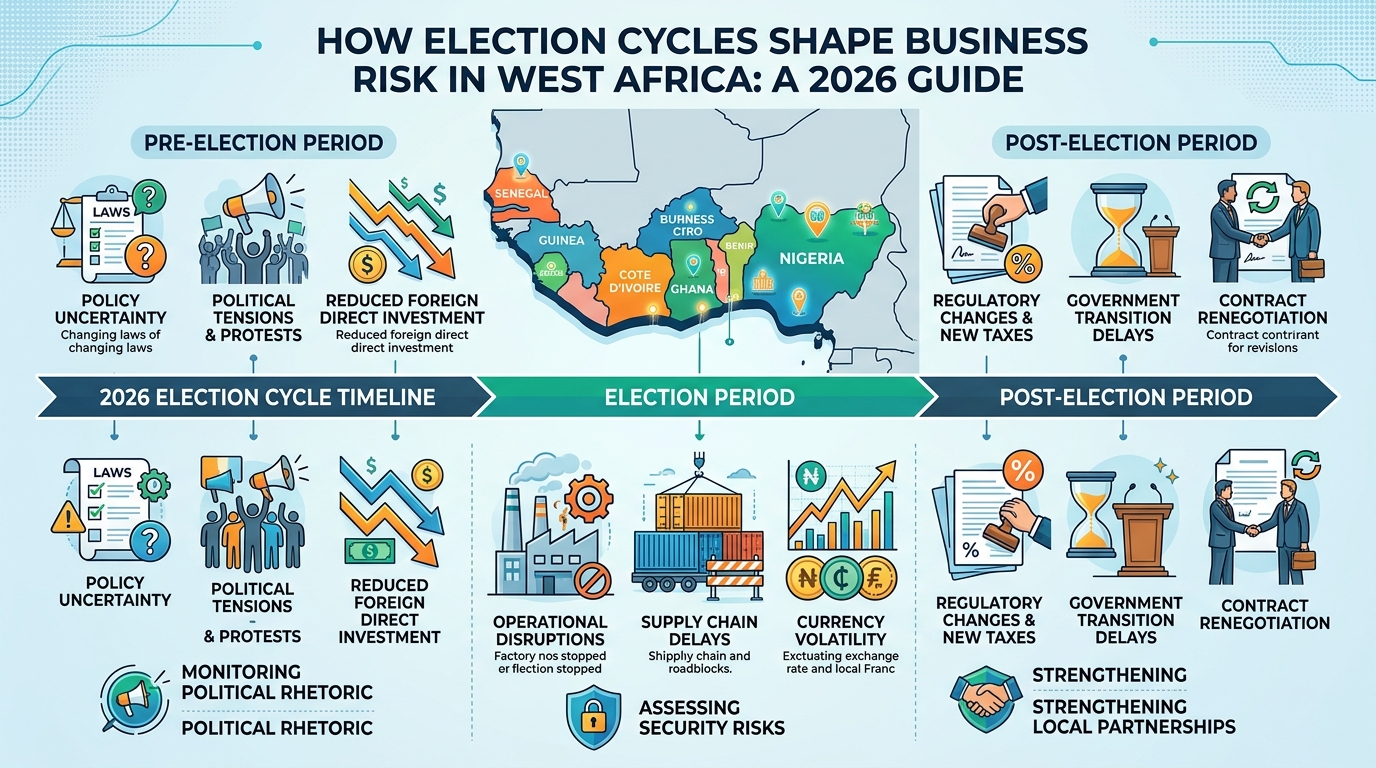
Elections create a ripple effect across the business environment. Even after the votes are counted, the impacts linger.
Economic policy uncertainty
Election periods bring significant uncertainty about future economic policies. The election outcome weighs on policy direction, investor sentiment, and market sentiment. This is especially true in countries heavily dependent on commodities like cocoa and gold.
Pre-election periods often see governments implementing populist policies or delaying necessary economic reforms to maintain electoral support. Post-election periods may bring abrupt policy reversals.
Currency and financial volatility
High inflation, weak currency, debt, and high policy rates continue to hinder growth in Ghana and Nigeria in 2026. West Africa’s economic output is limited by rising costs of goods and services.
During election cycles, currency volatility typically intensifies. Investors adopt a wait-and-see approach. This leads to capital flight and pressure on foreign exchange reserves. In 2026, some markets are still stabilising post-election.
Operational disruptions
The political landscape during elections is dynamic. There is potential for localized unrest and disruptions that can affect office closures, site security, and workforce safety.
Businesses must prepare for physical security threats like protests, demonstrations, and electoral violence that can damage property and endanger personnel. Supply chain interruptions from civil unrest can disrupt transportation networks, port operations, and cross-border trade. Workforce management becomes challenging with employee safety concerns, restricted movement, and potential evacuations.
Regulatory and contractual risk
Post-election governments may review or nullify contracts signed by previous administrations. This is particularly common in extractive industries and infrastructure projects. In 2026, businesses are assessing whether new governments are honouring or revisiting existing agreements.
Governmental authority in Guinea-Bissau often equates to control of patronage. Narcotics trafficking. Illegal logging. Control of procurement contracts. Diversion of tax revenues. Political transitions can affect business relationships built on patronage networks.
Sector-specific vulnerabilities in 2026
Different business sectors face varying levels of exposure, especially in the post-election year.
Natural resources and extractives
The mining, oil, and gas sectors remain particularly vulnerable to post-election policy changes. Renegotiation of concession agreements. Changes to taxation and royalty rates. Nationalization pressures. Local content requirements. In 2026, businesses in Côte d’Ivoire and Guinea-Bissau are closely monitoring new government policies.
Financial services
Banks and financial institutions face heightened risks. Potential changes in banking regulations. Currency controls and restrictions. Non-performing loans as economic uncertainty rises. Capital adequacy pressures. The post-election period of 2026 requires careful liquidity management.
Manufacturing and retail
Consumer-facing businesses must navigate fluctuating consumer confidence, supply chain vulnerabilities, potential price controls, and changes in import and export regulations. Post-election policy shifts in 2026 could affect import duties and local sourcing requirements.
Infrastructure and construction
Long-term infrastructure projects face particular challenges. Contract review or cancellation by new governments. Delayed payments due to fiscal constraints. Shifting priorities for public spending. In 2026, infrastructure investors are assessing the reliability of post-election commitments.
Related service: Our Customized Political Risk Assessments helps businesses evaluate sector-specific vulnerabilities.
Democratic regression: a growing concern in 2026
Beyond individual elections, West Africa faces a broader challenge of democratic backsliding.
The coup phenomenon
Democratic regression in Africa has been on the rise. Driven by military coups, authoritarian rule, and the shrinking of civic spaces. Growing restrictions on human rights and press freedom are evident.
Regional body limitations
Shortcomings of regional organizations like ECOWAS and the African Union (AU) have been spotlighted for their inability to hold governments accountable. Some member states have initiated withdrawal proceedings from ECOWAS, creating additional uncertainty for cross-border business in 2026.
Implications for business in 2026
The weakening of regional integration and democratic norms creates additional layers of risk. Reduced predictability in regional trade agreements. Weakened enforcement of commercial contracts. Increased bilateral tensions affecting cross-border operations. Growing restrictions on media freedom limiting information flow.
Risk mitigation strategies for businesses in 2026
Election-related risks cannot be eliminated. But they can be managed, even in the post-election year.
Post-election assessment (2026 focus)
Rapid policy evaluation. Quickly evaluate the new political landscape. Policy intentions of incoming government. Key personnel appointments in relevant ministries. Signals about contract continuity or review. Overall economic strategy and priorities.
Relationship building with new governments. Establish connections with new government officials and decision-makers promptly. Maintain ethical business practices and compliance with anti-corruption regulations.
Policy advocacy. Where appropriate, engage in constructive dialogue about business-friendly policies through business associations and chambers of commerce, industry-specific advocacy groups, direct engagement with relevant ministries, and regional business forums.
Preparing for the next election cycle
Comprehensive risk assessment. Conduct thorough political risk assessments well before the next elections. Evaluate historical patterns of electoral violence. Economic policy platforms of major candidates. Institutional strength and independence. Regional and international dynamics.
Source: Voice of America. African Election Outcomes and Implications. https://www.voanews.com/a/african-elections-some-ruling-parties-retain-power-some-suffer-defeats/7902194.html [VERIFY: link active]
Scenario planning. Develop contingency plans for multiple electoral outcomes. Best-case scenarios for peaceful transition and policy continuity. Base-case scenarios for minor disruptions and moderate policy shifts. Worst-case scenarios for violence, major policy reversals, and contract nullifications.
Stakeholder engagement. Maintain relationships across the political spectrum. Ensure business continuity regardless of electoral outcomes. Avoid being perceived as aligned with any particular political faction.
During future election periods
Enhanced security protocols. Review contingency plans including evacuation, relocation, and stand-fast plans. Undertake site security reviews and vulnerability assessments. Map out key locations relative to main flashpoints.
Cash flow management. Strengthen liquidity positions to weather potential disruptions. Accelerate receivables collection. Defer non-essential capital expenditures. Secure credit facilities before uncertainty peaks. Hedge currency exposures.
Communication strategy. Maintain clear communication channels with local employees and management, government officials and regulators, international headquarters and stakeholders, and security and risk management teams.
Related post: Check out Crisis Management for West African Operations for practical guidance.
The role of political risk insurance in 2026
Political risk insurance (PRI) provides a crucial safety net for businesses operating in West Africa.
Coverage options
Standard PRI policies typically cover expropriation and nationalization. Protection against government seizure of assets. Political violence coverage for damage from war, terrorism, and civil unrest. Currency inconvertibility protection when governments restrict currency transfer. Contract frustration coverage when governments breach contracts. Non-honoring of sovereign obligations protection when governments fail to pay.
Considerations for West African operations in 2026
When purchasing PRI for West African operations, ensure coverage extends to election-related disruptions specifically. Understand exclusions related to pre-existing political tensions. Evaluate whether coverage includes sub-national violence. Consider standalone terrorism coverage given regional security challenges. Review waiting periods and claim procedures.
Related service: Our Due Diligence for Market Entry and Expansion helps businesses assess political risk before committing capital.

Looking ahead: 2026 and beyond
Beyond the immediate post-election period, consider longer-term trends.
Economic recovery trajectories
The International Monetary Fund projects Ghana’s economy will grow in 2025 and 2026. A faster pace of recovery is expected from 2025 onward, driven by an anticipated decline in consumer prices. However, downside risks emanate from post-election policy uncertainty, high inflation, and elevated interest rates weighing on private consumption and investment spending.
Regional integration challenges
West Africa and the Sahel continue to grapple with a confluence of political, security, and humanitarian crises. These affect regional cooperation and economic integration. Businesses must monitor how electoral outcomes affect ECOWAS cohesion and effectiveness, cross-border trade facilitation, regional infrastructure projects, and security cooperation frameworks.
Source: International Monetary Fund. West Africa Economic Outlook 2026. [VERIFY: source]
Youth demographics and political change
West Africa’s young and rapidly growing population will increasingly shape political dynamics. Understanding youth priorities around employment, digital economy opportunities, and governance reform will be crucial for long-term strategic planning heading into the next election cycle.
Climate and resource pressures
Climate-related pressures will increasingly influence electoral politics and policy priorities across West Africa. Businesses should monitor how environmental issues become politicised in future elections.
The bottom line for 2026
The 2025 election cycles in West Africa created real business risk. Now in 2026, the impacts are still being felt.
New governments are settling in. Policies are being implemented or reversed. Currency volatility continues. Businesses that prepared are navigating this period better than those that did not.
The key lessons for 2026 and beyond are clear. Maintain sophisticated political risk monitoring capabilities. Develop flexible operational strategies that can adapt to political transitions. Build diverse stakeholder relationships that transcend political divides. Invest in comprehensive contingency planning and crisis management. Consider political risk insurance as part of a broader risk mitigation strategy.
The next election cycle is already taking shape for 2027 and beyond. Companies that invest in understanding the political landscape, prepare systematically for multiple scenarios, and maintain operational agility will be best positioned.
Political risk in West Africa is real and consequential. But it is manageable. The businesses that succeed will be those that treat political risk management as a core strategic capability, not an afterthought.
Related services from Stonehill Research
-
Political Risk Assessment – Comprehensive analysis of election cycles and political transitions in West Africa.
-
Customized Political Risk Assessments – Sector-specific vulnerability evaluation.
-
Due Diligence for Market Entry and Expansion – Political risk assessment before committing capital.
Recommended reading from the Stonehill Research blog
-
West Africa Political Risk Monitor 2026 – Ongoing updates on regional political developments.
-
Crisis Management for West African Operations – Practical guidance for business continuity.
-
ECOWAS and Business: What the Withdrawal Threats Mean – Analysis of regional integration challenges.
Let’s work together
Navigate West Africa’s political landscape with confidence. At Stonehill Research, we provide comprehensive political and economic risk analysis to help businesses make informed decisions in West Africa’s dynamic environment. Our team of regional experts offers post-election policy monitoring and analysis, customized political risk assessments, scenario planning for the next election cycle, due diligence services for market entry and expansion, and crisis response support and contingency planning.
Contact us today:
📧 Email: info@stonehillresearch.com
📞 Phone: +234 802 320 0801
📍 Address: 5, Ishola Bello Close, Off Iyalla Street, Alausa, Ikeja, Lagos, Nigeria
Contact Stonehill Research to schedule a consultation.
Don’t let political uncertainty derail your business objectives. Partner with Stonehill Research to gain the insights you need to operate confidently across West Africa.
Stonehill Research – Your Partner in Political Risk Intelligence
References
-
Washington State University. Definition of Political Risk. https://opentext.wsu.edu/mktg360/chapter/4-9-political-risk/
-
Africa Center for Strategic Studies. Africa’s 2025 Elections: A Test of Credibility. https://africacenter.org/spotlight/2025-elections/
-
African Elections. 2025 Africa Elections Outlook. https://africanelections.org/news/2025-african-elections-outlook/
-
The Centre for Joint International Development. African Elections in 2025 Amid Democratic Regression. https://thecjid.org/african-elections-in-2025-amid-democratic-regression/
-
International SOS. Africa’s Election Security Challenges. https://www.internationalsos.com/insights/africa-election-2025-security-challenges
-
Deloitte. West Africa Economic Outlook 2026.
-
United Nations. Security and Economic Woes Plague West Africa. https://news.un.org/en/story/2024/12/1158441
-
Voice of America. African Election Outcomes and Implications. https://www.voanews.com/a/african-elections-some-ruling-parties-retain-power-some-suffer-defeats/7902194.html
-
World Bank Group. Political Risk Insurance Products (MIGA).
-
International Monetary Fund. West Africa Economic Outlook 2026.
There are no comments