

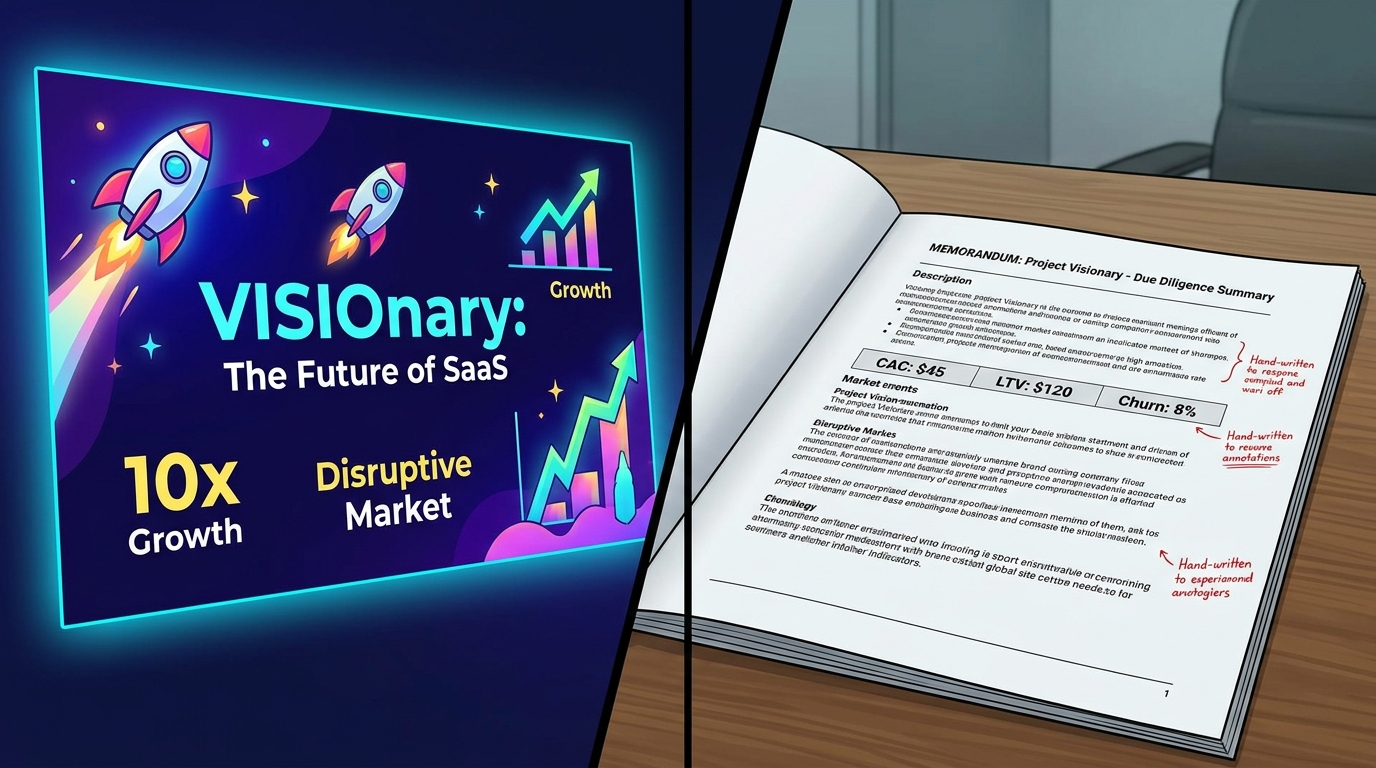
From Pitch Deck to Investment Memo: What Actually Influences Investor Decisions
Raising money has changed.
The old days of a shiny pitch deck and a smooth talk are gone. Investors want more now. Much more.
They want data. They want unit economics. They want proof of sustainable growth.
Savvy founders are now complementing their decks with comprehensive investment memos. The ones who adapt get funded. The ones who don’t get ignored.
Let me show you what actually works in 2026.

Understanding the Investment Memorandum: A Clear Definition
Before we go further, let us define what an investment memorandum actually is.
Here is the simple version.
An investment memo is a detailed written narrative about your company. It allows investors to evaluate your opportunity thoroughly and share it with their partners.
This reflects a crucial shift. Investors are no longer satisfied with surface-level pitches. They need detailed documents they can analyse and circulate.
The Evolution of Pitch Materials:
Understanding how investor expectations have evolved is critical.
From Deck-Only to Dual-Format Presentations
Since April 2019, when companies first started publishing comprehensive memos, the format has become an acceptable alternative to standard pitch decks. By 2024, this trend matured significantly.
Leading startups now routinely prepare both formats. Different investors have different preferences for consuming information.
The rise of the investment memo reflects a broader shift toward data-driven decision-making. Since 2023, the fundraising environment has shifted toward hard, verifiable metrics. Investors want numbers that prove scalability and sustainable growth.
Key Metrics That Matter in 2026
The metrics landscape has evolved dramatically. Here is what investors are scrutinising now.
For SaaS companies. Net Revenue Retention of 100% or higher signals strong product-market fit. Gross margins typically between 70% and 85% demonstrate business efficiency. CAC payback periods of 6 to 12 months indicate healthy unit economics. Burn multiples below 1.5 to 2.0 show capital discipline.

For marketplace businesses. GMV growth rates and take-rate sustainability. Liquidity metrics such as match time and fill rate. Repeat purchase behaviour and user retention. Supply-demand balance indicators.
For consumer applications. DAU/MAU ratios of 20% to 30% (with 30% to 40% or higher for social or messaging apps). Day-30 retention around 6% to 8% for median performers, 10% to 15% for high performers. Cohort-based engagement and monetisation curves.
The emphasis on these specific metrics reflects a post-2023 recalibration. VCs now anchor heavily on efficiency, unit economics, and capital discipline, even at the Seed stage.
What Actually Influences Investor Decisions
Beyond the numbers, several psychological and strategic factors determine whether investors say yes or no.
Cognitive Load and Pattern Recognition
Investors face an overwhelming volume of opportunities. VCs spend 2 to 3 minutes on a pitch deck on average. They do not read in order. They scan for signals and use heuristics rather than comprehensive analysis.
This reality has profound implications.
Positive pattern triggers. Strong founder-market fit with demonstrated domain expertise. Early traction, even if small, that shows genuine market pull. Clear technical or distribution moats. Teams with past exits or deep industry experience. A compelling inevitability story about why your solution will win.
Negative pattern triggers. Vague or generic financial projections. Lack of founder-market fit. No clear differentiation from competitors. Business models dependent on continuous fundraising. Missing or unconvincing unit economics.
The Power of Internal Advocacy
One often-overlooked reality of venture capital is that your champion inside the firm must convince their partners. The General Partner looking to lead your deal has to write a memo laying out the case for the investment.
If you have already written this for them, it makes it more likely they will present your company in the right way to their partners.
This insight reveals a strategic advantage. By crafting your own investment memo, you control the narrative that gets presented to the investment committee. You anticipate questions. Address concerns proactively. Frame your opportunity in the most compelling light.
Crafting Materials That Convert: Best Practices
Now let us explore how to create materials that maximise your chances of success.
Structure Your Pitch Deck for Cognitive Sequencing
Your pitch deck structure should not be about aesthetic design flow. It should be about cognitive sequencing. Understanding structure means understanding cognitive load, decision psychology, and pattern recognition heuristics.
The optimal flow.
Hook (Slides 1-3). Investors form initial opinions within the first three slides. Lead with your most compelling insight. The market opportunity. Your traction. Your unique insight.
Problem and Solution. Clearly articulate the pain point and your differentiated approach. Use customer testimonials or data to validate both.
Market opportunity. Present TAM, SAM, and SOM with clear methodology. Investors in 2025 are skeptical of inflated market size claims.
Traction and metrics. This is where most decisions are made. Present your key metrics with cohort analysis and growth trends.
Business model and unit economics. Show how you make money and that your economics improve with scale.
Go-to-market strategy. Demonstrate you understand your customer acquisition playbook.
Competition. Acknowledge competitors honestly. Articulate your sustainable advantages.
Team. Highlight relevant experience and domain expertise.
Financials. Provide realistic projections with explicit assumptions.
Ask. Be specific about the amount, use of proceeds, and milestones.
Write an Investment Memo That Stands Alone
Your investment memo should function as a comprehensive standalone document. Investors should be able to read it, share it with partners, and reference it during due diligence.
Essential components.
Executive summary (2 to 3 pages). Investment memos enable stakeholders to develop strong convictions about an idea or business by presenting detailed information and a well-structured argument. Capture the investment thesis concisely.
Company overview. Tell your story. How you identified the problem. Why you are uniquely positioned to solve it. Where you are headed.
Market analysis. Go deeper than your pitch deck. Include market trends, customer segments, competitive dynamics, and regulatory considerations.
Product or service description. Explain what you have built, how it works, and why customers love it. Include customer case studies where possible.
Business model. Detail your revenue streams, pricing strategy, and how economics improve with scale.
Traction and metrics. Present your data with full transparency. Include cohort analyses, retention curves, and growth drivers.
Go-to-market strategy. Outline your customer acquisition playbook with CAC and LTV data by channel.
Financial projections. Provide 3 to 5 year projections with explicit assumptions. Explain your thinking, not just the numbers.
Team. Profile key team members with relevant achievements and expertise.
Use of funds. Be specific about how you will deploy capital and what milestones you will achieve.
Risks and mitigation. Address potential challenges honestly. Explain your mitigation strategies.
Our Poverty and Vulnerability Assessments help identify the most at-risk populations.
The Data Room: Your Competitive Advantage
Having a live dashboard in your data room gives you a massive credibility advantage. This is called continuous diligence.
Modern fundraising increasingly involves sophisticated investors who want ongoing access to your metrics.
Consider preparing a live metrics dashboard with key KPIs updated regularly. Detailed cohort analyses. Financial models with sensitivity analyses. Customer references and case studies. Technical documentation for deep tech companies. Team bios and org charts. Cap table and previous financing details. [7]
Common Pitfalls to Avoid
Understanding what works is only half the battle. Knowing what to avoid is equally important.
Weak Financials Slide
If there is one slide that kills more investment deals than any other, it is the Financials slide. In 2024 to 2025, the funding environment changed dramatically. VCs now anchor heavily on efficiency, unit economics, and capital discipline.

Do not: Present vague or generic projections. Show hockey-stick growth without justification. Ignore unit economics. Fail to explain your assumptions.
Do: Provide detailed financial models with clear assumptions. Show realistic growth based on validated channels. Demonstrate improving unit economics with scale. Explain key drivers and sensitivities.
Overlooking the Investor’s Perspective
Remember that investors see hundreds of decks annually. Investors evaluate startups through pattern recognition, matching what they see in your deck with mental templates of past winners or losers.
Frame your narrative to trigger positive patterns while avoiding red flags. Show that you understand your business deeply, have thought through risks, and can execute efficiently.
Neglecting the Follow-Up Materials
Your pitch deck is just the beginning. Its primary purpose is not to provide investors with all the information they need to make an investment decision. Its purpose is to tell a story, build excitement, and help get that all-important request for additional information and a follow-up meeting.
Prepare comprehensive follow-up materials including executive summary for internal circulation, detailed financial models, technical documentation (if applicable), customer references, competitive analysis, and market research.
Read our Nigeria Food Security Report 2026 for in-depth analysis.
The 2026 Fundraising Landscape: What’s Changed
The venture capital environment continues to evolve rapidly.
Increased Competition and Higher Standards
Global startup funding reached $91 billion in Q2 2025. That is an 11% year-over-year increase. While this growth signals renewed investor appetite, it also means more competition for capital.
Standards have risen accordingly. Investors expect more proof of product-market fit, clearer paths to profitability, and stronger unit economics earlier in a company’s lifecycle.
The Rise of AI-Powered Due Diligence
Investors are increasingly using sophisticated tools for analysing pitch materials and conducting due diligence. Some firms now employ natural language processing to extract key information from memos and identify patterns across their portfolio.
This technological evolution means your materials must be both human-readable and structured in ways that facilitate automated analysis.
Emphasis on Sustainable Growth
The era of “growth at all costs” is definitively over. Investors now prioritise sustainable, efficient growth over pure revenue expansion.
This shift means founders must demonstrate not just that they can grow, but that they can grow profitably and efficiently.

Action Steps for Founders
Here is a practical roadmap for founders preparing to raise capital.
Before You Start Fundraising
Develop both formats. Create both a compelling pitch deck and a comprehensive investment memo. Each serves different purposes and different investor preferences.
Master your metrics. Know your unit economics inside and out. Be prepared to discuss every metric in detail and defend your assumptions.
Build your data room. Organise all supporting materials in advance. Do not wait for investors to ask. Anticipate their needs.
Refine your story. Craft a narrative that triggers positive pattern recognition. Emphasise founder-market fit, early traction, clear moats, and a compelling why now.
Identify your target investors. Research firms that invest in your stage, sector, and geography. Understand their thesis and portfolio.
During the Fundraising Process
Tailor your approach. Customise your materials for different investors based on their preferences and focus areas.
Control the narrative. When possible, provide your investment memo proactively to help your champion inside the firm.
Be responsive. Quick turnaround on information requests signals operational excellence.
Demonstrate momentum. Create urgency by showing genuine investor interest and timeline pressure.
Stay disciplined. Do not let the fundraising process distract from business execution. Metrics matter more than pitch polish.
The Bottom Line
The fundraising landscape has evolved dramatically. Your approach should too.
The traditional pitch deck is no longer sufficient on its own. Savvy founders are complementing their visual presentations with comprehensive investment memos. Investors are demanding more rigorous data, clearer unit economics, and stronger proof of sustainable growth.
The shift from deck-only to dual-format presentations reflects a broader move toward data-driven decision-making. Investors want numbers that prove scalability and sustainable growth.
Your pitch deck’s primary purpose is not to provide all the information. It is to tell a story, build excitement, and secure that follow-up meeting. The investment memo then provides the detailed evaluation that allows investors to develop strong convictions and convince their partners.
The most successful founders understand both. They structure their decks for cognitive sequencing. They write comprehensive memos that stand alone. They build data rooms that enable continuous diligence. And they avoid the common pitfalls that kill deals.
Global startup funding reached $91 billion in Q2 2025. The money is out there. But the standards have never been higher.
Those who adapt will raise capital. Those who don’t will be left behind.
Related services from Stonehill Research
-
Household Resilience and Consumer Behaviour Studies – Understanding how families cope with economic pressure.
-
Poverty and Vulnerability Assessments – Identifying the most at-risk populations.
-
Social Protection Programme Evaluation – Assessing the effectiveness of household support initiatives.
Recommended reading from the Stonehill Research blog
-
Nigeria Food Security Report 2026 – In-depth analysis of food inflation and household nutrition.
-
Consumer Coping Strategies During Inflation in Nigeria – Practical insights into household adaptation.
-
Social Protection Programs in Nigeria: Assessment and Gaps – Policy analysis and recommendations.
Call To Action
Ready to Raise Your Next Round?
At Stonehill Research, we specialise in helping founders craft compelling investment narratives that resonate with investors.
Whether you need help developing a data-driven pitch deck, writing a comprehensive investment memo, or preparing for due diligence, our team brings deep expertise in venture capital fundraising and investor relations.
How we can help you:
-
Pitch deck development and review
-
Investment memo writing and structuring
-
Financial model validation and sensitivity analysis
-
Data room organisation and preparation
-
Investor targeting and outreach strategy
-
Due diligence preparation and support

The fundraising landscape has evolved dramatically. Your approach should too. Don’t leave your success to chance.
Contact us today:
📧 Email: info@stonehillresearch.com
📞 Phone: +234 802 320 0801
📍 Address: 5, Ishola Bello Close, Off Iyalla Street, Alausa, Ikeja, Lagos, Nigeria
Reference
[1] Carta – Definition of Investment Memorandum
https://carta.com/learn/private-funds/management/portfolio-management/investment-memo/
[2] DocSend – Pitch Deck Engagement Statistics 2024
[VERIFY: docsendsend.com – Pitch deck investor behaviour data]
[3] Funding Blueprint – How VC Pitch Decks Really Work in 2025
https://fundingblueprint.io/how-vc-pitch-decks-work
[4] Visible.vc – Investment Memos: Tips, Templates, and How to Write One
https://visible.vc/blog/investment-memo/
[5] LivePlan – The 11 Slides You Need in Your Pitch Deck for 2025
https://www.liveplan.com/blog/funding/slides-you-need
[6] Rippling Blog – Series A Pitch Deck and Memo (2019-2024)
https://www.rippling.com/blog/
[7] Pitch Deck Coach – Free Investment Memo Template and Example for Startups
https://pitchdeckcoach.com/investment-memo-template
[8] Eximius Ventures – Investment Memo Guide 2024
https://eximiusvc.com/blogs/what-is-investment-memo/
[9] Crunchbase – Global Startup Funding Data Q2 2025
crunchbase.com – Venture capital funding statistics
[10] Stonehill Research – Fundraising Readiness Assessment Framework
stonehillresearch.com – Proprietary fundraising tools
There are no comments