

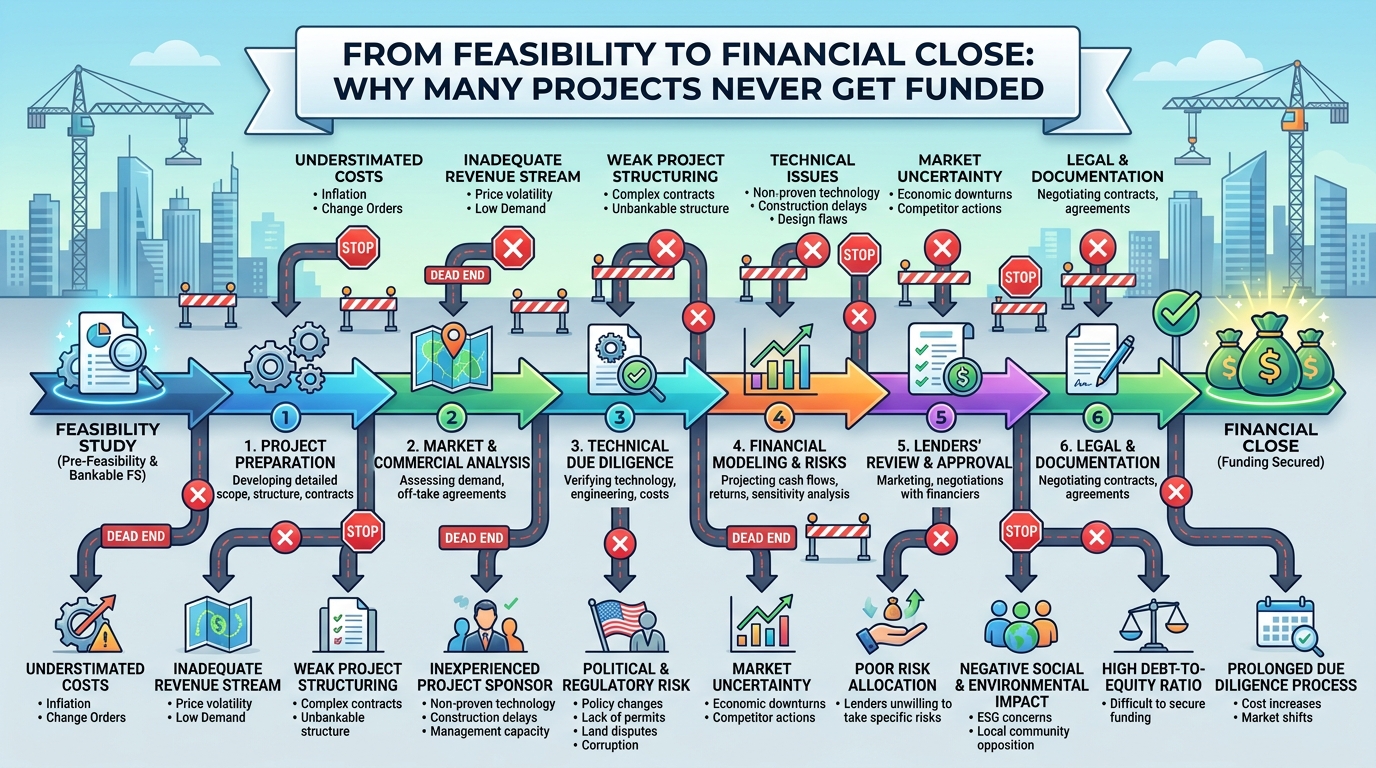
From Feasibility to Financial Close: Why Many Projects Never Get Funded
Your project looks great on paper. The numbers work. The market is there. The team is ready.
But the money never comes.
You are not alone. According to recent industry data, about 67% of projects that complete feasibility studies fail to achieve financial close within their projected timelines. Nearly 40% never secure funding at all.
That is billions in wasted development costs. Countless missed opportunities across infrastructure, energy, technology, and real estate.
Understanding why this happens is essential. Let me show you the real barriers and how to overcome them.

Understanding Financial Close: A Clear Definition
Before we explore why projects fail, let us define what financial close actually means.
Here is the simple version.
Financial close is the moment when commitment turns into actual money in the bank. All the paperwork is signed. All the conditions are met. The first cheque clears.
It represents the culmination of extensive negotiations, due diligence, and documentation. The journey from feasibility to funding involves far more than just showing that a project could work.
1. The Feasibility-Reality Gap
The transition from feasibility assessment to investment-grade proposition often reveals fundamental disconnects between planning assumptions and market realities.
Why This Gap Emerges
Optimistic assumption bias. Feasibility studies frequently incorporate best-case or moderately optimistic scenarios for critical variables. Construction timelines. Regulatory approval durations. Market penetration rates. Operational efficiency. While individual assumptions may seem reasonable, their cumulative effect creates unrealistic baseline expectations. Sophisticated investors immediately recognise and discount this.
Insufficient downside analysis. Many feasibility studies provide limited analysis of adverse scenarios. They fail to adequately model the financial impacts of delays, cost overruns, demand shortfalls, or operational challenges. Investors evaluating risk-adjusted returns need a comprehensive understanding of downside exposure. Not just upside potential.
Technical complexity underestimation. Projects involving novel technologies, complex integrations, or innovative processes often underestimate implementation challenges during feasibility phases. These complexities manifest during due diligence as increased cost, risk, or timeline exposures that diminish investment attractiveness.
Analysis of 2025 infrastructure projects shows that those which updated their feasibility studies within six months of funding discussions had a 58% higher probability of achieving financial close compared to those presenting studies older than 18 months.

2. Inadequate Risk Allocation and Mitigation
One of the most common funding barriers emerges from poorly structured risk allocation frameworks. Investors end up exposed to uncertainties they cannot effectively price or manage.
Read our Nigeria Food Security Report 2026 for in-depth analysis.
Key Risk Allocation Failures
Construction risk concentration. When projects fail to transfer construction risk to well-capitalised contractors through fixed-price, date-certain contracts with meaningful performance guarantees, investors face exposure to cost overruns and delays that can fundamentally alter returns.
Demand risk ambiguity. For revenue-dependent projects, inadequate demand risk mitigation leaves investors exposed to market adoption uncertainties. Offtake agreements. Customer contracts. Minimum revenue guarantees. Traffic or usage commitments. Without these, investors cannot underwrite the risk.
Regulatory and political risk. Projects in emerging markets or highly regulated sectors often fail to adequately address regulatory approval risks, political stability concerns, currency convertibility issues, or changes in government policy. Without appropriate insurance, guarantees, or structural protections, these risks can prove insurmountable.
Operating performance risk. Insufficient attention to operational phase risks creates uncertainty about long-term cash flow stability. Technology performance. Maintenance requirements. Workforce availability. Ongoing cost management. All of these deter investors seeking predictable returns.
Counterparty credit risk. Projects dependent on long-term commitments from government entities, utilities, or corporate off-takers must address counterparty credit risk through appropriate guarantees, security structures, or credit enhancement mechanisms.
Recent 2026 data reveals that projects with comprehensive risk allocation matrices addressing at least eight major risk categories achieved financial close in an average of 14 months, compared to 27 months for projects with basic risk frameworks.

3. Capital Structure and Financing Strategy Flaws
Even technically sound, commercially viable projects often fail due to inappropriate or unrealistic capital structure proposals.
Common Capital Structure Mistakes
Excessive leverage targets. Projects proposing debt-to-equity ratios that exceed market norms for their sector, geography, or risk profile struggle to attract either debt or equity investors. While developers naturally seek to maximise leverage to enhance equity returns, over-leveraged structures increase default probability.
Mismatch between capital sources and project needs. Attempting to fund long-term infrastructure with short-term debt. Seeking commercial bank financing for early-stage technology ventures. Pursuing venture capital for stable cash-flow businesses. These reflect fundamental misunderstanding of capital provider mandates.
Inadequate equity commitment. When project sponsors propose minimal equity contributions or seek disproportionate returns relative to capital at risk, it signals lack of confidence. This creates moral hazard concerns that make debt and co-equity investors uncomfortable.
Currency and tenor mismatches. Projects generating revenue in local currency while proposing significant hard currency debt create structural vulnerabilities. Seeking long-term financing for assets with shorter economic lives does the same.
Unrealistic return expectations. Sponsors demanding equity returns inconsistent with project risk profiles struggle to attract capital at any level. Whether too high given actual risks or too low to compensate equity investors adequately.
McKinsey’s 2025 Global Project Finance Survey found that projects with capital structures aligned to industry benchmarks (typically 60-80% debt for infrastructure, 30-50% for energy transition projects) achieved financial close 2.3 times faster than those with non-standard structures. [4]
4. Insufficient Development Capital and Premature Fundraising
A surprisingly common barrier is attempting to secure construction or project financing before completing essential development activities.
Development Phase Inadequacies
Incomplete permitting and approvals. Approaching investors before securing critical environmental permits, construction licenses, grid connection agreements, or regulatory approvals introduces significant execution risk. Most project financiers are unwilling to underwrite this.
Inadequate site control and land rights. Projects without secure land tenure, properly documented easements, or resolved land title issues present legal and execution risks that prevent financing regardless of other merits. The costs and timelines to resolve land issues are often underestimated during feasibility.
Insufficient engineering and design development. Moving to fundraising with conceptual or preliminary designs rather than detailed engineering creates uncertainty about construction costs, timelines, and technical feasibility. Investment-grade projects typically require design completion of 30% to 50% or higher.
Weak procurement and contracting progress. Without competitive procurement processes, contractor engagement, or preliminary offtake discussions, projects lack the commercial foundations that give investors confidence in execution capability.
Sponsor capacity and track record gaps. First-time developers or sponsors lacking demonstrated experience in similar projects struggle to attract competitive financing. Insufficient development capital often prevents these sponsors from engaging experienced development managers or technical advisors who could bridge credibility gaps.
Analysis of energy projects in 2025 shows that those achieving at least 40% design completion and securing major permits before active fundraising closed financing 4.7 months faster on average and at 35 basis points lower cost of capital.
5. Market Conditions and Investor Appetite Dynamics

External market conditions and shifting investor preferences create funding barriers independent of project quality.
Market-Driven Funding Challenges
Interest rate environment impact. Rising interest rates fundamentally alter project economics by increasing debt service costs and raising the discount rates investors apply to future cash flows. Projects conceived in low-rate environments often become financially unviable when rates rise.
Sector-specific investment trends. Investor appetite varies significantly across sectors and follows cyclical patterns influenced by policy changes, technological disruptions, and macro trends. Projects in sectors experiencing capital flight face funding challenges regardless of individual merit.
Geographic risk premium evolution. Country risk perceptions change based on political developments, economic performance, currency stability, and regional trends. Projects in geographies experiencing risk premium expansion face higher capital costs or complete capital unavailability.
Competitive funding dynamics. When numerous similar projects compete for limited capital within a sector or geography, investors gain negotiating leverage. Projects lacking clear competitive advantages struggle to differentiate themselves.
ESG and sustainability mandates. The rapid evolution of environmental, social, and governance investing criteria has created both opportunities and barriers. Projects failing to meet emerging ESG standards increasingly struggle to access mainstream institutional capital.
According to Bloomberg’s 2025 Energy Finance Report, renewable energy projects meeting comprehensive ESG criteria attracted capital at average interest rates 90 to 125 basis points lower than comparable projects without robust ESG frameworks. [6]
6. Documentation, Legal, and Governance Deficiencies
The complexity of project finance documentation creates numerous opportunities for funding delays or failures.
Critical Documentation Failures
Inadequate due diligence response. Projects unprepared for intensive investor due diligence signal operational immaturity. Lacking organised data rooms, comprehensive financial models, technical documentation, or prompt responses to information requests raises broader concerns.
Weak contractual frameworks. Poorly drafted or incomplete project agreements create legal ambiguity and risk allocation uncertainty that prevents financial close. EPC contracts. Power purchase agreements. Concession agreements. Operating contracts. All must be solid.
Governance structure deficiencies. Projects lacking clear decision-making frameworks, appropriate stakeholder representation, or effective dispute resolution mechanisms struggle to attract sophisticated investors. Governance failures often lead to project failures.
Security and collateral documentation. Inadequate security packages, improperly perfected liens, or unclear asset ownership structures prevent lenders from achieving the first-priority security positions they require. These legal technicalities can be absolute barriers to debt financing.
Jurisdictional and legal risk. Projects spanning multiple jurisdictions without proper legal analysis face complexity that many investors prefer to avoid. Projects in jurisdictions with weak rule of law carry elevated risk premiums.
Research from 2025 shows that projects utilising standardised documentation templates from multilateral development banks (such as the IFC’s model agreements) achieved financial close 3.2 months faster on average than those developing entirely bespoke documentation.
Check out Consumer Coping Strategies During Inflation in Nigeria for practical insights.
7. Sponsor Credibility and Execution Capability Concerns
Ultimately, investors fund not just projects but the teams executing them.
Sponsor-Related Funding Barriers
Track record deficiencies. Sponsors without demonstrated success in similar projects face elevated scrutiny. They often cannot access competitive financing terms regardless of project quality. First-time developers particularly struggle with this credibility gap.
Financial capacity limitations. When sponsors lack the balance sheet strength to support equity commitments, provide completion guarantees, or weather adverse scenarios, investors question project viability. Thinly capitalised sponsors are often perceived as unable to manage challenges.
Team competency gaps. Projects led by teams lacking essential expertise in technical, financial, regulatory, or operational domains raise concerns about execution capability. While advisors can fill knowledge gaps, investors prefer sponsors with demonstrated internal competency.
Reputational issues. Sponsors with histories of project failures, contractual disputes, or stakeholder conflicts face significant barriers to capital access. Reputational due diligence increasingly identifies red flags that prevent investor engagement.
Misaligned incentives. When sponsor economics are structured in ways that create misalignment with investor interests (excessive development fees, disproportionate returns for minimal capital at risk, exit rights that disadvantage remaining partners), capital providers become cautious.
Project outcomes found that sponsors with successful track records of delivering at least two comparable projects achieved financial close at debt pricing averaging 75 to 100 basis points lower than first-time developers.
8. Communication and Investor Relations Failures
Securing project finance requires sophisticated communication and relationship management.
Communication Breakdown Patterns
Generic pitching approaches. Presenting identical materials to diverse investor types without tailoring messages to specific mandates, return requirements, and risk appetites signals lack of sophistication and wastes everyone’s time.

Inadequate response to concerns. When sponsors react defensively to investor questions, fail to address identified weaknesses, or cannot articulate clear risk mitigation strategies, it erodes confidence. It suggests inability to manage challenges during project execution.
Poor expectation management. Overpromising on timelines, understating the funding process complexity, or failing to communicate setbacks transparently damages credibility. It can poison relationships essential for eventual success.
Insufficient relationship investment. Successful project finance often requires months or years of relationship building with potential investors. Sponsors approaching capital providers only when desperate for funding miss opportunities to cultivate understanding, trust, and enthusiasm.
Neglecting market intelligence. Failing to understand current investor priorities, competitive funding environments, or market standard terms leads to proposals that are out of touch with reality.
Bridging the Gap: Strategies for Success
Understanding why projects fail provides a roadmap for increasing success probability.
Critical Success Factors
Invest adequately in development. Secure sufficient development capital to complete permitting, advance engineering, finalise major contracts, and properly structure the transaction before approaching project financiers. Premature fundraising almost always proves counterproductive.
Align with market realities. Continuously update feasibility assumptions, capital structure proposals, and return expectations to reflect current market conditions, investor appetites, and competitive dynamics. Do not cling to outdated analyses.
Build comprehensive risk frameworks. Develop detailed risk allocation matrices addressing all major project risks. Include clear identification of mitigation strategies, responsible parties, and residual exposures. Demonstrate deep understanding of investor risk concerns.
Engage professional advisors. Utilise experienced financial advisors, legal counsel, and technical consultants who understand investor requirements. The cost of quality advisory services is typically recovered many times over through improved financing terms and faster close timelines.
Cultivate long-term relationships. Begin investor relationship building early. Maintain regular communication throughout development. Approach fundraising as relationship development rather than transactional capital seeking.
Maintain flexibility and adaptability. Remain open to feedback. Be willing to restructure proposals based on investor input. Recognise that achieving financial close often requires compromise and evolution from initial concepts.
Comprehensive 2025 research tracking 500 projects from feasibility through financial close identified that projects implementing at least five of the above success factors achieved funding rates of 78%, compared to 34% for projects implementing two or fewer.

The Path Forward: Realistic Timelines and Expectations
One of the most important insights is establishing realistic expectations about the timeline and complexity of reaching financial close.
For typical infrastructure or energy projects, the journey from feasibility completion to financial close generally requires 24 to 36 months under favourable conditions. Complex or first-of-kind projects often extend to 48 months or more.
This timeline includes:
-
Development phase: 12 to 18 months for permitting, detailed design, and contract negotiation
-
Financing documentation: 6 to 9 months for due diligence, term sheet negotiation, and documentation
-
Final approvals and closing: 3 to 6 months for board approvals, final conditions satisfaction, and close execution
Sponsors who underestimate these timelines inevitably run short of development capital, make premature compromises, or abandon viable projects due to exhaustion. All preventable outcomes with proper planning.
The Bottom Line
The gap between feasibility and financial close is one of the most challenging passages in project development. It consumes significant time, capital, and organisational energy while offering no guarantee of success.
But this challenge is not insurmountable for well-prepared sponsors who understand investor requirements and common pitfalls.
The projects that successfully navigate from planning to funded implementation share common characteristics. Comprehensive risk management. Market-aligned capital structures. Thorough development work. Credible sponsors. Sophisticated investor engagement.

They recognise that feasibility studies demonstrate potential but that reaching financial close requires transforming that potential into investment-grade opportunities. Through rigorous execution of development activities and financing strategy.
As we move through 2026, the importance of these principles only intensifies. Rising interest rates. Evolving ESG requirements. Heightened geopolitical risks. Increased competition for capital. The margin for error continues to shrink.
Projects that might have secured funding with minimal preparation in prior market cycles now require exceptional execution across all dimensions.
For sponsors committed to bringing viable projects to fruition, the message is clear. Invest adequate time and resources in the journey from feasibility to financial close. Engage experienced advisors. Build strong investor relationships. Maintain realistic expectations about timelines and challenges.
The rewards for those who persevere and execute strategically remain substantial. But success increasingly belongs to those who treat the funding process with the same rigor and sophistication they apply to project execution itself.
Related services from Stonehill Research
-
Household Resilience and Consumer Behaviour Studies – Understanding how families cope with economic pressure.
-
Poverty and Vulnerability Assessments – Identifying the most at-risk populations.
-
Social Protection Programme Evaluation – Assessing the effectiveness of household support initiatives.
Recommended reading from the Stonehill Research blog
-
Nigeria Food Security Report 2026 – In-depth analysis of food inflation and household nutrition.
-
Consumer Coping Strategies During Inflation in Nigeria – Practical insights into household adaptation.
-
Social Protection Programs in Nigeria: Assessment and Gaps – Policy analysis and recommendations.
Call To Action
Partner with Stonehill Research for Funding Success
At Stonehill Research, we specialise in bridging the gap between project feasibility and financial close. Our comprehensive advisory services help sponsors navigate the complex journey from concept to funded execution.
Our services include:
-
Feasibility Study Review and Enhancement – Identifying gaps that could derail funding discussions
-
Risk Framework Development – Creating comprehensive risk allocation structures that attract investors
-
Capital Structure Optimisation – Designing financing strategies aligned with market conditions
-
Investor Readiness Assessment – Evaluating development progress and documentation quality
-
Due Diligence Support – Preparing for and managing intensive investor scrutiny
-
Investor Introduction and Facilitation – Leveraging our network to connect projects with appropriate capital sources
Contact us today:
📧 Email: info@stonehillresearch.com
📞 Phone: +234 802 320 0801
📍 Office: 5, Ishola Bello Close, Off Iyalla Street, Alausa, Ikeja, Lagos, Nigeria
Stonehill Research – Transforming feasible projects into funded realities.
Reference Links
[1] International Finance Corporation (IFC) – Definition of Financial Close
https://www.ifc.org/en/what-we-do/sector-expertise/financial-institutions/definitions
[2] World Bank – Infrastructure Finance Report 2025
https://www.worldbank.org/en/topic/infrastructure/publication
[3] Asian Development Bank – Project Finance Review 2025
https://www.adb.org/publications/series/economics-working-papers
[4] McKinsey & Company – Global Project Finance Survey 2025
https://www.mckinsey.com/capabilities/operations/our-insights
[5] International Renewable Energy Agency (IRENA) – Financing Report 2025
https://www.irena.org/publications
[6] Bloomberg New Energy Finance – Energy Finance Report 2025
https://www.bloomberg.com/professional/solution/bloomberg-new-energy-finance/
[7] International Finance Corporation (IFC) – Project Documentation Study 2025
https://www.ifc.org/en/insights-reports
[8] Standard & Poor’s Global – Infrastructure Finance Analysis 2025
https://www.spglobal.com/ratings/en/research
[9] Preqin – Private Capital Study 2025
https://www.preqin.com/insights/research
[10] Cambridge Judge Business School – Project Finance Study 2025
https://www.jbs.cam.ac.uk/faculty-research/
There are no comments