

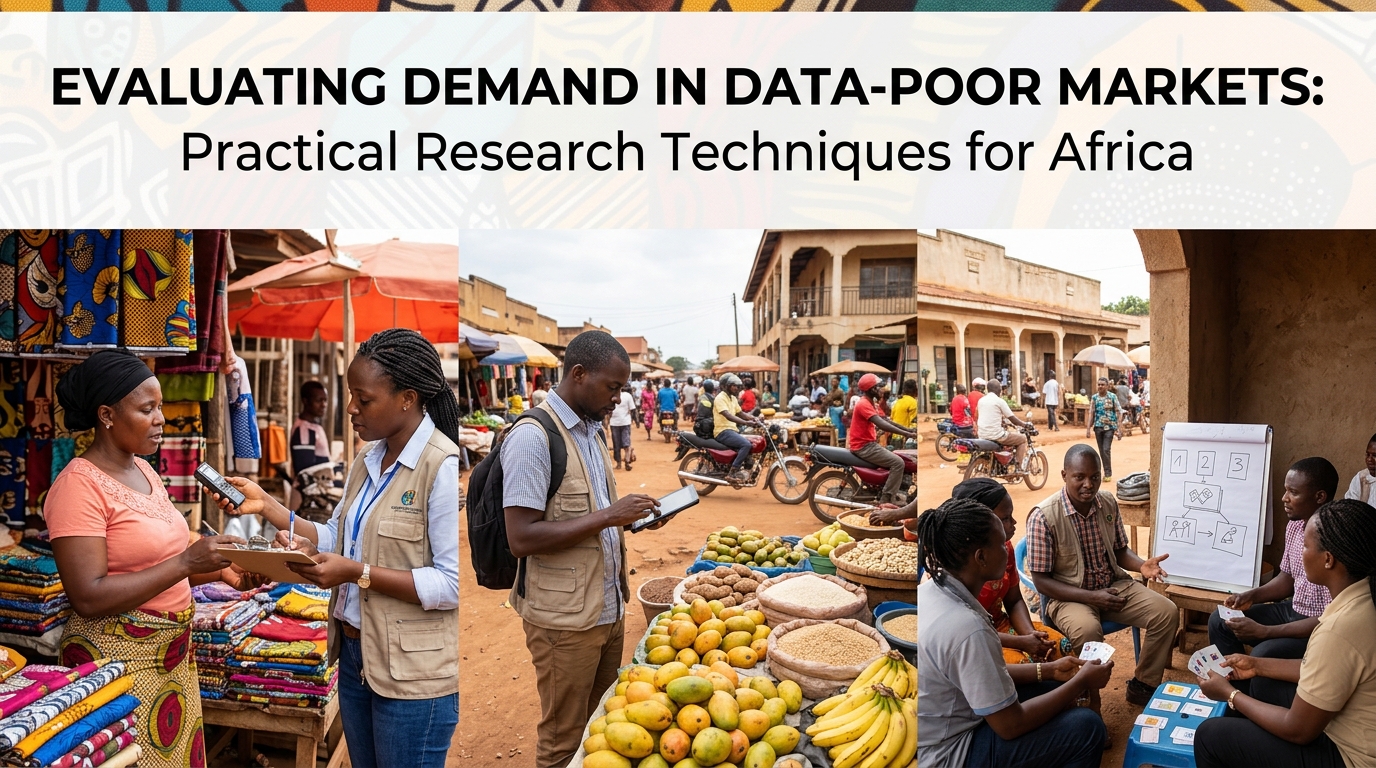
Evaluating Demand in Data-Poor Markets: Practical Research Techniques for Africa
You want to enter a new market. But there is no reliable data.
No census numbers you can trust. No sales figures. No consumer panels. Just empty spreadsheets and guesswork.
This is the reality of data-poor markets. Rural communities. Informal economies. Rapidly changing environments where traditional research methods fail.
But lack of data does not mean lack of opportunity. It just means you need different tools.
Let me show you practical techniques that actually work.

Understanding Data-Poor Markets: A Clear Definition
Before we go further, let us define what we are dealing with.
Here is the simple version.
Data-poor markets have limited or outdated census data. Predominantly informal economies with unrecorded transactions. Sparse digital footprints. Fragmented distribution channels. Low penetration of formal retail structures. Rapid socioeconomic changes that outpace data collection. Cultural or linguistic barriers that complicate standardised research.
Traditional market research approaches fail here. They rely on existing datasets, established consumer panels, digital tracking tools, and formal economic structures. None of which exist in these environments.
Core Research Techniques for Data-Poor Environments

When conventional data sources are unavailable, you need creative, boots-on-the-ground methodologies.
1. Rapid Market Assessment (RMA)
Rapid Market Assessment provides a quick snapshot through intensive, short-duration fieldwork.
Key components. Transect walks involve physical observation of market areas, noting shop types, product availability, pricing, and customer traffic patterns. Key informant interviews involve conversations with local business owners, distributors, community leaders, and long-term residents who possess institutional knowledge. Point-of-sale observations involve direct monitoring of purchasing behaviour at retail locations without formal surveys. Photographic documentation provides visual records of signage, product displays, pricing, and market infrastructure.
Mobile technology has transformed RMA effectiveness. Field researchers now use specialised apps like Fulcrum, Survey123, and KoboToolbox to capture geotagged observations, photos, and audio notes in real-time, even in low-connectivity environments. These tools enable same-day data synthesis and pattern recognition that previously took weeks. [2]
Implementation tips. Conduct RMAs during different times and days to capture variation in market activity. Engage local research assistants who understand cultural nuances and can access informal networks. Create standardised observation checklists while remaining flexible to unexpected insights. Cross-reference observations across multiple market locations to identify patterns versus anomalies.
2. Proxy Indicators and Correlative Data
When direct demand data is unavailable, identify proxy indicators that correlate with the target market behaviour.
Satellite imagery analysis has become more accessible and affordable. Services like Planet Labs, Maxar, and Google Earth Engine allow researchers to track infrastructure development, urbanisation patterns, agricultural activity, and even traffic flows. AI-powered image analysis can now detect market density, building construction, and land use changes at scale. [3]
Application strategy. Identify which proxy indicators have the strongest theoretical connection to your target market. Collect proxy data from multiple sources to triangulate findings. Establish baseline measurements and track changes over time. Validate proxy relationships through small-scale direct research when possible.
3. Participatory Rural Appraisal (PRA)
Participatory methods engage community members as active contributors rather than passive subjects.
Core PRA techniques. Focus group discussions involve structured conversations with 6 to 12 participants from target segments to explore attitudes, preferences, and decision-making processes. Community mapping has participants create visual representations of their community, marking important locations, resources, and economic activity centres. Seasonal calendars have groups develop calendars showing income patterns, expenditure cycles, and resource availability throughout the year. Wealth ranking exercises have community members categorise households into economic tiers using locally relevant criteria. Problem trees are visual diagrams where participants identify problems, causes, and effects related to specific needs or challenges.
Implementation best practices. Facilitate sessions in local languages with culturally appropriate gender and age group compositions. Use visual tools and activities that do not require literacy. Allow sufficient time for discussion and avoid rushing to conclusions. Validate findings across multiple community sessions. Respect local customs regarding participation and information sharing.
4. Test Marketing and Pilot Programs

Direct market testing provides the most reliable demand signals by introducing products or services on a small scale and measuring actual purchasing behaviour.
Test marketing approaches. Pop-up stores are temporary retail locations in target areas to gauge interest and gather feedback. Limited distribution pilots involve partnering with select retailers to stock products and track sales velocity. Mobile demonstrations bring products directly to communities for hands-on trials and immediate purchase opportunities. Conditional pre-orders gauge interest by collecting non-binding purchase commitments or small deposits. Rent-to-own trials allow consumers to test products over time before committing to full purchase.
Digital payment systems have expanded dramatically in many developing markets. M-Pesa, mobile money platforms, and digital wallets now operate in previously cash-only environments, enabling researchers to track transactions with unprecedented precision. This digital infrastructure makes test marketing more measurable even in informal market settings.
Design considerations. Start with very small scale to minimise risk while generating learnings. Vary pricing, packaging, and positioning across test locations to identify optimal configurations. Collect not just sales data but also qualitative feedback on barriers to purchase. Plan for longer test periods than in data-rich markets, as awareness builds more slowly. Factor in seasonal variations that might affect results.
Our Social Protection Programme Evaluation helps assess the effectiveness of household support initiatives.
5. Supply Chain Intelligence
Understanding the distribution network and engaging with intermediaries provides valuable insights into end-user demand patterns.
Supply chain research methods. Distributor interviews involve conversations with wholesalers and distributors about product movement, seasonal patterns, and customer segments. Retailer surveys involve systematic data collection from shop owners about inventory turnover, customer requests, and competitive products. Transportation tracking follows product movement from distribution points to final retail locations. Stock-out analysis documents which products consistently sell out and how quickly they are replenished. Informal market mapping identifies and engages with informal vendors who often serve segments missed by formal retail.
Strategic approach. Build relationships with supply chain partners who can provide ongoing market intelligence. Incentivise information sharing through mutual benefit arrangements. Recognise that supply chain actors have direct financial interest in market performance, colouring their perspectives. Cross-reference supply-side data with consumer-facing research to validate findings. [6]
6. Mobile and Digital Data Collection
Technology-enabled research methods can overcome geographic barriers and reach dispersed populations more efficiently.
Digital research tools. SMS surveys are text-based questionnaires that work on basic mobile phones without internet connectivity. Mobile ethnography has participants document their lives through photos and voice notes submitted via smartphone. WhatsApp and Telegram groups serve as moderated discussion groups for ongoing qualitative research. USSD polling provides interactive mobile surveys accessible through feature phones. App-based data capture involves specialised applications for field researchers to standardise data collection.
AI-powered chatbots now conduct market research conversations in local languages via popular messaging platforms. These conversational AI tools can engage hundreds of respondents simultaneously while adapting questions based on responses, generating qualitative insights at quantitative scale. Natural language processing analyses open-ended responses across multiple languages, identifying themes without manual coding. [7]
Implementation guidelines. Ensure mobile research designs account for varying levels of digital literacy. Provide clear instructions and support for participants unfamiliar with digital tools. Consider connectivity constraints and design for offline functionality where needed. Protect participant privacy and data security, especially in contexts without strong data protection regulations. Validate digital findings through some face-to-face research to check for selection bias.
Integrating Multiple Methods: The Triangulation Approach
No single research technique provides complete understanding in data-poor markets. Combine multiple methods to cross-validate findings.

Effective triangulation strategies. Sequential design begins with rapid assessment and proxy data to form hypotheses, then tests through participatory methods and small-scale pilots. Parallel data collection simultaneously gathers quantitative transaction data and qualitative consumer insights to understand both what and why. Stakeholder diversity collects perspectives from consumers, retailers, distributors, community leaders, and competitors to build a complete picture. Geographic variation conducts research across multiple locations within the target market to distinguish local peculiarities from broader patterns. Temporal validation revisits markets over time to confirm that initial findings reflect stable conditions rather than temporary anomalies.
Triangulation best practices. Document discrepancies between different data sources and investigate their causes. Weight findings based on data quality and source reliability. Remain open to revising conclusions as new information emerges. Communicate uncertainty clearly when making recommendations based on limited data.
Common Pitfalls and How to Avoid Them
Even experienced researchers encounter challenges in data-poor environments.
Projection Bias
The issue. Assuming that consumers in data-poor markets will behave similarly to those in data-rich markets or that purchasing patterns will mirror those in other developing economies.
The solution. Approach each market as unique. Conduct exploratory research without predetermined conclusions about consumer needs, preferences, or price sensitivity. Pay attention to local context, cultural factors, and specific economic conditions that shape behaviour.
Sampling Limitations
The issue. Reaching only accessible populations while missing important market segments, particularly in rural or informal areas.
The solution. Deliberately design research to include hard-to-reach populations. Use snowball sampling. Work with local organisations that have existing community trust. Allocate sufficient time and resources for accessing remote areas.
Over-Reliance on Self-Reported Data
The issue. Consumers may provide aspirational responses about future purchasing behaviour that does not reflect actual conduct when faced with spending decisions.
The solution. Prioritise observed behaviour and actual transactions over stated intentions whenever possible. When using surveys, focus questions on past behaviour rather than future plans. Validate self-reported data through other research methods.
Inadequate Cultural Adaptation
The issue. Research instruments, concepts, and approaches that work in other contexts may fail or produce misleading results when cultural adaptation is insufficient.
The solution. Involve local research partners in every stage of study design. Pilot test all research instruments with target populations. Be prepared to modify approaches based on cultural feedback. Learn enough about local context to recognise when responses may reflect cultural politeness rather than honest opinions.
Seasonal Blindness

The issue. Drawing conclusions from research conducted during atypical seasons without accounting for cyclical variations in income, product availability, or needs.
The solution. Document the timing of research activities and understand local seasonal patterns including agricultural cycles, holiday periods, and weather variations. When possible, conduct research across multiple seasons or explicitly factor seasonality into projections. [9]
Building Research Capacity in Data-Poor Markets
Organisations operating long-term in challenging markets benefit from developing sustained research capabilities.
Capacity building strategies. Train local research teams by investing in developing skilled local researchers who understand both rigorous methodology and local context. Establish ongoing monitoring systems by creating lightweight data collection processes that generate continuous insights rather than periodic snapshots. Develop distributor partnerships by engaging supply chain partners in systematic data sharing that benefits all parties. Build consumer panels by recruiting groups of consumers willing to provide ongoing feedback through various research methods. Create knowledge management systems by documenting research findings, methodologies, and lessons learned in accessible formats for organisational learning.
Cloud-based research management platforms like Qualtrics, SurveyCTO, and Airtable now offer robust offline functionality and advanced analytics. These platforms allow distributed teams to collaborate on research design, data collection, and analysis even in low-bandwidth environments. Integrated dashboards provide real-time visibility into research progress and preliminary findings.
Ethical Considerations in Resource-Constrained Research
Conducting research in data-poor markets raises important ethical questions.
Key ethical principles. Informed consent ensures participants understand research purposes, how information will be used, and their right to decline or withdraw without consequences. Fair compensation provides appropriate incentives for participation that recognise time and effort without being coercive. Privacy protection safeguards participant information, particularly in contexts where data protection regulations may be weak or unenforced. Community benefit considers how research contributes to or extracts value from communities, and looks for ways to ensure mutual benefit. Realistic expectations avoid creating false hopes about product availability, pricing, or employment opportunities through research activities. Cultural sensitivity respects local customs, power dynamics, and social structures throughout the research process. [10]
Turning Research into Action: From Insights to Strategy
The ultimate value of demand research in data-poor markets comes from translating findings into effective market strategies.
From research to market entry strategy. Segment pragmatically by using research findings to identify which market segments offer the most accessible opportunity rather than the largest theoretical market. Phase market entry by beginning with geographic or demographic segments where research confidence is highest, using early results to refine approaches for subsequent expansion. Design for learning by structuring initial market activities to generate ongoing insights that compensate for initial data limitations. Build distribution partnerships by leveraging supply chain relationships developed during research as go-to-market partners. Maintain research continuity by continuing data collection as you enter the market, treating the early operational phase as extended research. Stay adaptable by using research findings as hypotheses to test rather than certainties to implement, remaining responsive to market feedback. Document and share by creating feedback loops that ensure market intelligence flows back to product development, marketing, and strategic planning teams.

The Bottom Line
Evaluating demand in data-poor markets requires creativity, resourcefulness, and methodological rigor. The absence of traditional data sources creates challenges, but the techniques we have covered enable informed decisions even in the most information-scarce environments.
Success comes from combining multiple research methods, maintaining healthy skepticism about individual data points, continuously validating assumptions through market interaction, and building sustained research capabilities rather than relying on one-time studies.
The effort invested in understanding data-poor markets often yields not just market intelligence but also deeper relationships with communities, distribution partners, and customers. Relationships that become competitive advantages as markets develop.
Organisations that master research in challenging environments position themselves to capture opportunities that others overlook. They build presence in markets before they become crowded with competition.
The research techniques and principles outlined here provide a foundation for that competitive advantage.
Related services from Stonehill Research
-
Household Resilience and Consumer Behaviour Studies – Understanding how families cope with economic pressure.
-
Poverty and Vulnerability Assessments – Identifying the most at-risk populations.
-
Social Protection Programme Evaluation – Assessing the effectiveness of household support initiatives.
Recommended reading from the Stonehill Research blog
-
Nigeria Food Security Report 2026 – In-depth analysis of food inflation and household nutrition.
-
Consumer Coping Strategies During Inflation in Nigeria – Practical insights into household adaptation.
-
Social Protection Programs in Nigeria: Assessment and Gaps – Policy analysis and recommendations.
Call To Action
Ready to Evaluate Demand in Your Target Market?
At Stonehill Research, we specialise in conducting rigorous market research in data-poor and emerging markets across Africa and beyond.
How we can help you:
-
Rapid Market Assessment (RMA) design and execution
-
Proxy indicator and correlative data analysis
-
Participatory research and community engagement
-
Test marketing and pilot program design
-
Supply chain intelligence gathering
-
Mobile and digital data collection
Contact us today to discuss your research needs:
📧 Email: info@stonehillresearch.com
📞 Phone: +234 802 320 0801
📍 Address: 5, Ishola Bello Close, Off Iyalla Street, Alausa, Ikeja, Lagos, Nigeria
Let us turn market uncertainty into strategic opportunity.
Reference
[1] Harvard Business Review – Definition of Data-Poor Markets
https://hbr.org/topic/emerging-markets
[2] KoboToolbox – Mobile Data Collection for Field Research
[VERIFY: kobotoolbox.org – Offline data collection tools]
[3] Google Earth Engine – Satellite Imagery for Market Analysis
https://earthengine.google.com/
[4] World Bank – Participatory Rural Appraisal Toolkit
worldbank.org – PRA methodologies guide
[5] GSMA – Mobile Money in Emerging Markets
https://www.gsma.com/mobile-money/
[6] USAID – Supply Chain Intelligence for Development
usaid.gov – Market systems research guides
[7] SurveyCTO – Offline Data Collection for Research
surveycto.com – Mobile research platforms
[8] MIT D-Lab – Market Research for Data-Poor Environments
d-lab.mit.edu – Practical research techniques
[9] Innovations for Poverty Action – Seasonal Adjustment in Research
poverty-action.org – Research methodology guides
[10] UNU-WIDER – Ethical Research in Low-Resource Settings
wider.unu.edu – Research ethics guidelines
There are no comments