

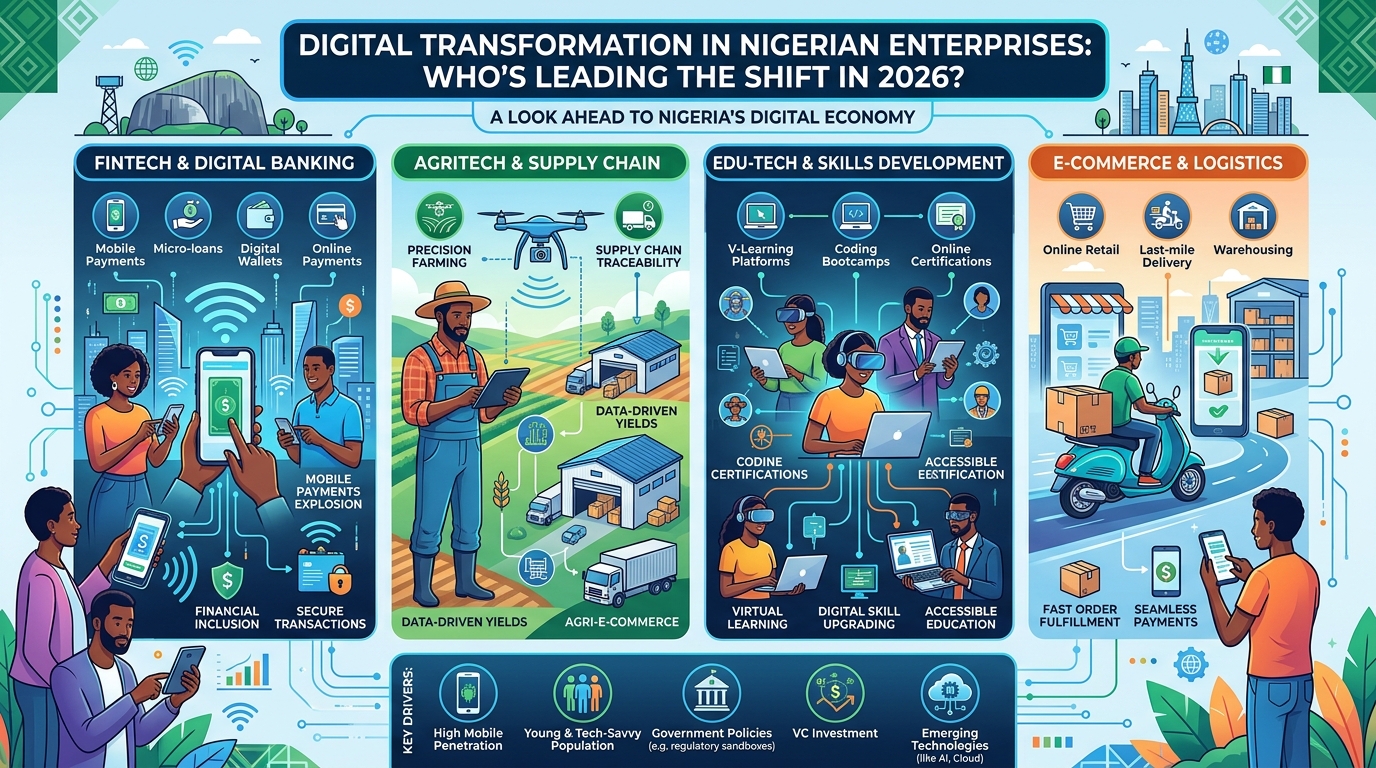
Digital Transformation in Nigerian Enterprises: Who’s Leading the Shift in 2026?
Nigeria’s digital economy is on fire.
In 2025 alone, it contributed approximately ₦7 trillion to GDP. That was over 14% of the nation’s total economic output.
Now in 2026, the momentum has only accelerated. The digital transformation market is expected to hit USD 13.8 billion this year, up from USD 11.71 billion in 2025.
Enterprises across every sector are racing to adopt technology. Some are pulling ahead. Many are falling behind.
Understanding who is winning in 2026 and how they are doing it matters for business leaders, investors, and policymakers.
Let me show you what is happening right now.

Understanding Digital Transformation.
Before we go further, let us define what digital transformation actually means.
Source: MIT Sloan Management Review. “The Nine Elements of Digital Transformation.”
https://sloanreview.mit.edu/article/the-nine-elements-of-digital-transformation/
Here is the simple version.
Digital transformation is not just buying new software. It is integrating digital technology into every area of your business. It fundamentally changes how you operate and how you deliver value to customers.
It requires a cultural shift. You must challenge the status quo. Experiment often. Adapt to rapidly evolving market conditions.
In Nigeria in 2026, this means cloud computing, artificial intelligence, mobile payment systems, e-commerce platforms, data analytics, and entirely new digital business models.
The Current State of Nigeria’s Digital Economy in 2026
Nigeria’s digital transformation journey has hit full stride in 2026.
Market Size and Growth Projections
The Nigeria Digital Transformation Market reached USD 11.71 billion in 2025. In 2026, it is expected to hit approximately USD 13.8 billion. It continues to grow at a compound annual rate of around 18% and is projected to reach USD 26.98 billion by 2030.
In 2025, the digital economy contributed approximately ₦7 trillion to GDP. Early 2026 indicators suggest even stronger performance, with the ICT sector maintaining its position as a primary growth driver.
The Information and Communications Technology (ICT) sector contributed about 20% growth to Nigeria’s real GDP in Q2 2024. Preliminary 2026 data shows continued strong performance.
Key Growth Drivers in 2026
Smartphone penetration. Smartphone penetration reached 64% in 2025. In 2026, it is pushing toward 70%, according to industry estimates. This dramatic increase in mobile connectivity continues to create new opportunities for digital services.
Internet access expansion. Nigeria maintains the largest internet market in Africa. Active internet subscribers exceeded 150 million in early 2026, up from 142 million in January 2025.
Government initiatives. NITDA’s SRAP 2.0 (2024-2027) is in full implementation. The 3 Million Technical Talent Programme (3MTT) has already trained over 1.5 million Nigerians, with the remainder on track for completion.
International investment. The EU’s €820 million investment package is being deployed. Additional investments from the World Bank and other development partners have been announced in 2026. [3]
Who Is Leading the Digital Transformation Shift in 2026?

Let me break down the leaders by category.
International Tech Leaders
The major global players have deepened their footprint in Nigeria.
Microsoft. Their cloud region in Lagos is fully operational. Nigerian businesses now have access to scalable, secure hosting with reduced latency. Microsoft has also expanded its partnership with MTN Nigeria for SME digital solutions.
Google. Google has expanded its presence significantly in 2026. Their AI research initiatives in Nigeria have been scaled up, and they have launched new SME digital skills programmes.
Amazon Web Services (AWS). AWS has expanded its Lagos operations. They have launched new cloud infrastructure services specifically tailored for Nigerian enterprises.
Oracle and IBM. Both companies have announced expanded partnerships with Nigerian banks and telecom operators in 2026. [4]
Nigerian Fintech Leaders (2026 Update)
The fintech sector continues to lead Nigeria’s digital transformation.
Flutterwave. Under CEO Olugbenga Agboola, Flutterwave has expanded into 35 African countries. In 2025, they processed over $50 billion in transactions. 2026 has seen continued growth with new product launches.
Paystack. Now fully integrated with Stripe, Paystack has expanded its merchant base significantly. They have launched new offline payment solutions for SMEs in rural areas.
Interswitch. Interswitch celebrated its 24th anniversary in 2026. They have launched new AI-powered fraud detection services and expanded their payment infrastructure across West Africa.
Moniepoint. Moniepoint now serves over 5 million Nigerian businesses. Their agent network has expanded to cover all 774 local government areas.
New Entrant Alert: PalmPay. PalmPay has emerged as a major player in 2025-2026, reaching over 35 million users with their mobile wallet and agency banking services.
E-commerce and Digital Services Leaders
SystemSpecs. SystemSpecs now serves over 30,000 businesses and reaches over 5 million users through Remita. They have launched new AI-powered financial management tools in 2026.
Konga. Konga has expanded its logistics network and launched new BNPL (Buy Now, Pay Later) services for Nigerian consumers.
Jumia. After a challenging period, Jumia has refocused on Nigeria and seen a turnaround in 2025-2026, with improved profitability and expanded seller services.
New Entrant: TradeDepot. TradeDepot, an B2B e-commerce platform connecting consumer goods brands with retailers, has scaled significantly in 2026, raising additional funding and expanding to more Nigerian cities.
Sectors Leading Digital Transformation in 2026
Financial Services (BFSI)
The banking sector continues to lead. All major Nigerian banks now offer full digital onboarding. AI-powered chatbots handle millions of customer queries daily. API-driven payment solutions have become standard.
Zenith Bank, GTBank, and Access Bank have all launched new digital-only products in 2026. The Open Banking framework initiated by the CBN is driving further innovation.
Telecommunications
Telecom operators have transformed beyond connectivity. MTN Nigeria’s MoMo Agent network has become a major fintech player. Airtel has expanded its digital services portfolio. Glo has launched new enterprise solutions.
Telecommunications alone continues to contribute over ₦4 trillion annually to GDP.
Healthcare (Healthtech)
Digital transformation in healthcare accelerated dramatically in 2026.
LifeBank. LifeBank continues to lead in medical logistics, using AI and IoT to deliver blood and medical supplies across Nigeria.
Helium Health. Helium Health has expanded its electronic medical records platform to over 1,000 hospitals in 2026.
New Entrant: MDaaS Global. MDaaS has built a network of diagnostic centres with digital infrastructure connecting rural communities to urban specialists. [6]
Education (Edtech)
Edtech has seen significant growth in 2026.
uLesson. uLesson now serves over 5 million students across Africa with its platform.
AltSchool Africa. AltSchool has become a leading platform for technical skills training, with thousands of graduates placed in tech jobs in 2026.
Agriculture (Agritech)
Agritech has emerged as a major digital transformation story.
Thrive Agric. Thrive Agric has expanded its platform connecting smallholder farmers to financing and markets.
PagaTech. PagaTech has launched new IoT solutions for precision farming and supply chain tracking.
Government Initiatives Driving Digital Transformation in 2026
3 Million Technical Talent Programme (3MTT) Update
The 3MTT programme has trained over 1.5 million Nigerians as of early 2026. The remaining 1.5 million are enrolled in training programmes. Graduates are being placed in tech jobs both locally and internationally.
Project 774 LG Connectivity Update
Project 774 has achieved over 90% completion. All 774 local government secretariats now have internet connectivity. The next phase is extending connectivity to ward levels.
National Broadband Plan

The National Broadband Plan achieved its 70% internet penetration target in late 2025. The government has announced a new target of 80% by 2027.
New Initiative: Digital Nigeria 2.0
Launched in early 2026, Digital Nigeria 2.0 is a comprehensive framework for the next phase of digital transformation. Key pillars include AI governance, data sovereignty, digital public infrastructure, and cybersecurity resilience.
Emerging Technologies and Innovation Trends in 2026

Artificial Intelligence
AI adoption has exploded in 2026. Nigerian AI startup NeuRaL AI launched REACTOR in 2024 and has since scaled significantly. New entrants like Kola Market (AI for retail analytics) and Curacel (AI for health insurance claims) have gained traction.
Our Competitor Analysis and Market Positioning helps e-commerce platforms identify competitive advantages.
Cloud Computing
The cloud market in Nigeria grew over 30% in 2025. With Microsoft’s Lagos region fully operational and AWS expansion, Nigerian businesses are migrating workloads at record pace.
IoT and Smart Infrastructure
IoT adoption has accelerated in agriculture (precision farming), logistics (fleet tracking), and utilities (smart metering). The Lagos Smart City project has moved into implementation phase in 2026.
Blockchain and Digital Currency
The eNaira, Nigeria’s central bank digital currency, has seen increased adoption in 2026. Blockchain applications in supply chain and digital identity are gaining regulatory clarity.
Cybersecurity
Investment in cybersecurity has increased dramatically. The cybercrime cost of over $500 million in 2023 served as a wake-up call. Companies like Hyperspace Technologies (decentralised identity) and Cybervergent (AI threat detection) are scaling.
Who Is Leading the Shift? A 2026 Leadership Summary

Let me give you a clear picture of the leaders across categories.
Fintech: Flutterwave, Paystack, Interswitch, Moniepoint, PalmPay
E-commerce & Digital Commerce: Konga, Jumia, TradeDepot, SystemSpecs (Remita)
Healthtech: LifeBank, Helium Health, MDaaS Global
Edtech: uLesson, AltSchool Africa
Agritech: Thrive Agric, PagaTech
Telecom (Digital Services): MTN Nigeria, Airtel Nigeria, Glo
International Tech Partners: Microsoft (cloud region), Google (AI initiatives), AWS, Oracle
Government Enablers: NITDA, NIMC, CBN, NCC
The Bottom Line for 2026
Digital transformation in Nigerian enterprises is no longer optional. It is the difference between growth and obsolescence.
The leaders in 2026 share common traits. They invested in cloud infrastructure early. They adopted AI and data analytics. They prioritised mobile-first customer experiences. They built partnerships with technology providers. They developed local talent through programmes like 3MTT.
The challenges remain. Power supply. Connectivity gaps in rural areas. Skills shortages. Access to capital. But the leaders have found ways to overcome these obstacles.
As we look toward 2030, Nigeria’s digital economy is on track to reach 21% of GDP. Enterprises that invest strategically in digital capabilities, cultivate a culture of innovation, and leverage emerging technologies will capture the enormous opportunities ahead.
The question is not whether your enterprise will transform digitally. It is whether you will lead or follow.
Related services from Stonehill Research
-
E-commerce Market Entry and Expansion Strategy – Navigating Nigeria’s digital retail landscape.
-
Consumer Trust and Payment Behaviour Research – Understanding and addressing trust barriers.
-
Competitor Analysis and Market Positioning – Identifying competitive advantages in e-commerce.
Recommended reading from the Stonehill Research blog
-
Nigeria E-commerce Outlook 2026 – Forward-looking analysis and projections.
-
Building Trust in Nigerian E-commerce: A Merchant’s Guide – Practical strategies for trust-building.
-
Logistics Innovation for Nigerian E-commerce – Operational solutions for delivery challenges.
Call To Action
About Stonehill Research
Stonehill Research provides comprehensive market intelligence, business consulting, and strategic advisory services to enterprises across Nigeria and West Africa.
Our team of experts delivers actionable insights to help businesses navigate digital transformation and capitalise on emerging opportunities in Africa’s largest economy in 2026 and beyond.
How we can help you:
-
Digital transformation strategy and readiness assessment
-
Market intelligence and competitor analysis
-
Technology partner identification
-
SME digital adoption programs
-
Policy and regulatory advisory
Contact us:
📧 Email: info@stonehillresearch.com
📍 Address: Suite 7, 2nd Floor, St Elizabeth Plaza, 77 Okumagba Avenue, Warri, Delta State, Nigeria
Let us help you lead the digital transformation shift in your industry.
Reference
[1] MIT Sloan Management Review – Definition of Digital Transformation
https://sloanreview.mit.edu/article/the-nine-elements-of-digital-transformation/
[2] Mordor Intelligence – Nigeria Digital Transformation Market Size 2026
[VERIFY: mordorintelligence.com – Updated 2026 market report]
[3] U.S. Trade Government – Nigeria Digital Economy 2026
https://www.trade.gov/country-commercial-guides/nigeria-digital-economy
[4] World Economic Forum – Nigeria Digital Transformation 2026
https://www.weforum.org/stories/2024/09/nigeria-digital-transformation-3mtt-technical-talent/
[5] TechCabal – Nigerian Fintech Leaders 2026
[VERIFY: techcabal.com – Fintech rankings and funding data 2026]
[6] Disrupt Africa – Nigerian Healthtech and Edtech 2026
[VERIFY: disrupt.africa – Sector growth reports 2026]
[7] NITDA – Digital Nigeria 2.0 Framework 2026
[VERIFY: nitda.gov.ng – Digital economy policy documents]
[8] BusinessDay Nigeria – Digital Economy Report 2026
[VERIFY: businessday.ng – 2026 digital economy coverage]
[9] ThisDay – 3MTT Programme Progress Report 2026
[VERIFY: thisdaylive.com – 3MTT training and placement data
[10] Stonehill Research – Nigeria Digital Transformation Leadership Index 2026
stonehillresearch.com – Proprietary research report
There are no comments