

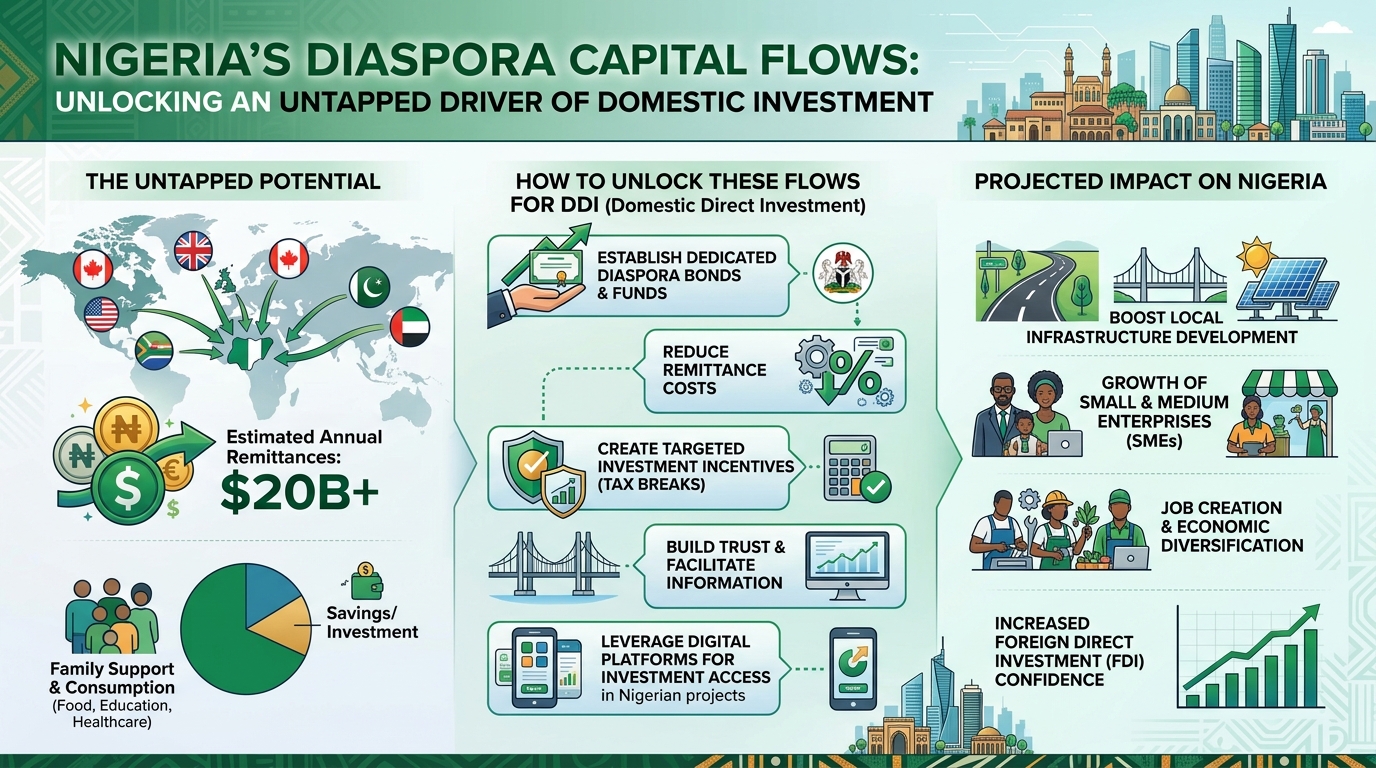
Diaspora Capital Flows: How Nigeria Can Unlock This Untapped Driver of Domestic Investment
Nigeria’s economy is experiencing a quiet revolution.
Everyone talks about foreign direct investment (FDI). But there is another force reshaping the country’s development. Diaspora capital.
Over 15 million Nigerians live abroad. In 2024, they sent home $20.93 billion. That is quadruple the country’s FDI for the same period.
The question is no longer whether the diaspora can contribute. It is how Nigeria can strategically channel these flows from household consumption into transformative investments.
Let me show you what is possible.

Understanding Diaspora Capital Flows: A Clear Definition
Before we go further, let us define a key concept.
Source: Cbonds. “Diaspora bonds.”
https://cbonds.com/glossary/diaspora-bonds/
Here is the simple version.
Diaspora bonds are debt instruments issued by a country to raise financing from its overseas citizens. They transform short-term consumption-focused remittances into long-term investment vehicles.
Instead of just sending money home for family needs, diaspora members can purchase government securities. Those securities fund infrastructure projects. They provide market-rate returns. They strengthen emotional and financial connection to the homeland.
The Magnitude of Nigeria’s Diaspora Capital
Let me share the numbers. They are staggering.
Record-Breaking Remittance Flows
Total remittances in 2024 reached 20.93billion.Thatisan8.94.73 billion, a 43.5% year-on-year increase.
Quarterly performance in 2025 shows continued strength. Q1 2025 recorded 4.93billion.Q22025roseto5.3 billion.
Remittances contribute approximately 6% to GDP according to the National Bureau of Statistics. Nigeria captured nearly 37% of Sub-Saharan Africa’s total remittances in 2024. That makes Nigeria not only Africa’s largest recipient but also one of the top five globally.
Here is the kicker. These inflows exceeded oil export revenues. They dwarfed the approximately $5.2 billion in FDI received during the same period. A 4:1 ratio.

The Diaspora Profile
Nigeria’s diaspora community comprises an estimated 15 to 20 million documented citizens living abroad.
Significant concentrations exist in the United States, where one of the most educated and economically successful Nigerian communities lives. The United Kingdom is a major source of remittance outflows. Canada has a growing Nigerian population with strong professional networks. The European Union, particularly Germany, Italy, and France, hosts many Nigerians. Emerging destinations in the Middle East and Asia are seeing increasing Nigerian migration.
According to Sharon Dimanche, Chief of Mission of the International Organization for Migration (IOM) Nigeria, these communities are “embedded in global institutions across health, technology, education, and the arts, while maintaining deep connections to Nigeria.” [3]
From Consumption to Investment: The Current Challenge
Despite the impressive volume, Nigeria faces a fundamental challenge. The vast majority of these funds go toward immediate consumption.
The Consumption Trap
Current estimates suggest that over 70% of remittances support household consumption. Food, healthcare, education, basic needs. Approximately 15% to 20% goes toward housing and real estate. Less than 10% is directed toward business investment or entrepreneurship. Minimal amounts are invested in financial instruments or government securities.
While supporting household welfare is important, this consumption-heavy allocation pattern limits the long-term developmental impact of diaspora capital.
Why Diaspora Capital Remains Underutilised for Investment

Several structural barriers prevent the conversion of remittances into productive investments.
Lack of investment vehicles. Limited availability of accessible, trustworthy investment products specifically designed for diaspora investors.
Trust deficit. Historical instances of fraud, property disputes, and government policy reversals have eroded diaspora confidence.
Information asymmetry. Diaspora members often lack reliable information about investment opportunities, regulatory requirements, and market conditions.
Complex regulatory environment. Cumbersome procedures for property acquisition, business registration, and financial transactions discourage diaspora investment.
Currency risk. Naira volatility creates significant uncertainty for diaspora investors evaluating returns in foreign currency terms.
Limited financial inclusion. Over 30% of Nigerians remain unbanked or underbanked, limiting infrastructure for channelling remittances through formal systems. [4]
Emerging Government Initiatives to Mobilise Diaspora Investment
The Nigerian government has launched several initiatives aimed at channelling these flows toward productive investments.
The Nigeria Diaspora Investment Summit (NDIS)
The 8th edition of NDIS held in November 2025 marked a significant milestone. The theme was “Fast-Tracking Regional and National Development by Mobilising Diaspora Investment.”
Key outcomes included investment pitching sessions across eight sectors. Healthcare. Education. Agribusiness. Creative and entertainment. Sports. Telecoms and ICT and fintech. Manufacturing. Oil and Gas. Infrastructure and Real Estate.
The summit also introduced the Non-Resident Bank Verification Number (BVN) to facilitate financial system access. More flexible exchange rate regimes for diaspora transactions were announced.
As NiDCOM Chairman Hon. Abike Dabiri-Erewa stated, “Our aim is to go beyond remittances. We are building structured, sustainable pathways for diaspora investment that can create jobs, transform lives, and strengthen local economies.” [5]
Diaspora Mortgage and Housing Schemes
One of the most concrete initiatives is the expansion of housing finance options specifically designed for diaspora Nigerians.
The Federal Mortgage Bank of Nigeria (FMBN) Diaspora NHF Mortgage offers loan amounts up to ₦50 million (approximately $100,000). Interest rate is 6.9% per annum. Loan tenure is 10 to 15 years. Loan-to-value ratio is up to 70%. Minimum contribution period is 12 months to the National Housing Fund.
The scheme allows diaspora Nigerians to register online from anywhere in the world, make monthly contributions via international transfer, monitor contributions using USSD code or online platforms, select properties from government-approved estates, and access mortgage insurance and title protection.
The Home and Abroad Housing Platform, launched by NiDCOM in collaboration with First Bank and FMBN, facilitates secure property investment across all 36 states. Features include discounted land prices, digitised land registries, virtual property tours, escrow-backed purchase mechanisms, and fast-tracked title issuance. [6]
Proposed Diaspora Bond Program
Perhaps the most transformative initiative is the establishment of a dedicated diaspora bond program.

The government announced a target of a $10 billion diaspora fund in April 2024. Purpose is infrastructure, healthcare, education, and critical economic sectors. They are seeking bids from asset managers for fund management. Potential rollout is late 2025 or 2026.
Vice President Shettima noted during the 2025 NDIS that the proposed Diaspora Bond is “designed to make investment in Nigeria more secure and rewarding,” with structured returns and capital protection instruments.
Strategic Investment Opportunities for Diaspora Capital
Beyond housing, multiple sectors offer high-potential opportunities.
Infrastructure Development
Nigeria’s infrastructure deficit creates enormous investment opportunities. Renewable energy projects like solar, wind, and mini-grids. Transportation networks including roads, rail, and ports. Digital infrastructure like broadband expansion and data centres. Water supply and sanitation systems. Power generation and distribution.
The United Nations Development Programme identifies infrastructure as offering “promising avenues for financial returns while contributing to Nigeria’s sustainable development.”
Technology and Innovation Ecosystem
Nigeria’s ICT sector achieved 5.78% real growth in Q3 2025. It contributes 9.10% to GDP. The broader digital economy accounts for nearly 20% of GDP in 2024. Almost four times oil’s contribution.
Diaspora investment opportunities include venture capital and private equity in Nigerian startups, creation of tech hubs and innovation centres in tier-2 cities, fintech platforms addressing financial inclusion, healthtech solutions, edtech, and agtech.
The Connected Diaspora x DOWA Start Up Challenge, unveiled by NiDCOM, specifically targets diaspora funding for high-impact tech concepts. [7]
Agricultural Value Chains
Agriculture contributes 31.21% to Nigeria’s real GDP (Q3 2025) and grew by 3.79%. Yet the sector remains significantly undercapitalised.
Investment opportunities include modern farming equipment and mechanisation, agro-processing facilities for cassava, cocoa, and palm oil, cold chain infrastructure, sustainable agricultural practices, export-oriented cash crop production, and livestock feed mills.
Healthcare Infrastructure
Nigeria’s healthcare system faces chronic underfunding. Opportunities include private hospitals and diagnostic centres, telemedicine platforms, medical equipment manufacturing, pharmaceutical production facilities, community health programs, and medical research institutions.
Education Sector
Investment opportunities span from basic to tertiary education. Building and upgrading schools. Teacher training programs. Digital learning platforms. Vocational training centres. STEM education facilities. Study abroad consultancy.
Manufacturing and Industrialisation
Selective manufacturing subsectors offer diaspora investment potential. Food processing and packaging. Textiles and garments. Pharmaceuticals and medical supplies. Building materials production. Light assembly operations. Import substitution industries.
Success Stories: What Works in Diaspora Investment Mobilisation
Nigeria can learn from countries that have successfully mobilised diaspora capital.
Israel: The Gold Standard
Israel has raised over $40 billion through diaspora bonds since 1951 via the Development Corporation for Israel (DCI).
Success factors include retail accessibility with minimum investments as low as $100. Diverse options with multiple maturity periods (3, 5, 10, 15, 30 years) and currency denominations. Trust and transparency having never defaulted on diaspora bonds. Active marketing through global events, online portals, and community engagement. A broad investor base available beyond just the diaspora. Clear purpose with funds directed toward specific sectors.

India: Crisis-Driven Success
India has raised approximately $35 billion through three major diaspora bond issues (1991, 1998, 2000) plus recent initiatives.
Key features included rupee-denomination exclusive to non-resident Indians, crisis timing issued during balance of payments crises when diaspora patriotism peaked, banking integration structured as bank certificates of deposit, exclusivity appeal, and regulatory clarity.
Ethiopia: Lessons from Challenges
Ethiopia’s attempted diaspora bonds in 2008 and 2011 failed to achieve expected results.
Failure factors included lack of trust in government institutions, illicit financial flows undermining confidence, insufficient transparency in fund usage, political instability affecting investor sentiment, and poor marketing and diaspora engagement.
Policy Recommendations: Unlocking Diaspora Investment Potential
To transform diaspora capital into a productive investment driver, Nigeria needs comprehensive policy reforms.
1. Establish a Comprehensive Diaspora Investment Framework
Create a one-stop regulatory framework specifically for diaspora investors. Simplify business registration, property acquisition, and financial transaction processes. Establish clear, predictable rules that protect diaspora investor rights. Guarantee repatriation of capital and profits.
Strengthen NiDCOM’s capacity to serve as the central coordination body. Establish dedicated diaspora investment desks at all relevant ministries. Create fast-track approval processes for diaspora-led projects. Implement regular stakeholder consultations.
2. Launch a Well-Structured Diaspora Bond Program
Issue bonds in multiple currencies (USD, GBP, EUR) to reduce currency risk. Offer various maturity periods (5, 10, 15, 20 years) to suit different investor profiles. Price at competitive interest rates with a modest “patriotic discount.” Ensure retail accessibility with minimum investments of 500to1,000. Register with major securities regulators (SEC in US, FCA in UK) for transparency. Designate specific infrastructure projects as bond proceeds beneficiaries.
Launch diaspora bond roadshows in major diaspora concentration cities. Leverage digital platforms and social media for awareness. Partner with diaspora associations and community organisations. Provide clear, regular reporting on project progress. [9]
3. Accelerate Digital Financial Infrastructure
Expand digital payment systems for seamless remittance-to-investment conversion. Develop mobile applications for diaspora investment monitoring. Implement blockchain-based land registries for transparent property transactions. Create online platforms connecting diaspora investors with vetted local entrepreneurs. Establish secure escrow mechanisms for large transactions.

Reduce the 30% unbanked population through agent banking and digital finance. Lower remittance transaction costs (currently averaging 5% to 9%) toward the global target of 3%. Expand Non-Resident BVN registration to enable full banking access. Develop diaspora-specific financial products.
Check out Building Trust in Nigerian E-commerce: A Merchant’s Guide for practical strategies.
4. Strengthen Trust Through Transparency and Accountability
Establish independent oversight bodies for diaspora investment funds. Publish regular, audited reports on diaspora fund utilisation. Implement whistleblower protections and anti-corruption measures. Create a diaspora investment ombudsman to resolve disputes. Guarantee legal recourse through specialised diaspora investment courts.
Provide investment insurance schemes for diaspora projects. Establish guarantee funds for diaspora bonds and mortgages. Partner with multilateral institutions like the World Bank and AfDB for credit enhancement. Implement investor protection regulations with clear enforcement mechanisms.
5. Create Targeted Incentive Structures
Offer tax holidays for diaspora-funded infrastructure projects. Provide capital gains tax exemptions on diaspora bond returns. Allow tax deductions for contributions to diaspora development funds. Implement reduced stamp duty rates for diaspora property transactions.
Expedite visa and immigration processes for diaspora investors and families. Provide dual citizenship provisions (if not already available). Offer special residency permits for returning diaspora entrepreneurs. Provide preferential access to government contracts for diaspora-owned businesses.
6. Facilitate Public-Private Partnerships
Establish diaspora co-investment funds matching government and diaspora capital. Create special economic zones with diaspora-friendly regulations. Develop bankable project pipelines specifically targeting diaspora investment. Partner with international financial institutions to de-risk diaspora investments.
7. Build Diaspora Human Capital Engagement
Establish a Diaspora Presidential Fellowship Program (6-month sabbaticals for diaspora professionals). Create diaspora mentorship networks for local entrepreneurs. Facilitate technology transfer and skills development programs. Organise annual diaspora innovation challenges with funding prizes. Partner with NASENI to connect diaspora scientists and engineers with local opportunities.
Addressing Implementation Challenges
Successful mobilisation requires acknowledging and addressing persistent challenges.
Currency Volatility Management
The naira’s depreciation creates significant uncertainty.
Solutions include issuing diaspora bonds in hard currencies (USD, GBP, EUR). Developing currency-hedged investment products. Allowing diaspora investors to hold domiciliary accounts for investment purposes. Creating natural hedges by investing in export-oriented sectors.
Political and Economic Stability Concerns
Diaspora investors express concerns about political uncertainty and policy reversals.
Mitigation strategies include enshrining diaspora investment protections in law, providing government guarantees for diaspora bonds, securing multilateral institution support for credit enhancement, establishing long-term policy frameworks that survive political transitions, and demonstrating consistent commitment through actions, not just rhetoric.
Trust Building
Historical fraud and disappointments have created skepticism.
Information Asymmetry
Many diaspora members lack detailed knowledge of Nigeria’s current investment landscape.
Information solutions include creating comprehensive diaspora investment portals with real-time information, organising regular investment webinars and virtual town halls, publishing detailed sector-specific investment guides, facilitating diaspora investor site visits with government support, and establishing diaspora investment helplines and advisory services.
Measuring Success: Key Performance Indicators
To track progress, Nigeria should establish clear metrics.
Quantitative indicators. Total diaspora investment volume target increasing from current estimated 10% to 30% of total remittances within 5 years. Diaspora bond subscriptions target raising $2-3 billion in first issue. Diaspora housing scheme participation track number of mortgages issued and total value. Business investment monitor diaspora-owned or co-owned business registrations. Venture capital measure diaspora contribution to startup funding.
Qualitative indicators. Trust levels survey diaspora sentiment toward Nigerian investment climate. Policy stability assess consistency of diaspora-related policies over time. Success stories document and publicise positive diaspora investment outcomes. Regulatory efficiency measure time required for diaspora investor processes. Diaspora engagement track participation in NDIS and other diaspora events.
The Economic Multiplier Effect
Converting even a portion of consumption-focused remittances into productive investments could generate significant economic multipliers.
Current state (2024). Total remittances 20.93billion.Estimatedinvestmentallocation 102.09 billion. Consumption allocation ~70% = $14.65 billion.
Target state (2030). Projected remittances 30billion(assuming79 billion. Maintained consumption allocation 60% = $18 billion.
Potential impact of additional $6.91 billion in annual investment. Infrastructure development equivalent to 1.5% of current GDP. Creation of 200,000 to 300,000 direct jobs. Multiplier effect generating additional 500,000 to 700,000 indirect jobs. Reduced infrastructure financing gap by 15% to 20%. Increased tax revenue from economic activity. Strengthened foreign exchange reserves. Reduced dependence on external borrowing.
The Bottom Line
Nigeria’s diaspora represents a largely untapped reservoir of capital. If strategically mobilised, it could fundamentally transform the country’s development trajectory.
With $20.93 billion flowing into the country annually, quadrupling foreign direct investment, the potential for channelling even a modest portion into productive investments is enormous.
By learning from international success stories like Israel and India while avoiding pitfalls experienced by others, Nigeria can create an enabling environment where diaspora capital flows seamlessly from consumption to investment.
The proposed diaspora bond program, if properly structured and transparently managed, could unlock billions in long-term development finance. Complementary initiatives in digital infrastructure, housing finance, venture capital, and sector-specific investment vehicles can create multiple pathways for diaspora participation.
The economic multiplier effects of converting just 20% of current remittances from consumption to investment could generate hundreds of thousands of jobs, accelerate infrastructure development, and reduce Nigeria’s dependence on volatile external financing.
More fundamentally, it would strengthen the connection between Nigeria and its global community, transforming the diaspora from generous family supporters into strategic development partners.
The question is no longer whether diaspora capital can drive domestic investment in Nigeria. The question is whether Nigeria’s policymakers and institutions have the vision, commitment, and execution capacity to unlock this untapped potential.
The opportunity is clear. The resources are available. What remains is political will and strategic implementation.
As NiDCOM Chairman Abike Dabiri-Erewa aptly stated, “The Nigerian diaspora remains one of our most valuable national assets.” It is time to fully leverage that asset for transformative national development.
Related services from Stonehill Research
-
E-commerce Market Entry and Expansion Strategy – Navigating Nigeria’s digital retail landscape.
-
Consumer Trust and Payment Behaviour Research – Understanding and addressing trust barriers.
-
Competitor Analysis and Market Positioning – Identifying competitive advantages in e-commerce.
Recommended reading from the Stonehill Research blog
-
Nigeria E-commerce Outlook 2026 – Forward-looking analysis and projections.
-
Building Trust in Nigerian E-commerce: A Merchant’s Guide – Practical strategies for trust-building.
-
Logistics Innovation for Nigerian E-commerce – Operational solutions for delivery challenges.
Call To Action
About Stonehill Research
At Stonehill Research, we provide comprehensive economic analysis, investment intelligence, and strategic advisory services to help businesses, investors, and policymakers navigate Nigeria’s evolving economic landscape.
Our team of experts specialises in diaspora investment analysis, capital markets research, and sectoral performance monitoring.
Our services include:
-
Diaspora Investment Advisory: Customised guidance for diaspora investors seeking opportunities in Nigeria
-
Market Intelligence Reports: In-depth analysis of sectoral trends and investment opportunities
-
Policy Analysis: Assessment of government initiatives and their implications for investors
-
Due Diligence Services: Comprehensive evaluation of investment projects and business opportunities
-
Strategic Consulting: Long-term planning and market entry strategies
Contact us today:
📧 Email: info@stonehillresearch.com
📞 Phone: +234 802 320 0801
📍 Address: 5, Ishola Bello Close, Off Iyalla Street, Alausa, Ikeja, Lagos, Nigeria
Reference
[1] Cbonds – Definition of Diaspora Bonds
https://cbonds.com/glossary/diaspora-bonds/
[2] World Bank – Migration and Development Brief 2025
https://www.worldbank.org/en/topic/migrationremittancesdiasporaissues/brief/migration-and-development-brief
[3] International Organization for Migration (IOM) – Nigeria Diaspora Mapping Report
iom.int – Nigeria diaspora data and analysis
[4] National Bureau of Statistics (NBS) – Remittance Statistics 2024
nigerianstat.gov.ng – Remittance and financial inclusion data
[5] Nigerians in Diaspora Commission (NiDCOM) – NDIS 2025 Report
nidcom.gov.ng – Diaspora investment summit outcomes
[6] Federal Mortgage Bank of Nigeria (FMBN) – diaspora NHF Mortgage Scheme
fmbn.gov.ng – Diaspora housing finance products
[7] National Information Technology Development Agency (NITDA) – ICT Sector Report 2025
nitda.gov.ng – Digital economy contribution data
[8] Development Corporation for Israel (DCI) – Israel Bonds Program
israelbonds.com – Diaspora bond success metrics
[9] Securities and Exchange Commission (SEC) Nigeria – Diaspora Bond Framework
sec.gov.ng – Capital market regulations for diaspora investment]
[10] African Development Bank (AfDB) – Diaspora Investment in Africa Report
afdb.org – Diaspora capital mobilisation best practices
There are no comments