

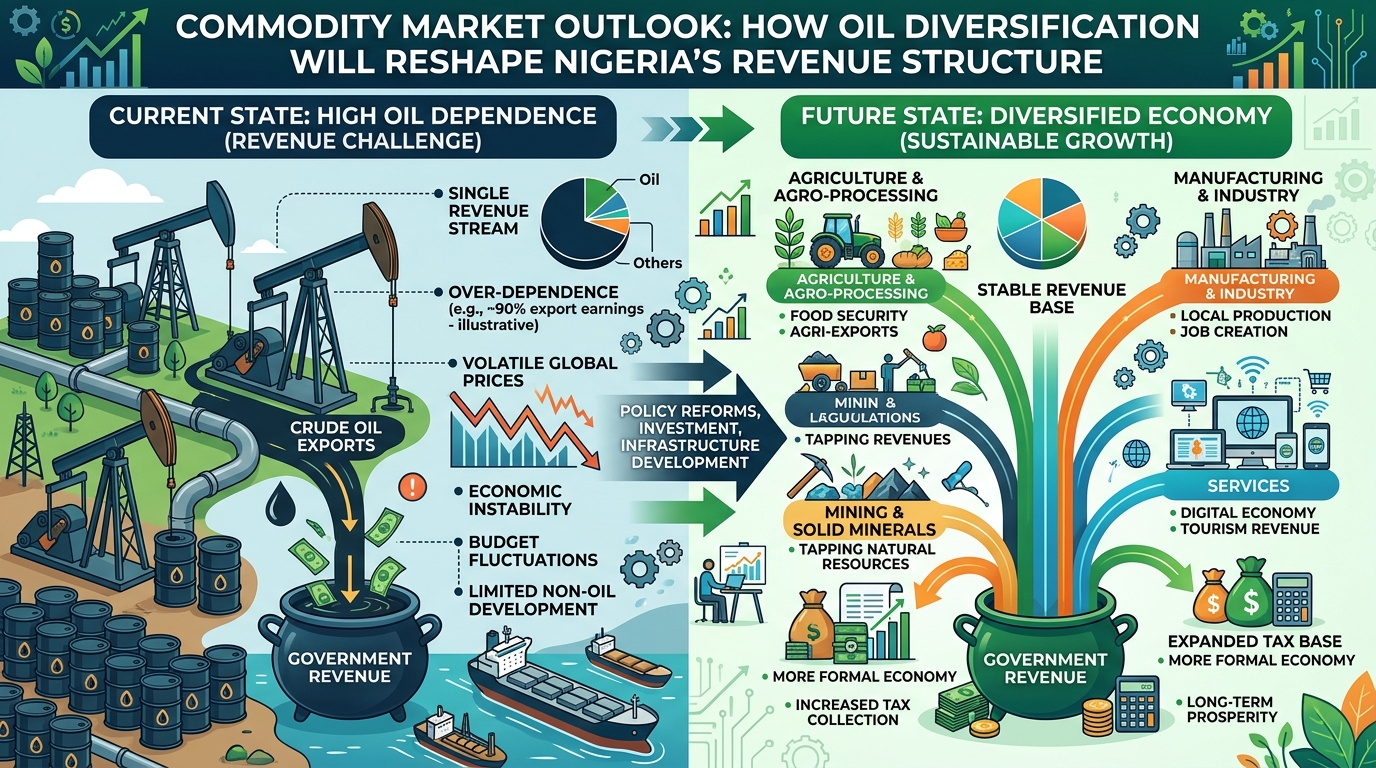
Commodity Market Outlook: How Oil Diversification Will Reshape Nigeria’s Revenue Structure
Nigeria has a problem. Too much dependence on one thing.
For decades, oil has been the lifeblood. It created wealth. It also created deep vulnerability.
The world is shifting toward cleaner energy. Nigeria cannot afford to be left behind.
The question is not whether to diversify. It is how fast. And whether the country will get it right.
Let me show you what is happening and where the opportunities are.
Understanding Economic Diversification: A Clear Definition
Before we go further, let us define what economic diversification actually means.
Definition: According to CS Global Partners, economic diversification is “the process of moving an economy away from depending on one income source toward gaining revenue from multiple sources across various sectors and markets.”
Source: CS Global Partners. “Economic Diversification.”
https://csglobalpartners.com/resources/what-is-economic-diversification/
Here is the simple version.
Stop putting all your eggs in one basket.
For resource-rich nations like Nigeria, diversification takes two forms. Product diversification expands the range of goods and services beyond traditional sectors. Export diversification introduces new products into the export portfolio and accesses new international markets.
Current State of Nigeria’s Oil Sector
Let me give you the latest picture.
Production Trends and Targets
As of 2024, Nigeria is producing 1.8 million barrels per day. This still falls short of true capacity. The government has set ambitious targets. 3 million barrels per day by 2025. 2.7 million barrels per day by 2027 under the Decade of Gas initiative. [2]
The Nigeria Oil and Gas Market is expected to reach 8.25billionin2025.Itwillgrowata4.3810.22 billion by 2030. Upstream activities captured 75.2% of the market share in 2024.
Infrastructure Developments
Big changes are happening.
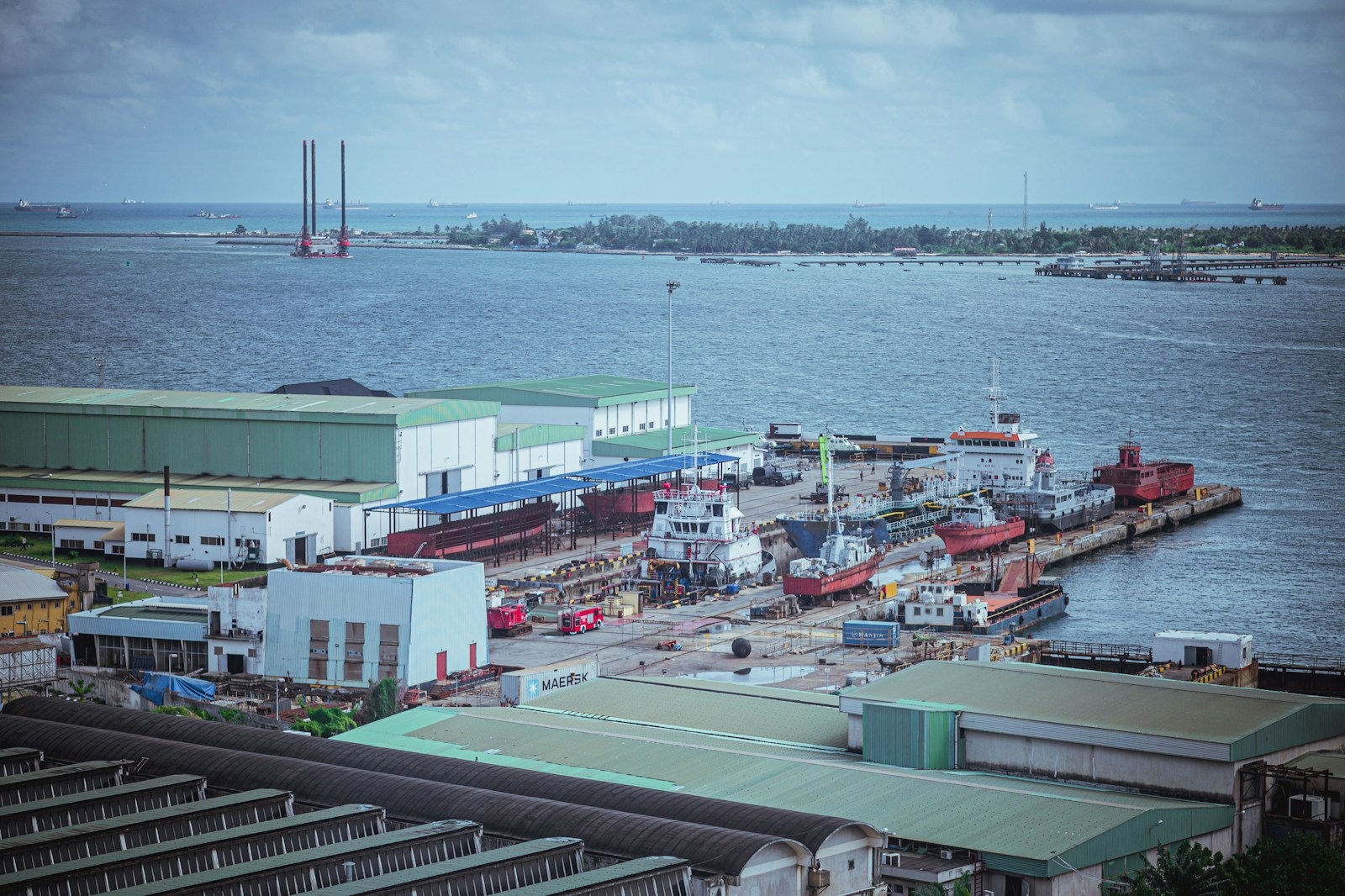
The Dangote Refinery. With capacity of 650,000 barrels per day, this refinery can transform Nigeria from a net importer of refined products to a self-sufficient producer. As of 2024, the facility reached 85% operational capacity. It has begun operations under the Naira-for-crude deal with NNPCL.
Natural gas expansion. Nigeria holds over 200 trillion cubic feet of natural gas reserves. This is an underexploited asset. The country commissioned five mini-LNG plants in February 2025. Gas demand is projected to grow at 16.6% annually through 2030.
Indigenous participation. Nigerian energy firm Green Energy International Limited exported its first oil cargo from the country’s first indigenous onshore crude export terminal in Otakikpo, Rivers State. Commissioned in June 2025, the facility features 750,000 barrels of storage capacity.
Persistent Challenges
Let me be honest about the problems.
Pipeline sabotage costs the oil and gas market more than $1 billion in lost revenue annually. Up to 30% of onshore throughput is at risk of theft. Security concerns in the Niger Delta continue to disrupt production.
Nigeria’s production costs of 48perbarrelaffectrevenuegeneration.Thismakesthecountrylesscompetitivecomparedtolower−costproducersglobally.Investmenthasfallenfromapeakof29 billion in 2014 to just over $5 billion in 2024.

The Economic Case for Diversification
Oil dependence creates systemic vulnerabilities. Let me explain why.
The Vulnerability of Oil Dependence
Oil has historically dominated government revenues and export earnings. This concentration exposes Nigeria to severe economic shocks. Heavy reliance on oil remains the primary challenge in an environment marked by declining prices and reduced demand.
Here is a surprising fact. The non-oil sector, including agriculture, contributed 95.40% to real GDP in Q4 2024. This statistic reveals a profound truth. Nigeria’s productive economy is already more diversified than its revenue structure suggests. But government finances remain dangerously tied to petroleum. [6]
Economic Performance and Projections
Nigeria’s economy is projected to grow by 3.2% in 2025. The World Bank forecasts 3.6% growth driven by fiscal reforms and non-oil sector expansion. The agriculture sector contributed 24.64% to real GDP in Q4 2024. This demonstrates significant yet underutilized potential.
Untargeted oil subsidies are scheduled to be phased out to 0% of GDP by 2028. However, the 2025 budget allocates less than 20% to capital expenditure. This constrains infrastructure investments critical for diversification.
Agriculture: The Cornerstone of Diversification
Agriculture offers the most promising pathway. Let me show you why.
Historical Context and Current Contribution
Before the oil boom, agriculture was the undisputed mainstay of Nigeria’s economy. It contributed over 60% to GDP. It employed more than 70% of the population. Nigeria was a significant global exporter of cocoa, palm oil, groundnuts, and rubber.
The oil boom in the 1970s changed everything. The agricultural sector was neglected. Today, agriculture still employs a significant portion of the population. But productivity remains well below potential. [7]
Government Initiatives and Policy Reforms
President Bola Ahmed Tinubu declared a national emergency on food security in July 2023. This signaled commitment to transforming agriculture.
National Agricultural Technology and Innovation Policy (NATIP) 2022-2027. This policy emphasizes mechanization, technology adoption, and value chain development.
Agro-Pocket Initiative. This flagship program targets cultivation of 750,000 hectares for staple crops like rice, maize, wheat, and cassava. It provides targeted support and input vouchers to farmers.
Infrastructure development. The government is harmonizing efforts between the Ministry of Agriculture and the Ministry of Water Resources. All-season farming through expanded irrigation is the goal. A National Commodity Board will stabilize food prices.
International Partnerships
Brazil and Nigeria executed a $1 billion agricultural agreement on June 24, 2025. This includes mechanized farming tools, training services, and operational facilities. Brazilian expertise in large-scale agriculture could transform Nigerian productivity. [9]
Persistent Agricultural Challenges
The obstacles are real.
Security crisis. Widespread banditry across food-producing states has forced farmers to abandon farmlands. Attacks, kidnappings, and extortion directly link insecurity to food insecurity.
Infrastructure deficits. Poor transportation networks. Limited cold chain facilities. Inadequate irrigation systems. High post-harvest losses continue to constrain productivity.
Input costs. Fuel subsidy removal and exchange rate unification have led to higher input costs. Producers face cash shortages.
Beyond Oil and Agriculture: Emerging Sectors
Diversification extends beyond agriculture. Multiple high-potential sectors can reduce oil dependence.
Natural Gas: The Transition Fuel
As of mid-2025, Nigeria achieved its natural gas reserve target of 210 trillion cubic feet. The country maintains a crude oil reserve base of 37.28 billion barrels. Gas demand is projected to grow at 16.6% annually through 2030.
Compressed Natural Gas (CNG) Initiative. CNG conversion centers increased from seven at the beginning of 2024 to 170 by mid-December 2024. One thousand technicians were trained within the year. The government launched a fleet of CNG-powered buses in Abuja.
LNG Expansion. The $10 billion Nigeria LNG Train 7 project continues to progress. Nigeria LNG is targeting 40 million tonnes per year of output by the end of the decade. [10]
Technology and Digital Economy

Nigeria’s technology sector has attracted global attention. Fintech, e-commerce, and digital services are booming. A young, tech-savvy population drives growth. Investments in startups, digital infrastructure, and technology services present significant opportunities.
Renewable Energy
Nigeria is exploring renewable energy options while promoting gas as a transitional fuel. Solar and wind energy projects are being developed. The government has committed to achieving net-zero emissions by 2060.
Pan-African renewable energy company WeLight has been contracted for $200 million to build hundreds of microgrids powered by renewable energy. This marks a significant shift in Nigeria’s energy infrastructure approach.
Manufacturing and Processing
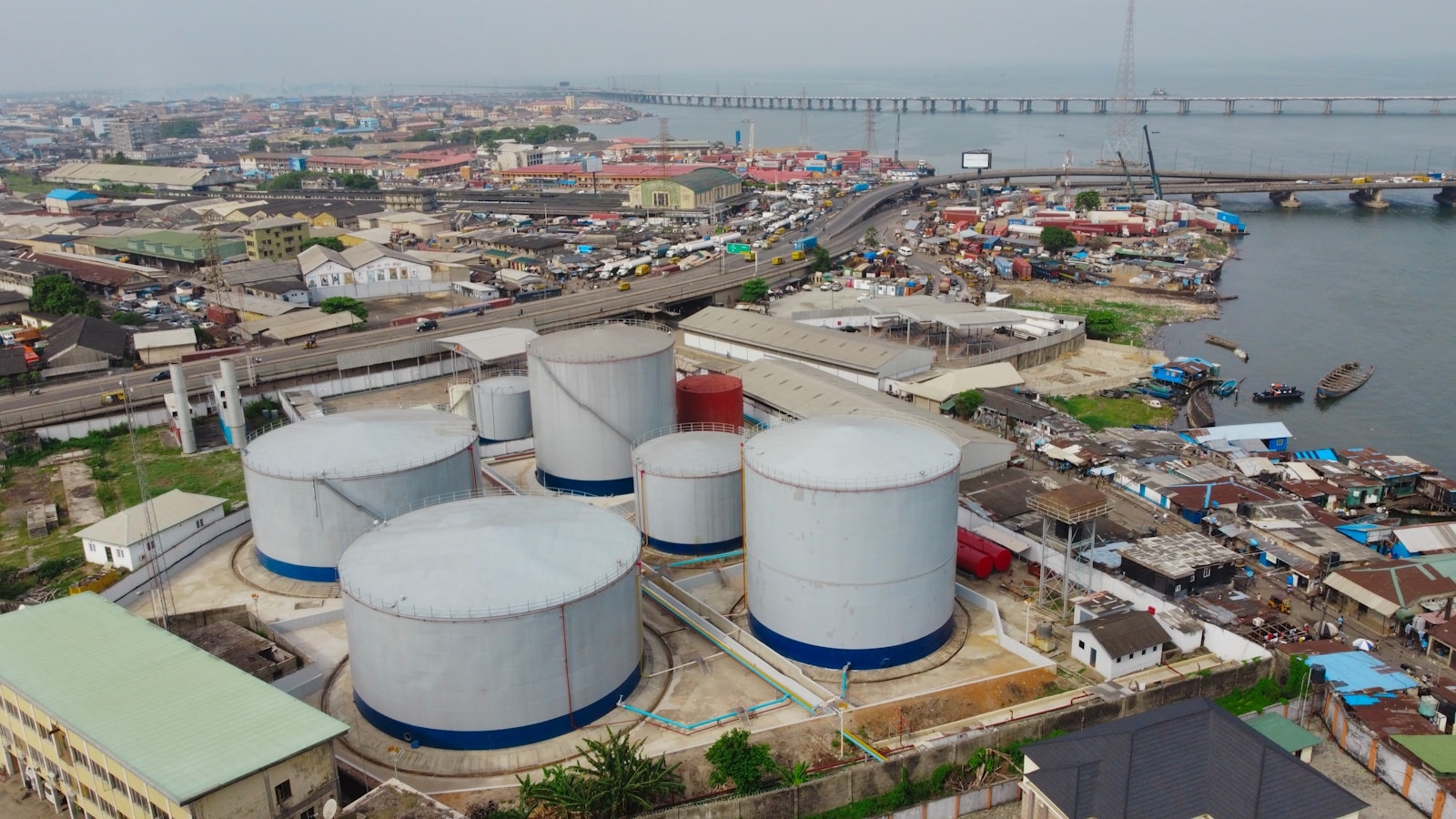
The downstream petroleum sector, centered on the Dangote Refinery, creates follow-on demand for storage terminals, jetty upgrades, and product pipelines. This represents value addition that keeps more revenue within Nigeria.
Agro-processing presents enormous opportunities. By processing agricultural commodities domestically before export, Nigeria can capture more value, create industrial jobs, and develop technical expertise.
Policy Framework and Institutional Reforms
Effective diversification requires comprehensive policy reforms.
Petroleum Industry Act and Fiscal Reforms
The Petroleum Industry Act (PIA) has introduced significant changes to oil and gas governance. The PIA mandates annual escrow contributions and full abandonment plans. Tax incentives for gas development aim to accelerate investment.
President Tinubu signed the Upstream Petroleum Operations Cost Efficiency Incentives Order in April 2025. This provides fiscal clarity and has drawn strong investor interest.
Business Environment Reforms
The government has implemented various reforms. Streamlining regulatory processes. Enhancing infrastructure. Attracting domestic and international investment.
Persistent Implementation Challenges
Here is a critical gap. Even with lower government spending, there is no further effort planned to diversify government revenue from oil. The deficit is projected to remain at least -4% of GDP in the long term.
The 2025 budget allocated only 1.75% to agriculture. This is well below the 10% Nigeria committed to under the Maputo Declaration. Insufficient capital allocation constrains infrastructure investments, research and development, and institutional capacity building.
Investment Opportunities and Private Sector Role
Successful diversification requires robust private sector participation.
Agricultural Value Chain
Mechanization and technology. Supplying tractors, irrigation equipment, precision farming tools, and satellite-based monitoring systems. Nigeria’s mechanization level is far below global standards.
Processing and storage. Establishing processing facilities, cold chain infrastructure, and storage terminals. This reduces post-harvest losses and adds value.
Export development. Building capacity to meet international quality standards. Accessing export markets for Nigerian agricultural products.
Energy Sector Transformation
Gas infrastructure. Development of gas processing plants, distribution networks, and CNG stations as Nigeria transitions toward a gas-powered economy.
Renewable energy. Solar, wind, and hybrid energy projects to expand access to electricity and support industrial growth.
Downstream petroleum. Tank farms, jetties, modular refineries, and distribution networks supporting domestic refining capacity.
Manufacturing and Industrial Growth
Nigeria’s large domestic market and strategic location make it attractive for manufacturing investments.
Import substitution. Manufacturing products currently imported to capture domestic demand and save foreign exchange.
Export-oriented manufacturing. Leveraging AfCFTA market access to produce for regional and continental markets.
Industrial inputs. Supplying machinery, equipment, and inputs to support industrial growth across sectors.
Challenges and Risk Factors

Let me be clear about the obstacles.
Security and Stability
Security remains the most pressing challenge across multiple sectors. In agriculture, banditry and farmer-herder conflicts reduce cultivated land. In the oil sector, pipeline vandalism and theft cost over $1 billion annually.
Infrastructure Deficits
Systemic challenges impede progress. Rising input costs. Climate change. Post-harvest loss. Low levels of mechanization and irrigation. Poor transportation and cold chain networks.
Policy Consistency and Implementation
Policy inconsistencies undermine investor confidence. Delays in regulatory approvals. Bureaucratic inefficiencies. Uncertain policy environments increase business risks.
Financing Constraints
Many indigenous companies have taken on considerable debt to acquire assets. Access to affordable financing remains a critical constraint for businesses seeking to expand into non-oil sectors.
Global Economic Headwinds
Volatile oil prices. Geopolitical tensions. Slower economic activity in major markets like Europe and China. All of these affect Nigeria’s export prospects and foreign exchange earnings.
The Road Ahead: 2025-2030 Outlook
Let me paint the picture for the next five years.
Short-Term Priorities (2025-2027)
Stabilizing oil production. Meet OPEC quotas and production targets. Maximize revenue from existing oil assets while global demand remains relatively strong.
Accelerating gas development. Capitalize on natural gas as a transition fuel. Make concrete progress on LNG expansion and domestic gas utilization.
Agricultural transformation. Implement mechanization programs. Expand irrigation. Address security challenges. Establish processing capacity.
Infrastructure investment. Prioritize transport networks, power generation, and digital infrastructure.
Medium-Term Transformation (2027-2030)
By the end of the decade, Nigeria aims to achieve significantly reduced dependence on oil for government revenues. Establish robust agricultural production and processing capacity. Position natural gas as a major revenue source alongside crude oil. Develop manufacturing and technology sectors capable of competing regionally and globally through AfCFTA.
Success Factors
The journey beyond oil will be long and arduous. Success requires political will sustained commitment despite short-term revenue pressures. Security solutions comprehensive approaches to address banditry, pipeline vandalism, and regional instability. Investment in human capital education, technical training, and skills development. Infrastructure development strategic investments in transport, power, water, and digital infrastructure. Institutional capacity strengthening regulatory bodies, reducing corruption, and improving policy implementation. Private sector engagement creating enabling environments that attract domestic and foreign investment.
The Bottom Line
Nigeria stands at a pivotal moment.
Global energy transition pressures. Volatile commodity prices. Internal security challenges. Oil diversification is not just desirable. It is essential for long-term prosperity.
The foundations for transformation are emerging. The Dangote Refinery is reshaping petroleum value chains. Natural gas infrastructure is expanding. Agricultural modernization programs are launching. Renewable energy investments are beginning.
The non-oil sector already contributes 95% to GDP. Nigeria’s productive economy has diversified significantly even as government revenues remain dangerously concentrated.
But challenges remain formidable. Security threats disrupt agriculture and oil production. Infrastructure deficits constrain productivity. Policy implementation gaps undermine investor confidence. Insufficient capital allocation limits the scale and pace of transformation.
The path forward requires coordinated action across government, private sector, and civil society.
The stakes could not be higher. Successfully diversifying Nigeria’s revenue structure will unlock sustainable growth, create millions of jobs, reduce poverty, and build economic resilience against external shocks.
Failure to diversify risks continued vulnerability to commodity price volatility, limited fiscal space for development, and missed opportunities to harness Nigeria’s enormous human and natural resource potential.
Nigeria’s economic future will not be written in oil alone. The nation’s prosperity increasingly depends on agriculture, gas, manufacturing, technology, and services working together.
The question is not whether Nigeria must diversify. It is whether the country will do so with the urgency, strategic focus, and sustained commitment that the moment demands.
Related services from Stonehill Research
-
E-commerce Market Entry and Expansion Strategy – Navigating Nigeria’s digital retail landscape.
-
Consumer Trust and Payment Behaviour Research – Understanding and addressing trust barriers.
-
Competitor Analysis and Market Positioning – Identifying competitive advantages in e-commerce.
Recommended reading from the Stonehill Research blog
-
Nigeria E-commerce Outlook 2026 – Forward-looking analysis and projections.
-
Building Trust in Nigerian E-commerce: A Merchant’s Guide – Practical strategies for trust-building.
-
Logistics Innovation for Nigerian E-commerce – Operational solutions for delivery challenges.
Call To Action
About Stonehill Research
Stonehill Research provides comprehensive market intelligence, economic analysis, and strategic insights to help businesses and investors navigate Nigeria’s evolving economic landscape.
Our research combines data-driven analysis with on-the-ground expertise. We deliver actionable insights across sectors.
How we can help you:
-
Identify high-potential investment opportunities in Nigeria’s diversifying economy
-
Navigate regulatory complexity across non-oil sectors
-
Assess market dynamics including supply chains, competitive landscapes, and emerging trends
-
Develop strategic entry plans tailored to Nigeria’s unique environment
-
Evaluate risk factors including security, infrastructure, policy, and macroeconomic conditions
Are you positioned to capitalize on Nigeria’s economic transformation?
Nigeria’s diversification journey creates unprecedented opportunities across agriculture, energy, manufacturing, and technology sectors.
Contact Stonehill Research today:
📧 Email: info@stonehillresearch.com
📞 Phone: +234 802 320 0801
📍 Address: 5, Ishola Bello Close, Off Iyalla Street, Alausa, Ikeja, Lagos, Nigeria
Let us help you transform Nigeria’s economic diversification into your competitive advantage.
Reference
[1] CS Global Partners – Definition of Economic Diversification
https://csglobalpartners.com/resources/what-is-economic-diversification/
[2] Mordor Intelligence – Nigeria Oil and Gas Market Analysis 2025
https://www.mordorintelligence.com/industry-reports/nigeria-oil-and-gas-market
[3] Olaniwun Ajayi LP – Nigeria’s Oil and Gas Industry Outlook 2025
https://www.olaniwunajayi.net/blog/nigerias-oil-gas-industry-outlook-2025-key-industry-trends/
[4] African Leadership Magazine – Nigeria’s Oil Industry in 2025
https://www.africanleadershipmagazine.co.uk/nigerias-oil-industry-in-2025-can-it-thrive-amid-global-shifts/
[5] U.S. Department of Commerce – Nigeria Oil, Gas, and Mining Sectors 2024
https://www.trade.gov/country-commercial-guides/nigeria-oil-gas-and-mining-sectors
[6] Allianz Trade – Nigeria Economic Report 2024
https://www.allianz-trade.com/en_global/economic-research/country-reports/Nigeria.html
[7] Punch – Agriculture’s Potential for Nigeria’s Economic Diversification
https://punchng.com/agricultures-potential-for-nigerias-economic-diversification/
[8] Federal Ministry of Agriculture – National Agricultural Technology and Innovation Policy (NATIP) 2022-2027
agriculture.gov.ng – NATIP policy document
[9] Naija News – Nigeria-Brazil Agriculture Deal 2025
https://www.naijanews.com/2025/07/30/the-nigeria-brazil-agriculture-deal-presents-an-opportunity-to-reduce-economic-dependence-on-oil/
[10] Wood Mackenzie – Nigeria’s Bold Strategy to Double Oil Production 2025
woodmac.com – Nigeria oil production and gas expansion analysis
There are no comments