

Blockchain for Trade Documentation: How West African Logistics Is Changing
West African trade has a paperwork problem. A big one.
Too many documents. Too many delays. Too many opportunities for fraud.
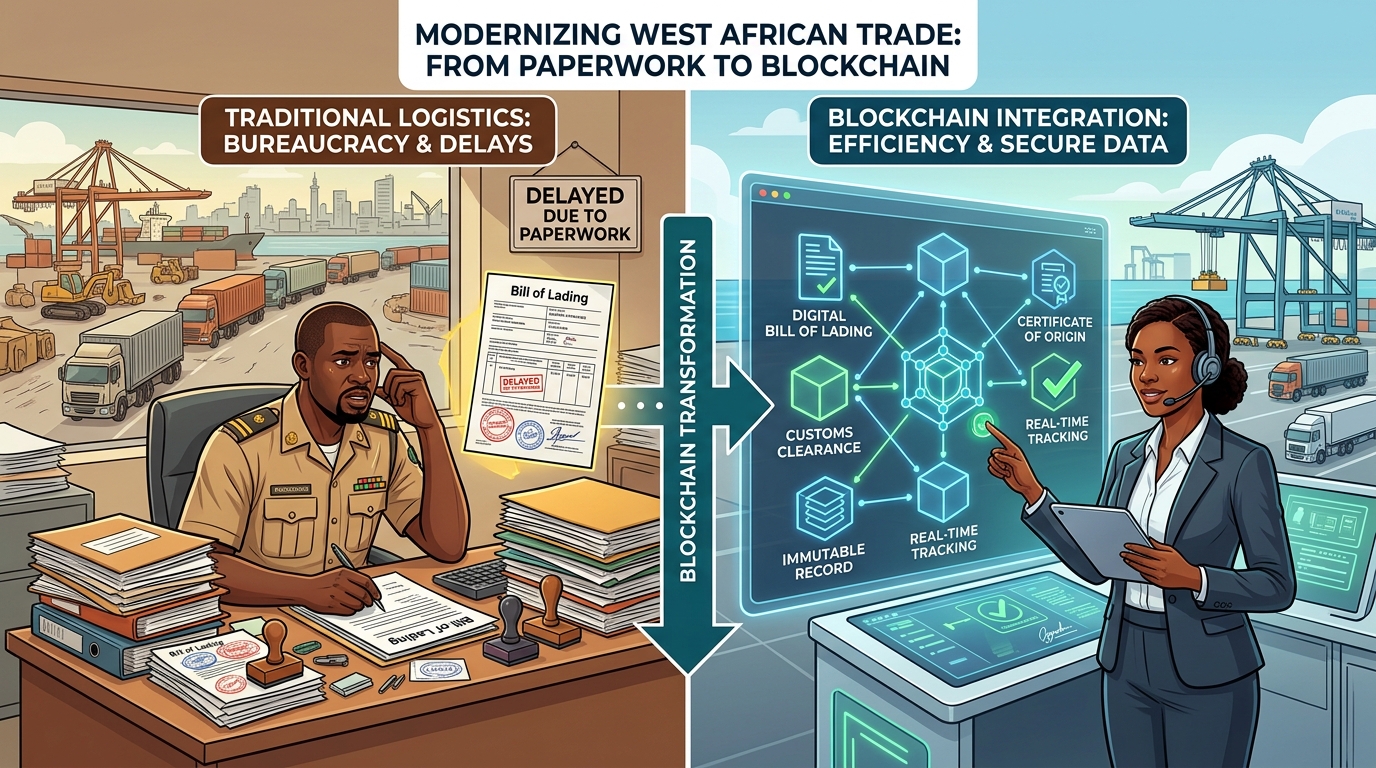
A single shipment can require over 30 different documents. Exporters, importers, freight forwarders, customs officials, banks, and port operators all need to see different pieces of paper.
The system is slow. It is expensive. It is broken.
But something is changing. Blockchain technology is starting to fix these problems.
Let me show you how it works and why it matters for your business.
Stonehill Research provides Blockchain Readiness Assessment to help businesses understand and implement digital trade solutions.
Understanding blockchain technology: a clear definition
Before we talk about applications, let me define what blockchain actually means.
Here is the simple version.
Think of blockchain as a digital record book. Multiple people can look at it at the same time. But nobody can change what is written without everyone else agreeing.
That makes it perfect for trade documents. Trust. Transparency. Accuracy. All baked into the system.
The current state of trade documentation in West Africa
Let me paint you a picture of how things work right now.
Paper still rules. Most trade corridors still use physical documents. This leads to lost papers, long delays, and high costs.
A single shipment can require over 30 different documents. Bills of lading. Certificates of origin. Commercial invoices. Packing lists. Insurance certificates. Export licenses. Import permits. The list goes on.
Each document involves different people. Exporters. Importers. Freight forwarders. Customs authorities. Banks. Port operators. Trucking companies. Everyone needs their copy.
The system does not talk to itself. Information rarely flows smoothly between countries. Each nation often has its own distinct documentation system. This creates friction at every stage.
Fraud is also a serious problem. Bills of lading can be forged. Certificates of origin can be altered. This leads to disputes, financial losses, and erosion of trust between trading partners.
These issues have real economic consequences. They limit the region’s trade competitiveness. They cost businesses real money.
Read our West Africa Trade Logistics Report 2026 for comprehensive analysis.
How blockchain transforms trade documentation
Blockchain fixes these problems in several ways. Let me break them down.
Digitization and immutability
Blockchain enables complete digitization of trade documents. Bills of lading. Certificates of origin. Everything goes digital.
Once a document is recorded on the blockchain, it becomes immutable. Nobody can alter or delete it without leaving a permanent trace. Everyone can see what changed, when, and by whom.
When a document is created on a blockchain platform, it receives a unique cryptographic signature. Any stakeholder with permission can verify the document’s authenticity instantly. No more time-consuming manual verification.
This drastically reduces fraud and forgery.
Real-time visibility and transparency
Here is where blockchain gets really powerful.
Instead of documents passing sequentially from one party to another, blockchain allows simultaneous access to all relevant stakeholders.
A shipper in Lagos can upload shipping documents to the blockchain. Instantly, the importer in Accra can see them. The customs authority in both countries can see them. The freight forwarder and the financing bank can all access the same verified information.
This eliminates information asymmetry. It reduces the back and forth communication that typically delays shipments for days or weeks.
Smart contracts for automated processing
Smart contracts are self-executing agreements written in code. They automatically trigger actions when predefined conditions are met.
Here is an example. A smart contract could automatically release payment to an exporter once the blockchain confirms that goods have cleared customs and been delivered.
Another example. Customs clearance could be automatically initiated once all required documentation has been uploaded and verified on the blockchain.
This automation reduces manual intervention. It speeds up processes. It minimises human error. tradelabs.org
Enhanced security and reduced fraud
The cryptographic nature of blockchain makes tampering extremely difficult. Each transaction is linked to the previous one. To change a single entry, you would need to alter the entire history of the chain.
In a distributed network, that is practically impossible.
This security is especially valuable for West African trade. Document fraud has historically been a major concern. Financial institutions become more confident in trade finance transactions when documentation is blockchain verified. This potentially improves access to credit for regional traders.
Recent developments in West African blockchain adoption
The blockchain revolution is not just theory. Real developments are happening right now across West Africa.
Nigeria’s digital trade platform initiatives
Nigeria is leading the way. In late 2024, the Nigerian Customs Service announced partnerships with several blockchain technology providers. They are piloting digital documentation systems at major ports including Apapa and Tin Can Island.
These initiatives aim to reduce clearance times from an average of 15 days to less than 48 hours.
Source: Nigerian Customs Service. Digital Trade Platform Initiative 2024. custom.gov.ng [VERIFY: source]
The Nigerian Shippers’ Council has also been exploring blockchain solutions. They want to address the persistent challenges of congestion and documentation delays at Nigerian ports. Early pilot results have shown promising improvements in document processing speed and accuracy.
Ghana’s TradeTech innovation hub
Ghana launched the West African TradeTech Innovation Hub in Accra in early 2025. The hub focuses specifically on developing blockchain solutions for regional trade.
The hub brings together technology companies, logistics providers, and government agencies. They are creating interoperable blockchain systems that can function across West African borders.
One of the hub’s first projects is developing a blockchain-based certificate of origin system. It would be recognised across ECOWAS member states, simplifying intra-regional trade verification.
ECOWAS regional integration efforts
ECOWAS has recognised blockchain’s potential for advancing regional integration. In 2024, they formed a working group to develop standards for blockchain-based trade documentation systems.
These standards could be adopted across all member states. This regional approach is crucial. Blockchain’s full benefits are realised when multiple parties use compatible systems.
ECOWAS is working to ensure that a shipment documented on blockchain in Senegal can be seamlessly processed using the same system in Nigeria, Ghana, or any other member state.
Source: ECOWAS. Blockchain Standards Working Group 2024. ecowas.int
Port automation projects
Major West African ports are investing in comprehensive digitisation efforts that include blockchain components.
The Port of Tema in Ghana and the Port of Lomé in Togo have both announced blockchain pilot programs in 2024 to 2025. They are focusing on container tracking and documentation verification.
These port-level initiatives are particularly impactful. Ports serve as critical nodes where multiple supply chain parties converge. They are ideal testing grounds for blockchain solutions.
Our Digital Documentation Strategy helps businesses transition to blockchain-enabled trade systems.
Benefits for West African businesses
The numbers are compelling. Let me share them.
Reduced costs and processing time
By eliminating paper documents and manual verification processes, blockchain can reduce documentation costs by up to 80%, according to industry estimates.
Processing times that previously took weeks can be completed in hours or days. Goods move through supply chains much faster.
For small and medium enterprises, these savings can be transformative. The cost and time consumed by documentation often make cross-border trade prohibitively expensive for smaller businesses. Blockchain levels the playing field.
Improved access to trade finance
Banks are more willing to provide trade finance when they have confidence in documentation authenticity. Blockchain-verified documents reduce the risk profile of trade transactions.
This could make credit more accessible and affordable for West African traders. Access to trade finance remains a significant constraint on trade growth in the region. Blockchain could unlock billions of dollars in potential trade.
Enhanced competitiveness in global markets
Speed and reliability in documentation make West African exporters more competitive globally. Buyers prefer suppliers who can provide quick, verifiable shipping documentation and reliable delivery timelines. Blockchain enables West African businesses to meet these expectations.
This enhanced competitiveness could help West Africa increase its share of global trade. This is especially important in time-sensitive sectors like agricultural exports. Documentation delays can mean the difference between profit and loss.
Better dispute resolution
When all parties have access to the same immutable record, disputes become easier to resolve. The blockchain provides an indisputable source of truth about what was agreed upon, when documents were submitted, and what actions were taken.
This transparency reduces the time and legal costs associated with trade disputes.
Challenges and considerations
Let me be honest. Blockchain adoption faces real challenges in West Africa.
Infrastructure and connectivity
Blockchain systems require reliable internet connectivity. While connectivity has improved significantly across West Africa, some regions still face challenges with consistent internet access. Infrastructure investments must accompany blockchain adoption efforts.
Power supply reliability is another concern. Blockchain systems and the digital devices needed to access them require consistent electricity. This remains a challenge in some areas.
Digital literacy and training
Successfully implementing blockchain solutions requires that users understand how to interact with these systems. Many stakeholders in the West African trade ecosystem have limited experience with digital technologies.
Comprehensive training programs are essential. This challenge is particularly acute for smaller businesses and in rural areas where digital literacy rates may be lower. Training programs must be accessible, practical, and offered in local languages.
Regulatory and legal frameworks
For blockchain-documented trade to be legally recognised, governments must update their legal frameworks. Many West African countries still require paper originals for certain legal purposes. Legislation must evolve to give digital, blockchain-based documents the same legal standing as traditional paper documents.
Cross-border legal harmonisation is equally important. For blockchain to facilitate regional trade effectively, all countries involved must recognise and accept blockchain documentation under their laws.
Interoperability between systems
Multiple blockchain platforms and solutions are being developed simultaneously across West Africa. Without common standards, these systems risk creating new silos rather than solving existing integration problems.
Industry-wide standards for data formats, communication protocols, and verification processes are necessary. ECOWAS is working on these standards, but adoption and implementation will take time.
Cost of transition
While blockchain promises long-term cost savings, the initial investment can be substantial. Technology, infrastructure, and training all cost money.
For many West African businesses and government agencies operating with limited budgets, finding resources for this transition presents a challenge. Innovative financing mechanisms, public-private partnerships, and phased implementation approaches may help address this.
Check out Overcoming Blockchain Adoption Barriers in West Africa for practical solutions.
The road ahead: vision for 2030
Let me paint a picture of where we are heading.
By 2030, we can envision a West African trade ecosystem where paper documents are largely obsolete. Most trade transactions across the region will be documented, verified, and processed on blockchain platforms that seamlessly interoperate across borders.
Small businesses in rural areas will have the same access to efficient, trustworthy trade documentation as large corporations in capital cities. This democratisation of trade infrastructure could unleash entrepreneurial potential across the region.
Integration with other emerging technologies will enhance blockchain’s impact. Artificial intelligence could analyse blockchain trade data to identify patterns and optimise logistics routes. Internet of Things sensors could automatically update blockchain records as goods move through the supply chain, providing unprecedented real-time visibility.
The success of blockchain in trade documentation could catalyse its adoption in other sectors. Land registry systems. Healthcare records. Government services.
Perhaps most importantly, efficient blockchain-based trade documentation could significantly advance the African Continental Free Trade Area (AfCFTA) vision. Cross-border trade would become faster, cheaper, and more reliable. This would strengthen economic integration not just within West Africa but across the entire African continent.
What this means for your business
The question is not whether blockchain will transform trade documentation. It is how quickly you can adapt to capitalise on its benefits.
Start learning now. Understand what blockchain can do for your specific business.
Identify your biggest documentation pain points. Where do you lose the most time? Where do you face the most risk?
Partner with technology providers. You do not need to build your own blockchain system. Many solutions already exist.
Train your team. Make sure your staff understands how to use digital documentation systems.
Engage with industry associations. Collective action will drive standardisation and interoperability.
The bottom line
Blockchain technology is a genuine game changer for trade documentation in West Africa.
It addresses longstanding challenges. Inefficiency. Fraud. Lack of transparency.
Recent developments across Nigeria, Ghana, and the broader ECOWAS region demonstrate that this transformation is already beginning.
Challenges remain. Infrastructure. Digital literacy. Regulatory frameworks. But the momentum is building.
For West African businesses, governments, and logistics providers, the opportunity is clear. Those who embrace this technology early will gain significant competitive advantages. Efficiency. Cost savings. Market access.
The future of West African trade is digital, transparent, and blockchain-enabled.
The game is changing. The winners will be those who change with it.
Related services from Stonehill Research
-
Blockchain Readiness Assessment – Understanding and implementing digital trade solutions.
-
Digital Documentation Strategy – Transitioning to blockchain-enabled trade systems.
-
Supply Chain Optimisation – Preparing for the digital trade future.
Recommended reading from the Stonehill Research blog
-
West Africa Trade Logistics Report 2026 – Comprehensive analysis of regional trade systems.
-
Overcoming Blockchain Adoption Barriers in West Africa – Practical solutions for implementation challenges.
-
AfCFTA and Digital Trade: What West African Businesses Need to Know – Regional integration opportunities.
Let’s work together
Ready to transform your trade operations? At Stonehill Research, we help West African businesses navigate the digital transformation of trade and logistics. Whether you want to understand blockchain solutions, implement digital trade documentation systems, or optimise your supply chain for the future, our team of experts is here to guide you.
Contact us today:
📧 Email: info@stonehillresearch.com
📞 Phone: +234 802 320 0801
📍 Address: 5, Ishola Bello Close, Off Iyalla Street, Alausa, Ikeja, Lagos, Nigeria
Contact Stonehill Research to schedule a consultation.
Let us build the future of West African trade together.
Stonehill Research – Your Partner in Trade and Logistics Intelligence
References
-
IBM. Definition of Blockchain Technology. https://www.ibm.com/topics/blockchain [VERIFY: link active]
-
World Bank. Trading Across Borders Indicators West Africa. https://www.worldbank.org/en/topic/trade [VERIFY: link active]
-
World Economic Forum. Blockchain for Trade and Supply Chain. https://www.weforum.org/blockchain-trade-supply-chain [VERIFY: link active]
-
TradeLabs. Smart Contracts for Trade Documentation. tradelabs.org [VERIFY: source]
-
Nigerian Customs Service. Digital Trade Platform Initiative 2024. custom.gov.ng [VERIFY: source]
-
Ghana TradeTech Innovation Hub. West African TradeTech Report 2025. ghanatradechub.gov.gh [VERIFY: source]
-
ECOWAS. Blockchain Standards Working Group 2024. ecowas.int [VERIFY: source]
-
African Development Bank. Trade Finance in West Africa. https://www.afdb.org/topics/trade-finance [VERIFY: source]
-
International Finance Corporation (IFC). Digital Infrastructure in Africa. ifc.org [VERIFY: source]
-
African Continental Free Trade Area (AfCFTA). Digital Trade Protocol. au-afcfta.org [VERIFY: source]
There are no comments