

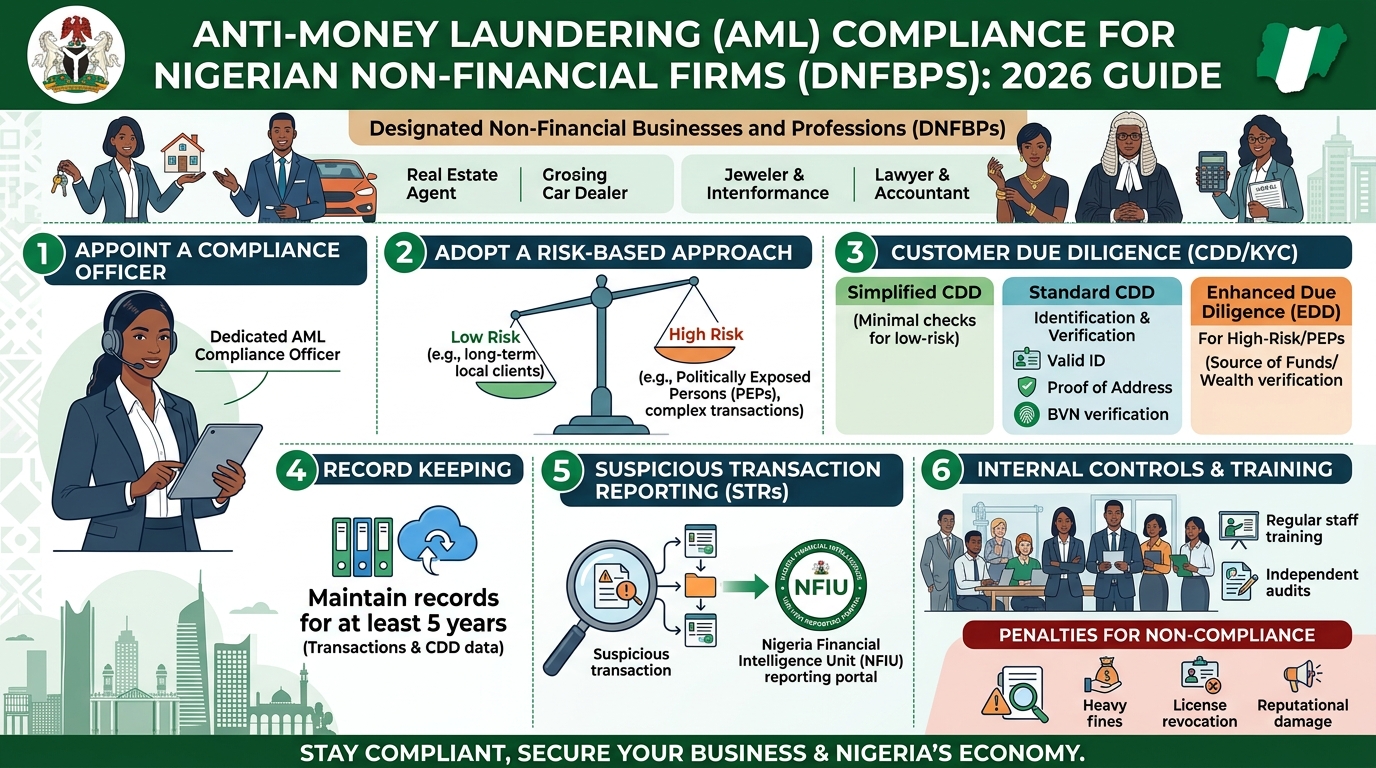
Anti-Money Laundering Compliance for Non-Financial Firms in Nigeria: A 2026 Guide
Money laundering is a serious threat. It does not just hit banks. It hits real estate agents, lawyers, accountants, and even jewellery shops.
In Nigeria, the rules have changed. The government is watching more closely than ever.
If you run a non-financial business, you need to understand your obligations. Penalties are severe. Reputational damage can destroy you.
Let me walk you through everything you need to know for 2026.
Stonehill Research provides AML Compliance Services including DNFBP registration, policy development, and employee training.
What is money laundering? A clear definition
Before we talk about compliance, let us define what we are dealing with.
Definition: According to Investopedia, money laundering involves “disguising illegally obtained money or assets to make them appear lawful.”
Source: Investopedia. “What Is Money Laundering?” https://www.investopedia.com/terms/m/moneylaundering.asp [VERIFY: link active]
Think of it this way. Criminals make dirty money from drug trafficking, corruption, fraud, or terrorism funding. They need to make that money look clean.
The process has three stages.
Placement. The criminal introduces illegal funds into the financial system. This could be depositing cash into a bank account or buying an asset.
Layering. They separate the illicit proceeds from their source through complex transactions. Multiple transfers. Shell companies. False invoices.
Integration. The now clean money returns to the criminal. It looks legitimate. They spend it freely.
Non-financial firms are prime targets for criminals. Why? Because banks have strong controls. Lawyers, accountants, and real estate agents often do not.

Nigeria’s AML regulatory framework: what has changed
Nigeria has made huge progress in fighting money laundering. The government is serious.
Here are the key laws you need to know.
The Terrorism (Prevention and Prohibition) Act, 2022 (TPPA). This addresses terrorist financing. It works alongside the MLPPA.
The EFCC Regulations, 2024. These provide detailed guidance for DNFBPs. Customer due diligence. Transaction monitoring. Reporting requirements.
Major updates for 2026
FATF Grey List Status. As of June 2025, Nigeria remains on the FATF grey list. That means enhanced scrutiny. However, the FATF recognised in February 2025 that Nigeria has made significant progress. Transparency around beneficial owners has improved. Risk-based supervision for DNFBPs has strengthened.
Enhanced Supervision of DNFBPs. The Nigerian Financial Intelligence Unit (NFIU) is watching non-financial businesses more closely. As of December 2024, new guidelines apply stricter requirements to vulnerable sectors.
Technology-Driven Compliance. In May 2025, the CBN released draft standards for automated AML solutions. Real-time surveillance using AI and machine learning is becoming the norm. These expectations are increasingly extending to DNFBPs with large transaction volumes.
Read our Nigeria AML Regulatory Update 2026 for the latest changes.

Who are Designated Non-Financial Businesses and Professions (DNFBPs)?
This is the most important question for your business.
Under Nigerian law, DNFBPs include:
Legal professionals. Lawyers, notaries, and independent legal professionals. This applies when they handle real estate transactions, manage client money, or create legal persons.
Accounting and auditing professionals. Accountants and auditors. This applies when they prepare transactions for clients or provide tax advice.
Real estate agents and brokers. Anyone involved in buying or selling property.
Dealers in precious metals and stones. Businesses that handle gold, diamonds, jewellery, or other precious items in cash transactions.
Trust and company service providers. Entities that form companies, act as directors, provide registered office services, or act as trustees.
Casinos and gaming operators. Physical and online gambling. Sports betting operators.
Dealers in high-value goods. Businesses that accept large cash payments for cars, luxury goods, or artwork.
Non-governmental organisations (NGOs). Particularly those receiving significant funding or operating in high-risk areas.
If your business falls into any of these categories, you have legal obligations. Ignorance is not an excuse.
Core AML compliance obligations for non-financial firms
Let me break down exactly what you need to do.
Customer Due Diligence (CDD)
This is the foundation of AML compliance. You must know who your customers are.
Identity verification. Verify every customer using reliable, independent documents. In Nigeria, use the Bank Verification Number (BVN) and National Identification Number (NIN). Collect full names, dates of birth, addresses, and occupations.
Beneficial ownership identification. For corporate clients, find out who really owns the company. The natural persons behind the corporate veil. This requirement has been strengthened significantly.
Purpose of business relationship. Understand why the customer wants to do business with you. What is the intended nature of the transaction?
Enhanced Due Diligence (EDD)
Some customers need extra scrutiny.
Politically Exposed Persons (PEPs). These are individuals who hold or have held prominent public positions. Their family members and close associates also count. For PEPs, you need additional verification of source of funds. Continuous monitoring. Senior management approval.
High-risk jurisdictions. Customers from countries with weak AML controls. The FATF grey list and black list guide this.
Complex corporate structures. Businesses with opaque ownership or multiple jurisdictions. These can hide beneficial ownership.
Non-face-to-face customers. Remote onboarding requires additional verification to prevent identity fraud.
Record-keeping requirements
You must keep comprehensive records.
Transaction records. Keep all records for at least five years after the transaction completes. Records must permit reconstruction of individual transactions.
Identification records. Keep copies of identification documents for at least five years after the business relationship ends.
Record accessibility. Make all records readily accessible to regulators upon request. Failure to produce records can result in significant penalties.
Suspicious Transaction Reporting (STR)
This is critical. You must report suspicious activity immediately.
Immediate reporting. Submit a Suspicious Transaction Report to the NFIU as soon as you detect suspicious activity. Do not wait. Do not investigate fully on your own.
Red flags to watch for. Transactions inconsistent with the customer’s known business. Unusual patterns without economic purpose. Reluctance to provide information. Transactions involving high-risk jurisdictions. Structuring to avoid reporting thresholds. Use of multiple accounts without reasonable explanation.
Severe penalties for non-reporting. Failure to report carries a penalty of ₦1 million per day for every day the business fails to report. That is not a typo. One million naira. Every day.
Internal compliance programs
You need a written AML compliance program.
Written policies and procedures. Document everything. CDD procedures. Transaction monitoring. Record-keeping. Reporting processes.
Compliance officer appointment. Designate a compliance officer at management level. This person is responsible for implementing and monitoring the AML program.
Employee training. Train all relevant personnel regularly. They need to understand their obligations. They need to recognise suspicious activity. They need to know how to report concerns.
Independent audits. Conduct periodic independent reviews. Test the effectiveness of your internal controls. Ensure ongoing compliance.
Risk assessment. Assess your specific money laundering risks regularly. Consider customer types, geographical locations, products, and delivery channels.
Our AML Policy Development and Documentation service helps create comprehensive compliance programs.
Regulatory oversight and enforcement
Know who is watching and what they can do.
SCUML. The Special Control Unit Against Money Laundering is your primary regulator. Register with SCUML. Submit to periodic examinations.
NFIU. The Nigerian Financial Intelligence Unit receives and analyses suspicious transaction reports. They coordinate Nigeria’s AML framework.
EFCC. The Economic and Financial Crimes Commission investigates and prosecutes money laundering. They work closely with SCUML and NFIU.
CBN. While focused on financial institutions, CBN standards influence expectations for DNFBPs, especially regarding technology adoption.
Penalties for non-compliance
The consequences are severe.
Daily fines. ₦1 million per day for failure to report suspicious transactions.
Business license revocation. SCUML can suspend, revoke, or withdraw your operating license. This can end your business.
Criminal prosecution. Money laundering carries imprisonment of up to five years. Executives, directors, and compliance officers can face personal criminal liability.
Reputational damage. Even if you avoid formal penalties, being associated with money laundering destroys customer trust. Banks may refuse to work with you. Partners may walk away.

Best practices for AML compliance in 2026
Do not just meet minimum requirements. Build a strong program.
Implement a risk-based approach
Not all customers and transactions present equal risk.
Conduct comprehensive risk assessments. Evaluate risks based on customer types, geography, products, and delivery channels. Document your assessments. Update them regularly.
Allocate resources strategically. Focus enhanced due diligence on higher-risk relationships. Apply simplified measures to lower-risk scenarios where permitted.
Customise controls to your business. Develop procedures that reflect your specific operations. Generic templates often miss your actual risk exposures.
Leverage technology for compliance
Technology is your friend.
Transaction monitoring systems. For businesses with significant transaction volumes, automated monitoring identifies suspicious patterns. Machine learning detects anomalies.
Digital identity verification. Biometric verification and document authentication strengthen CDD while improving customer experience.
Sanctions screening. Automated screening against sanctions lists, PEP databases, and adverse media is more efficient and comprehensive than manual checks.
Record management systems. Digital systems ensure records are properly maintained, readily accessible, and protected against loss.
Build a culture of compliance
Technology alone is not enough.
Tone from the top. Senior management must demonstrate visible commitment. Allocate sufficient resources. Make compliance a business priority.
Continuous training. Educate employees regularly about risks, red flags, reporting obligations, and consequences.
Clear reporting channels. Employees need accessible channels to report suspicious activity without fear of retaliation. Whistleblower protections encourage reporting.
Regular testing and updates. Test your compliance program through internal audits and external reviews. Update promptly to address weaknesses and regulatory changes.
Stay current with regulatory developments
The landscape is changing fast.
Monitor regulatory publications. Regularly review guidance from SCUML, NFIU, EFCC, and CBN.
Engage professional advisors. Consider compliance consultants, legal advisors, or industry associations with AML expertise.
Participate in industry forums. Join professional associations. Attend conferences. Learn from peers.
Track international standards. Monitor FATF recommendations and global AML trends. These will influence future Nigerian requirements.
Check out Technology Solutions for AML Compliance in Nigeria for tool recommendations.
Challenges and practical considerations
Be honest about the difficulties.
Resource constraints
Smaller businesses struggle with the cost of compliance. AML programs require investment in systems, training, and expertise.
Prioritise a risk-based approach. Focus your limited resources on the highest-risk areas.
Balancing compliance with customer experience
Rigorous CDD creates friction. Customers may get frustrated.
Communicate clearly about regulatory requirements. Make verification processes efficient. Train customer-facing staff well.
Keeping pace with criminal innovation
Money launderers are smart. They develop new techniques constantly.
Cryptocurrencies and mobile payment platforms create new vulnerabilities. Stay vigilant. Adapt your risk assessments as the threat evolves.
Integration with business operations
AML compliance should not be a separate function. Integrate it into sales, onboarding, transaction processing, and customer relationships.
This requires collaboration across different business functions. Manage the change carefully.
Our Risk Assessment and Gap Analysis helps identify vulnerabilities in your compliance program.
The path forward: Nigeria’s AML journey
Nigeria has made commendable progress. The FATF has recognised this.
But significant work remains to remove the country from the grey list.
For non-financial businesses, this presents both challenges and opportunities.
Businesses that embrace compliance, invest in robust systems, and genuinely commit to preventing exploitation will be better positioned for long-term success.
Those that treat AML compliance as a box-ticking exercise risk severe consequences.
As Nigeria strengthens its position as West Africa’s largest economy, AML compliance will remain a critical business imperative.
Non-financial firms that build strong compliance foundations today will benefit from enhanced reputation, stronger regulatory relationships, and competitive advantages.
The bottom line
Anti-money laundering compliance for non-financial firms in Nigeria has evolved from a peripheral concern to a central business imperative.
The regulatory framework continues to strengthen. Enforcement is intensifying. The consequences of non-compliance have never been more severe.
Real estate agents. Lawyers. Accountants. Casino operators. NGOs. All DNFBPs must understand their obligations and implement effective compliance programs.
The key elements remain consistent. Customer due diligence. Transaction monitoring. Suspicious activity reporting. Record-keeping. Staff training.
But implementation must be tailored to your specific risk profile and operational reality.
The trends for 2025 are clear. Greater regulatory scrutiny. Enhanced technological expectations. More severe enforcement actions. Continued alignment with international standards.
Non-financial businesses that embrace these realities, invest appropriately in compliance infrastructure, and foster cultures of integrity will not only avoid penalties. They will position themselves as trusted partners in Nigeria’s economy.
The fight against money laundering protects the integrity of Nigeria’s financial system. It supports economic development. It contributes to national security.
Every business has a role to play.
Related services from Stonehill Research
-
AML Compliance Services – DNFBP registration, policy development, and employee training.
-
AML Policy Development and Documentation – Creating comprehensive compliance programs.
-
Risk Assessment and Gap Analysis – Identifying vulnerabilities in your compliance program.
Recommended reading from the Stonehill Research blog
-
Nigeria AML Regulatory Update 2026 – Latest changes and requirements.
-
Technology Solutions for AML Compliance in Nigeria – Tool recommendations for compliance.
-
SCUML Registration Guide for DNFBPs – Step-by-step registration guidance.
Let’s work together
Do not navigate AML compliance alone. Stonehill Research provides comprehensive research, advisory, and compliance solutions to businesses across Nigeria. Our expertise spans regulatory compliance, financial crime prevention, and risk management.
Contact us today:
📧 Email: info@stonehillresearch.com
📞 Phone: +234 802 320 0801
📍 Address: 5, Ishola Bello Close, Off Iyalla Street, Alausa, Ikeja, Lagos, Nigeria
Contact Stonehill Research to schedule a consultation.
Let us help you build a strong AML compliance program.
Stonehill Research – Your Partner in Regulatory Compliance
References
-
Investopedia. Definition of Money Laundering. https://www.investopedia.com/terms/m/moneylaundering.asp [VERIFY: link active]
-
Sanction Scanner. Anti-Money Laundering (AML) in Nigeria 2025. https://www.sanctionscanner.com/aml-guide/anti-money-laundering-aml-in-nigeria-434 [VERIFY: link active]
-
Mondaq. A Guide on AML and CTF Compliance for DNFBPs in Nigeria. https://www.mondaq.com/nigeria/money-laundering/1695346/ [VERIFY: link active]
-
Anqa Compliance. Guide to AML and FATF Compliance in Nigeria 2025. https://www.anqacompliance.com/nigeria-aml-giaba [VERIFY: link active]
-
FATF. Jurisdictions under Increased Monitoring (Grey List) June 2025. https://www.fatf-gafi.org/en/countries [VERIFY: link active]
-
YouVerify. Navigating AML Compliance Regulations for 2025. https://youverify.co/blog/navigating-aml-compliance-regulations-2025 [VERIFY: link active]
-
Arctic Intelligence. AML/CTF Compliance in Nigeria. https://arctic-intelligence.com/countries/compliance-nigeria [VERIFY: link active]
-
Sanctions.io. Anti-Money Laundering (AML) in Nigeria: A 2025 Guide. https://www.sanctions.io/blog/anti-money-laundering-aml-in-nigeria-a-2025-guide [VERIFY: link active]
-
OMNIO Compliance. Why AML Software Is Essential for Nigerian Compliance in 2025. https://omniocompliance.com/compliance-guide-nigeria/ [VERIFY: link active]
-
EFCC Regulations 2024. Anti-Money Laundering for DNFBPs. [VERIFY: source]
There are no comments