

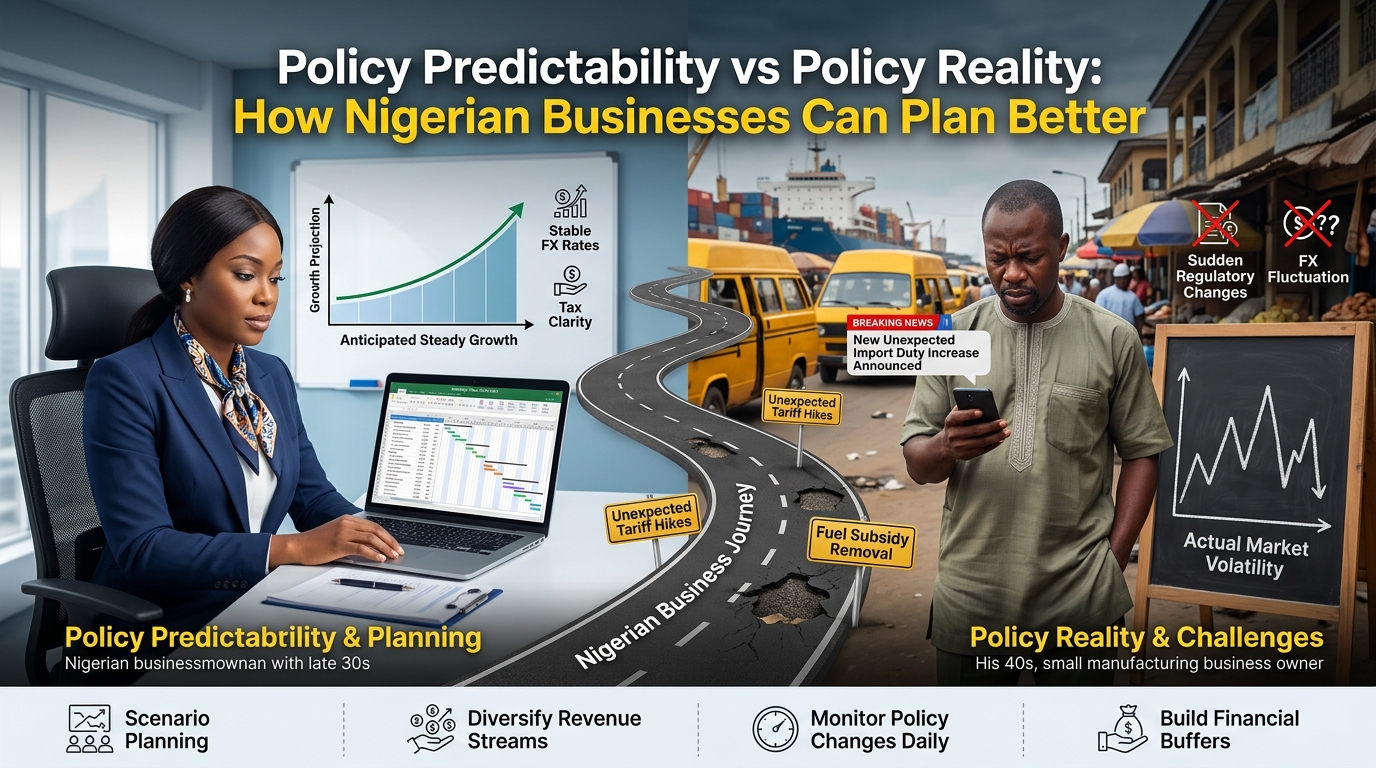
Policy Predictability vs Policy Reality: How Nigerian Businesses Can Plan Better
Governments make promises. Then reality hits.
You have seen it before. A new policy gets announced with great fanfare. Business owners get excited. Then nothing happens. Or something completely different happens.
The gap between what governments promise and what they deliver is real. And it costs businesses money.
Let me show you how to plan better anyway.

What policy predictability actually means: a clear definition
Before we go further, let us define our terms precisely.
According to the World Bank, policy predictability is “the extent to which government policy changes are anticipated and understood by the private sector, allowing firms to make informed investment decisions.”
That was formal. Sorry.
Here is the real talk. You need to guess what the government will do next. The better your guess, the better your business plan.
Policy predictability rests on four pillars.
Consistency. Policies stay stable over reasonable timeframes. You do not wake up to a completely new tax regime every Monday.
Transparency. The government clearly communicates policy intentions and changes before they happen. No surprises.
Rule of law. Regulations are enforced fairly and impartially. The rules apply to everyone equally.
Stakeholder engagement. The government actually talks to businesses before implementing policies. Your voice gets heard.
When these four things work well, you can invest confidently. You can expand. You can hire. You can plan for five years ahead.
When they do not, everything slows down. Capital flees. Innovation stalls. Good businesses struggle.
The gap between promises and reality
Here is the hard truth.
Governments around the world announce ambitious policies all the time. Reforms designed to help businesses. Initiatives to improve the environment.
Then implementation falls short. Often far short.
Why does this keep happening?
Political cycles and priorities. Election cycles can flip everything. What one government promised, the next one cancels. Your five-year plan gets destroyed in five months.
Implementation capacity. Even well-intentioned policies fail when the government lacks the people, skills, or money to enforce them. A beautiful law on paper means nothing without boots on the ground.
Competing interests. Powerful groups resist changes that hurt them. They lobby. They delay. They water down enforcement. The original policy gets compromised beyond recognition.
Economic shocks. Currency devaluations. Commodity price crashes. Global recessions. When these hit, governments abandon their plans fast. Promises mean nothing in a crisis.
Corruption and rent-seeking. In some environments, official policies exist on paper while unofficial practices dominate in reality. You end up navigating two systems. The written one and the real one.
Here is a recent example from 2025. Several African nations announced business-friendly tax reforms. Business owners celebrated. Then the reforms were either delayed indefinitely or implemented with significant modifications that reduced their benefits. The gap between promise and reality cost companies real money.
Infrastructure timelines across emerging markets consistently exceed initial projections by 200% to 300%. A road promised in two years takes six. A power plant promised in three takes nine.
Plan accordingly.
How this uncertainty hurts your business
The policy predictability gap is not just annoying. It has real, measurable consequences for your bottom line.
Investment hesitation. When you cannot predict policy, you wait. You delay capital investments. You adopt a “wait and see” approach. A 2024 survey of Nigerian businesses found that 67% had postponed major investments due to policy uncertainty. That is two out of every three businesses hitting pause.
Shortened planning horizons. Instead of making 5 to 10-year strategic plans, you focus on 1 to 2-year tactical adjustments. That short-term thinking prevents the kind of transformative investments that drive real productivity gains.
Risk premiums. Businesses factor policy uncertainty into their pricing and return requirements. Effectively, you charge more to cover the risk. This makes your products less competitive and can price you out of markets entirely.
Compliance costs. Constantly changing or unclear regulations force you to maintain larger legal and compliance teams. Those are resources you could have spent on product development, marketing, or hiring.
Strategic inflexibility. You may overinvest in flexibility. Maintaining excess capacity. Avoiding specialised equipment. Keeping options open. That reduces your operational efficiency, but it provides insurance against policy shifts you cannot predict.
How to plan better anyway
You cannot control government policy. But you can control how you respond to it.
Here are six strategies that actually work.
1. Scenario planning and stress testing. Do not rely on a single forecast. That is a trap. Build multiple scenarios based on different policy outcomes.
Create at least three scenarios. An optimistic one where policies are implemented as promised. A realistic one with partial implementation and delays. A pessimistic one with policy reversal or major modification.
Then test your business model against each scenario. Identify vulnerabilities. Develop contingency plans for each one. When reality shifts, you are ready.
2. Diversification strategies. Do not put all your eggs in one policy basket.
Spread across geographic markets. Operate in multiple jurisdictions so no single policy change kills you.
Spread across product lines. Avoid over-concentration in heavily regulated sectors.
Spread across suppliers and customers. Reduce exposure to single points of failure.
3. Agile business models. Build flexibility directly into your operations.
Make modular, smaller, incremental investments rather than large, irreversible commitments. Include policy change clauses in your long-term contracts. Maintain the ability to quickly pivot operations in response to policy shifts.
4. Political risk assessment. Develop systematic processes for monitoring policy developments.
Establish dedicated teams or hire consultants to track regulatory changes. Maintain relationships with policymakers and industry associations. Use early warning indicators to anticipate policy shifts before they are announced. Subscribe to policy analysis services and research reports.
5. Stakeholder engagement. Do not just complain about policies. Participate.
Join industry associations that lobby for favourable policies. Provide constructive feedback during public consultation periods. Build relationships with regulators and government officials. Support policy research that demonstrates the business impact of regulatory decisions.

6. Insurance and hedging mechanisms. Protect yourself against specific policy risks.
Political risk insurance covers expropriation, currency inconvertibility, and political violence. Currency hedging protects against exchange rate volatility from policy changes. Supply chain insurance covers disruptions caused by regulatory changes.
Our Political Risk Assessment helps businesses identify and mitigate policy-related vulnerabilities.
Real companies that got this right
Let me share two stories. One success. One warning.
Success: Dangote Group in Nigeria.
Dangote has navigated Nigeria’s unpredictable policy environment better than most. How?
They maintain close government relationships while building operational flexibility. When fuel subsidy policies changed unexpectedly in 2023 to 2024, Dangote’s petroleum refinery adjusted its pricing and distribution model within weeks, not months. They maintained profitability despite the regulatory shift.
Their strategy includes policy monitoring teams, diversification across multiple sectors, and built-in buffer capacity. They plan for uncertainty instead of hoping it goes away.
Warning: Multinational retailers in South Africa.
Several international retailers struggled in South Africa during 2023 to 2024. Employment regulations changed more drastically than anticipated.
Companies that had built inflexible staffing models based on original policy proposals faced huge restructuring costs and reputational damage. Those that had maintained scenario plans and flexible employment arrangements adapted smoothly.
The difference was preparation.
Lesson from telecoms across Africa.
Telecommunications companies have developed sophisticated approaches to policy uncertainty. They maintain detailed regulatory databases. They conduct quarterly policy risk assessments. They build strong relationships with industry regulators.
This proactive approach has enabled faster adaptation to spectrum licensing changes, interconnection rate adjustments, and data privacy regulations.
The role of research and intelligence
Quality information is the foundation of effective planning.
In environments where policy predictability is low, businesses that invest in superior research and intelligence capabilities gain significant competitive advantages.
Market intelligence services provide continuous monitoring of policy developments across multiple jurisdictions. Analysis of political dynamics that might affect policy implementation. Early warning systems for regulatory changes. Comparative analysis of how similar policies have played out in other markets. Access to networks of experts, officials, and industry insiders.
Economic forecasting helps you understand the economic constraints and incentives that shape actual policy outcomes. This includes analyzing fiscal positions, balance of payments, debt sustainability, and political economy factors.
Regulatory mapping covers the complete regulatory landscape. Overlapping authorities. Enforcement patterns. Informal practices. Most businesses cannot maintain this kind of dedicated research capacity in-house.
Sector-specific analysis gives you deep dives into regulatory trajectories for your specific industry. You anticipate changes before they are officially announced.
Customized risk assessments provide personalized analysis aligned with your specific operations and vulnerabilities. Generic country risk ratings often miss what actually matters to your business.
Read our article on How to Build a Political Risk Dashboard for Your Business for practical implementation guidance.
Building your own internal capabilities
External research services are valuable. But you also need internal capacity.
Establish policy monitoring functions. Designate specific team members responsible for tracking regulatory developments. Make this a formal role with clear objectives. Do not just add it to someone’s existing workload.
Create cross-functional policy response teams. When policy changes occur, response should not be siloed in legal or compliance departments. Include operations, finance, strategy, and business unit leaders. Assess implications and develop responses quickly.
Invest in training. Ensure relevant staff understand the policy environment. How government decision-making works. Who the key stakeholders are. What signals to watch for. This contextual knowledge improves the quality of your internal analysis.
Develop institutional memory. Document how previous policy changes affected your business. Record what responses worked and what did not. This organisational learning prevents repeated mistakes and builds expertise over time.
Integrate policy risk into strategic planning. Make policy scenario analysis a standard part of your annual strategic planning processes. Do not treat it as an occasional exercise triggered by crises.
Recent policy developments you should watch
Several significant policy trends have emerged recently that businesses should monitor closely.
Digital economy regulations. Countries across Africa and globally have accelerated the implementation of digital taxation frameworks, data localization requirements, and platform economy regulations. Nigeria’s digital services tax and Kenya’s proposed data protection amendments represent significant shifts that affect tech companies, financial services, and e-commerce operations.
Climate and ESG mandates. Environmental, social, and governance requirements are expanding rapidly. The EU’s Carbon Border Adjustment Mechanism (CBAM), which began its transitional phase in 2023, is now affecting African exporters of steel, cement, and aluminum. Businesses in affected sectors must now track carbon emissions across their supply chains.
Trade policy realignments. The African Continental Free Trade Area (AfCFTA) implementation continues with uneven progress across member states. While intra-African trade barriers are officially reduced, actual implementation varies significantly by country and product category.
Foreign exchange controls. Several African nations have tightened currency controls in response to foreign exchange shortages from 2024 to 2025. These measures affect repatriation of profits, import licensing, and access to forex for business operations. They often emerge with little warning and evolve rapidly.
Labour and employment regulations. Minimum wage adjustments, pension contribution requirements, and employment protection measures have seen significant changes across multiple jurisdictions. These affect labour cost structures and operational flexibility.
Recommendations for Nigerian businesses
Given Nigeria’s particularly dynamic policy environment, here is specific guidance.
Maintain multiple scenario plans. Given the frequency of policy reversals and modifications, Nigerian businesses should maintain at least four scenarios. Include a “radical shift” scenario that accounts for dramatic policy changes.
Build strong local networks. Personal relationships and local knowledge networks are particularly valuable in Nigeria. Policy implementation often differs significantly from official announcements. Active participation in industry groups like the Lagos Chamber of Commerce, Manufacturers Association of Nigeria, or sector-specific associations provides early warning and collective advocacy opportunities.
Monitor sub-national policies. State and local government policies can vary significantly from federal positions. Businesses operating across multiple states must track policy developments at all relevant levels.
Plan for infrastructure gaps. Government infrastructure promises frequently face delays. Build self-sufficiency in power generation, water supply, and logistics into your business model. Do not rely on promised improvements.
Manage currency risk. Given Nigeria’s complex foreign exchange situation, maintain sophisticated currency management strategies. Natural hedging through export activities. Strategic forex holdings. Close relationships with multiple banking partners.
Engage early in policy consultations. When government agencies invite public comments on proposed regulations, participate actively and substantively. Nigerian policymakers are increasingly responsive to well-articulated business concerns backed by data.

Where to start tomorrow
Do not try to fix everything at once.
First, audit your current policy monitoring. Do you have a system? Is it working?
Second, build one scenario. Start with your most critical uncertainty. Map out optimistic, realistic, and pessimistic outcomes.
Third, identify your greatest vulnerability. What single policy change would hurt most? Plan for it.
Fourth, join one industry association. Start building relationships. Share intelligence.
Finally, talk to your team. Make policy monitoring someone’s responsibility. Train them.
Recommended reading from the Stonehill Research blog
While you are here, check out these related articles from our team:
-
How to Build a Political Risk Dashboard for Your Business – Tracking policy signals systematically
-
Scenario Planning for Nigerian Manufacturers: A Practical Framework – Stress-testing your operations
-
The Art of Stakeholder Engagement: Influencing Policy Before It Happens – Making your voice heard
-
AfCFTA Implementation Realities: What Your Trade Strategy Needs Now – Navigating uneven progress
Related services from Stonehill Research
We help businesses navigate policy uncertainty. Here is how:
-
Growth Strategy Design – Building strategies that work in Nigeria’s unique environment
-
Market Segmentation – Treating Nigeria as multiple markets, not one
-
Consumer Insight Research – Understanding real needs and behaviours
-
Strategic Alignment Review – Aligning structure with strategy
-
Operational Resilience Assessment – Building systems that absorb friction
-
Talent and Capability Development – Developing talent and institutional knowledge
-
Data-Driven Decision-Making Frameworks – Making better business decisions with data
About Stonehill Research
Stonehill Research helps organisations move from ambition to execution. Our data-driven insights enable businesses, investors, and policymakers to design strategies that reflect Nigeria’s real market conditions.
We understand the complexity. Market fragmentation. Infrastructure gaps. Regulatory volatility. Capital constraints. We have seen it all.
We do not guess. We use market data to guide our recommendations. And we do not just give you a strategy document. We help you execute.
That matters for policy planning because governments change direction fast. You need current, accurate intelligence. You need a partner who understands how to turn uncertainty into strategic advantage.
Final word from the trenches
The gap between policy predictability and policy reality is one of the biggest challenges facing businesses in emerging markets. Developed economies face it too now.
Governments promise stability, transparency, and business-friendly environments. Actual implementation often falls short due to political dynamics, capacity constraints, and changing economic circumstances.
But you are not helpless.
By adopting sophisticated scenario planning, building organizational flexibility, investing in quality research and intelligence, maintaining strong stakeholder relationships, and developing internal policy analysis capabilities, you can navigate uncertain policy environments more effectively.
The most successful businesses treat policy uncertainty not as an excuse for inaction but as a challenge requiring strategic sophistication.
In environments where government policy is unpredictable, competitive advantage goes to organizations that can anticipate, adapt, and respond faster than their competitors.
As the global business environment becomes increasingly complex and interconnected, the ability to navigate policy uncertainty will become an even more critical competence.
Businesses that develop this capability today will be better positioned for sustainable success tomorrow.
Stonehill Research is your partner in turning policy uncertainty into strategic advantage. We help you move from ambition to execution.
Let’s work together
Partner with Stonehill Research.
Contact us today:
📧 Email: info@stonehillresearch.com
📞 Phone: +234 802 320 0801
📍 Address: 5, Ishola Bello Close, Off Iyalla Street, Alausa, Ikeja, Lagos, Nigeria
Warri Office:
Suite 7, 2nd Floor, St Elizabeth Plaza, 77, Okumagba Avenue, Warri, Delta State
Stonehill Research – Your Partner in Strategic Intelligence
References
-
World Bank. Policy Predictability Definition. https://www.worldbank.org/en/topic/competitiveness/brief/business-enabling-environment
-
World Bank. Political Cycles and Policy Uncertainty.
-
OECD. Implementation Capacity and Policy Outcomes. https://www.oecd.org/governance/implementation-capacity/
-
Transparency International. Corruption and Policy Implementation.
-
Nigerian Bureau of Statistics (NBS). Business Confidence Survey 2024.
-
PwC. Global Compliance Cost Survey 2025.
-
Harvard Business Review. Scenario Planning for Policy Uncertainty.
-
World Bank Group. Political Risk Insurance Products.
-
African Continental Free Trade Area (AfCFTA). Implementation Status Report 202
There are no comments