

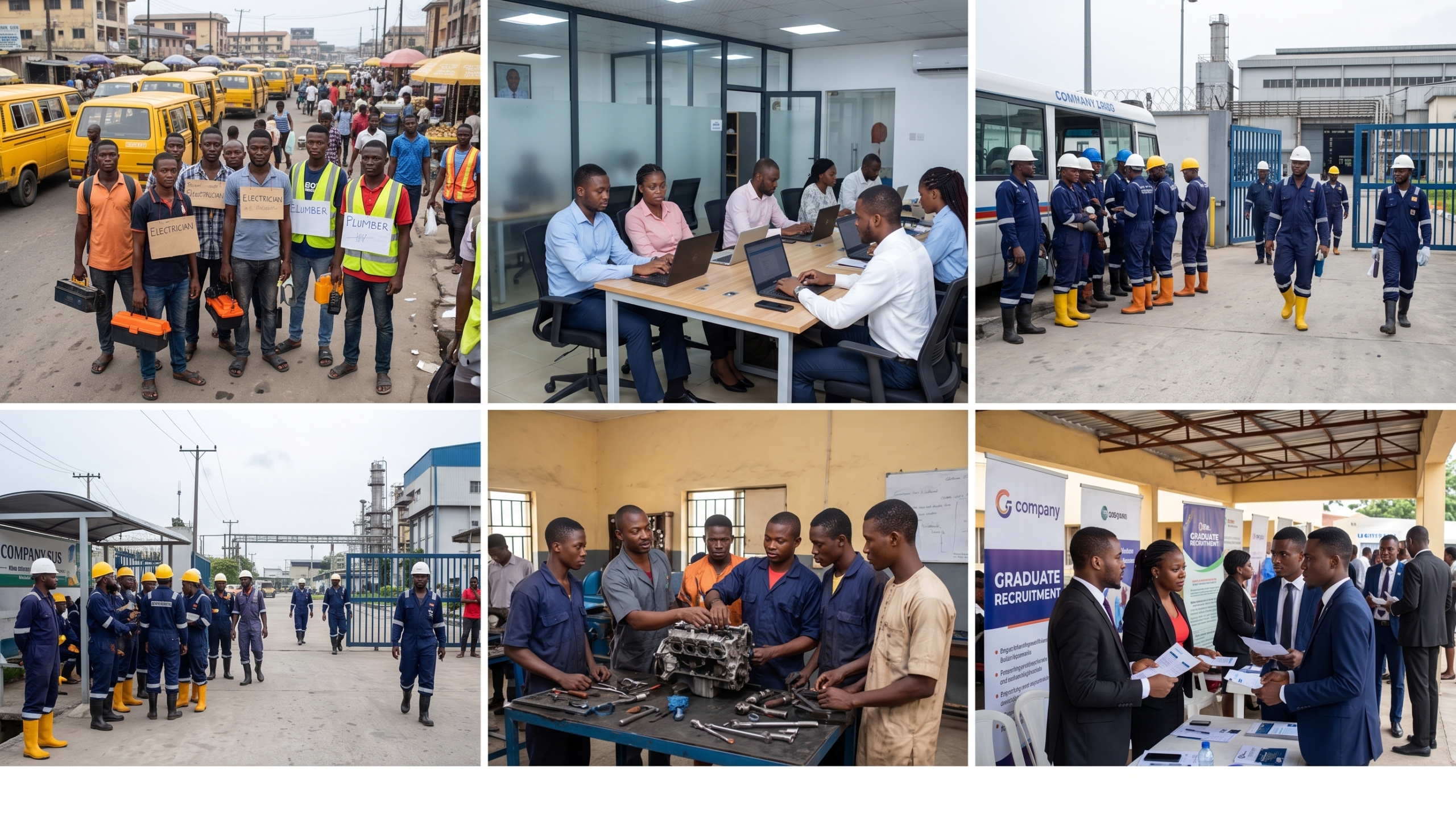
The Future of Work in Nigeria: What Labour Market Trends Mean for Employers
Nigeria’s labour market is changing. Fast.
Emerging technologies. Shifting demographics. Evolving work arrangements. Employers who understand these trends will thrive. Those who ignore them will struggle to attract and keep top talent.
Let me walk you through the key labour market trends shaping Nigeria’s employment landscape and what they mean for your organisation.
Understanding Nigeria’s labour force
According to the International Labour Organisation, the labour force comprises employed individuals and those actively seeking employment. This measure captures the active labour supply available to produce goods and services within an economy.
In simple terms, it is the pool of people ready and available to work.
Current state of Nigeria’s labour market in 2024 and 2025
The numbers behind the workforce.
Nigeria’s labour force participation rate stood at 77.3% in the first quarter of 2024. The vast majority of working-age Nigerians remain economically active. By the second quarter of 2024, the employment rate had increased to 76.10%.
However, unemployment rose to 5.39% by the end of 2023. The total labour force was 88.94 million people. Of these, 84.15 million were employed. While single-digit unemployment figures appear encouraging, they mask deeper structural challenges. Underemployment. Informal sector dominance.
By the fourth quarter of 2024, the employment rate reached 75.70%, slightly up from 75.40% in the third quarter. The unemployment rate stood at 4.90% in Q4 2024, with youth unemployment at 6.50% in Q2 2024.

The dominance of informal employment.
The informal sector continues to be the backbone of Nigeria’s economy. Informal employment represented 92.2% of the employed population in 2023. It rose slightly to 92.7% by the first quarter of 2024.
Self-employment predominates Nigeria’s labour market. Nearly nine in ten employed Nigerians, 87.3%, are engaged in this type of work. Only a small fraction hold traditional wage-earning positions.
Trend 1: The remote and hybrid work revolution
Current adoption rates.
Only 14% of Nigerian businesses operate fully remotely as of 2024. Fifty-five percent remain on site. Thirty-one percent have adopted hybrid setups.
Social Media Manager, Product Manager, and Content Creator were the top three remote roles in Nigeria. This reflects the digital-first nature of remote opportunities currently available.
Infrastructure challenges.
Eighty per cent of respondents reported struggling with slow WiFi and data network issues. This makes online meetings and real-time collaboration difficult. Employers must factor these connectivity challenges into their remote work strategies.
Nigerian workplaces are overloaded with digital tools. Eighty-one per cent of C-suite employees use more than ten different apps daily. This tool proliferation creates coordination challenges.
What this means for employers.
Fifty-five percent of job seekers prioritise hybrid or remote options when considering new roles. Flexible work arrangements are a competitive advantage in talent acquisition.
Invest in unified collaboration platforms to reduce digital fatigue. Provide connectivity support like data allowances or internet subsidies for remote workers. Develop clear hybrid policies that balance flexibility with collaboration needs. Focus on outcome-based performance metrics rather than time tracking. Create intentional opportunities for team building and culture development in distributed teams.
Trend 2: The critical digital skills gap
The magnitude of the problem.
By 2030, between 35% and 45% of jobs in Nigeria will require digital competencies. Yet the country faces a severe shortage of workers with these capabilities.
More than 230 million jobs across Sub-Saharan Africa will require digital skills by 2030. This creates intense competition for qualified talent.
Eighty-five percent of Nigerian graduates have no digital skills and cannot use basic office software like Microsoft Word, according to NITDA. This alarming statistic reveals the depth of the employability crisis.
The graduate employability crisis.
Annually, over 1.5 million applicants sit for the Unified Tertiary Matriculation Examination, with 40% admitted into various universities. The remaining 60% is distributed across polytechnics and colleges of education. This reflects a significant influx of graduates into the labour market, outpacing the limited skilled jobs.
A report from the National Bureau of Statistics in 2022 showed that 53.40% of youths in Nigeria are unemployed; this includes graduates. According to the Nigeria Graduate Report, a significant percentage of recent graduates find it difficult to secure employment, with HND graduates affected the most.
Government and private sector response.
The Nigerian government launched the 3 Million Technical Talent (3MTT) Programme. The first phase trained 30,000 technical talents between December 2023 and March 2024. The second phase onboarded 270,000 more talents, covering twelve in-demand skill areas, including software development, machine learning, UI/UX design, and data analysis.
The Federal Government, through the Computer Professionals Registration Council of Nigeria, developed 35 new National Occupational Standards in ICT areas like Artificial Intelligence, Robotics, and UI/UX.
What this means for employers.
Invest heavily in internal training and upskilling programmes rather than relying solely on external hiring. Partner with technical training providers to create customised programmes aligned with your specific needs. Implement apprenticeship and internship programmes to develop talent pipelines. Consider skills-based hiring that evaluates potential and learning ability over formal credentials. Build relationships with government training initiatives like 3MTT to access emerging talent. Create clear career progression paths that incentivise continuous learning.
Our Skills Gap Analysis helps employers identify critical capability gaps and design targeted training interventions.
Trend 3: Youth demographics and employment patterns
The youth employment landscape.
The unemployment rate among youth was 8.4% in Q1 2024. This was a decrease of 0.2% compared to 8.6% in Q3 2023. While this slight improvement is encouraging, youth unemployment and underemployment remain persistently high.
Among the 15 to 24-year-olds, 98% work in the private sector. Young workers increasingly view government jobs as less appealing. They prefer private organisations with technological advancement, competitive compensation, and regular promotion opportunities.
The NEET challenge.
The NEET phenomenon, Not in Education, Employment, or Training, represents a significant concern. With significant numbers of employers citing a skills mismatch, Nigeria faces a growing disconnect between academic output and labour market needs.
What this means for employers.
Design entry-level programmes that bridge the gap between academic preparation and workplace requirements. Offer mentorship and on-the-job training to compensate for educational system gaps. Create youth-focused recruitment initiatives that identify potential over polish. Implement structured graduate development programmes with clear progression timelines. Partner with universities to influence curriculum development and provide real-world exposure. Leverage young workers’ digital nativity and adaptability as organisational assets.
Read our article on Bridging the Graduate Employability Gap: What Nigerian Employers Can Do for deeper insights on youth workforce integration.

Trend 4: Sector-specific employment patterns
Leading employment sectors.
Agriculture continues to be the backbone of Nigeria’s labour market, employing 30.1% of the workforce. Wholesale and retail follow closely at 27.5%. Manufacturing accounts for 12.7%. Accommodation and food services represent 7.8%.
ICT/Telecommunications, NGOs, Education/Teaching, Banking, and Healthcare/Medical were the top five hiring industries in 2024. This demonstrates the economy’s gradual shift toward services and technology.
Urban versus rural dynamics.
Nigeria’s labour force is concentrated more in urban areas at 57.7% than in rural areas at 42.3%. This urbanisation trend continues to accelerate, driven by economic opportunities and better infrastructure in cities.
What this means for employers.
Recognise sector-specific talent availability and adjust recruitment strategies accordingly. Consider geographic location when planning operations and talent acquisition. Explore opportunities in high-growth sectors like ICT, healthcare, and education. Develop sector-specific value propositions that resonate with industry-specific worker priorities. Stay informed about sectoral policy changes and economic shifts.
Trend 5: The gender dimension
Participation and sectoral differences.
Men are more likely to be employed in agriculture at 43.2% compared to 25.5% for women. Women are more likely to work in commerce at 36.5% compared to 16.5% for men.
The underemployment rate among women was 12.5% compared to 8.5% among men in Q1 2024. This highlights persistent gender disparities in employment quality.
What this means for employers.
Implement gender-inclusive recruitment and promotion policies. Address barriers that limit women’s full economic participation. Create supportive workplace policies around childcare and flexible work arrangements. Monitor pay equity and advancement opportunities across gender lines. Build diverse leadership teams that reflect Nigeria’s workforce demographics.
Trend 6: Economic pressures and compensation expectations
The inflation impact.
Annual inflation in Nigeria has created significant pressure on household budgets. Basic groceries have increased in price rapidly. The weakening of the Naira has made it increasingly difficult to import essential fuel supplies, delivering a significant supply-side shock to inflation.
These economic pressures mean workers increasingly prioritise compensation packages that provide real purchasing power and protection against inflation.
What this means for employers.
Conduct regular compensation reviews to maintain competitiveness. Consider inflation-indexed salary adjustments or periodic reviews. Expand benefits packages to include essentials like transportation support and meal allowances. Explore non-monetary benefits that improve employee welfare. Communicate the total compensation value clearly to employees. Consider opportunities for employees to earn in foreign currency through international contracts.
Our Compensation Benchmarking helps employers ensure their packages remain competitive.
Trend 7: Educational attainment and employment outcomes
The education paradox.
74.3% of employment in Nigeria requires a B.A., B.Sc., or HND. This shows strong demand for tertiary education. Yet the unemployment rate among persons with post-secondary education was 9.0% in Q1 2024, significantly higher than at other education levels.
The unemployment rate among persons with postgraduate education was 2.0% in Q1 2024. This suggests that advanced qualifications provide better employment outcomes, though employers increasingly value skills over credentials.
What this means for employers.
Balance educational requirements with skills-based assessments. Recognise that degree holders may still require significant workplace training. Value demonstrated competencies and practical experience alongside formal credentials. Create pathways for continuous professional development. Consider candidates from non-traditional educational backgrounds who demonstrate relevant skills.
Looking ahead: preparing for Nigeria’s workforce future
Nigeria’s labour market stands at a pivotal moment. Demographic pressures, technological transformation, and economic restructuring are converging. This creates both challenges and unprecedented opportunities for employers.
Embrace flexibility. Workers increasingly demand remote and hybrid options. Organisations that resist risk losing talent to more adaptable competitors.
Invest in development. With 85% of graduates lacking basic digital skills, employers must become educators. Training investments build both capability and loyalty.
Prioritise inclusion. Gender disparities, regional differences, and educational mismatches all require intentional strategies to build truly diverse workforces.
Leverage technology wisely. Digital tools enable productivity but require thoughtful implementation to avoid overwhelming workers.
Stay agile. Labour market conditions evolve rapidly. Regular environmental scanning and strategy adjustments are essential.
Partner strategically. Government initiatives, training providers, and industry associations offer resources that individual employers can leverage for mutual benefit.
Where to start tomorrow
Do not try to address every trend at once.
First, start with a skills audit. What capabilities do you have? What gaps exist?
Second, review your work arrangements. Can you offer more flexibility? What hybrid options are feasible?
Third, benchmark your compensation. Are you competitive in this inflationary environment?
Fourth, build training partnerships. Local tech hubs. Government programmes. Online learning platforms.
Fifth, engage your workforce. Ask them what they need. Listen to their concerns.
Finally, plan for the long term. The trends are not going away.
Recommended reading from the Stonehill Research blog
While you are here, check out these related articles from our team:
-
Bridging the Graduate Employability Gap: What Nigerian Employers Can Do – Turning the skills crisis into opportunity
-
Building a Hybrid Work Policy That Works in Nigeria – Balancing flexibility with productivity
-
The 3MTT Programme: How Employers Can Access Nigeria’s New Tech Talent – Leveraging government training initiatives
-
Inflation-Proof Compensation Strategies for Nigerian Employers – Protecting purchasing power and retention
Related services from Stonehill Research
We help employers navigate workforce changes. Here is how:
-
Growth Strategy Design – Building strategies that work in Nigeria’s unique environment
-
Market Segmentation – Treating Nigeria as multiple markets, not one
-
Consumer Insight Research – Understanding real needs and behaviours
-
Strategic Alignment Review – Aligning structure with strategy
-
Operational Resilience Assessment – Building systems that absorb friction
-
Talent and Capability Development – Developing talent and institutional knowledge
-
Data-Driven Decision-Making Frameworks – Making better business decisions with data
About Stonehill Research
Stonehill Research helps organisations move from ambition to execution. Our data-driven insights enable businesses, investors, and policymakers to design strategies that reflect Nigeria’s real market conditions.
We understand the complexity. Market fragmentation. Infrastructure gaps. Regulatory volatility. Capital constraints. We have seen it all.
We do not guess. We use market data to guide our recommendations. And we do not just give you a strategy document. We help you execute.
That matters for workforce planning because labour markets shift fast. You need current, accurate intelligence. You need a partner who understands how to turn labour market trends into competitive advantage.
Final word from the trenches
The future of work in Nigeria will be shaped by how effectively employers respond to these interconnected trends.
Organisations that view workforce challenges as strategic opportunities will thrive. Investing in skills development. Embracing flexibility. Building inclusive cultures.
The demographic dividend of Nigeria’s youthful population can become an economic engine. But only if employers, government, and educational institutions work together to bridge skills gaps and create pathways to productive employment.
Those who act decisively today will shape tomorrow’s workforce and secure competitive advantages in Africa’s largest economy.
Stonehill Research is your partner in workforce strategy. We help you move from ambition to execution.
Let’s work together
Partner with Stonehill Research for strategic workforce solutions.
Contact us today:
📧 Email: info@stonehillresearch.com
📞 Phone: +234 802 320 0801
📍 Address: 5, Ishola Bello Close, Off Iyalla Street, Alausa, Ikeja, Lagos, Nigeria
Warri Office:
Suite 7, 2nd Floor, St Elizabeth Plaza, 77, Okumagba Avenue, Warri, Delta State
Stonehill Research – Your Partner in Workforce Strategy
References
-
International Labour Organisation (ILO). Labour force.
-
National Bureau of Statistics (NBS). Nigeria Labour Force Survey (NLFS), Q1 2024.
-
Trading Economics. Nigeria Employment Rate. https://tradingeconomics.com/nigeria/employment-rate
-
Founder Africa. Remote Work in Nigeria 2024.
-
Dataleum. How to Support Nigeria’s Growing Hybrid Work Trend.
-
World Bank. Digital Skills in Nigeria.
-
TC Insights. Nigeria’s Digital Skills Gap in Four Charts.
-
Veriv Africa. Nigeria’s Graduate Employability Crisis: Bridging the Skill Gap for Career Success. https://www.verivafrica.com/insights/nigerias-graduate-employability-crisis-bridging-the-skill-gap-for-career-success
-
World Economic Forum. Nigeria seeks digital transformation for a stronger economy.
-
Nairametrics. Nigeria, others face severe digital skills shortage – World Bank.
-
MyJobMag. 70 Job Statistics in Nigeria 2025.
There are no comments