

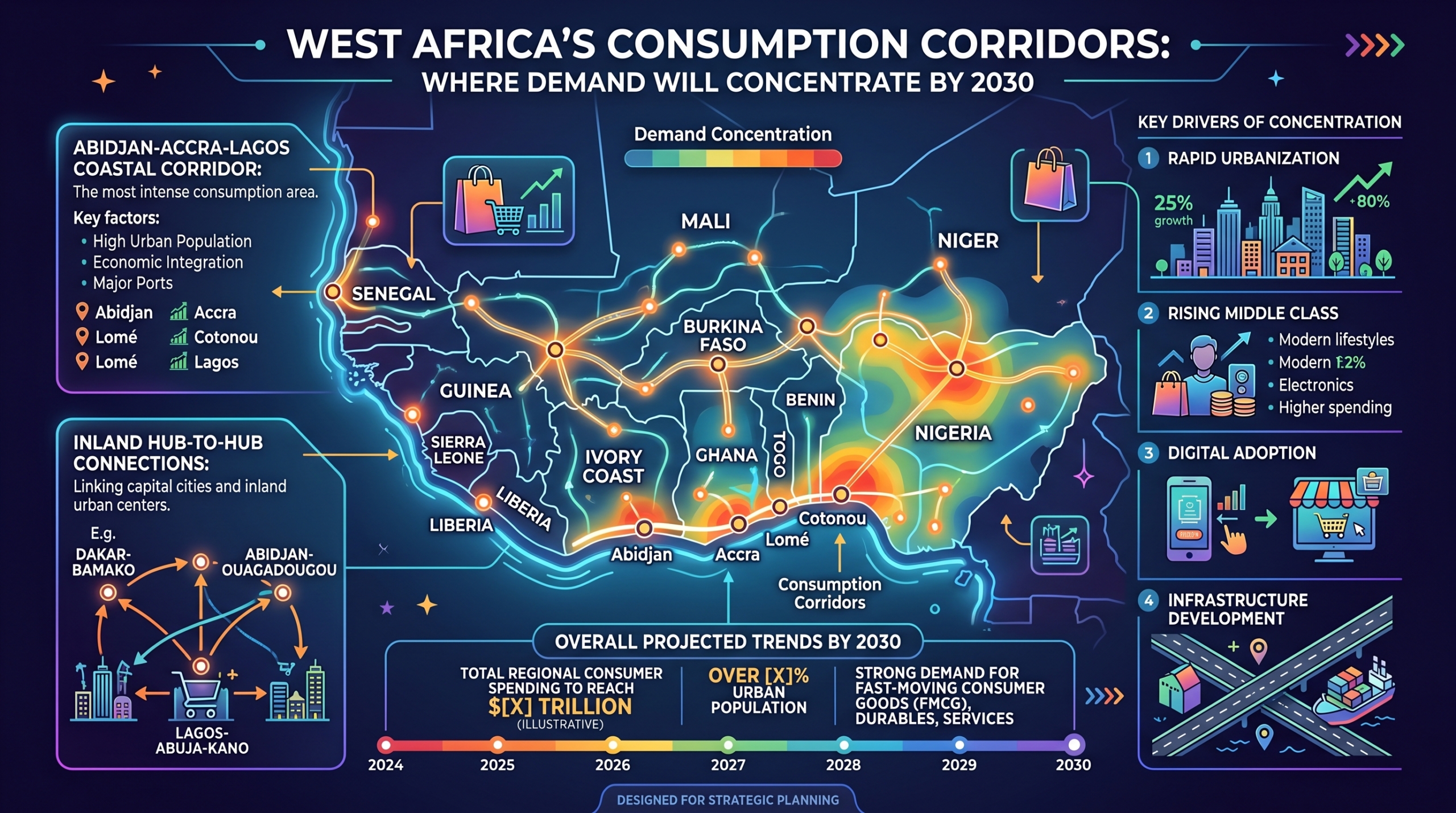
West Africa’s Consumption Corridors: Where Demand Will Concentrate by 2030
West Africa is on the edge of a consumption revolution.
Household spending is projected to help drive Africa’s $2.5 trillion consumer market by 2030. The region’s economic geography is being reshaped by strategic infrastructure investments, urbanisation, and rising middle-class purchasing power.
Understanding where demand will concentrate is not just interesting. It is essential for any business planning to succeed in West Africa over the next six years.
Let me walk you through where the growth is happening, what is driving it, and how you can position your business to benefit.
At Stonehill Research , we help businesses navigate West Africa’s transforming markets. Our Consumer Market Analysis service gives you the intelligence you need.
Understanding economic corridors: a framework for regional growth
That was formal. Sorry.
Here is the real talk. Economic corridors have three complementary components. A transport corridor, which is the physical infrastructure. Industrial production centres where goods are manufactured. And cities, which are major consumption markets and sources of labour and innovation.
Think of it like a highway with factories along it and big cities at both ends. The highway moves goods. The factories make them. The cities buy them.

The term was first coined by the Asian Development Bank in 1998. It has since become a fundamental framework for understanding regional economic integration and development.
The West African consumer market: current state and 2030 projections
Market size and growth trajectory.
West Africa is one of the most dynamic consumption frontiers on the African continent. The region’s consumer market is expanding due to three key factors. Rapid urbanisation. Demographic growth. And increasing household incomes.
Africa’s total household consumption reached 1.4trillionin2015andisprojectedtoreach2.5 trillion by 2030. West Africa, home to Nigeria (Africa’s most populous nation) and several other fast-growing economies, will capture a substantial portion of this growth.
The demographic dividend.
West Africa’s youthful population presents both a challenge and an extraordinary opportunity. Nigeria alone has a population exceeding 200 million and one of the largest youth demographics globally. This young workforce is increasingly urban, digitally connected, and aspirational.
By 2030, nearly 75% of Africans are expected to have internet access. This will fundamentally transform consumption patterns and market dynamics.
Key consumption hubs like Lagos and Kano in Nigeria, Accra in Ghana, and Abidjan in Côte d’Ivoire are experiencing rapid population growth. Lagos and Johannesburg each boast over 8 million consumers. Cities like Kinshasa and Luanda have more than 4 million. These urban centres are becoming the focal points of consumer spending.
Spending patterns and consumer behaviour.
West African consumers are sophisticated. They show brand awareness, value consciousness, and an increasing preference for quality products. However, recent data reveal a notable shift. Shoppers across the region are spending more cautiously, choosing value over brand loyalty, and turning to informal markets more frequently.
Key expenditure categories include food and beverages (the largest share), telecommunications and mobile services, fashion and clothing, housing and real estate, education and healthcare, and entertainment and leisure.
The rise of mobile money and digital payment systems has revolutionised access to consumer goods. This is particularly true in Nigeria and Ghana, where mobile penetration exceeds regional averages.
Strategic infrastructure corridors reshaping West Africa
The Abidjan-Lagos coastal corridor: a game changer.
The most transformative infrastructure project currently underway in West Africa is the 1,028 kilometre Abidjan-Lagos transnational coastal motorway. This ambitious corridor will connect Côte d’Ivoire to Nigeria via Ghana, Togo, and Benin, fundamentally altering the region’s economic geography.
The investment is up to $15.6 billion from private and institutional partners. Construction is scheduled to commence in 2026, with completion targeted for 2030. The impact will be revolutionary connectivity across five West African nations. The African Development Bank funded feasibility studies and developed financing frameworks.
This corridor will reduce transportation costs, decrease journey times, and unlock economic opportunities for communities along its route. Most importantly, it will integrate five national economies into a more cohesive regional market.
Dr Akinwumi Adesina, President of the African Development Bank Group, emphasised that regional corridors enable easy movement of goods and services across the continent, reduce transport costs, encourage integration, and achieve effective economic development.
The Trans-Saharan highway: connecting North and Sub-Saharan markets.
The Trans-Sahara Highway has already demonstrated the transformative potential of corridor development. In Niger, modern tarmac roads have replaced old, bumpy surfaces. This has significantly reduced journey times and unlocked new economic opportunities for local communities.
This infrastructure reinforces Niger’s strategic role as a crossroads between the Maghreb and the Sahel, facilitating connections between Algeria, Nigeria, and Chad.
Secondary corridors and regional integration.
The Accra-Ouagadougou corridor records an average of 17,500 tons of cereals and 96,000 heads of livestock in informal trade annually. This is equivalent to 5.5millionand68 million respectively. While much of this trade remains informal due to bureaucratic barriers, ongoing efforts to streamline customs procedures promise to formalise and expand these flows.
The Economic Community of West African States is actively working to improve road infrastructure connecting all 15 member states. Between 2004 and 2022, the African Development Bank provided over $13 billion to finance regional road corridor projects across Africa. West Africa received substantial allocations.
Consumption concentration points: cities as economic magnets
Lagos, Nigeria: Africa’s megacity consumer hub.
Lagos is West Africa’s preeminent consumption centre. With a metropolitan population exceeding 15 million and growing, Lagos accounts for a disproportionate share of Nigeria’s consumer spending.
The city serves as Nigeria’s commercial capital, the primary gateway for international trade, a hub for technology startups and e-commerce, the centre of West Africa’s entertainment industry (Nollywood), and the headquarters for financial services.
Consumer spending in Lagos spans all categories. Particular strength is seen in telecommunications, fashion, real estate, and luxury goods. The city’s port facilities handle the majority of Nigeria’s imports, making it the primary entry point for consumer goods entering West Africa’s largest economy.
Abidjan, Côte d’Ivoire: the rising star.
Abidjan has experienced a remarkable economic resurgence. It has positioned itself as West Africa’s second major consumption centre.
The city’s strategic advantages include its status as a regional trade hub, modern port facilities on the Atlantic coast, a growing middle class with increasing purchasing power, and strong sectors in food and beverages, clothing, and entertainment.
Recent analysis from early 2025 indicates that Abidjan presents a ripe market for brands looking to scale, particularly if they can adapt to regional tastes and move beyond traditional urban retail.
Accra, Ghana: stability and growth.
Ghana’s consistent economic growth has elevated Accra to prominence as a key West African consumption hub.
The city’s appeal to consumers and investors stems from political stability and democratic governance, a well developed banking and financial services sector, a growing shopping mall and retail outlet infrastructure, strong education and healthcare spending, and a strategic location as a regional gateway.
Urban centres like Accra and Kumasi demonstrate evolving consumer landscapes. There is increasing preference for formal retail environments and international brands.
Secondary cities: emerging opportunities.
Beyond the primary hubs, several secondary cities are experiencing rapid consumption growth. Kano, Nigeria is Northern Nigeria’s commercial centre with over 3 million consumers. Kumasi, Ghana is a major commercial city in Ghana’s interior. Dakar, Senegal is West Africa’s westernmost major port city. Lomé, Togo is a growing trade and logistics hub. Cotonou, Benin is an important port city serving landlocked neighbours.
Our Market Entry Strategy Development can help you identify the right cities for your expansion.
Sector-specific consumption trends
Fast-moving consumer goods.
The FMCG sector is the largest and most dynamic segment of West African consumption. Both multinational corporations and local champions compete for market share in beverages (soft drinks, bottled water, alcoholic beverages), personal care products, household cleaning products, packaged foods, and dairy products.
Companies like Dangote Group, Nigerian Breweries, Unilever, and local producers have expanded production capacity to meet growing demand. The informal retail sector, including roadside vendors, small shops, and open markets, still accounts for the majority of FMCG sales. However, formal retail is gaining ground in urban centres.
Telecommunications and digital services.
Telecommunications remains one of West Africa’s most lucrative consumer sectors. Mobile phone penetration exceeds 80% in several countries, with smartphone adoption accelerating. Over 525 million Africans used the internet in 2019, and projections suggest nearly 75% of the continent will be online by 2030.
Key trends include the shift from voice to data services, explosive growth in mobile money and digital payments, expansion of e-commerce platforms, rising demand for streaming services and digital content, and a growing fintech ecosystem.
Real estate and construction.
Urbanisation is driving unprecedented demand for housing, commercial real estate, and infrastructure. Lagos alone faces a housing deficit estimated in millions of units.
This creates opportunities across residential development for both affordable and luxury units, commercial office space, retail centres and shopping malls, industrial parks and warehouses, and hospitality facilities.
Energy and power.
Energy consumption represents both a critical need and a significant market opportunity. The West African Clean Energy Corridor aims to increase renewable energy’s share in the regional electricity mix to 48% by 2030, including large hydro.
This transition creates opportunities in solar power systems for residential and commercial use, battery storage solutions, energy-efficient appliances, grid infrastructure, and power generation equipment.
Challenges and constraints to consumption growth
Infrastructure deficits.
Despite significant investments, West Africa still faces substantial infrastructure challenges. Roads remain inadequate in many areas. Some regions have the world’s longest transportation times between countries and the highest costs per kilometre.
Electricity supply remains unreliable in most countries outside of major urban centres. This constrains industrial production and consumer comfort.
Trade barriers and bureaucracy.
The region’s corridors face numerous administrative obstacles. Cumbersome border and customs clearance processes. Formal and informal checkpoints and roadblocks. Inconsistent implementation of ECOWAS trade liberalisation schemes. High duties, taxes, and bureaucratic procedures.
These barriers drive substantial informal cross-border trade. Informal trade in agricultural products exceeds formal trade along many corridors. The Accra-Ouagadougou corridor alone sees informal trade valued at over $73 million annually.
Financial access.
Despite progress in mobile money, access to formal credit remains limited for many West African consumers and businesses. Heavy reliance on family and informal financing sources constrains both consumer spending and business investment.
Banking penetration remains low in rural areas and among lower-income populations.
Currency and exchange rate volatility.
Eight ECOWAS countries use the CFA franc pegged to the Euro, while others maintain national currencies subject to significant volatility. Currency fluctuations affect import costs, consumer purchasing power, and cross-border trade.
Security concerns.
Certain corridors and regions face security challenges from insurgencies, banditry, and piracy. These disrupt trade flows and discourage investment. The Sahel region, in particular, has experienced instability affecting commerce and movement.

Policy frameworks enabling corridor development
African Continental Free Trade Area (AfCFTA).
The AfCFTA, which became operational in 2021, creates a single continental market for goods and services with potential reach to 1.7 billion people. By 2030, if properly implemented, this framework will offer corporations multiple entry points to African markets and unprecedented opportunities for intra-African trade.
For West Africa specifically, the AfCFTA promises to reduce tariffs and non tariff barriers, harmonise trade documentation and procedures, facilitate cross border movement of professionals and workers, and create larger, more efficient markets for consumer goods.
ECOWAS integration agenda.
The Economic Community of West African States, established in 1975, continues driving regional integration through common external tariff policies, the ECOWAS Trade Liberalisation Scheme, free movement protocols for persons and goods, regional infrastructure investment coordination, and the ECOWAS Renewable Energy Policy targeting 48% renewable energy by 2030.
Read our article on How AfCFTA Is Reshaping West African Supply Chains for deeper insights on the trade policy landscape.
Investment opportunities and strategic recommendations
For manufacturers and brand owners.
Localise production. Establish manufacturing facilities within West Africa to reduce import costs, avoid tariffs, and respond quickly to local preferences. Nigeria, Ghana, and Côte d’Ivoire offer the most developed industrial ecosystems.
Master distribution challenges. Success requires understanding both formal and informal retail channels. Partner with established local distributors who understand complex, multi tiered distribution networks.
Adapt products to local preferences. West African consumers have distinct tastes, preferences, and purchasing behaviours. Products that succeed elsewhere may require modification in formulation, packaging size, or pricing strategy.
Invest in route to market infrastructure. Consider investing in your own distribution infrastructure including warehouses, cold storage facilities, and delivery vehicles.
For retailers and e-commerce platforms.
Modern retail formats like shopping malls, supermarkets, and convenience stores remain underdeveloped relative to the region’s consumption potential. Urban centres can support additional formal retail infrastructure.
Mobile first e-commerce platforms tailored to local payment preferences (mobile money and cash on delivery) can capture growing online demand.
Successful retailers will integrate physical and digital channels, recognising that many consumers prefer to see and touch products before purchasing.
Companies that solve the challenging last mile delivery problem in West African cities will gain significant competitive advantage.
For infrastructure investors.
Corridor development creates opportunities in logistics and warehousing. Modern logistics facilities, particularly near major ports and along key corridors, will command premium rents as formal trade expands.
Transport services including trucking companies, freight forwarders, and shipping lines will benefit from increasing trade volumes along developed corridors.
Real estate development in commercial and residential properties along major corridors will appreciate as economic activity intensifies.
Energy infrastructure including power generation, transmission, and distribution remains critically undersupplied across the region.
For financial services providers.
The financial sector can capitalise on consumer lending as the growing middle class requires access to credit for housing, vehicles, education, and consumer goods.
Small and medium enterprises driving consumption growth need working capital and investment financing.
Payment systems including digital payment infrastructure, mobile money platforms, and point of sale networks remain underdeveloped.
Insurance products for property, vehicle, health, and life insurance will see rising demand as asset ownership increases.
Our Investment Due Diligence service helps investors evaluate opportunities along West Africa’s corridors.
The 2030 vision: a transformed region
By 2030, West Africa’s consumption landscape will look markedly different.
The completion of the Abidjan-Lagos corridor will have catalysed integration among five economies representing over 300 million consumers. Improved infrastructure will have reduced trade costs, enabling both formal and informal businesses to access larger markets more efficiently.
Market integration. The five countries along the Abidjan-Lagos corridor will function increasingly as a single economic zone, with goods, services, and people moving freely. This integration will create opportunities for regional brands and supply chains that span multiple countries.
Urbanisation acceleration. Cities along major corridors will experience rapid population growth as improved connectivity attracts businesses and workers. Secondary cities like Lomé, Cotonou, and interior manufacturing centres will emerge as important consumption nodes.
Formalisation of trade. Better infrastructure and streamlined border procedures will shift substantial trade from informal to formal channels. This will increase tax revenues for governments and create opportunities for established businesses.
Digital transformation. Near-universal internet access will fundamentally alter how West Africans discover, evaluate, and purchase goods and services. E-commerce, digital payments, and online services will capture an increasing share of consumer spending.
Manufacturing renaissance. Local production will increase across categories as companies establish facilities to serve the growing regional market. This will create employment, develop industrial expertise, and reduce dependence on imports.
Middle-class expansion. Rising incomes will expand the middle class substantially. By 2030, approximately 582 million Africans will achieve middle-class income levels, with West Africa contributing significantly to this growth.
Where to start tomorrow
Do not wait for 2030 to prepare.
First, map your target corridors. Which routes align with your customer base and supply chain?
Second, assess your distribution network. Can you reach consumers along the Abidjan-Lagos corridor?
Third, localise your products. Are your formulations, packaging, and pricing right for West African consumers?
Fourth, build local partnerships. You cannot go it alone. Find distributors, logistics partners, and local manufacturers.
Fifth, monitor infrastructure progress. The corridor construction timeline will create windows of opportunity.
Finally, prepare for formalisation. Informal trade will shift to formal channels. Position yourself now.
Recommended reading from the Stonehill Research blog
While you are here, check out these related articles from our team:
-
How AfCFTA Is Reshaping West African Supply Chains – Trade policy implications for corridor development
-
The Abidjan-Lagos Corridor: What Investors Need to Know Before 2026 – Deep dive on West Africa’s game-changing infrastructure project
-
Informal Trade Formalisation: Opportunities for Consumer Goods Companies – Capturing value as trade channels evolve
-
Secondary Cities as Consumption Hubs: Beyond Lagos and Accra – Emerging opportunities in Kano, Kumasi, and beyond
Related services from Stonehill Research
We help businesses navigate West Africa’s transforming markets. Here is how:
-
Growth Strategy Design – Building strategies that work in West Africa’s unique environment
-
Market Segmentation – Treating West Africa as multiple markets, not one
-
Consumer Insight Research – Understanding real needs and behaviours
-
Strategic Alignment Review – Aligning structure with strategy
-
Operational Resilience Assessment – Building systems that absorb friction
-
Talent and Capability Development – Developing talent and institutional knowledge
-
Data-Driven Decision-Making Frameworks – Making better business decisions with data
About Stonehill Research
Stonehill Research helps organisations move from ambition to execution. Our data-driven insights enable businesses, investors, and policymakers to design strategies that reflect West Africa’s real market conditions.
We understand the complexity. Market fragmentation. Infrastructure gaps. Regulatory volatility. Capital constraints. We have seen it all.
We do not guess. We use market data to guide our recommendations. And we do not just give you a strategy document. We help you execute.
That matters for corridor opportunities because infrastructure timelines shift. You need current, practical intelligence. You need a partner who understands how these trends affect your actual business operations.
Final word from the trenches
West Africa is at an inflection point.
Demographic trends, infrastructure investments, policy frameworks, and technological adoption are converging. This is creating unprecedented opportunities for businesses that understand where and how consumption will concentrate by 2030.
The strategic corridors connecting Lagos, Abidjan, Accra, and other major cities will serve as the region’s economic arteries. They will channel goods, services, capital, and people.
Companies that establish strong positions along these corridors, whether through manufacturing facilities, distribution networks, retail presence, or digital platforms, will capture disproportionate value as the region’s consumer market expands toward $2.5 trillion.
Success will require more than simply entering the market. It demands deep understanding of local consumer preferences. Patience with complex regulatory and infrastructure challenges. Strategic partnerships with local entities. Investment in building distribution and service capabilities. Commitment to adapting products and business models to West African realities.
For those willing to make these commitments, West Africa’s consumption corridors offer one of the world’s most compelling growth opportunities over the next six years and beyond.
The transformation is already underway. The question is not whether West Africa’s consumption corridors will reshape the region’s economic geography. That is inevitable. The question is which companies and investors will position themselves to benefit from this historic shift.
Stonehill Research is your partner in African market intelligence. We help you move from ambition to execution.
Let’s work together
Ready to explore opportunities in West Africa’s consumption corridors?
Contact us today:
📧 Email: info@stonehillresearch.com
📞 Phone: +234 802 320 0801
📍 Address: 5, Ishola Bello Close, Off Iyalla Street, Alausa, Ikeja, Lagos, Nigeria
Warri Office:
Suite 7, 2nd Floor, St Elizabeth Plaza, 77, Okumagba Avenue, Warri, Delta State
📞 Matthew: 08023200801 | Fred: 08062532219
Stonehill Research – Your Partner in African Market Intelligence
References
-
Asian Development Bank. What is Economic Corridor Development and What Can It Achieve in Asia’s Subregions? https://www.adb.org/publications/economic-corridor-development-and-what-it-can-achieve-in-asia-subregions
-
African Development Bank. Annual Meetings: Regional corridors as drivers of continental integration. https://www.afdb.org/en/news-and-events/2025-annual-meetings-regional-corridors-drivers-continental-integration-81924
-
African Development Bank. Cross-Border Road Corridors – Expanding Market Access in Africa.
-
Brookings Institution. Africa’s Consumer Market Potential.
-
African Exponent. Top 10 Countries with the Highest Consumer Market Spending Habits in Africa 2025.
-
The Business & Financial Times. West Africa’s new budgets signal caution.
-
ECREEE. West Africa Clean Energy Corridors (WACEC) Program.
-
ISS Africa. ECOWAS – African Futures. https://futures.issafrica.org/geographic/recs/ecowas/
-
Empower Africa. Measuring the African Consumer Market.
There are no comments