
Technology Tools for Internal Audit in Nigeria: Digitising Assurance for the Modern Enterprise
Spreadsheets are not enough anymore.
Email trails are not audit trails. Manual testing of 30 transactions does not give you confidence. Paperwork gets lost, damaged, or misfiled.
The Nigerian internal audit landscape is changing fast. Regulators demand more. Audit committees want real-time assurance. Fraudsters use technology. Your audit team must keep up.
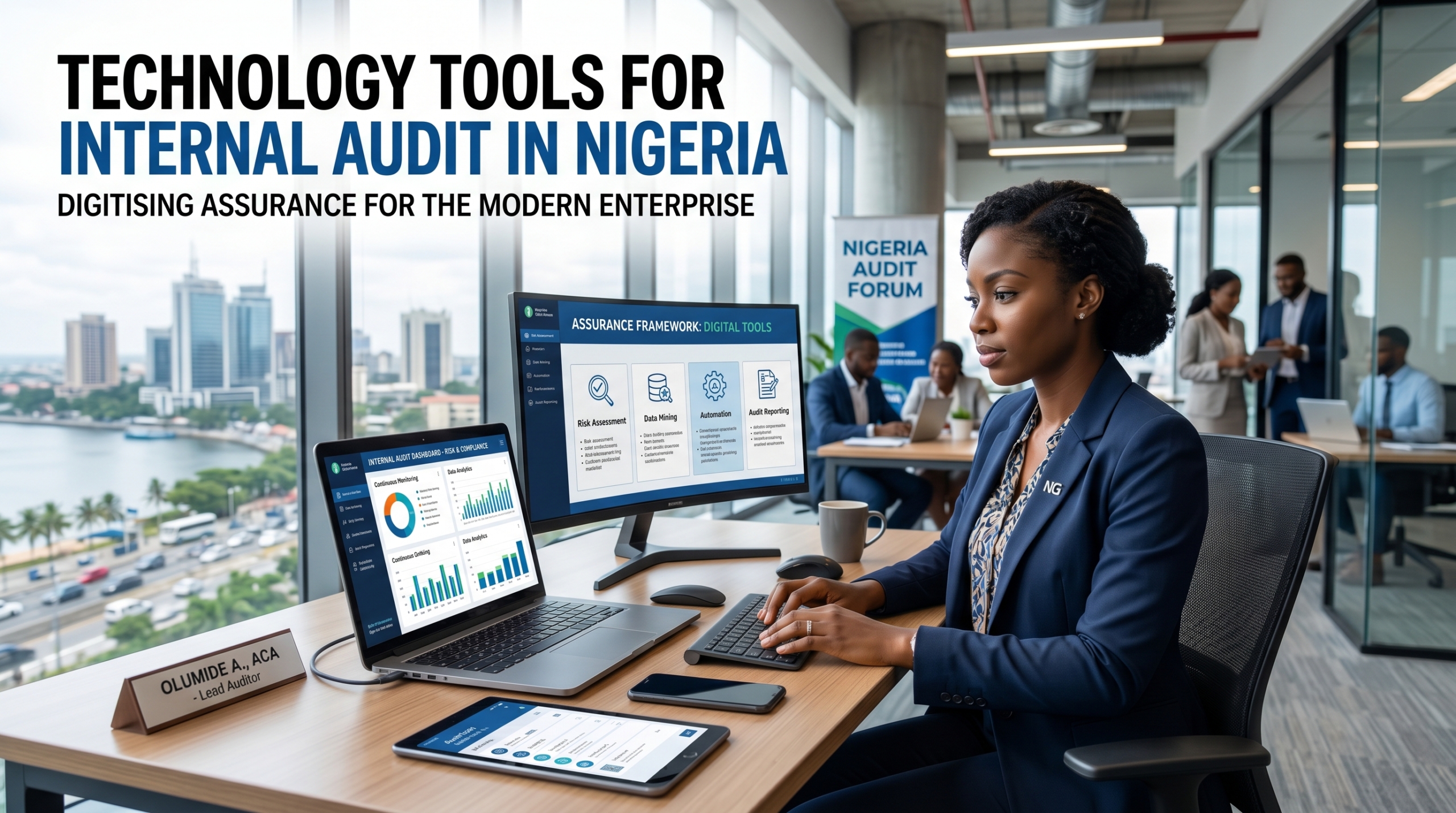
Technology is the answer. Audit management software. Data analytics. Continuous monitoring. GRC platforms.
Let me walk you through exactly what tools are available, what is changing in 2025 and 2026, and how to start your digital transformation.
At Stonehill Research , we help organisations transform their internal audit functions. Our Internal Audit Technology Maturity Assessment is a great place to start.
The state of internal audit technology in Nigeria
For years, internal audit in Nigeria lagged behind South Africa, Kenya, and North Africa in technology adoption. Many organisations, particularly in the public sector, SMEs, and mid-sized financial institutions, still rely on Excel spreadsheets, physical binders, and email-based workflows.
But a significant shift is underway.

Key drivers of this shift include regulatory pressure from the CBN’s Risk-Based Supervision framework. The growing sophistication of fraud and cyber threats. The push for real-time assurance from audit committees. Remote work demands exposing weaknesses in manual audit processes. And the IIA’s updated International Standards.
What is internal audit technology? Let me explain
Internal Audit Technology refers to the use of digital tools, software applications, data analytics platforms, and automation systems to plan, execute, manage, and report on internal audit activities. These technologies enable auditors to analyse large volumes of data, identify anomalies and risks, standardise audit workflows, and provide continuous, evidence-based assurance to management and the board.
In plain language, it means moving from paper and spreadsheets to software and automation. Your audit team works faster, smarter, and with better evidence.
Think about it. Instead of manually checking 30 transactions, you analyse 100% of them. Instead of searching through email chains, you have a single source of truth. Instead of waiting for month-end reports, you have real-time dashboards.
That is the power of audit technology.
Core technology tools for internal audit in Nigeria
Audit Management Software.
Audit Management Software centralises the entire audit lifecycle from risk assessment and planning through fieldwork, findings management, and reporting on a single digital platform. These systems replace paper-based workpapers and fragmented email trails with structured, searchable, and fully traceable audit records.
Leading AMS platforms adopted by Nigerian organisations include TeamMate+ from Wolters Kluwer, widely used in banking and financial services. AuditBoard is gaining traction among multinational subsidiaries operating in Nigeria. Ideagen Pentana is used in regulated industries, including insurance and telecoms. Orbit Audit is a Nigerian-developed solution increasingly deployed by public sector bodies.
Data analytics and continuous auditing tools.
Data analytics has fundamentally transformed what internal auditors can achieve. Rather than testing a sample of 25 to 30 transactions, auditors can now analyse 100% of transactions to detect anomalies, patterns, and outliers.
In Nigeria, this capability is especially powerful given widespread risks around procurement fraud, payroll manipulation, and revenue leakage.
Key tools include ACL Analytics, now Galvanise HighBond, which is the gold standard for audit data analytics. IDEA Data Analysis Software is widely used for financial services and public sector audits. Power BI and Tableau provide visualisation and dashboarding of audit findings. Python and R are increasingly used by data savvy audit teams for custom analytics scripts.
Our Data Analytics Capability Building service helps internal audit teams master these tools.
GRC platforms.
GRC platforms integrate internal audit with enterprise risk management and compliance functions. They enable a unified view of organisational risk across the three lines of defence.
For Nigerian organisations under regulatory scrutiny, particularly banks subject to CBN’s ICAAP guidelines, GRC integration is becoming essential.
Notable GRC platforms in use include MetricStream, SAP GRC, ServiceNow GRC, and LogicGate. Several multinational banks and oil majors operating in Nigeria have deployed these platforms across their African operations, with Nigerian audit teams benefiting from shared infrastructure.
Robotic Process Automation in internal audit.
RPA tools such as UiPath, Blue Prism, and Automation Anywhere allow internal audit teams to automate repetitive tasks. Data extraction. Reconciliation checks. Report generation.
In Nigeria, forward-thinking audit departments in Tier 1 banks and FMCG companies are piloting RPA to free up auditor time for higher-value analytical and judgment-based work.
Artificial intelligence and machine learning.
AI-powered audit tools can flag unusual journal entries, predict high-risk vendors, and generate preliminary audit observations from unstructured data. While full AI deployment in Nigerian internal audit remains nascent, organisations are actively exploring tools such as IBM OpenPages with Watson and Workiva’s integrated AI capabilities.

What is changing in 2025 and 2026
The internal audit technology landscape is evolving faster than ever.
The IIA’s new global standards.
The IIA’s revised International Standards, effective from January 9, 2025, place significantly greater emphasis on technology-enabled audit approaches. Standard 11.1 now explicitly requires Chief Audit Executives to consider the use of technology tools in audit planning. Standard 13.6 addresses the use of data analytics in drawing audit conclusions.
Nigerian auditors must align their methodologies and documentation with these updated requirements as a matter of professional compliance.
AI-powered continuous monitoring goes mainstream.
In 2025, several major vendors released AI native continuous monitoring modules. AuditBoard launched its AI Risk Intelligence engine, which automatically flags emerging risk themes from news feeds, regulatory filings, and internal data. Workiva introduced WDesk AI, enabling auditors to draft findings narratives directly from structured data sets.
These tools are now accessible to Nigerian teams through existing enterprise licence agreements held by their parent organisations.
Cloud first audit infrastructure.
The transition from on-premises audit software to cloud-based platforms has accelerated dramatically in 2025. Nigerian organisations, previously cautious about cloud adoption due to data sovereignty concerns, have been reassured by NITDA’s Nigeria Cloud Policy framework.
The CBN’s revised cloud computing guidelines from 2024 now permit regulated financial institutions to deploy audit workpapers and documentation on approved cloud platforms.
The rise of integrated assurance platforms.
The boundary between internal audit, risk management, and compliance is dissolving. Platforms like AuditBoard’s CrossComply, Galvanise HighBond, and OneTrust now offer combined audit, risk, and compliance modules on a single interface.
This integrated approach, sometimes called Connected Risk, is gaining traction in Nigerian banks and insurance companies that previously ran these functions in complete silos.
RegTech convergence in Nigerian financial services.
The CBN and NDIC’s push for real-time regulatory reporting is converging with internal audit technology. RegTech platforms that automate regulatory returns are now being integrated with audit management systems.
Auditors can now validate regulatory data at source rather than relying on downstream reports. This is a significant and fast-moving development for compliance-focused audit departments across Nigerian financial institutions.
Read our article on How Regulatory Uncertainty Impacts Long-Term Feasibility Studies in Nigeria for more on navigating regulatory changes.
Challenges to technology adoption in Nigerian internal audit
Understanding the barriers is just as important as knowing the tools.
Budget constraints. Many organisations treat internal audit as a cost centre with limited technology budgets. Audit leaders must build compelling business cases showing return on investment.
Skills gap. There is a shortage of auditors who combine audit expertise with data analytics capability. Most ICAN and ACCA-trained auditors in Nigeria have had limited exposure to tools beyond Excel.
Change resistance. Senior auditors accustomed to traditional methodologies often resist new ways of working. This requires strong leadership and clear communication of benefits.
Infrastructure limitations. Inconsistent power supply and internet connectivity can disrupt cloud based audit platforms, especially outside Lagos and Abuja.
Limited local implementation support. International AMS platforms often lack strong local support in Nigeria. This increases both deployment costs and timelines.
Overcoming these challenges requires deliberate investment in upskilling, a phased technology adoption roadmap, and strong executive sponsorship from the audit committee and board.
Our Audit Management Software Selection and Implementation Support helps organisations navigate these challenges.

A practical roadmap for getting started
Successful digital transformation in internal audit does not require a big bang approach. It starts with a clear, deliberate, and phased plan.
Phase one: Assess. Conduct an internal audit technology maturity assessment. Baseline your current capabilities against IIA standards and peer benchmarks.
Phase two: Prioritise. Identify the highest value use case. Data analytics for payroll fraud detection. Automated reconciliation for bank audits. Continuous monitoring for procurement. Build a compelling business case.
Phase three: Pilot. Select a fit-for-purpose tool. Run a structured pilot on a defined audit engagement. Measure results. Learn what works.
Phase four: Scale. Develop a phased rollout plan with clear KPIs. Audit cycle time reduction. Coverage rate improvement. Finding identification speed.
Phase five: Integrate. Embed technology into the Annual Audit Plan. Update the audit methodology manual. Build technology skills into staff development programmes.
Stonehill Research supports organisations through all five phases, from initial maturity assessments and vendor selection through implementation oversight and long-term capability building.
Where to start tomorrow
Do not try to transform everything at once.
First, start with one process. Payroll audit. Procurement review. Bank reconciliation. Choose something repetitive and data heavy.
Second, run a pilot with a single tool. Even Excel with Power Query is a step up from manual sampling. Learn before you invest heavily.
Third, measure your results. How much time did you save? What anomalies did you find? Build your business case.
Fourth, train one person first. Develop an internal champion before training the whole team.
Finally, talk to your audit committee. Explain the benefits. Get their support.
Our Training and Upskilling Workshops help develop internal champions for audit technology.
Recommended reading from the Stonehill Research blog
While you are here, check out these related articles from our team:
-
Building Strategy Around Constraints, Not Assumptions – Strategic frameworks for Nigeria’s unique environment
-
How Regulatory Uncertainty Impacts Long-Term Feasibility Studies in Nigeria – Planning amid regulatory volatility
-
How Investors Can De-risk Infrastructure Projects in Frontier Markets – Risk management in challenging environments
-
Nigeria’s Informal Economy: The $200B Market Everyone Is Underestimating – Understanding Nigeria’s unique business landscape
Related services from Stonehill Research
We help organisations transform internal audit. Here is how:
-
Growth Strategy Design – Building strategies that work in Nigeria’s unique environment
-
Market Segmentation – Treating Nigeria as multiple markets, not one
-
Consumer Insight Research – Understanding real needs and behaviours
-
Strategic Alignment Review – Aligning structure with strategy
-
Operational Resilience Assessment – Building systems that absorb friction
-
Talent and Capability Development – Developing talent and institutional knowledge
-
Data-Driven Decision-Making Frameworks – Making better business decisions with data
About Stonehill Research
Stonehill Research helps organisations move from ambition to execution. Our data-driven insights enable businesses, investors, and policymakers to design strategies that reflect Nigeria’s real market conditions.
We understand the complexity. Market fragmentation. Infrastructure gaps. Regulatory volatility. Capital constraints. We have seen it all.
We do not guess. We use market data to guide our recommendations. And we do not just give you a strategy document. We help you execute.
That matters for internal audit technology because the standards keep changing. You need current, accurate information. You need a partner who understands how these tools apply to your actual operations.
Final word from the trenches
Spreadsheets are not enough anymore.
Your competitors are adopting technology. Your regulators expect it. Your audit committee demands real-time assurance.
The tools exist. Audit management software, data analytics, GRC platforms, RPA, and AI are all available to Nigerian organisations today.
The IIA’s new standards require technology-enabled audits. The CBN permits cloud-based audit workpapers. The technology gap between early adopters and laggards is widening fast.
Start your digital transformation now. Assess your maturity. Prioritise a pilot. Build your capabilities.
Your internal audit function will work faster, provide better evidence, and deliver more value.
Stonehill Research is your trusted partner in internal audit excellence. We help you move from ambition to execution.
Let’s work together
Ready to digitise your internal audit function?
Contact us today:
📧 Email: info@stonehillresearch.com
📞 Phone: +234 802 320 0801
📍 Address: 5, Ishola Bello Close, Off Iyalla Street, Alausa, Ikeja, Lagos, Nigeria
Warri Office:
Suite 7, 2nd Floor, St Elizabeth Plaza, 77, Okumagba Avenue, Warri, Delta State
📞 Matthew: 08023200801 | Fred: 08062532219
Stonehill Research – Your Trusted Partner in Internal Audit Excellence
References
-
Institute of Internal Auditors Australia. Internal Audit Technology Resource Paper. https://www.iia.org.au/sf_docs/default-source/technical-resources/resource-papers/internal-audit-technology.pdf
-
The Institute of Internal Auditors. 2024 Global Internal Audit Standards. https://www.theiia.org/en/standards/
-
Central Bank of Nigeria. Cloud Computing Risk Management Guidelines. https://www.cbn.gov.ng
-
National Information Technology Development Agency (NITDA). Nigeria Cloud Policy. https://www.nitda.gov.ng
-
Galvanize. HighBond Platform Overview. https://www.galvanize.com
-
AuditBoard. AI Risk Intelligence. https://www.auditboard.com
-
Workiva. WDesk AI Capabilities. https://www.workiva.com
-
IIA Nigeria Chapter. https://www.iiangr.org
There are no comments