

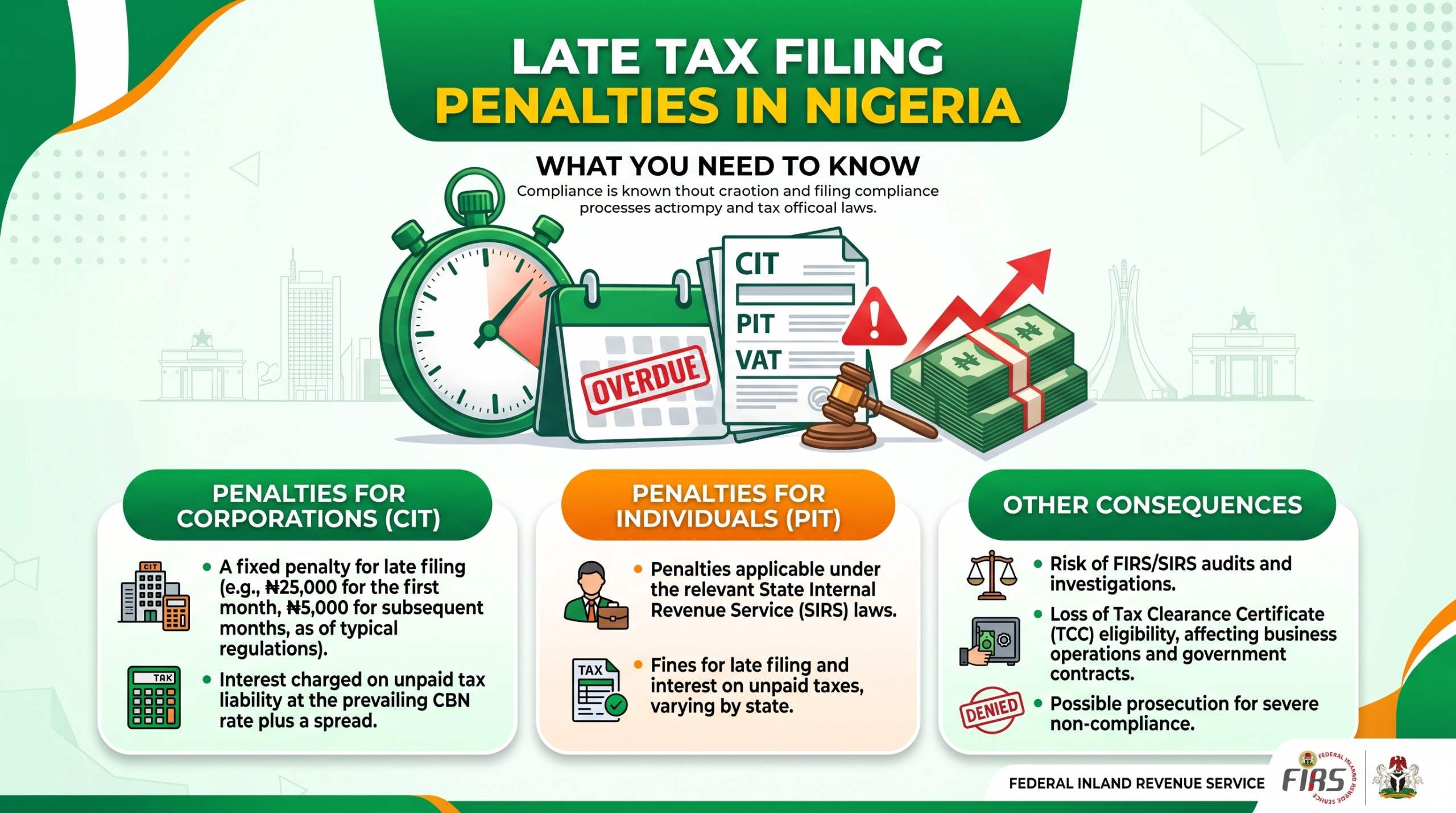
Penalties for Late Tax Filing in Nigeria: What You Need to Know
Missing a tax deadline is expensive. Very expensive.
A company that files its CIT just six months late pays an extra ₦1.4 million on a ₦10 million tax bill. That is 14% more than you owed. Just for being late.
And the penalties keep growing every month you wait.
Many Nigerian businesses discover this the hard way. Do not be one of them.
Let me walk you through exactly what happens when you file late, how much it costs, and how to avoid it entirely.
At Stonehill Research , we help businesses stay tax compliant. Our Full Tax Compliance Management service ensures you never miss a deadline.
What is tax filing? Let me explain
According to the OECD, tax filing is “the process by which taxpayers declare their income, expenses, and other tax-relevant information to the tax authority, either on paper or electronically, for the purpose of determining their tax liability for a specific period.”
That was formal. Sorry.
Here is the real talk. In Nigeria, tax filing means submitting returns to the tax authority for federal taxes or State Internal Revenue Services for state taxes. You declare your income, claim reliefs, compute your tax liability, and pay what you owe.
Filing is not a suggestion. It is a legal obligation with serious consequences for non-compliance.

Types of tax returns required in Nigeria
Corporate Income Tax returns. Required from all registered companies. Annual filing within 6 months of your accounting year-end. The rate is 30% of assessable profits for large companies and 20% for small companies.
Personal Income Tax returns. Required from employees, self-employed individuals, and professionals. The annual filing deadline is March 31st following the assessment year. Rates range from 7% to 24% based on income.
Value Added Tax returns. Monthly filing for VAT-registered businesses. The deadline is the 21st day of the following month. The current rate is 7.5% on taxable supplies.
Withholding Tax returns. Monthly remittance and filing. The deadline is the 21st day of the following month. Rates vary from 2.5% to 10% depending on the transaction type.
PAYE returns. Monthly remittance from employers. The deadline is the 10th day of the following month. Annual reconciliation is also required.
Capital Gains Tax returns. Must be filed within 90 days of disposing of chargeable assets. The rate is 10% of gains.
Companies’ Income Tax late filing penalties
The numbers matter. Let me show you exactly what you face.
Initial penalties for CIT.
First month: ₦25,000. Second month: additional ₦25,000, bringing the total to ₦50,000. Third month: additional ₦25,000, bringing the total to ₦75,000. Subsequent months: ₦25,000 per month continues to accumulate.
Example. A company with a December 31, 2024, year-end must file by June 30, 2025. If they file on October 15, 2025, that is 3.5 months late. The penalty is ₦100,000. That is ₦25,000 multiplied by 4 months. Plus interest on the unpaid tax.
Additional consequences. Interest at the commercial rate on unpaid tax from the due date. Potential criminal prosecution for willful default. Restriction from bidding for government contracts. Difficulty obtaining a Tax Clearance Certificate.
Personal Income Tax late filing penalties
For individuals. Initial penalty of ₦10,000. Then ₦5,000 for each additional month or part thereof. Penalties can accumulate indefinitely.
Example. An individual earning ₦12 million annually who fails to file by March 31st and files on September 30th is 6 months late. The penalty is ₦10,000 plus ₦5,000 times 6, which equals ₦40,000. Plus interest on the unpaid tax.
For employers with PAYE non-remittance. Penalty of 10% of the tax not remitted. Interest of 5% per annum on the outstanding amount. Possible criminal prosecution for persistent default.
Value Added Tax late filing penalties
Monthly filing penalties. First failure costs ₦50,000. Continued failure costs ₦25,000 for each month the failure continues. Interest at 5% per annum on outstanding VAT.
Late payment additional penalties. 10% penalty on outstanding VAT plus 5% interest per annum. Both compound monthly if the default continues.
Example. A business with a ₦2 million monthly VAT liability that files 4 months late faces a filing penalty of ₦50,000 plus ₦25,000 times 3, which equals ₦125,000. A payment penalty of 10% of ₦8 million, which is ₦800,000. Plus 5% annual interest on the outstanding amount. The total potential penalty is over ₦925,000 plus interest.
Withholding Tax late filing and remittance penalties
Non-remittance penalties. Penalty of 10% of the tax withheld but not remitted. Interest of 5% per annum from the date the tax ought to have been remitted. Criminal sanctions, including imprisonment or a fine for willful default.
Late filing penalty. ₦25,000 for the first month of default. ₦5,000 for each subsequent month.
Example. A company that withheld ₦5 million in WHT in January but remitted in June, 5 months late, faces a non-remittance penalty of 10% of ₦5 million, which is ₦500,000. A filing penalty of ₦25,000 plus ₦5,000 times 4, which is ₦45,000. Interest of approximately ₦104,167 at 5% annual for 5 months. Total penalty of ₦649,167.
PAYE late remittance penalties
Employer penalties. Late payment penalty of 10% of tax not remitted. Interest of 5% per annum. Monthly penalty continues for each month of default.
Additional consequences. Directors can be held personally liable. Possible prosecution and imprisonment. Business closure for persistent default. Blacklisting from government contracts.
Example. An employer with a ₦3 million monthly PAYE obligation remitting 3 months late faces a penalty of 10% of ₦9 million, which is ₦900,000. Interest of approximately ₦112,500 at 5% annual for 3 months. Total penalty of ₦1,012,500.
Interest charges on late tax payments
Beyond fixed penalties, interest charges make delayed payment increasingly expensive.
Current interest rates as of 2025. Standard rate is 5% per annum on outstanding tax. A commercial rate of 15% to 21% annually applies in certain circumstances. Interest compounds monthly in most cases.
How interest is calculated using the simple interest formula. Interest equals Principal times Rate times Time.
Example calculation for outstanding CIT of ₦10 million at 5% per annum over 6 months. Interest equals ₦10 million times 0.05 times 6 divided by 12, which equals ₦250,000.
With monthly compounding. Month 1 interest is ₦41,667. Month 2 is ₦41,841. Month 3 is ₦42,016. Month 4 is ₦42,191. Month 5 is ₦42,367. Month 6 is ₦42,544. Total interest is ₦252,626.
Combined penalty and interest impact example. A ₦10 million CIT liability filed and paid 6 months late. Filing penalty is ₦150,000 (₦25,000 times 6). Payment penalty is ₦1 million (10% of tax). Interest is ₦252,626 at 5% per annum compounded. Total additional cost is ₦1,402,626. That is 14% of the original tax liability.
Our Penalty Resolution Package helps businesses negotiate these penalties down.
Criminal penalties and legal consequences
Many taxpayers underestimate the potential for criminal prosecution. Do not make that mistake.
Under the Federal Inland Revenue Service (Establishment) Act. Offences include willful failure to file tax returns, knowingly making false statements, aiding or abetting tax evasion, and obstructing tax officials. Penalties include imprisonment for up to 3 years, fines of ₦1 million or more, or both.
Under the Companies Income Tax Act. Offences include failure to maintain proper books, refusal to allow access for audit, making false declarations, and non-filing despite notices. First conviction brings a fine of ₦500,000 or imprisonment for 3 years. Subsequent conviction brings a fine of ₦1 million or imprisonment for 5 years.
Recent enforcement actions in 2024 and 2025. In October 2024, a Lagos-based company director was sentenced to 2 years for ₦45 million in VAT fraud. In December 2024, a professional was convicted for willful PAYE evasion totalling ₦12 million. In January 2025, three company directors were prosecuted for persistent CIT non-filing.

According to enforcement statistics for 2024, over 1,200 criminal cases were filed against tax evaders. The authorities secured 347 convictions. They recovered ₦18.7 billion through enforcement actions. They temporarily closed 89 businesses for tax default.
Administrative sanctions
Beyond criminal prosecution, the tax authority can impose several administrative measures.
Tax Clearance Certificate denial. TCC is required for government contracts, bank loan applications, visa processing, and business renewals.
Bank account restrictions. The tax authority can obtain court orders to freeze accounts, garnish accounts for tax recovery, and restrict withdrawals until settlement.
Business closure. The tax authority can order temporary or permanent closure of premises, seize assets to offset tax liabilities, and appoint tax collectors at business locations.
Director disqualification. Directors can be held personally liable for company taxes. They can be disqualified from serving as directors. Personal assets can be attached for company liabilities.
Travel restrictions. Persistent defaulters can be placed on immigration watch lists. They may face difficulties obtaining international passports. Travel bans can be imposed for significant tax debts.
How to avoid late tax filing penalties
Prevention is always cheaper than paying penalties.
Implement a tax compliance calendar. List all applicable tax types and filing deadlines. Set internal deadlines 2 to 3 weeks before official deadlines. Include quarterly review dates for estimated taxes. Mark document preparation milestone dates.
Use digital calendar apps with automated reminders. Set multiple alerts at 30 days, 14 days, 7 days, and 1 day before each deadline. Sync across all team members responsible for tax matters.
Maintain organised financial records. Update books daily or weekly, not monthly. Use accounting software like QuickBooks, Sage, or Xero. Backup all records securely in the cloud. Properly classify income, expenses, and assets. Retain all invoices, receipts, and contracts. Keep records for a minimum of 6 years.
Leverage technology and automation. Use the official tax portal for filing. Use accounting software with tax features. Use payroll systems for automated PAYE calculations. Use VAT tools for automated VAT return preparation.
Technology gives you automated calculations that reduce errors, real time compliance monitoring, electronic filing that saves time, digital payment integration, automatic penalty alerts, and audit trail documentation.
Engage professional tax advisors. Hire professionals when you have complex business structures, multiple tax obligations, limited internal expertise, a history of late filing, significant tax liabilities, or multi jurisdictional operations.
Professional advisors provide tax compliance calendar management, preparation and filing of all returns, tax optimization and planning, representation before tax authorities, audit support and defense, penalty negotiation and reduction, and advisory on tax implications of business decisions.
The cost benefit analysis is clear. Professional fees typically range from ₦500,000 to ₦3 million annually. Potential penalty savings range from ₦1 million to ₦10 million or more. The peace of mind is priceless. And the time saved is redirected to your core business.
Our Tax Planning and Advisory service provides year-round professional support.
What to do if you have missed tax filing deadlines
If you have already missed deadlines, immediate action can minimize penalties.
Step one: Assess your situation immediately. Determine which tax types are overdue. Count how many months you are behind. Calculate approximate tax liability amounts. Estimate penalties and interest already accrued. Check whether the tax authority has issued any notices.
Gather last filed returns with confirmation receipts, outstanding transaction records, bank statements for relevant periods, any correspondence received, and details of previous payments made.
Step two: Calculate penalties and liabilities. Compute the principal tax owed. Add filing penalties for each month late. Add payment penalties of 10% in most cases. Add interest charges at 5% per annum compounded.
Step three: File outstanding returns immediately. Prepare all outstanding returns as quickly as possible. File with the best available information. Do not wait for perfection. File electronically through the official portal when possible. Keep proof of filing with acknowledgment receipts.
File even if you cannot pay immediately. Filing stops the accumulation of filing penalties. It shows good faith to the tax authority. It is required before payment arrangement negotiations. It reduces the risk of criminal prosecution. It is necessary for obtaining a Tax Clearance Certificate.
Step four: Make payment or arrange a payment plan. If funds are available, pay in full immediately. This stops interest accrual, demonstrates compliance, restores good standing, and allows you to obtain a Tax Clearance Certificate.

If full payment is impossible, contact the tax authority immediately to request a payment arrangement. Submit a realistic payment schedule. Provide justification explaining your financial constraints. Demonstrate good faith with an initial partial payment. Get a written agreement with documented terms.
Typical payment plan terms include a duration of 3 to 12 months depending on the amount, a down payment of 10% to 30% upfront, equal or graduated monthly installments, continued interest accrual during the payment period, and a requirement to stay current on ongoing obligations.
Step five: Request penalty waiver or reduction. Grounds for waiver include a first time offense with no previous history of late filing, reasonable cause with circumstances beyond your control such as illness or disaster, a small business with limited resources and genuine difficulty, voluntary disclosure where you self reported before detection, and full payment of all taxes due promptly after realizing the error.
Write a formal waiver request. Provide a detailed explanation of circumstances. Include supporting documentation. Demonstrate your current compliance. Submit through the official portal or in person.
Step six: Engage professional tax advisors. Professional help is essential when penalties exceed ₦500,000, when multiple tax types are affected, when legal notices have been issued, when criminal prosecution is threatened, when complex calculation is required, or when negotiation is needed.
Professionals provide accurate calculation of all liabilities, preparation of outstanding returns, representation, penalty negotiation and reduction, payment plan arrangement, and legal defense if necessary.
Our Tax Audit Support service provides professional representation during tax authority interactions.
Where to start tomorrow
Do not wait for the tax authority to come after you.
First, check your filing status today. Log into the tax portal. See where you stand.
Second, identify any late filings. Determine your biggest gaps.
Third, file outstanding returns immediately. Even if you cannot pay. Stop the clock on filing penalties.
Fourth, calculate what you owe. Know the full amount before you call.
Finally, talk to a professional. Tax problems do not get better with time. Set up a payment plan if you cannot pay in full. The tax authority would rather get paid over time than get nothing.
Recommended reading from the Stonehill Research blog
While you are here, check out these related articles from our team:
-
Building Strategy Around Constraints, Not Assumptions – Strategic frameworks for Nigeria’s unique environment
-
How Regulatory Uncertainty Impacts Long-Term Feasibility Studies in Nigeria – Planning amid regulatory volatility
-
How Investors Can De-risk Infrastructure Projects in Frontier Markets – Risk management in challenging environments
-
Nigeria’s Informal Economy: The $200B Market Everyone Is Underestimating – Understanding Nigeria’s unique business landscape
Related services from Stonehill Research
We help businesses stay tax compliant. Here is how:
-
Growth Strategy Design – Building strategies that work in Nigeria’s unique environment
-
Market Segmentation – Treating Nigeria as multiple markets, not one
-
Consumer Insight Research – Understanding real needs and behaviours
-
Strategic Alignment Review – Aligning structure with strategy
-
Operational Resilience Assessment – Building systems that absorb friction
-
Talent and Capability Development – Developing talent and institutional knowledge
-
Data-Driven Decision-Making Frameworks – Making better business decisions with data
About Stonehill Research
Stonehill Research helps organisations move from ambition to execution. Our data-driven insights enable businesses, investors, and policymakers to design strategies that reflect Nigeria’s real market conditions.
We understand the complexity. Market fragmentation. Infrastructure gaps. Regulatory volatility. Capital constraints. We have seen it all.
We do not guess. We use market data to guide our recommendations. And we do not just give you a strategy document. We help you execute.
That matters for tax compliance because the penalties keep changing. You need current, accurate information. You need a partner who understands how these rules affect your actual business operations.
Final word from the trenches
Late tax filing is expensive. Very expensive.
A six month delay on a ₦10 million tax bill costs you an extra ₦1.4 million in penalties and interest. That is 14% more than you owed. Just for being late.
The penalties grow every month you wait. Criminal prosecution is possible. Your business can be closed. Your bank accounts can be frozen.
But you can avoid all of this. File on time. Keep good records. Use a compliance calendar. Get professional help.
If you are already late, act now. File immediately. Pay what you can. Negotiate a payment plan. Request penalty waivers.
Every day you wait costs you money.
Stonehill Research is your trusted partner in tax compliance. We help you move from ambition to execution.
Let’s work together
Protect your business from tax penalties today.
Contact us today:
📧 Email: info@stonehillresearch.com
📞 Phone: +234 802 320 0801
📍 Address: 5, Ishola Bello Close, Off Iyalla Street, Alausa, Ikeja, Lagos, Nigeria
Warri Office:
Suite 7, 2nd Floor, St Elizabeth Plaza, 77, Okumagba Avenue, Warri, Delta State
📞 Matthew: 08023200801 | Fred: 08062532219
Stonehill Research – Your Trusted Partner in Tax Compliance
References
-
Organisation for Economic Co-operation and Development (OECD). Glossary of Tax Terms – Tax Return. https://www.oecd.org/ctp/glossaryoftaxterms.htm
-
Federal Inland Revenue Service (Establishment) Act, 2007. Federal Republic of Nigeria.
-
Companies Income Tax Act (CITA), CAP C21, LFN 2004 (as amended).
-
Personal Income Tax Act (PITA), CAP P8, LFN 2004 (as amended).
-
Value Added Tax Act, CAP V1, LFN 2004 (as amended).
-
Finance Act 2023. Federal Republic of Nigeria.
-
Chartered Institute of Taxation of Nigeria (CITN). Guide to Tax Compliance in Nigeria.P
There are no comments