

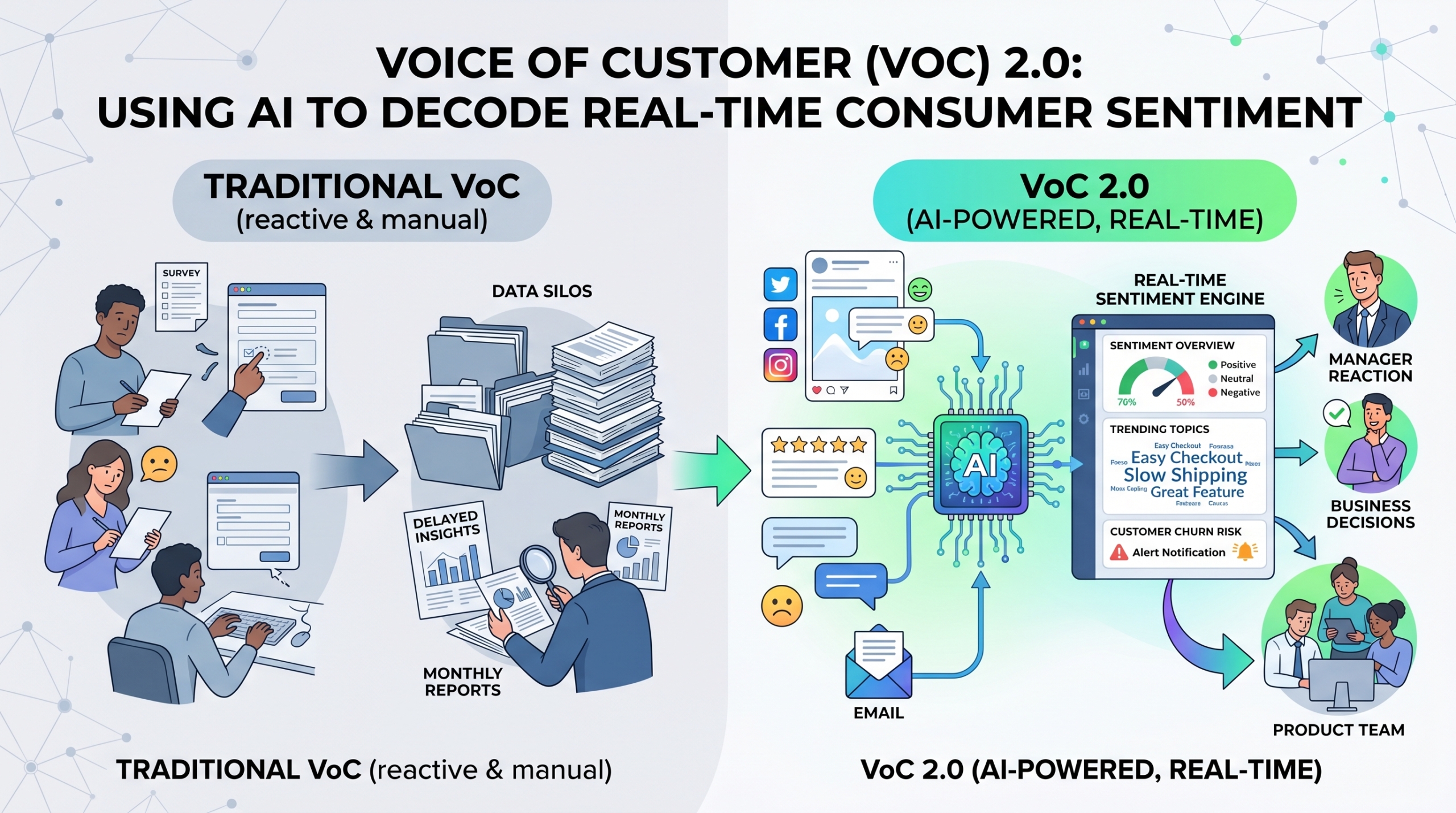
Voice of Customer (VoC) 2.0: Using AI to Decode Real-Time Consumer Sentiment
Understanding what customers truly think about your brand has never been more critical. Or more complex.
Traditional Voice of Customer programmes have value. But they struggle to keep pace with the volume and velocity of modern consumer feedback.
Enter VoC 2.0. A revolutionary approach powered by artificial intelligence that transforms how businesses capture, analyse, and act on customer sentiment in real time.
Let me walk you through what VoC 2.0 is, how it works, and why your business cannot afford to ignore it.
At Stonehill Research , we help businesses implement cutting-edge VoC solutions. Our AI-Powered Sentiment Analysis service is where smart companies start.
What is Voice of Customer? Let me explain
That was formal. Sorry.
Here is the real talk. VoC encompasses all the feedback, both solicited and unsolicited, that customers provide about their experiences with your products, services, or brand.

Think of it like this. Every time a customer posts about you on social media, fills out a survey, calls your support line, or leaves a review, they are giving you a piece of their mind. VoC is the system that captures all those pieces and turns them into something useful.
The evolution from VoC 1.0 to VoC 2.0
Traditional VoC 1.0: the old paradigm.
Traditional VoC programmes relied heavily on structured feedback mechanisms. Surveys. Focus groups. Customer interviews. Comment cards.
These methods provided valuable insights. But they came with significant limitations.
Time lag meant data collection and analysis could take weeks or months, making insights outdated by the time they reached decision makers.
Limited scope meant surveys captured only a fraction of customer opinions. Response bias meant only the most satisfied or most dissatisfied customers typically participated. Manual analysis meant human analysts could process only limited data volumes.
VoC 2.0: the AI-powered revolution.
VoC 2.0 leverages advanced artificial intelligence and machine learning to overcome these limitations. This new paradigm enables businesses to capture and analyse customer sentiment at unprecedented scale and speed.
Key differentiators include real-time processing, where AI algorithms analyse feedback as it arrives, providing instant insights. Comprehensive coverage allows systems to process millions of data points from diverse sources simultaneously. Mastery of unstructured data through Natural Language Processing enables understanding of context, emotion, and nuance in open-ended feedback. Predictive intelligence identifies patterns and predicts future sentiment trends.
How AI decodes real-time consumer sentiment
Natural Language Processing.
NLP enables AI systems to understand human language in all its complexity. Modern NLP algorithms can interpret slang, detect sarcasm, understand context, and identify emotional undertones.
This technology processes text from social media posts, customer reviews, chat transcripts, emails, and more. It extracts meaningful sentiment indicators that would be impossible for humans to analyse at scale.
Sentiment analysis engines.
Advanced sentiment analysis goes beyond simple positive, negative, or neutral classifications. Today’s AI systems can detect nuanced emotions like frustration, delight, confusion, or anticipation.
They can also measure sentiment intensity, identifying whether a customer is mildly pleased or absolutely thrilled, slightly annoyed or deeply frustrated. As of 2025, the latest sentiment analysis models achieve accuracy rates exceeding 90% for most business applications.
Multi-channel data integration.
VoC 2.0 platforms aggregate feedback from an extensive array of touchpoints. Social media platforms like Twitter, Facebook, Instagram, LinkedIn, and TikTok. Review sites like Google Reviews, Yelp, and Trustpilot. Customer service interactions, including chat logs, email tickets, and call transcripts. Surveys and feedback forms. App store reviews. Community forums.
This omnichannel approach ensures no customer voice goes unheard.
Pattern recognition and trend analysis.
Machine learning algorithms excel at identifying patterns humans might miss. They can detect emerging issues before they become crises. Spot unexpected correlations between product features and customer satisfaction. Identify demographic or geographic sentiment variations. Track how sentiment evolves in response to company actions.
Automated alert systems.
Real-time monitoring means real-time response. VoC 2.0 systems can automatically trigger alerts when sentiment drops below defined thresholds, a potential PR crisis emerges on social media, specific keywords or topics surge in mentions, or competitor sentiment changes significantly.
Latest updates in AI-powered VoC technology in 2025
Emotion AI and multimodal sentiment analysis.
One of the most significant advances in 2025 is the integration of emotion AI. It analyses not just text but also voice tone, facial expressions in video reviews, and even emoji usage patterns.
This multimodal approach provides a more complete picture of customer sentiment by capturing emotional cues that text alone might miss.
Generative AI for insight synthesis.
Large Language Models like GPT-4 and Claude are now being integrated into VoC platforms. They automatically generate comprehensive reports, executive summaries, and actionable recommendations.
These AI assistants can answer complex questions about customer sentiment in natural language. This makes insights accessible to stakeholders across the organisation without requiring data science expertise.
Predictive churn analysis.
Advanced machine learning models can now predict customer churn with remarkable accuracy by analysing sentiment trajectories. By identifying customers whose sentiment is declining before they actually leave, companies can implement targeted retention strategies with significantly higher success rates.
Hyper-personalised response recommendations.
AI systems can now recommend specific, personalised responses to individual customer feedback. They base these on sentiment analysis, customer history, and successful resolution patterns.
This capability enables customer service teams to respond more effectively and efficiently to each unique situation.
Privacy-preserving sentiment analysis.
With growing concerns about data privacy and regulations, new federated learning approaches allow companies to analyse customer sentiment without centralising sensitive personal data.
This advancement enables comprehensive VoC programmes while maintaining the highest privacy standards.
Real-world impact: the numbers
Companies implementing VoC 2.0 solutions are seeing transformative results.
Recent industry studies show that businesses using AI-powered sentiment analysis experience a 35% improvement in customer retention rates. A 50% reduction in response time to customer issues. A 40% increase in customer satisfaction scores. Up to 25% revenue growth through better alignment with customer needs.
These are not incremental improvements. They are fundamental shifts in competitive advantage.
Read our article on Why Traditional Customer Surveys Are Failing You (And What to Do Instead) for more on the limitations of VoC 1.0.
Implementing VoC 2.0: best practices
Start with clear objectives.
Define what success looks like for your VoC 2.0 initiative. Are you focused on improving product development? Enhancing customer service? Managing brand reputation? Reducing churn?
Clear objectives guide technology selection and implementation strategy.
Ensure data quality and integration.
AI is only as good as the data it analyses. Establish processes to ensure feedback data is accurate, complete, and properly integrated across all customer touchpoints.
Clean, well structured data is the foundation of reliable sentiment analysis.
Combine AI insights with human expertise.
While AI excels at processing vast amounts of data and identifying patterns, human judgment remains essential. Interpreting context. Making strategic decisions. Maintaining the empathy that customers expect.
The most effective VoC programmes combine AI efficiency with human wisdom.
Create closed-loop processes.
Insights are valuable only when they drive action. Establish clear workflows for how sentiment insights flow to relevant teams, how decisions are made based on those insights, and how actions are tracked and measured for effectiveness.

Commit to continuous improvement.
AI models improve with use. Regularly review and refine your sentiment analysis algorithms. Update training data to reflect evolving language patterns. Continuously validate that insights match business reality.
Our Customer Insight Dashboard Design service helps you visualise and act on sentiment data.
Where to start tomorrow
Do not try to implement every capability at once.
First, start with one feedback channel. Social media. Customer service tickets. Reviews. Master one source before expanding.
Second, define your alerts. What sentiment drops trigger notifications? What keywords or topics need immediate attention?
Third, integrate your data sources. Break down silos between marketing, sales, and customer service.
Fourth, train your team. Help them interpret AI generated insights. Keep human judgment in the loop.
Finally, act on insights. VoC without action is just noise. Create closed loop processes before you start collecting data.
Recommended reading from the Stonehill Research blog
While you are here, check out these related articles from our team:
-
Why Traditional Customer Surveys Are Failing You (And What to Do Instead) – The limitations of VoC 1.0
-
Emotion AI: The Next Frontier in Customer Experience – Understanding how customers really feel
-
Predictive Churn Analytics: Saving Customers Before They Leave – Using sentiment trajectories to prevent loss
-
Omnichannel Feedback Integration: Breaking Down Customer Data Silos – Unifying the customer voice
Related services from Stonehill Research
We help businesses understand their customers better. Here is how:
-
Growth Strategy Design – Building strategies that work in Nigeria’s unique environment
-
Market Segmentation – Treating Nigeria as multiple markets, not one
-
Consumer Insight Research – Understanding real needs and behaviours
-
Strategic Alignment Review – Aligning structure with strategy
-
Operational Resilience Assessment – Building systems that absorb friction
-
Talent and Capability Development – Developing talent and institutional knowledge
-
Data-Driven Decision-Making Frameworks – Making better business decisions with data
About Stonehill Research
Stonehill Research helps organisations move from ambition to execution. Our data-driven insights enable businesses, investors, and policymakers to design strategies that reflect real market conditions.
We understand the complexity. Market fragmentation. Infrastructure gaps. Regulatory volatility. Capital constraints. We have seen it all.
We do not guess. We use market data to guide our recommendations. And we do not just give you a strategy document. We help you execute.
That matters for VoC because customer sentiment shifts fast. You need current, accurate insights. You need a partner who understands how to turn feedback into action.
Final word from the trenches
VoC 2.0 is more than a technological upgrade. It represents a fundamental shift in how businesses understand and respond to their customers.
Organisations that embrace VoC 2.0 today position themselves not just to hear their customers better, but to truly understand them. Anticipating needs. Preventing problems. Creating experiences that drive loyalty and growth.
The question is no longer whether to implement AI-powered VoC programmes. It is how quickly your organisation can adapt to this new paradigm.
In a world where customer expectations evolve daily and competitive advantages can disappear overnight, real-time understanding of consumer sentiment is not a luxury. It is a necessity for survival and success.
Stonehill Research is your partner in customer understanding. We help you move from ambition to execution.
Let’s work together
Ready to decode what your customers are really saying?
Contact us today:
📧 Email: info@stonehillresearch.com
📞 Phone: +234 802 320 0801
📍 Address: 5, Ishola Bello Close, Off Iyalla Street, Alausa, Ikeja, Lagos, Nigeria
Warri Office:
Suite 7, 2nd Floor, St Elizabeth Plaza, 77, Okumagba Avenue, Warri, Delta State
📞 Matthew: 08023200801 | Fred: 08062532219
Stonehill Research – Your Partner in Customer Understanding
References
-
American Society for Quality (ASQ). Voice of the Customer (VOC). https://asq.org/quality-resources/voice-of-customer
There are no comments